←

Dinosauria

Taxon

277 image(s) · 274 Actualités

Voir la fiche

Galerie d'images

Changchunsaurus parvus, a neornithischian dinosaur.
Taxons Changchunsaurus

Changchunsaurus parvus, a neornithischian dinosaur.

Changchunsaurus Dinosauria Neornithischia
A replica of MIWG 1530, the holotype of the indeterminate archosaur Yaverlandia bitholus. As seen from two angles.
Taxons Yaverlandia

A replica of MIWG 1530, the holotype of the indeterminate archosaur Yaverlandia bitholus. As seen from two angles.

holotype Dinosauria Maniraptora Yaverlandia
Notohypsilodon comodorensis, an elasmarian ornithopod dinosaur.
Taxons Notohypsilophodon

Notohypsilodon comodorensis, an elasmarian ornithopod dinosaur.

Dinosauria Elasmaria Notohypsilophodon
Holotype (MTM V 2009.192.1) of Ajkaceratops kozmai .mw-parser-output .smallcaps{font-variant:small-caps}Ősi et al., 2010 (Dinosauria: Ceratopsia), fused rostral and premaxillae, in lateral view, length of scale bar = 1 cm.
Taxons Ajkaceratops

Holotype (MTM V 2009.192.1) of Ajkaceratops kozmai .mw-parser-output .smallcaps{font-variant:small-caps}Ősi et al., 2010 (Dinosauria: Ceratopsia), fused rostral and premaxillae, in lateral view, length of scale bar = 1 cm.

écaille holotype Ajkaceratops Ceratopsia +1
Gandititan is a basal titanosaurian sauropod dinosaur from the Late Cretaceous of what is now China. It was a long-necked herbivore, typical of sauropods, with a relatively short tail, a characteristic of titanosaurs compared to other sauropods. Titanosauria have a wide range of body sizes, and Gandititan falls around the middle, slightly on the smaller side. Discovered with a fairly well articluated spine from neck to tail, Gandititan is estimated at about 14 m in total body length.
Taxons Gandititan

Gandititan is a basal titanosaurian sauropod dinosaur from the Late Cretaceous of what is now China. It was a long-necked herbivore, typical of sauropods, with a relatively short tail, a characteristic of titanosaurs compared to other sauropods. Titanosauria have a wide range of body sizes, and Gandititan falls around the middle, slightly on the smaller side. Discovered with a fairly well articluated spine from neck to tail, Gandititan is estimated at about 14 m in total body length.

Chine Crétacé Crétacé supérieur Dinosauria +2
Holotype of Ferrisaurus sustutensis, RBCM P900, on display in the Okanagan Heritage Museum exhibition Dinosaurs of BC, June-September 2024.
Taxons Ferrisaurus

Holotype of Ferrisaurus sustutensis, RBCM P900, on display in the Okanagan Heritage Museum exhibition Dinosaurs of BC, June-September 2024.

musée holotype Dinosauria Ferrisaurus
Astigmasaura is a medium-sized rebbachisaurid sauropod dinosaur from the Late Cretaceous period of what is now Argentina. Rebbachisaurids had highly pneumatized bones that helped them to hold their weight on their four pillar-like legs, and extremely long tails. Astigmasaura was likely a ground-level browsing herbivore.

Astigmasaura is a medium-sized rebbachisaurid sauropod dinosaur from the Late Cretaceous period of what is now Argentina. Rebbachisaurids had highly pneumatized bones that helped them to hold their weight on their four pillar-like legs, and extremely long tails. Astigmasaura was likely a ground-level browsing herbivore.

os Argentine Crétacé Crétacé supérieur +3
Illustration of Sinusonasus (Dinosauria, Theropoda, Coelurosauria, Deinonychosauria, Troodontidae). This restoration is an edited and updated version of a drawing I originally uploaded on Wikimedia at December 11th 2009 (which i turn is based on a fossil seen at http://site.sinodino.com/Museum/images/Sinusonasus.JPG.).
Taxons Sinusonasus

Illustration of Sinusonasus (Dinosauria, Theropoda, Coelurosauria, Deinonychosauria, Troodontidae). This restoration is an edited and updated version of a drawing I originally uploaded on Wikimedia at December 11th 2009 (which i turn is based on a fossil seen at http://site.sinodino.com/Museum/images/Sinusonasus.JPG.).

dessin musée fossile Coelurosauria +5
Rebbachisaurids are the latest known sauropod dinosaurs outside the titanosaur lineage. Cienciargentina is a rebbachisaurid from the Late Cretaceous, making it among the most recent. It had many hollow bones, and likely had batteries of teeth used for chewing, a rebbachisaurid feature unique among sauropods.

Rebbachisaurids are the latest known sauropod dinosaurs outside the titanosaur lineage. Cienciargentina is a rebbachisaurid from the Late Cretaceous, making it among the most recent. It had many hollow bones, and likely had batteries of teeth used for chewing, a rebbachisaurid feature unique among sauropods.

os Crétacé Crétacé supérieur Cienciargentina +3
Skeletal reconstruction of the Sauropod dinosaur Abdarainurus barsboldi based on holotype PIN 5669/1, as figured in Averianov and Lopatin, 2020. Outline is based on related Sauropods, modified from SlvrHwk.
Taxons Abdarainurus

Skeletal reconstruction of the Sauropod dinosaur Abdarainurus barsboldi based on holotype PIN 5669/1, as figured in Averianov and Lopatin, 2020. Outline is based on related Sauropods, modified from SlvrHwk.

holotype Abdarainurus Dinosauria
Reconstructed skull of Duriavenator hesperis showing known material (white) of the holotype and only known specimen. Unknown bones based on related Eustreptospondylus oxoniensis. Scale bar is 10cm, image is 10px/cm. Cranial anatomy based on Benson (2008) "A redescription of "Megalosaurus" hesperis (Dinosauria, Theropoda) from the Inferior Oolite (Bajocian, Middle Jurassic) of Dorset, United Kingdom"
Taxons Duriavenator

Reconstructed skull of Duriavenator hesperis showing known material (white) of the holotype and only known specimen. Unknown bones based on related Eustreptospondylus oxoniensis. Scale bar is 10cm, image is 10px/cm. Cranial anatomy based on Benson (2008) "A redescription of "Megalosaurus" hesperis (Dinosauria, Theropoda) from the Inferior Oolite (Bajocian, Middle Jurassic) of Dorset, United Kingdom"

os écaille Royaume-Uni Bajocien +11
Reconstructed skull of Wiehenvenator albati based on holotype specimen (white). Scale bar is 10cm, image if 10px/cm. Unknown material based on related Torvosaurus tanneri. Cranial anatomy based on Rauhut et al (2016) "A new megalosaurid theropod dinosaur from the late Middle Jurassic (Callovian) of north-western Germany: implications for theropod evolution and faunal turnover in the Jurassic"
Taxons Wiehenvenator

Reconstructed skull of Wiehenvenator albati based on holotype specimen (white). Scale bar is 10cm, image if 10px/cm. Unknown material based on related Torvosaurus tanneri. Cranial anatomy based on Rauhut et al (2016) "A new megalosaurid theropod dinosaur from the late Middle Jurassic (Callovian) of north-western Germany: implications for theropod evolution and faunal turnover in the Jurassic"

écaille Allemagne Callovien Jurassique +10
Original caption: "Calibrated phylogeny of Neosauropoda. Summarized strict consensus tree showing the relationships among neosauropod dinosaurs and the phylogenetic position of Tapuiasaurus macedoi gen. n. sp. n. The support values (Bremer/Bootstrap) for the nodes labelled in the figure are: Neosauropoda (1/-), Somphospondyli (2/68), Titanosauria (2/58), Lithostrotia (3/68), “advanced titanosaurians” (3/65), Nemegtosauridae (1/-), Saltasauridae (1/-). See Figure S4 for a complete strict consensus tree including all sauropod terminal taxa used in the analysis. Age of first appearance for taxa used in the calibrated phylogeny are given in Text S4."

Original caption: "Calibrated phylogeny of Neosauropoda. Summarized strict consensus tree showing the relationships among neosauropod dinosaurs and the phylogenetic position of Tapuiasaurus macedoi gen. n. sp. n. The support values (Bremer/Bootstrap) for the nodes labelled in the figure are: Neosauropoda (1/-), Somphospondyli (2/68), Titanosauria (2/58), Lithostrotia (3/68), “advanced titanosaurians” (3/65), Nemegtosauridae (1/-), Saltasauridae (1/-). See Figure S4 for a complete strict consensus tree including all sauropod terminal taxa used in the analysis. Age of first appearance for taxa used in the calibrated phylogeny are given in Text S4."

Dinosauria Lithostrotia Nemegtosauridae Neosauropoda +6
Duonychus tsogtbaatari in Dinosaur Expo 2019 at Nationail Science Museum in Tokyo
Taxons Duonychus

Duonychus tsogtbaatari in Dinosaur Expo 2019 at Nationail Science Museum in Tokyo

musée Dinosauria Duonychus
This file represents a possible life appearance of the Indian Titanosaurian Sauropod dinosaur Jainosaurus septentrionalis from the Late Cretaceous (Maastrichtian) of India, belonging to the Lameta Formation.
References used: 
Huene & Matley (1933)
Hunt et al. (1995)
Gunnar Bivens' skeletal diagram

Wilson et al. (2008) "Reassessment of Sauropod Dinosaur Jainosaurus (="Antarctosaurus") Septentrionalis from the Upper Cretaceous of India"
Taxons Jainosaurus

This file represents a possible life appearance of the Indian Titanosaurian Sauropod dinosaur Jainosaurus septentrionalis from the Late Cretaceous (Maastrichtian) of India, belonging to the Lameta Formation. References used: Huene & Matley (1933) Hunt et al. (1995) Gunnar Bivens' skeletal diagram Wilson et al. (2008) "Reassessment of Sauropod Dinosaur Jainosaurus (="Antarctosaurus") Septentrionalis from the Upper Cretaceous of India"

Inde Lameta Crétacé Crétacé supérieur +6
Dinosaur Vectaerovenator Reconstruction
Taxons Vectaerovenator

Dinosaur Vectaerovenator Reconstruction

Dinosauria Vectaerovenator
1 2 3 4 5 6 7 8 9 10 11 12 13 14 15 16 17 18

Actualités

Les poulpes géants régnaient sur les océans il y a 100 millions d'années, selon une étude
mâchoire prédateur proie fossile Dinosauria étude
Des poulpes géants et redoutables auraient pu autrefois régner sur les mers anciennes, selon de nouvelles recherches qui renversent le scénario de leur passé évolutif. En découvrant des mâchoires fossiles superbement préservées cachées dans la roche, les scientifiques ont révélé que les premières pieuvres de l’âge des dinosaures n’étaient pas des vagabonds timides et au corps mou : c’étaient d’énormes prédateurs au sommet, pouvant s’étendre jusqu’à 20 mètres de long et écrasant leurs proies avec de puissantes morsures.
25/04/2026 sciencedaily-paleo ⚙ Traduction automatique
New Fossil from Brazil Reveals Unexpected Diversity among Pre-Dinosaur Herbivores
Un nouveau fossile du Brésil révèle une diversité inattendue parmi les herbivores pré-dinosaures
mâchoire Brésil Trias fossile Dinosauria nouvelle espèce partiel crâne
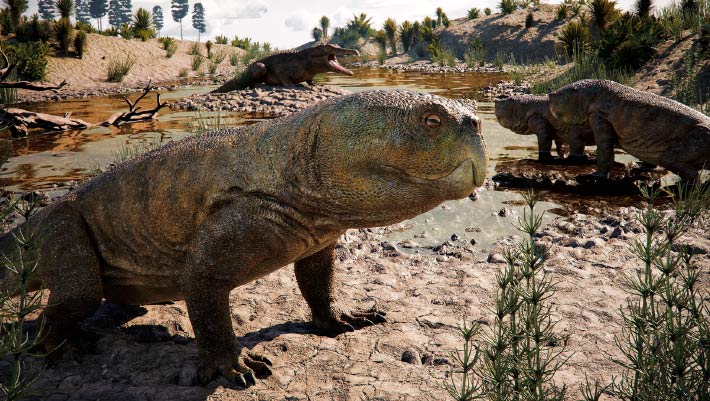
Des paléontologues du Brésil ont identifié un nouveau genre et une nouvelle espèce de rhynchosaure hyperodapédontique – une lignée éteinte de reptiles herbivores à bec – sur la base d'un crâne partiel et de mâchoires inférieures récupérés dans des roches du Trias. L'article Un nouveau fossile du Brésil révèle une diversité inattendue parmi les herbivores pré-dinosaures est apparu en premier sur Sci.News : Breaking Science News.
23/04/2026 sci-news ⚙ Traduction automatique
De superbes traces de dinosaures vieilles de 132 millions d’années réécrivent l’histoire
fossile empreintes Dinosauria découverte
Un mystère de longue date dans les archives fossiles de l’Afrique australe commence à être résolu. Après que des coulées de lave massives, il y a 182 millions d'années, aient semblé effacer les traces de dinosaures dans la région, les scientifiques ont maintenant découvert de nouveaux indices surprenants le long de la côte du Cap occidental. Des dizaines de traces de dinosaures, vieilles d'environ 132 millions d'années, ont été découvertes dans une petite étendue rocheuse près de Knysna, ce qui en fait les plus jeunes jamais découvertes en Afrique australe.
23/04/2026 sciencedaily ⚙ Traduction automatique
Cet ancien parent du crocodile a grandi sur quatre pattes puis a marché sur deux
fossile Dinosauria
Un étrange parent d'un crocodile de l'époque des dinosaures réécrit ce que les scientifiques pensaient savoir sur les anciens reptiles. Cette créature de la taille d'un caniche, appelée Sonselasuchus cedrus, semble avoir commencé sa vie en marchant à quatre pattes avant de passer à une position sur deux pattes à mesure qu'elle grandissait - une transformation inhabituelle rarement observée dans les archives fossiles.
23/04/2026 sciencedaily ⚙ Traduction automatique
Ces minuscules fossiles de dinosaures ont trompé les scientifiques pendant 20 ans
armure os croissance fossile Ankylosauria Dinosauria découverte
De minuscules fossiles de dinosaures qui ont intrigué les scientifiques pendant plus de 20 ans ont enfin révélé leur véritable identité. Plutôt que d’appartenir à une espèce miniature, ce sont en réalité des bébés ankylosaures, certains âgés de moins d’un an, y compris un possible nouveau-né. En étudiant les schémas de croissance osseuse, les chercheurs ont confirmé que ces jeunes dinosaures n’étaient pas encore devenus des adultes de grande taille. La découverte apporte un nouvel éclairage sur la façon dont les ankylosaures se sont développés, montrant qu'ils ont commencé à développer une armure étonnamment tôt.
21/04/2026 sciencedaily ⚙ Traduction automatique
1 2 3 4 5 6 7 8 9 10 11 12 13 14 15 16 17 18 19 20 21 22 23 24 25 26 27 28 29 30 31 32 33 34 35 36 37 38 39 40 41 42 43 44 45 46 47 48 49 50 51 52 53 54 55