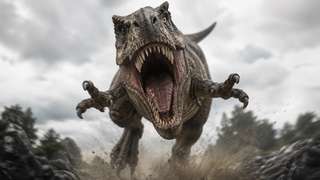
Tyrannosaurus

Taxon

28 image(s) · 26 News

View page

Image gallery

Coelophysis bauri (Cope, 1887) theropod dinosaur from the Triassic of New Mexico, USA.
This is a remarkable complete skeleton of the small early theropod Coelophysis.  It comes from a nearly monospecific concentration of numerous complete to disarticulated skeletons in reddish-colored fluvial siltstones, often called a "Coelophysis graveyard".  This occurrence has been interpreted as a carcass-jammed channel filling following mass mortality of dinosaurs by regional drought (see Schwartz & Gillette, 1994).
Stratigraphy: Rock Point Member, Chinle Formation, Upper Triassic
Locality: Whitaker Quarry (Coelophysis Quarry), Ghost Ranch, Rio Arriba County, northern New Mexico, USA


Some info. from:
Hunt, A.P. & S.G. Lucas.  1991.  Rioarribasaurus, a new name for a Late Triassic dinosaur from New Mexico (USA).  Paläontologische Zeitschrift  65: 191-198.
Schwartz, H.L. & D.D. Gillette.  1994.  Geology and taphonomy of the Coelophysis Quarry, Upper Triassic Chinle Formation, Ghost Ranch, New Mexico.  Journal of Paleontology 68: 1118-1130.


Theropod were small to large, bipedal dinosaurs.  Almost all known members of the group were carnivorous (predators and/or scavengers).  They represent the ancestral group to the birds, and some theropods are known to have had feathers.  Some of the most well known dinosaurs to the general public are theropods, such as Tyrannosaurus, Allosaurus, and Spinosaurus.
Taxa Coelophysoidea

Coelophysis bauri (Cope, 1887) theropod dinosaur from the Triassic of New Mexico, USA. This is a remarkable complete skeleton of the small early theropod Coelophysis. It comes from a nearly monospecific concentration of numerous complete to disarticulated skeletons in reddish-colored fluvial siltstones, often called a "Coelophysis graveyard". This occurrence has been interpreted as a carcass-jammed channel filling following mass mortality of dinosaurs by regional drought (see Schwartz & Gillette, 1994). Stratigraphy: Rock Point Member, Chinle Formation, Upper Triassic Locality: Whitaker Quarry (Coelophysis Quarry), Ghost Ranch, Rio Arriba County, northern New Mexico, USA Some info. from: Hunt, A.P. & S.G. Lucas. 1991. Rioarribasaurus, a new name for a Late Triassic dinosaur from New Mexico (USA). Paläontologische Zeitschrift 65: 191-198. Schwartz, H.L. & D.D. Gillette. 1994. Geology and taphonomy of the Coelophysis Quarry, Upper Triassic Chinle Formation, Ghost Ranch, New Mexico. Journal of Paleontology 68: 1118-1130. Theropod were small to large, bipedal dinosaurs. Almost all known members of the group were carnivorous (predators and/or scavengers). They represent the ancestral group to the birds, and some theropods are known to have had feathers. Some of the most well known dinosaurs to the general public are theropods, such as Tyrannosaurus, Allosaurus, and Spinosaurus.

feather predator Mexico United States +15
Coelophysis bauri (Cope, 1887) theropod dinosaur from the Triassic of New Mexico, USA.
This is a remarkable complete skeleton of the small early theropod Coelophysis.  It comes from a nearly monospecific concentration of numerous complete to disarticulated skeletons in reddish-colored fluvial siltstones, often called a "Coelophysis graveyard".  This occurrence has been interpreted as a carcass-jammed channel filling following mass mortality of dinosaurs by regional drought (see Schwartz & Gillette, 1994).
Stratigraphy: Rock Point Member, Chinle Formation, Upper Triassic
Locality: Whitaker Quarry (Coelophysis Quarry), Ghost Ranch, Rio Arriba County, northern New Mexico, USA


Some info. from:
Hunt, A.P. & S.G. Lucas.  1991.  Rioarribasaurus, a new name for a Late Triassic dinosaur from New Mexico (USA).  Paläontologische Zeitschrift  65: 191-198.
Schwartz, H.L. & D.D. Gillette.  1994.  Geology and taphonomy of the Coelophysis Quarry, Upper Triassic Chinle Formation, Ghost Ranch, New Mexico.  Journal of Paleontology 68: 1118-1130.


Theropod were small to large, bipedal dinosaurs.  Almost all known members of the group were carnivorous (predators and/or scavengers).  They represent the ancestral group to the birds, and some theropods are known to have had feathers.  Some of the most well known dinosaurs to the general public are theropods, such as Tyrannosaurus, Allosaurus, and Spinosaurus.
Taxa Coelophysis

Coelophysis bauri (Cope, 1887) theropod dinosaur from the Triassic of New Mexico, USA. This is a remarkable complete skeleton of the small early theropod Coelophysis. It comes from a nearly monospecific concentration of numerous complete to disarticulated skeletons in reddish-colored fluvial siltstones, often called a "Coelophysis graveyard". This occurrence has been interpreted as a carcass-jammed channel filling following mass mortality of dinosaurs by regional drought (see Schwartz & Gillette, 1994). Stratigraphy: Rock Point Member, Chinle Formation, Upper Triassic Locality: Whitaker Quarry (Coelophysis Quarry), Ghost Ranch, Rio Arriba County, northern New Mexico, USA Some info. from: Hunt, A.P. & S.G. Lucas. 1991. Rioarribasaurus, a new name for a Late Triassic dinosaur from New Mexico (USA). Paläontologische Zeitschrift 65: 191-198. Schwartz, H.L. & D.D. Gillette. 1994. Geology and taphonomy of the Coelophysis Quarry, Upper Triassic Chinle Formation, Ghost Ranch, New Mexico. Journal of Paleontology 68: 1118-1130. Theropod were small to large, bipedal dinosaurs. Almost all known members of the group were carnivorous (predators and/or scavengers). They represent the ancestral group to the birds, and some theropods are known to have had feathers. Some of the most well known dinosaurs to the general public are theropods, such as Tyrannosaurus, Allosaurus, and Spinosaurus.

feather predator Mexico United States +15
Tyrannosaurus
Taxa Tyrannosaurus
Tyrannosaurus
Collage of six tyrannosaurids, clockwise from top left: Tyrannosaurus, Daspletosaurus, Tarbosaurus, Gorgosaurus, Zhuchengtyrannus and Alioramus. This montage was made for the article Tyrannosauridae on Wikipedia.
File:OriginalPecks.jpg
File:Daspletosaurus at the Science Center of Iowa.jpg
File:Tarbosaurus baatar skeleton.jpg
File:Alioramus Te Papa.jpg
File:Zhuchengtyrannus mount.jpg
File:Gorgosaurus in Japan.jpg
Taxa Tyrannosauridae

Collage of six tyrannosaurids, clockwise from top left: Tyrannosaurus, Daspletosaurus, Tarbosaurus, Gorgosaurus, Zhuchengtyrannus and Alioramus. This montage was made for the article Tyrannosauridae on Wikipedia. File:OriginalPecks.jpg File:Daspletosaurus at the Science Center of Iowa.jpg File:Tarbosaurus baatar skeleton.jpg File:Alioramus Te Papa.jpg File:Zhuchengtyrannus mount.jpg File:Gorgosaurus in Japan.jpg

Japan Alioramus Daspletosaurus Gorgosaurus +6
Six tyrannosauroids (top to bottom):  Tyrannosaurus, Dilong, Alioramus (background) with Guanlong (foreground), Gorgosaurus, Yutyrannus
Taxa Tyrannosauroidea

Six tyrannosauroids (top to bottom): Tyrannosaurus, Dilong, Alioramus (background) with Guanlong (foreground), Gorgosaurus, Yutyrannus

Alioramus Dilong Gorgosaurus Guanlong +3
1st row (early saurischians): Herrerasaurus ischigualastensis (herrerasaur), Eodromaeus murphi (basal theropod);
2nd row (theropods): Pelecanus occidentalis, Tyrannosaurus rex;
3rd row (sauropodomorphs): Apatosaurus louisae, Plateosaurus trossingensis.
Taxa Saurischia

1st row (early saurischians): Herrerasaurus ischigualastensis (herrerasaur), Eodromaeus murphi (basal theropod); 2nd row (theropods): Pelecanus occidentalis, Tyrannosaurus rex; 3rd row (sauropodomorphs): Apatosaurus louisae, Plateosaurus trossingensis.

museum Apatosaurus Eodromaeus Herrerasaurus +3
Six exemplar coelurosaurs (clockwise from top left): Tyrannosaurus rex, Sinosauropteryx prima, Deinonychus antirrhopus, Archaeopteryx lithographica, an undescribed crested oviraptorid, and Passer domesticus.  This is a collection of six different works which have been previously published on Wikimedia Commons (see source field below).
Taxa Coelurosauria

Six exemplar coelurosaurs (clockwise from top left): Tyrannosaurus rex, Sinosauropteryx prima, Deinonychus antirrhopus, Archaeopteryx lithographica, an undescribed crested oviraptorid, and Passer domesticus. This is a collection of six different works which have been previously published on Wikimedia Commons (see source field below).

Archaeopteryx Coelurosauria Deinonychus Oviraptoridae +2
Tyrannosauripus pillmorei, probable Tyrannosaurus footprint from w:Philmont Scout Ranch, New Mexico
Taxa Tyrannosauripodidae

Tyrannosauripus pillmorei, probable Tyrannosaurus footprint from w:Philmont Scout Ranch, New Mexico

Mexico Tyrannosauripodidae Tyrannosauripus Tyrannosaurus
Tyrannosauripus pillmorei, probable Tyrannosaurus footprint from w:Philmont Scout Ranch, New Mexico
Taxa Tyrannosauripus

Tyrannosauripus pillmorei, probable Tyrannosaurus footprint from w:Philmont Scout Ranch, New Mexico

Mexico Tyrannosauripodidae Tyrannosauripus Tyrannosaurus
Montage of eight different representatives of coelurosaurian dinosaurs: (Clockwise from upper left) GIN 100/42 which may represent Citipati or a different oviraptorosaur, Sinosauropteryx prima, Nothronychus mckinleyi, Tyrannosaurus rex, Bambiraptor feinbergi, Passer domesticus, Struthiomimus altus, Microraptor gui. This is a collection of eight different works already found in Wikimedia Commons (see source field below).

Montage of eight different representatives of coelurosaurian dinosaurs: (Clockwise from upper left) GIN 100/42 which may represent Citipati or a different oviraptorosaur, Sinosauropteryx prima, Nothronychus mckinleyi, Tyrannosaurus rex, Bambiraptor feinbergi, Passer domesticus, Struthiomimus altus, Microraptor gui. This is a collection of eight different works already found in Wikimedia Commons (see source field below).

Bambiraptor Citipati Coelurosauria Dinosauria +6
Spinosaurus ile Giganotosaurus ve Tyrannosaurus boyut kıyaslaması

Spinosaurus ile Giganotosaurus ve Tyrannosaurus boyut kıyaslaması

Giganotosaurus Spinosauria Tyrannosaurus
The Tyrannosaurus rex, Dromaeosaurus, Triceratops, and Struthiomimus diorama in the Third Planet exhibit at the Milwaukee Public Museum in Milwaukee, Wisconsin (United States).

The Tyrannosaurus rex, Dromaeosaurus, Triceratops, and Struthiomimus diorama in the Third Planet exhibit at the Milwaukee Public Museum in Milwaukee, Wisconsin (United States).

museum United States Dromaeosauria Struthiomimus +2
The Tyrannosaurus rex, Dromaeosaurus, Triceratops, and Struthiomimus diorama in the Third Planet exhibit at the Milwaukee Public Museum in Milwaukee, Wisconsin (United States).

The Tyrannosaurus rex, Dromaeosaurus, Triceratops, and Struthiomimus diorama in the Third Planet exhibit at the Milwaukee Public Museum in Milwaukee, Wisconsin (United States).

museum United States Dromaeosauria Struthiomimus +2
The Tyrannosaurus rex, Dromaeosaurus, Triceratops, and Struthiomimus diorama in the Third Planet exhibit at the Milwaukee Public Museum in Milwaukee, Wisconsin (United States).

The Tyrannosaurus rex, Dromaeosaurus, Triceratops, and Struthiomimus diorama in the Third Planet exhibit at the Milwaukee Public Museum in Milwaukee, Wisconsin (United States).

museum United States Dromaeosauria Struthiomimus +2
Sue - Tyrannosaurus Rex Dinosaur - Field Museum of Natural History, Chicago by Joy of Museums, for more information, see: www.joyofmuseums.com

Sue - Tyrannosaurus Rex Dinosaur - Field Museum of Natural History, Chicago by Joy of Museums, for more information, see: www.joyofmuseums.com

museum Dinosauria Tyrannosaurus
Sue - Tyrannosaurus Rex Dinosaur - Field Museum of Natural History, Chicago by Joy of Museums, for more information, see: www.joyofmuseums.com

Sue - Tyrannosaurus Rex Dinosaur - Field Museum of Natural History, Chicago by Joy of Museums, for more information, see: www.joyofmuseums.com

museum Dinosauria Tyrannosaurus
1 2

News

Before T. rex, there was the “dragon prince”
migration predator Dinosauria Khankhuuluu Tyrannosaurus discovery new species
Scientists have unveiled Khankhuuluu, a new Mongolian dinosaur species that predates and closely resembles early Tyrannosaurs. With its long snout, small horns, and lean build, it represents a transitional form between swift mid-sized predators and giant apex hunters like T. rex. The find also suggests that large Tyrannosaurs first evolved in North America following an ancient migration from Asia.
24/10/2025 sciencedaily-human-evo
1 2 3 4 5 6