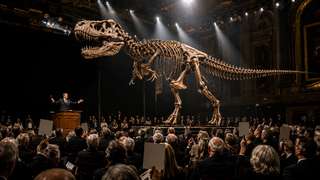
Tyrannosaurus

Taxon

28 image(s) · 26 Actualités

Voir la fiche

Galerie d'images

Coelophysis bauri (Cope, 1887) theropod dinosaur from the Triassic of New Mexico, USA.
This is a remarkable complete skeleton of the small early theropod Coelophysis.  It comes from a nearly monospecific concentration of numerous complete to disarticulated skeletons in reddish-colored fluvial siltstones, often called a "Coelophysis graveyard".  This occurrence has been interpreted as a carcass-jammed channel filling following mass mortality of dinosaurs by regional drought (see Schwartz & Gillette, 1994).
Stratigraphy: Rock Point Member, Chinle Formation, Upper Triassic
Locality: Whitaker Quarry (Coelophysis Quarry), Ghost Ranch, Rio Arriba County, northern New Mexico, USA


Some info. from:
Hunt, A.P. & S.G. Lucas.  1991.  Rioarribasaurus, a new name for a Late Triassic dinosaur from New Mexico (USA).  Paläontologische Zeitschrift  65: 191-198.
Schwartz, H.L. & D.D. Gillette.  1994.  Geology and taphonomy of the Coelophysis Quarry, Upper Triassic Chinle Formation, Ghost Ranch, New Mexico.  Journal of Paleontology 68: 1118-1130.


Theropod were small to large, bipedal dinosaurs.  Almost all known members of the group were carnivorous (predators and/or scavengers).  They represent the ancestral group to the birds, and some theropods are known to have had feathers.  Some of the most well known dinosaurs to the general public are theropods, such as Tyrannosaurus, Allosaurus, and Spinosaurus.
Taxons Coelophysoidea

Coelophysis bauri (Cope, 1887) theropod dinosaur from the Triassic of New Mexico, USA. This is a remarkable complete skeleton of the small early theropod Coelophysis. It comes from a nearly monospecific concentration of numerous complete to disarticulated skeletons in reddish-colored fluvial siltstones, often called a "Coelophysis graveyard". This occurrence has been interpreted as a carcass-jammed channel filling following mass mortality of dinosaurs by regional drought (see Schwartz & Gillette, 1994). Stratigraphy: Rock Point Member, Chinle Formation, Upper Triassic Locality: Whitaker Quarry (Coelophysis Quarry), Ghost Ranch, Rio Arriba County, northern New Mexico, USA Some info. from: Hunt, A.P. & S.G. Lucas. 1991. Rioarribasaurus, a new name for a Late Triassic dinosaur from New Mexico (USA). Paläontologische Zeitschrift 65: 191-198. Schwartz, H.L. & D.D. Gillette. 1994. Geology and taphonomy of the Coelophysis Quarry, Upper Triassic Chinle Formation, Ghost Ranch, New Mexico. Journal of Paleontology 68: 1118-1130. Theropod were small to large, bipedal dinosaurs. Almost all known members of the group were carnivorous (predators and/or scavengers). They represent the ancestral group to the birds, and some theropods are known to have had feathers. Some of the most well known dinosaurs to the general public are theropods, such as Tyrannosaurus, Allosaurus, and Spinosaurus.

plume prédateur Mexique États-Unis +15
Coelophysis bauri (Cope, 1887) theropod dinosaur from the Triassic of New Mexico, USA.
This is a remarkable complete skeleton of the small early theropod Coelophysis.  It comes from a nearly monospecific concentration of numerous complete to disarticulated skeletons in reddish-colored fluvial siltstones, often called a "Coelophysis graveyard".  This occurrence has been interpreted as a carcass-jammed channel filling following mass mortality of dinosaurs by regional drought (see Schwartz & Gillette, 1994).
Stratigraphy: Rock Point Member, Chinle Formation, Upper Triassic
Locality: Whitaker Quarry (Coelophysis Quarry), Ghost Ranch, Rio Arriba County, northern New Mexico, USA


Some info. from:
Hunt, A.P. & S.G. Lucas.  1991.  Rioarribasaurus, a new name for a Late Triassic dinosaur from New Mexico (USA).  Paläontologische Zeitschrift  65: 191-198.
Schwartz, H.L. & D.D. Gillette.  1994.  Geology and taphonomy of the Coelophysis Quarry, Upper Triassic Chinle Formation, Ghost Ranch, New Mexico.  Journal of Paleontology 68: 1118-1130.


Theropod were small to large, bipedal dinosaurs.  Almost all known members of the group were carnivorous (predators and/or scavengers).  They represent the ancestral group to the birds, and some theropods are known to have had feathers.  Some of the most well known dinosaurs to the general public are theropods, such as Tyrannosaurus, Allosaurus, and Spinosaurus.
Taxons Coelophysis

Coelophysis bauri (Cope, 1887) theropod dinosaur from the Triassic of New Mexico, USA. This is a remarkable complete skeleton of the small early theropod Coelophysis. It comes from a nearly monospecific concentration of numerous complete to disarticulated skeletons in reddish-colored fluvial siltstones, often called a "Coelophysis graveyard". This occurrence has been interpreted as a carcass-jammed channel filling following mass mortality of dinosaurs by regional drought (see Schwartz & Gillette, 1994). Stratigraphy: Rock Point Member, Chinle Formation, Upper Triassic Locality: Whitaker Quarry (Coelophysis Quarry), Ghost Ranch, Rio Arriba County, northern New Mexico, USA Some info. from: Hunt, A.P. & S.G. Lucas. 1991. Rioarribasaurus, a new name for a Late Triassic dinosaur from New Mexico (USA). Paläontologische Zeitschrift 65: 191-198. Schwartz, H.L. & D.D. Gillette. 1994. Geology and taphonomy of the Coelophysis Quarry, Upper Triassic Chinle Formation, Ghost Ranch, New Mexico. Journal of Paleontology 68: 1118-1130. Theropod were small to large, bipedal dinosaurs. Almost all known members of the group were carnivorous (predators and/or scavengers). They represent the ancestral group to the birds, and some theropods are known to have had feathers. Some of the most well known dinosaurs to the general public are theropods, such as Tyrannosaurus, Allosaurus, and Spinosaurus.

plume prédateur Mexique États-Unis +15
Tyrannosaurus
Taxons Tyrannosaurus
Tyrannosaurus
Collage of six tyrannosaurids, clockwise from top left: Tyrannosaurus, Daspletosaurus, Tarbosaurus, Gorgosaurus, Zhuchengtyrannus and Alioramus. This montage was made for the article Tyrannosauridae on Wikipedia.
File:OriginalPecks.jpg
File:Daspletosaurus at the Science Center of Iowa.jpg
File:Tarbosaurus baatar skeleton.jpg
File:Alioramus Te Papa.jpg
File:Zhuchengtyrannus mount.jpg
File:Gorgosaurus in Japan.jpg
Taxons Tyrannosauridae

Collage of six tyrannosaurids, clockwise from top left: Tyrannosaurus, Daspletosaurus, Tarbosaurus, Gorgosaurus, Zhuchengtyrannus and Alioramus. This montage was made for the article Tyrannosauridae on Wikipedia. File:OriginalPecks.jpg File:Daspletosaurus at the Science Center of Iowa.jpg File:Tarbosaurus baatar skeleton.jpg File:Alioramus Te Papa.jpg File:Zhuchengtyrannus mount.jpg File:Gorgosaurus in Japan.jpg

Japon Alioramus Daspletosaurus Gorgosaurus +6
Six tyrannosauroids (top to bottom):  Tyrannosaurus, Dilong, Alioramus (background) with Guanlong (foreground), Gorgosaurus, Yutyrannus
Taxons Tyrannosauroidea

Six tyrannosauroids (top to bottom): Tyrannosaurus, Dilong, Alioramus (background) with Guanlong (foreground), Gorgosaurus, Yutyrannus

Alioramus Dilong Gorgosaurus Guanlong +3
1st row (early saurischians): Herrerasaurus ischigualastensis (herrerasaur), Eodromaeus murphi (basal theropod);
2nd row (theropods): Pelecanus occidentalis, Tyrannosaurus rex;
3rd row (sauropodomorphs): Apatosaurus louisae, Plateosaurus trossingensis.
Taxons Saurischia

1st row (early saurischians): Herrerasaurus ischigualastensis (herrerasaur), Eodromaeus murphi (basal theropod); 2nd row (theropods): Pelecanus occidentalis, Tyrannosaurus rex; 3rd row (sauropodomorphs): Apatosaurus louisae, Plateosaurus trossingensis.

musée Apatosaurus Eodromaeus Herrerasaurus +3
Six exemplar coelurosaurs (clockwise from top left): Tyrannosaurus rex, Sinosauropteryx prima, Deinonychus antirrhopus, Archaeopteryx lithographica, an undescribed crested oviraptorid, and Passer domesticus.  This is a collection of six different works which have been previously published on Wikimedia Commons (see source field below).
Taxons Coelurosauria

Six exemplar coelurosaurs (clockwise from top left): Tyrannosaurus rex, Sinosauropteryx prima, Deinonychus antirrhopus, Archaeopteryx lithographica, an undescribed crested oviraptorid, and Passer domesticus. This is a collection of six different works which have been previously published on Wikimedia Commons (see source field below).

Archaeopteryx Coelurosauria Deinonychus Oviraptoridae +2
Tyrannosauripus pillmorei, probable Tyrannosaurus footprint from w:Philmont Scout Ranch, New Mexico
Taxons Tyrannosauripodidae

Tyrannosauripus pillmorei, probable Tyrannosaurus footprint from w:Philmont Scout Ranch, New Mexico

Mexique Tyrannosauripodidae Tyrannosauripus Tyrannosaurus
Tyrannosauripus pillmorei, probable Tyrannosaurus footprint from w:Philmont Scout Ranch, New Mexico
Taxons Tyrannosauripus

Tyrannosauripus pillmorei, probable Tyrannosaurus footprint from w:Philmont Scout Ranch, New Mexico

Mexique Tyrannosauripodidae Tyrannosauripus Tyrannosaurus
Montage of eight different representatives of coelurosaurian dinosaurs: (Clockwise from upper left) GIN 100/42 which may represent Citipati or a different oviraptorosaur, Sinosauropteryx prima, Nothronychus mckinleyi, Tyrannosaurus rex, Bambiraptor feinbergi, Passer domesticus, Struthiomimus altus, Microraptor gui. This is a collection of eight different works already found in Wikimedia Commons (see source field below).

Montage of eight different representatives of coelurosaurian dinosaurs: (Clockwise from upper left) GIN 100/42 which may represent Citipati or a different oviraptorosaur, Sinosauropteryx prima, Nothronychus mckinleyi, Tyrannosaurus rex, Bambiraptor feinbergi, Passer domesticus, Struthiomimus altus, Microraptor gui. This is a collection of eight different works already found in Wikimedia Commons (see source field below).

Bambiraptor Citipati Coelurosauria Dinosauria +6
Spinosaurus ile Giganotosaurus ve Tyrannosaurus boyut kıyaslaması

Spinosaurus ile Giganotosaurus ve Tyrannosaurus boyut kıyaslaması

Giganotosaurus Spinosauria Tyrannosaurus
The Tyrannosaurus rex, Dromaeosaurus, Triceratops, and Struthiomimus diorama in the Third Planet exhibit at the Milwaukee Public Museum in Milwaukee, Wisconsin (United States).

The Tyrannosaurus rex, Dromaeosaurus, Triceratops, and Struthiomimus diorama in the Third Planet exhibit at the Milwaukee Public Museum in Milwaukee, Wisconsin (United States).

musée États-Unis Dromaeosauria Struthiomimus +2
The Tyrannosaurus rex, Dromaeosaurus, Triceratops, and Struthiomimus diorama in the Third Planet exhibit at the Milwaukee Public Museum in Milwaukee, Wisconsin (United States).

The Tyrannosaurus rex, Dromaeosaurus, Triceratops, and Struthiomimus diorama in the Third Planet exhibit at the Milwaukee Public Museum in Milwaukee, Wisconsin (United States).

musée États-Unis Dromaeosauria Struthiomimus +2
The Tyrannosaurus rex, Dromaeosaurus, Triceratops, and Struthiomimus diorama in the Third Planet exhibit at the Milwaukee Public Museum in Milwaukee, Wisconsin (United States).

The Tyrannosaurus rex, Dromaeosaurus, Triceratops, and Struthiomimus diorama in the Third Planet exhibit at the Milwaukee Public Museum in Milwaukee, Wisconsin (United States).

musée États-Unis Dromaeosauria Struthiomimus +2
Sue - Tyrannosaurus Rex Dinosaur - Field Museum of Natural History, Chicago by Joy of Museums, for more information, see: www.joyofmuseums.com

Sue - Tyrannosaurus Rex Dinosaur - Field Museum of Natural History, Chicago by Joy of Museums, for more information, see: www.joyofmuseums.com

musée Dinosauria Tyrannosaurus
Sue - Tyrannosaurus Rex Dinosaur - Field Museum of Natural History, Chicago by Joy of Museums, for more information, see: www.joyofmuseums.com

Sue - Tyrannosaurus Rex Dinosaur - Field Museum of Natural History, Chicago by Joy of Museums, for more information, see: www.joyofmuseums.com

musée Dinosauria Tyrannosaurus
1 2

Actualités

Nouveau Cameron articulé le tyrannosaure rex
écaille Dinosauria Tyrannosaurus
La nouveauté pour 2026, a articulé le PNSO Cameron, la figurine Tyrannosaurus rex devrait arriver sous peu.  Nous sommes impatients de recevoir la première figurine de dinosaure articulée de PNSO.  Le modèle mesure trente-six centimètres de long et mesure plus de onze centimètres de haut.  Nous pensons qu'il s'agit d'une figurine à l'échelle 1:35. Le nouveau PNSO articulé T.
22/05/2026 everythingdinosaur ⚙ Traduction automatique
On sait enfin pourquoi le T. rex avait de si petits bras, et la réponse est brutale
membre prédateur Tyrannosaurus étude
Pendant des décennies, les minuscules bras du Tyrannosaurus rex ont intrigué les paléontologues. Comment un prédateur aussi gigantesque a-t-il pu évoluer avec des membres antérieurs si réduits ? Une nouvelle étude apporte aujourd’hui un début de réponse et elle pourrait bien concerner plusieurs...
20/05/2026 futura-terre
Une nouvelle étude résout le mystère des minuscules bras de dinosaures théropodes
membre Dinosauria Tyrannosaurus étude
Pourquoi le T. rex avait-il des bras minuscules ?  C’est une question qu’on nous pose souvent chez Everything Dinosaur.  Ironiquement, plusieurs lignées de théropodes non étroitement apparentées présentent une réduction des membres antérieurs. Le Tyrannosaure rex possédait des armes légères, tout comme de nombreux autres grands dinosaures carnivores. Une nouvelle étude suggère que les petits bras de certains théropodes
20/05/2026 everythingdinosaur ⚙ Traduction automatique
Mystery of Tyrannosaurus rex’s Tiny Arms May Finally Have an Answer
Le mystère des petits bras du Tyrannosaurus rex pourrait enfin avoir une réponse
os mâchoire prédateur proie Dinosauria Tyrannosaurus
Les paléontologues de l'University College de Londres et de l'Université de Cambridge affirment que les bras minuscules des grands dinosaures prédateurs ont évolué aux côtés de têtes massives et de mâchoires broyantes, ce qui suggère que les anciens prédateurs comptaient de plus en plus sur la morsure plutôt que sur la saisie de leurs proies. L’article Le mystère des petits bras du Tyrannosaurus rex pourrait enfin avoir une réponse apparaît en premier sur Sci.News : Breaking Science News.
20/05/2026 sci-news ⚙ Traduction automatique
Giant Tyrannosaur Fossil Found in New Mexico
Un fossile de tyrannosaure géant découvert au Nouveau-Mexique
musée Mexique fossile Dinosauria Tyrannosauridae Tyrannosaurus
Un grand dinosaure tyrannosauridé aurait pu rôder dans les plaines inondables de ce qui est aujourd'hui le Nouveau-Mexique il y a près de 74 millions d'années, selon une équipe de paléontologues de l'Université de Bath, de l'Université d'État du Montana et du Musée d'histoire naturelle et des sciences du Nouveau-Mexique. L'article Un fossile de tyrannosaure géant découvert au Nouveau-Mexique est apparu en premier sur Sci.News : Breaking Science News.
15/05/2026 sci-news ⚙ Traduction automatique
1 2 3 4 5 6