←

fossile

Nature du spécimen

239 image(s) · 241 Actualités

Galerie d'images

The Chicago specimen of Archaeopteryx (PA 830), a well-preserved fossil highlighting the transitional features between non-avian dinosaurs and birds, housed at the Field Museum of Natural History.

The Chicago specimen of Archaeopteryx (PA 830), a well-preserved fossil highlighting the transitional features between non-avian dinosaurs and birds, housed at the Field Museum of Natural History.

musée fossile spécimen Archaeopteryx +2
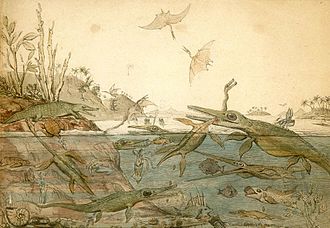
Duria Antiquior, célèbre aquarelle du géologue Henry de la Beche représentant la vie dans l'ancien Dorset d'après des fossiles trouvés par Mary Anning.

Duria Antiquior, célèbre aquarelle du géologue Henry de la Beche représentant la vie dans l'ancien Dorset d'après des fossiles trouvés par Mary Anning.

old school fossile Ichthyosaurus Plesiosaurus +1
Geographic and geologic map showing the location and involved strata of the studied fossil sites in the Xinhe Formation. (A, B) location of the fossiliferous localities in the Gansu Province. (C) Geological map of the involved strata of the studied fossil site (from State Bureau of Surveying and Mapping, GS (2016)2884). White star=Jinchuanloong niedu. Black star=plesiosaur fossils. (D) Stratigraphic chart of the Jurassic at the localities.

Geographic and geologic map showing the location and involved strata of the studied fossil sites in the Xinhe Formation. (A, B) location of the fossiliferous localities in the Gansu Province. (C) Geological map of the involved strata of the studied fossil site (from State Bureau of Surveying and Mapping, GS (2016)2884). White star=Jinchuanloong niedu. Black star=plesiosaur fossils. (D) Stratigraphic chart of the Jurassic at the localities.

Jurassique fossile Jinchuanloong Plesiosauria +1
Jinchuanloong is a relatively basal sauropod that measured an estimated 10 m in length. Sauropod skulls typically don't preserve well in the fossil record, but Jinchuanloong is known mainly from the skull, and parts of the neck and tail. Like all sauropods, Jinchuanloong was a quadrupedal herbivore that used its long neck to reach the vegetation that it fed on.

Jinchuanloong is a relatively basal sauropod that measured an estimated 10 m in length. Sauropod skulls typically don't preserve well in the fossil record, but Jinchuanloong is known mainly from the skull, and parts of the neck and tail. Like all sauropods, Jinchuanloong was a quadrupedal herbivore that used its long neck to reach the vegetation that it fed on.

fossile Jinchuanloong crâne
Artists’ reconstruction of the living Sarabosaurus dahli swimming with ammonites and fish in southern Utah, 94 million years ago. Artwork by Andrey Atuchin. On June 23, 2023, the following link will go live for more information, www.blm.gov/press-release/94-million-year-old-fossil-prov...

Artists’ reconstruction of the living Sarabosaurus dahli swimming with ammonites and fish in southern Utah, 94 million years ago. Artwork by Andrey Atuchin. On June 23, 2023, the following link will go live for more information, www.blm.gov/press-release/94-million-year-old-fossil-prov...

fossile Sarabosaurus Selmasaurini
Various fossils pertaining to the holotype of the Triassic ichthyosaur Toretocnemus (originally Leptocheirus, also Merriamia) zitteli. This image is derived from plate 23 in Merriam (1903), done by an uncredited artist. The arrangement of the individual figures has been modified from the original (most notably, figures 3 and 4 were swapped to minimize confusion).
Original description:
Leptocheirus zitteli n. gen. and sp.
Figures reproduced natural size from the type specimen.

Fig. 1.— Right side of skull.
Fig. 2. — Cross-section of posterior portion of the lower jaw, taken above the point marked A on the lateral view of the skull.
Fig. 3. — Cross-section of the upper and lower jaws, taken at the break immediately behind the point marked Sp on the lateral view of the skull.
Fig. 4. — Lateral view of an anterior caudal centrum.
Legend (modified from original):

Ar - articular
A - angular
D - dentary
J - jugal
L - lacrimal
Mx - maxilla
Po - postorbital
Sa - surangular
Se - sclerotic ring
Sp - spenial
T - cross-section of tooth
X - doubtful element

Various fossils pertaining to the holotype of the Triassic ichthyosaur Toretocnemus (originally Leptocheirus, also Merriamia) zitteli. This image is derived from plate 23 in Merriam (1903), done by an uncredited artist. The arrangement of the individual figures has been modified from the original (most notably, figures 3 and 4 were swapped to minimize confusion). Original description: Leptocheirus zitteli n. gen. and sp. Figures reproduced natural size from the type specimen. Fig. 1.— Right side of skull. Fig. 2. — Cross-section of posterior portion of the lower jaw, taken above the point marked A on the lateral view of the skull. Fig. 3. — Cross-section of the upper and lower jaws, taken at the break immediately behind the point marked Sp on the lateral view of the skull. Fig. 4. — Lateral view of an anterior caudal centrum. Legend (modified from original): Ar - articular A - angular D - dentary J - jugal L - lacrimal Mx - maxilla Po - postorbital Sa - surangular Se - sclerotic ring Sp - spenial T - cross-section of tooth X - doubtful element

description Trias fossile holotype +7
Photograph of a fossil cast of a Tanycolagreus topwilsoni skeleton taken at the North American Museum of Ancient Life.

Photograph of a fossil cast of a Tanycolagreus topwilsoni skeleton taken at the North American Museum of Ancient Life.

musée moulage fossile Coeluridae +2
Tanycolagreus fossil holotype TPII 2000-09-29, North American Museum of Ancient Life.

Tanycolagreus fossil holotype TPII 2000-09-29, North American Museum of Ancient Life.

musée États-Unis fossile holotype +2
Diagram of the skull of Taniwhasaurus antarcticus, the areas in black being the known fossil material.
Reference source:

Álvarez–Herrera, Agnolin & Novas (2020) "A rostral neurovascular system in the mosasaur Taniwhasaurus antarcticus"

Diagram of the skull of Taniwhasaurus antarcticus, the areas in black being the known fossil material. Reference source: Álvarez–Herrera, Agnolin & Novas (2020) "A rostral neurovascular system in the mosasaur Taniwhasaurus antarcticus"

fossile Plioplatecarpinae Taniwhasaurus crâne
Ctenochasma elegans (syn. Pterodactylus elegans) fossil from Solnhofen, Germany

American Museum of Natural History, New York, FR-5147
Received in exchange from the Paläontologisches Museum München, 1909
Taxons Ctenochasmatidae

Ctenochasma elegans (syn. Pterodactylus elegans) fossil from Solnhofen, Germany American Museum of Natural History, New York, FR-5147 Received in exchange from the Paläontologisches Museum München, 1909

musée Allemagne fossile Ctenochasma +5
Ctenochasma elegans (syn. Pterodactylus elegans) fossil from Solnhofen, Germany

American Museum of Natural History, New York, FR-5147
Received in exchange from the Paläontologisches Museum München, 1909
Taxons Gnathosaurinae

Ctenochasma elegans (syn. Pterodactylus elegans) fossil from Solnhofen, Germany American Museum of Natural History, New York, FR-5147 Received in exchange from the Paläontologisches Museum München, 1909

musée Allemagne fossile Ctenochasma +5
Ctenochasma elegans (syn. Pterodactylus elegans) fossil from Solnhofen, Germany

American Museum of Natural History, New York, FR-5147
Received in exchange from the Paläontologisches Museum München, 1909
Taxons Moganopterinae

Ctenochasma elegans (syn. Pterodactylus elegans) fossil from Solnhofen, Germany American Museum of Natural History, New York, FR-5147 Received in exchange from the Paläontologisches Museum München, 1909

musée Allemagne fossile Ctenochasma +5
Ctenochasma elegans (syn. Pterodactylus elegans) fossil from Solnhofen, Germany

American Museum of Natural History, New York, FR-5147
Received in exchange from the Paläontologisches Museum München, 1909
Taxons Ctenochasmatinae

Ctenochasma elegans (syn. Pterodactylus elegans) fossil from Solnhofen, Germany American Museum of Natural History, New York, FR-5147 Received in exchange from the Paläontologisches Museum München, 1909

musée Allemagne fossile Ctenochasma +5
Fossil of Halisaurus, an extinct reptile- Took the picture at Muse (Trento)
Taxons Halisaurinae

Fossil of Halisaurus, an extinct reptile- Took the picture at Muse (Trento)

fossile Halisaurinae Halisaurini Halisauromorpha +2
Fossil of Halisaurus, an extinct reptile- Took the picture at Muse (Trento)
Taxons Halisaurini

Fossil of Halisaurus, an extinct reptile- Took the picture at Muse (Trento)

fossile Halisaurinae Halisaurini Halisauromorpha +2
Fossil of Halisaurus, an extinct reptile- Took the picture at Muse (Trento)
Taxons Pluridensini

Fossil of Halisaurus, an extinct reptile- Took the picture at Muse (Trento)

fossile Halisaurinae Halisaurini Halisauromorpha +2
1 2 3 4 5 6 7 8 9 10 11 12 13 14 15

Actualités

Un fossile vieux de 500 millions d’années vient de réécrire l’histoire de l’araignée
fossile
Il y a un demi-milliard d’années, une étrange créature marine appelée Mollisonia symetrica aurait ouvert la voie aux araignées modernes. Grâce à une analyse détaillée du cerveau des fossiles, les chercheurs ont découvert des schémas neuronaux étonnamment similaires à ceux des arachnides d'aujourd'hui, ce qui suggère que les araignées ont évolué dans l'océan et non sur terre comme on le pensait auparavant. Cette structure cérébrale fait même allusion à un saut évolutif critique qui a permis aux araignées d’acquérir leur fameuse vitesse, leur dextérité et leurs prouesses à tisser des toiles. Les résultats constituent un défi de longue date
24/07/2025 sciencedaily-human-evo ⚙ Traduction automatique
1 2 3 4 5 6 7 8 9 10 11 12 13 14 15 16 17 18 19 20 21 22 23 24 25 26 27 28 29 30 31 32 33 34 35 36 37 38 39 40 41 42 43 44 45 46 47 48 49