fossile

Nature du spécimen

371 image(s) · 183 Actualités

Galerie d'images

A trackway of the trace fossil Bifurculapes laqueatus (positive hyporelief, i.e. casts on the bottom surface of the bed) from the Early Jurassic East Berlin Formation (Hartford Basin) of Holyoke, Massachusetts (not the same specimen as this one). Scale is in cm.
Formations East Berlin

A trackway of the trace fossil Bifurculapes laqueatus (positive hyporelief, i.e. casts on the bottom surface of the bed) from the Early Jurassic East Berlin Formation (Hartford Basin) of Holyoke, Massachusetts (not the same specimen as this one). Scale is in cm.

écaille East Berlin Jurassique inférieur Jurassique +4
Fossil eggs of the oospecies Macroelongatoolithus carlylei (believed to be the eggs of giant oviraptorosaurs) from the Cedar Mountain Formation of North America. At the SECU Dinolab of the North Carolina Museum of Natural Sciences

Fossil eggs of the oospecies Macroelongatoolithus carlylei (believed to be the eggs of giant oviraptorosaurs) from the Cedar Mountain Formation of North America. At the SECU Dinolab of the North Carolina Museum of Natural Sciences

musée Cedar Mountain fossile Macroelongatoolithus +2
Paleogeography and paleoclimate of the Late Jurassic - 150 Ma with dinosaur fossil localities:
A = Tendaguru Formation, Tanzania
C1 =  Shishugou & Kalazha Formations, China
C2 =  Shangshaximiao (Upper Shaximiao) Formation, China
E1 =  Sables de Glos, Argiles d’Octeville, Marnes de Bléville, Kimmeridge Clay, Calcareous Grit, Corallian Oolite, Oxford Clay, Portland Stone, England & France
E2 = Villar del Arzobispo, Alcobaça, Guimarota, Sobral, Amoreira-Porto Novo, Bombarral, Freixial, Lourinhã Formations, Spain & Portugal
M1-6 = Morrison Formation, United States
S1 =  Toquí & Cañadón Calcáreo Formations, Chile & Argentina

Paleogeography and paleoclimate of the Late Jurassic - 150 Ma with dinosaur fossil localities: A = Tendaguru Formation, Tanzania C1 = Shishugou & Kalazha Formations, China C2 = Shangshaximiao (Upper Shaximiao) Formation, China E1 = Sables de Glos, Argiles d’Octeville, Marnes de Bléville, Kimmeridge Clay, Calcareous Grit, Corallian Oolite, Oxford Clay, Portland Stone, England & France E2 = Villar del Arzobispo, Alcobaça, Guimarota, Sobral, Amoreira-Porto Novo, Bombarral, Freixial, Lourinhã Formations, Spain & Portugal M1-6 = Morrison Formation, United States S1 = Toquí & Cañadón Calcáreo Formations, Chile & Argentina

Argentine Chili Chine France +19
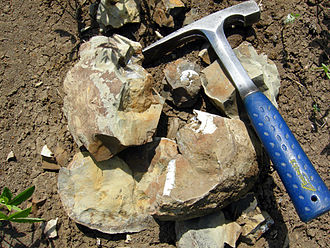
A broken concretion with fossils inside; Late Cretaceous Pierre shale, near Ekalaka, Montana.

A broken concretion with fossils inside; Late Cretaceous Pierre shale, near Ekalaka, Montana.

Pierre Shale Crétacé Crétacé supérieur fossile
The distictive banding of the Morrison Formation, a group of rock layers that occur throughout Dinosaur National Monument.  The formation originated as muds and sands laid down by ancient rivers, and some of its outcrops have been found to contain 150-million-year-old dinosaur fossils like those found at the monument's Dinosaur Quarry.

The distictive banding of the Morrison Formation, a group of rock layers that occur throughout Dinosaur National Monument. The formation originated as muds and sands laid down by ancient rivers, and some of its outcrops have been found to contain 150-million-year-old dinosaur fossils like those found at the monument's Dinosaur Quarry.

Morrison fossile Dinosauria formation
Bituminous claystone, Lower Jurassic, Hesselberg, Middle Franconia.
Sedimentary rock of very thin laminated layers (particles less than 0,0002 mm).

Rock formation is known for its rich fossil findings, ex. Ichthyosaur.

Bituminous claystone, Lower Jurassic, Hesselberg, Middle Franconia. Sedimentary rock of very thin laminated layers (particles less than 0,0002 mm). Rock formation is known for its rich fossil findings, ex. Ichthyosaur.

Jurassique fossile Ichthyosauria formation
Map of Cretaceous-aged dinosaur fossil localities of Mongolia.
Gobihadros mongoliensis was collected from Bayshin Tsav in Area C. Open squares indicate Late Cretaceous sites, solid squares represent Early Cretaceous localities. Abbreviations: A, Localities of Western Gobi Desert in Mongolia, mainly group of localities of Nemegtian age (early Maastrichtian), Late Cretaceous; B, Localities of Central Gobi Desert in Mongolia, mainly Djadokhtian age (Campanian), Late Cretaceous; C & D- Localities of Eastern Gobi Desert in Mongolia, mainly Baynshirenian age (Cenomanian-Santonian), Late Cretaceous. Figure has been modified from Tsogtbaatar et al. 2014, Figure 1 [24].

Map of Cretaceous-aged dinosaur fossil localities of Mongolia. Gobihadros mongoliensis was collected from Bayshin Tsav in Area C. Open squares indicate Late Cretaceous sites, solid squares represent Early Cretaceous localities. Abbreviations: A, Localities of Western Gobi Desert in Mongolia, mainly group of localities of Nemegtian age (early Maastrichtian), Late Cretaceous; B, Localities of Central Gobi Desert in Mongolia, mainly Djadokhtian age (Campanian), Late Cretaceous; C & D- Localities of Eastern Gobi Desert in Mongolia, mainly Baynshirenian age (Cenomanian-Santonian), Late Cretaceous. Figure has been modified from Tsogtbaatar et al. 2014, Figure 1 [24].

Mongolie Campanien Cénomanien Crétacé +8
Fossil hunting at Dinosaur Park
Formations Arundel Clay

Fossil hunting at Dinosaur Park

chasse Dinosaur Park fossile Dinosauria
Figure 2: Fossil vertebrate locality of Eric the Red West.
Shore platform looking west, showing undulating erosive boundary (solid white line) between the top of the Anchor Sandstone (AS) and the base of the ETRW Sandstone (ES). White dashed lines indicate selected bedding surfaces. White scale in mid-ground (indicated by arrow) equals 1 m.

Figure 2: Fossil vertebrate locality of Eric the Red West. Shore platform looking west, showing undulating erosive boundary (solid white line) between the top of the Anchor Sandstone (AS) and the base of the ETRW Sandstone (ES). White dashed lines indicate selected bedding surfaces. White scale in mid-ground (indicated by arrow) equals 1 m.

écaille fossile
Fossil of Suevoleviathan- Took the picture at Museum am Lowentor, Stuttgart

Fossil of Suevoleviathan- Took the picture at Museum am Lowentor, Stuttgart

musée fossile Suevoleviathan
Fossil of Suevoleviathan- Took the picture at Museum am Lowentor, Stuttgart

Fossil of Suevoleviathan- Took the picture at Museum am Lowentor, Stuttgart

musée fossile Suevoleviathan
Fossil of Suevoleviathan, an extinct reptile- Took the picture at Museum of Paleontology at Tuebingen

Fossil of Suevoleviathan, an extinct reptile- Took the picture at Museum of Paleontology at Tuebingen

musée fossile Suevoleviathan
Fossil of Suevoleviathan, an extinct reptile- Took the picture at Museum of Paleontology at Tuebingen

Fossil of Suevoleviathan, an extinct reptile- Took the picture at Museum of Paleontology at Tuebingen

musée fossile Suevoleviathan
The Naturmuseum Senckenberg in Frankfurt is the second largest museum of natural history in Germany. It is particularly popular with children, who enjoy the extensive collection of dinosaur skeletons: Senckenberg boasts the largest exhibition of large dinosaurs in Europe. One particular treasure is a dinosaur fossil with unique, preserved scaled skin. The museum contains the world's largest and most diverse collection of stuffed birds with about 2000 specimens.

The Naturmuseum Senckenberg in Frankfurt is the second largest museum of natural history in Germany. It is particularly popular with children, who enjoy the extensive collection of dinosaur skeletons: Senckenberg boasts the largest exhibition of large dinosaurs in Europe. One particular treasure is a dinosaur fossil with unique, preserved scaled skin. The museum contains the world's largest and most diverse collection of stuffed birds with about 2000 specimens.

musée Allemagne fossile spécimen +4
Fossil in the Oxford University natural history museum

Fossil in the Oxford University natural history museum

musée Pérou fossile Peloneustes
Identifier: catalogueoffossi02bri (find matches)
Title: Catalogue of the fossil Reptilia and Amphibia in the British Museum (Natural history) ... By Richard Lydekker ..
Year: 1888 (1880s)
Authors:  British Museum (Natural History). Dept. of Geology Lydekker, Richard, 1849-1915
Subjects:  Reptiles, Fossil Amphibians, Fossil
Publisher:  London, Printed by order of the Trustees
Contributing Library:  Smithsonian Libraries
Digitizing Sponsor:  Biodiversity Heritage Library

View Book Page: Book Viewer
About This Book: Catalog Entry
View All Images: All Images From Book
Click here to view book online to see this illustration in context in a browseable online version of this book.

Text Appearing Before Image:
rface smooth; their terminal faces onlyslightly cupped, transversely ellipsoidal, and somewhat angulatod.Dorsals with longer centra, having nearly flat terminal faces, andforward overhang of upper part. Pectoral girdle of the general typeof Pliosaurus, with a small triangular omostornum between theventral plates of the scapula) (fig. 48), which have a strong ridge 1 Quart. Journ. Geol. Soc. vol. xlv. p. 49 (1889). 152 SATJKOPTERYGTA. dividing the ventral from the dorsal portion, and are thus more ofthe type of Thaumatosaurus. Pelvis (figs. 53, 54) like that ofPliosaurus, the pubis and ischium uniting to form an obturatorforamen. Relative lengths of humerus and femur unknown.Humerus articulating distally with only the radius and ulna, whichare relatively short, and separated only by a small interval (fig. 52) ;ulna and fibula subreniform, the former being considerably thelarger of the two. This genus may have been directly derived from the Longiros-trine group of Plesiosaurus. Fig. 49.
Text Appearing After Image:
Peloneustes philarchus.—Dorsal aspect of the coracoids; from the Oxford Clay of Bedford. Reduced, gl, glenoid cavity. (This and the preceding figure from the Quart. Joum. Geol. Soc.) Peloneustes sequalis (Phillips1). Syn. Pliosaurus cequalis, Phillips2.Pliosaurus sterrodirus, Seeley3. Imperfectly known. Cervical vertebrae with the neural canal•sunk into the centrum, and the pectorals with distinctly concaveterminal faces. Larger than typical examples of the next species. This species was founded upon a femur (fig. 50) from the Kime-ridge Clay of Oxfordshire, which so closely resembles the corre-sponding bone of P.jihilarchus as to indicate its generic identity; the 1 Geology of Oxford, p. 365 (1871).—Plesiosaurus. 2 Loc. cit. 3 Index to Ayes &c. in Cambridge Museum, p. 98 (1869).—No description. PLESI0SATJKIDJE, 153 length of this specimen is 0,572 (23 inches). The undermentionedvertebrae agree in relative size with this femur, and in genericcharacters with those of the ty

Note About Images

Please note that these images are extracted from scanned page images that may have been digitally enhanced for readability - coloration and appearance of these illustrations may not perfectly resemble the original work.

Identifier: catalogueoffossi02bri (find matches) Title: Catalogue of the fossil Reptilia and Amphibia in the British Museum (Natural history) ... By Richard Lydekker .. Year: 1888 (1880s) Authors: British Museum (Natural History). Dept. of Geology Lydekker, Richard, 1849-1915 Subjects: Reptiles, Fossil Amphibians, Fossil Publisher: London, Printed by order of the Trustees Contributing Library: Smithsonian Libraries Digitizing Sponsor: Biodiversity Heritage Library View Book Page: Book Viewer About This Book: Catalog Entry View All Images: All Images From Book Click here to view book online to see this illustration in context in a browseable online version of this book. Text Appearing Before Image: rface smooth; their terminal faces onlyslightly cupped, transversely ellipsoidal, and somewhat angulatod.Dorsals with longer centra, having nearly flat terminal faces, andforward overhang of upper part. Pectoral girdle of the general typeof Pliosaurus, with a small triangular omostornum between theventral plates of the scapula) (fig. 48), which have a strong ridge 1 Quart. Journ. Geol. Soc. vol. xlv. p. 49 (1889). 152 SATJKOPTERYGTA. dividing the ventral from the dorsal portion, and are thus more ofthe type of Thaumatosaurus. Pelvis (figs. 53, 54) like that ofPliosaurus, the pubis and ischium uniting to form an obturatorforamen. Relative lengths of humerus and femur unknown.Humerus articulating distally with only the radius and ulna, whichare relatively short, and separated only by a small interval (fig. 52) ;ulna and fibula subreniform, the former being considerably thelarger of the two. This genus may have been directly derived from the Longiros-trine group of Plesiosaurus. Fig. 49. Text Appearing After Image: Peloneustes philarchus.—Dorsal aspect of the coracoids; from the Oxford Clay of Bedford. Reduced, gl, glenoid cavity. (This and the preceding figure from the Quart. Joum. Geol. Soc.) Peloneustes sequalis (Phillips1). Syn. Pliosaurus cequalis, Phillips2.Pliosaurus sterrodirus, Seeley3. Imperfectly known. Cervical vertebrae with the neural canal•sunk into the centrum, and the pectorals with distinctly concaveterminal faces. Larger than typical examples of the next species. This species was founded upon a femur (fig. 50) from the Kime-ridge Clay of Oxfordshire, which so closely resembles the corre-sponding bone of P.jihilarchus as to indicate its generic identity; the 1 Geology of Oxford, p. 365 (1871).—Plesiosaurus. 2 Loc. cit. 3 Index to Ayes &c. in Cambridge Museum, p. 98 (1869).—No description. PLESI0SATJKIDJE, 153 length of this specimen is 0,572 (23 inches). The undermentionedvertebrae agree in relative size with this femur, and in genericcharacters with those of the ty Note About Images Please note that these images are extracted from scanned page images that may have been digitally enhanced for readability - coloration and appearance of these illustrations may not perfectly resemble the original work.

musée fossile Peloneustes Pliosaurus +1
1 2 3 4 5 6 7 8 9 10 11 12 13 14 15 16 17 18 19 20 21 22 23 24

Actualités

The American “cheetah” wasn’t a cheetah at all
fossile poisson
The extinct “American cheetah” was not really a cheetah at all, but a puma relative with an unexpectedly flexible lifestyle. Fossils from the Yukon suggest northern populations survived partly by eating fish, possibly including salmon, while southern cats hunted on land.
08/09/2026 sciencedaily-paleo
115-Million-Year-Old Dinosaur Fossil Recovered from Deep Drill Core in China
Chine Mongolie Crétacé Crétacé inférieur fossile Dinosauria formation
Scientists have identified the first dinosaur fossil from a remote western section of the Bayan Gobi Formation in China’s Inner Mongolia, extending the known geographic range of dinosaur fossils in this important Early Cretaceous rock unit. The post 115-Million-Year-Old Dinosaur Fossil Recovered from Deep Drill Core in China appeared first on Sci.News: Breaking Science News.
07/09/2026 sci-news
Voici à quoi pouvait ressembler une partie de la bande-son des forêts au temps des dinosaures
Jurassique fossile Dinosauria insecte
Il y a 150 millions d’années, les forêts jurassiques résonnaient probablement de sons dont nous ignorons presque tout. Des fossiles d’insectes viennent pourtant de livrer de précieux indices sur cette mystérieuse bande-son, révélant notamment des signaux acoustiques aux fréquences étonnamment...
05/09/2026 futura-terre
Amazing Permian Raindrops – An Ephemeral Moment Preserved for 275 Million Years
musée Permien fossile Dinosauria
Fossils can preserve evidence of extraordinary events. However, sometimes the most mundane traces of the past prove equally remarkable. Everything Dinosaur team members recently visited the Museum für Naturkunde Berlin. There, they photographed exquisite Permian raindrop impressions preserved in sandstone. A record of rainfall from 275 million years ago. Individual water drops left marks,
03/09/2026 everythingdinosaur
Fossil of Giant Squid-Like Creature from Cretaceous Period Bears Marks of Deadly Attack
Canada Crétacé fossile squelette
Paleontologists studying a fossil unearthed in southern Manitoba, Canada, have identified what they believe are two bite marks on the internal skeleton of the ancient giant cephalopod Enchoteuthis. The post Fossil of Giant Squid-Like Creature from Cretaceous Period Bears Marks of Deadly Attack appeared first on Sci.News: Breaking Science News.
01/09/2026 sci-news
1 2 3 4 5 6 7 8 9 10 11 12 13 14 15 16 17 18 19 20 21 22 23 24 25 26 27 28 29 30 31 32 33 34 35 36 37