fossile

Nature du spécimen

371 image(s) · 183 Actualités

Galerie d'images

Fossil of Santanadactylus pricei and Anhanguera santanae, an extinct pterosaur- Took the photo at Senckenberg Museum of Frankfurt

Fossil of Santanadactylus pricei and Anhanguera santanae, an extinct pterosaur- Took the photo at Senckenberg Museum of Frankfurt

musée fossile Anhanguera Pterosauria +1
Fossil specimen (IVPP V17903) of Corpulentapus lilasia on display at the Paleozoological Museum of China.

Fossil specimen (IVPP V17903) of Corpulentapus lilasia on display at the Paleozoological Museum of China.

musée Chine fossile spécimen +1
The Natural Science Museum at El Chocón, in the northwestern Argentine Patagonia (the Comahue region). Fossil of dinosaur

The Natural Science Museum at El Chocón, in the northwestern Argentine Patagonia (the Comahue region). Fossil of dinosaur

musée Argentine fossile Dinosauria +1
Khaan fossil holotype IGM 100/1127.

Khaan fossil holotype IGM 100/1127.

États-Unis fossile holotype Khaan
Known fossil pieces after Aviatyrannis jurassica (Dinosauria, Theropoda, Coelurosauria, Tyrannosauroidea).[1]
Sources

↑ Rauhut O.W.M. (2003), "A tyrannosaurid dinosaur from the Upper Jurassic of Portugal", Paleontology 46(5): p. 903-910.

Known fossil pieces after Aviatyrannis jurassica (Dinosauria, Theropoda, Coelurosauria, Tyrannosauroidea).[1] Sources ↑ Rauhut O.W.M. (2003), "A tyrannosaurid dinosaur from the Upper Jurassic of Portugal", Paleontology 46(5): p. 903-910.

Portugal Jurassique fossile Aviatyrannis +5
Datousaurus. Fossil in Shanghai Science & Technology Museum

Datousaurus. Fossil in Shanghai Science & Technology Museum

musée fossile Datousaurus
Illustration of a fossil of Chubutisaurus

Illustration of a fossil of Chubutisaurus

fossile Chubutisaurus
Illustration of a fossil of Plateosauravus

Illustration of a fossil of Plateosauravus

fossile Plateosauravus
Fossil of Nannopterygius, an extinct reptile-- Took the photo at Natural History Museum, London
Taxons Paraophthalmosaurus

Fossil of Nannopterygius, an extinct reptile-- Took the photo at Natural History Museum, London

musée fossile Nannopterygius Paraophthalmosaurus
Fossil of Macropterygius, an extinct reptile--

Fossil of Macropterygius, an extinct reptile--

fossile Aegirosaurus
Cast of a Scaphognathus crassirostris, a kind of pterosaur. On display as part of the exhibit "Pterosaurs: Flight in the Age of Dinosaurs" at the Cleveland Natural History Museum in Cleveland, Ohio, in the United States.
This animal lived about 150 million years ago. This fossil was found in the Solnhofen formation in Germany. This is a cast; the fossil itself is held by the Institute of Geology and Paleontology at the University of Bonn.

Cast of a Scaphognathus crassirostris, a kind of pterosaur. On display as part of the exhibit "Pterosaurs: Flight in the Age of Dinosaurs" at the Cleveland Natural History Museum in Cleveland, Ohio, in the United States. This animal lived about 150 million years ago. This fossil was found in the Solnhofen formation in Germany. This is a cast; the fossil itself is held by the Institute of Geology and Paleontology at the University of Bonn.

vol musée Allemagne États-Unis +7
Fossil specimen of early Cretaceous pterosaur Sinopterus dongi, which is collected from Chaoyang, Liaoning, China. The specimen (BMNHC Ph773) is a collection of Beijing Museum of Natural History and was on display in the National Museum of Natural Science (Taichung, Taiwan) during a special exhibition.
Taxons Huaxiapterus

Fossil specimen of early Cretaceous pterosaur Sinopterus dongi, which is collected from Chaoyang, Liaoning, China. The specimen (BMNHC Ph773) is a collection of Beijing Museum of Natural History and was on display in the National Museum of Natural Science (Taichung, Taiwan) during a special exhibition.

musée Chine Taïwan Crétacé +6
A diagram of the dromaeosaurid dinosaur Pyroraptor olympius with selected fossil elements that can be reliably scaled using measurements given by Allain & Taquet (2000) to produce a realistic estimate of the taxon's size and proportions in life. This silhouette is based on the supposition of the missing elements of Pyroraptor's skeleton having fairly generalized dromaeosaurid proportions.

A diagram of the dromaeosaurid dinosaur Pyroraptor olympius with selected fossil elements that can be reliably scaled using measurements given by Allain & Taquet (2000) to produce a realistic estimate of the taxon's size and proportions in life. This silhouette is based on the supposition of the missing elements of Pyroraptor's skeleton having fairly generalized dromaeosaurid proportions.

fossile Dinosauria Dromaeosauridae Pyroraptor +1
Sinornithosaurus millenii fossil displayed in Hong Kong Science Museum

Sinornithosaurus millenii fossil displayed in Hong Kong Science Museum

musée fossile Sinornithosaurus
Fossiles de Variraptor présentés lors de l'exposition "Sur les traces des dinosaures de la montagne Sainte-Victoire"

Fossiles de Variraptor présentés lors de l'exposition "Sur les traces des dinosaures de la montagne Sainte-Victoire"

fossile Dinosauria Variraptor
Fossil specimen of Anchiornis huxleyi on display at the Beijing Museum of Natural History.

Fossil specimen of Anchiornis huxleyi on display at the Beijing Museum of Natural History.

musée fossile spécimen Anchiornis
1 2 3 4 5 6 7 8 9 10 11 12 13 14 15 16 17 18 19 20 21 22 23 24

Actualités

Cet animal vieux de 275 millions d'années avait une mâchoire tordue comme aucun animal vivant aujourd'hui
mâchoire Brésil fossile datation
Au fond d'un lit de rivière asséché au Brésil, des scientifiques ont découvert un étrange mystère préhistorique : les mâchoires tordues d'un étrange animal perdu depuis longtemps, comme on n'en avait jamais vu auparavant. Datant de 275 millions d'années, cette créature, nommée Tanyka amnicola, appartenait à une lignée ancienne qui aurait déjà dû disparaître, ce qui en fait une sorte de « fossile vivant » de son époque.
01/05/2026 sciencedaily ⚙ Traduction automatique
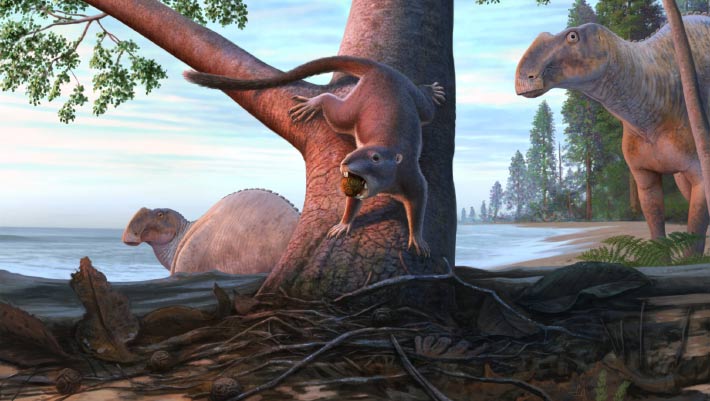
Omnivorous, Rodent-Like Mammal Lived in Dinosaurs’ Shadow on Pacific Coast
Un mammifère omnivore ressemblant à un rongeur vivait dans l’ombre des dinosaures sur la côte du Pacifique
Mexique fossile Dinosauria mammifères nouvelle espèce
Les paléontologues ont décrit une nouvelle espèce du genre de mammifères multituberculés Cimolodon sur la base d'un fossile trouvé en Basse-Californie, au Mexique. L'article Un mammifère omnivore ressemblant à un rongeur vivait dans l'ombre des dinosaures sur la côte du Pacifique est apparu en premier sur Sci.News : Breaking Science News.
29/04/2026 sci-news ⚙ Traduction automatique
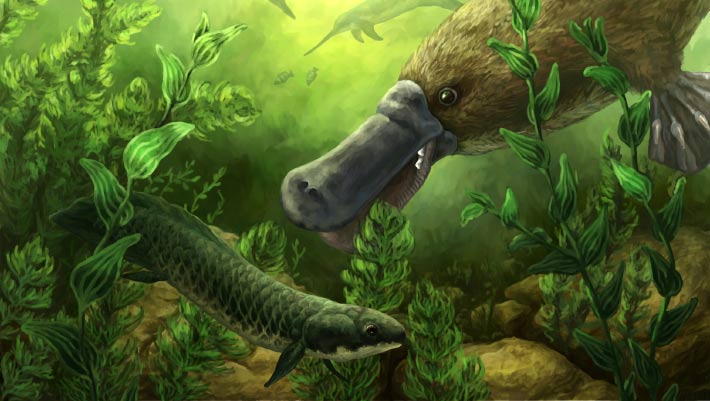
Early Platypuses Had Strong Teeth and Powerful Jaws, Fossils Show
Les premiers ornithorynques avaient des dents solides et des mâchoires puissantes, selon des fossiles
mâchoire dent Australie fossile formation
De nouveaux fossiles de la Formation de Namba, en Australie méridionale, révèlent qu'il y a 25 millions d'années, Obdurodon insignis prospérait dans les lacs intérieurs luxuriants aux côtés de dauphins d'eau douce et d'autres espèces aujourd'hui disparues. L'article Les premiers ornithorynques avaient des dents solides et des mâchoires puissantes, Fossils Show est apparu en premier sur Sci.News : Breaking Science News.
28/04/2026 sci-news ⚙ Traduction automatique
Ce fossile prouve enfin une théorie vieille de 200 ans
reproduction fossile évolution mammifères
Ce petit nodule fossilisé a été découvert en 2008. Il vient seulement de livrer ses secrets : de quoi valider une théorie vieille de près de deux siècles sur l’évolution de la reproduction chez les ancêtres des mammifères.
28/04/2026 sciencesetavenir
Ce petit mammifère a survécu à l'apocalypse des dinosaures et a changé la vie sur Terre
fossile Dinosauria extinction mammifères
Un mammifère préhistorique récemment découvert pourrait détenir des indices sur la façon dont la vie a survécu à l’extinction des dinosaures. La minuscule espèce, Cimolodon desosai, vivait il y a 75 millions d'années et possédait des caractéristiques, comme un petit corps et un régime alimentaire varié, qui augmentaient probablement ses chances de survie. Trouvé en Basse-Californie, le fossile comprend de rares restes squelettiques qui révèlent comment il se déplaçait et vivait. Les chercheurs pensent que sa lignée a aidé les mammifères à endurer l’un des événements les plus meurtriers sur Terre.
27/04/2026 sciencedaily ⚙ Traduction automatique
1 2 3 4 5 6 7 8 9 10 11 12 13 14 15 16 17 18 19 20 21 22 23 24 25 26 27 28 29 30 31 32 33 34 35 36 37