formation

Thématique

218 image(s) · 13 Actualités

Galerie d'images

Material of the dinosaur Bahariasaurus ingens (1-4, 7-18, 24-26) and indeterminate theropods (5-6, 19-23) from the Bahariya Formation of Egypt.

Material of the dinosaur Bahariasaurus ingens (1-4, 7-18, 24-26) and indeterminate theropods (5-6, 19-23) from the Bahariya Formation of Egypt.

Égypte Bahariasaurus Dinosauria formation
Arcovenator escotae (Theropoda, Abelisauridae), braincase (MHNAix-PV 2011-12) in dorsal view (Lower Argiles Rutilantes Formation, Jas Neuf Sud, Var)
Taxons Arcovenator

Arcovenator escotae (Theropoda, Abelisauridae), braincase (MHNAix-PV 2011-12) in dorsal view (Lower Argiles Rutilantes Formation, Jas Neuf Sud, Var)

Abelisauridae Arcovenator Theropoda formation
Left ilium of Stokesosaurus clevelandi, Madsen 1974 (UMNH VP 7473), Morrison Formation, Utah, USA, Late Jurassic (early Tithonian).
Taxons Stokesosaurus

Left ilium of Stokesosaurus clevelandi, Madsen 1974 (UMNH VP 7473), Morrison Formation, Utah, USA, Late Jurassic (early Tithonian).

États-Unis Morrison Jurassique Jurassique supérieur +3
Dentary of Echinodon becklesii from the Lower Cretaceous Purbeck Formation of England. Left dentary (NHMUK 48215b) in lateral (A), medial (B), and dorsal (C) views.
Taxons Echinodon

Dentary of Echinodon becklesii from the Lower Cretaceous Purbeck Formation of England. Left dentary (NHMUK 48215b) in lateral (A), medial (B), and dorsal (C) views.

Crétacé Echinodon Sauraechmodon formation
Dentary of Echinodon becklesii from the Lower Cretaceous Purbeck Formation of England. Left dentary (NHMUK 48215b) in lateral (A), medial (B), and dorsal (C) views.
Taxons Sauraechmodon

Dentary of Echinodon becklesii from the Lower Cretaceous Purbeck Formation of England. Left dentary (NHMUK 48215b) in lateral (A), medial (B), and dorsal (C) views.

Crétacé Echinodon Sauraechmodon formation
Comparison of cranial features between closely related southern Laramidian taxa; (A), Akainacephalus johnsoni (UMNH VP 20202) from the Late Cretaceous Kaiparowits Formation of Utah; and (B), Nodocephalosaurus kirtlandensis (SMP VP-900) from the Late Cretaceous Kirtland Formation of New Mexico, in left lateral views. Various synapomorphies are shared with N. kirtlandensis (highlighted in black and white arrows) and includes “flaring nostrils”; enlarged, laterally projecting, loreal osteoderms that are situated directly dorsal to the external nares. Other synapomorphies include pyramid-shaped nasal and frontal osteoderms positioned on the dorsal regions of the skull. A number of significant differences have been observed between both specimens; in A. johnsoni, the anterior, and posterior supraorbital bosses form an enlarged element that is somewhat backswept, whereas in N. kirtlandensis, the posterior and anterior supraorbital bosses are clearly defined as individual osteoderms, and are much smaller in size. Additionally, the squamosal horn in Akainacephalus is very small but is prominent and tetrahedrally shaped in Nodocephalosaurus. The quadratojugal horn in Akainacephalus is massive, has a subtriangular morphology in lateral view and projects almost entirely ventral, whereas in Nodocephalosaurus, the quadratojugal horn is smaller and has a typical fin-shaped morphology. Study sites: asob, anterior supraorbital boss; ext naris, external naris; laca, lacrimal caputegulum; loca, loreal caputegulum; naca, nasal caputegulae; orb, orbit; psob, posterior supraorbital boss; qjh, quadratojugal horn; sqh, squamosal horn.

Comparison of cranial features between closely related southern Laramidian taxa; (A), Akainacephalus johnsoni (UMNH VP 20202) from the Late Cretaceous Kaiparowits Formation of Utah; and (B), Nodocephalosaurus kirtlandensis (SMP VP-900) from the Late Cretaceous Kirtland Formation of New Mexico, in left lateral views. Various synapomorphies are shared with N. kirtlandensis (highlighted in black and white arrows) and includes “flaring nostrils”; enlarged, laterally projecting, loreal osteoderms that are situated directly dorsal to the external nares. Other synapomorphies include pyramid-shaped nasal and frontal osteoderms positioned on the dorsal regions of the skull. A number of significant differences have been observed between both specimens; in A. johnsoni, the anterior, and posterior supraorbital bosses form an enlarged element that is somewhat backswept, whereas in N. kirtlandensis, the posterior and anterior supraorbital bosses are clearly defined as individual osteoderms, and are much smaller in size. Additionally, the squamosal horn in Akainacephalus is very small but is prominent and tetrahedrally shaped in Nodocephalosaurus. The quadratojugal horn in Akainacephalus is massive, has a subtriangular morphology in lateral view and projects almost entirely ventral, whereas in Nodocephalosaurus, the quadratojugal horn is smaller and has a typical fin-shaped morphology. Study sites: asob, anterior supraorbital boss; ext naris, external naris; laca, lacrimal caputegulum; loca, loreal caputegulum; naca, nasal caputegulae; orb, orbit; psob, posterior supraorbital boss; qjh, quadratojugal horn; sqh, squamosal horn.

Mexique Kaiparowits Kirtland Crétacé +6
Tooth of cf. Zapsalis, with close up of denticles. Specimen UALVP 49582 from the Milk River Formation.
Taxons Zapsalis

Tooth of cf. Zapsalis, with close up of denticles. Specimen UALVP 49582 from the Milk River Formation.

dent Milk River spécimen Zapsalis +1
Digital illustration of the Sauropod Dinosaur Isisaurus colberti from the Late Cretaceous (Maastrichtian) of India (72.2-66 MYA). References include Jain & Bandyopadhyay (1997), several papers from Wilson et al. and skeletal reconstruction by Scott Hartman.
Illustrated by Ansh Saxena.
About Isisaurus–

Isisaurus colberti (=Titanosaurus colberti) was a species of Titanosaurian Sauropod Dinosaur from the Late Cretaceous (Maastrichtian) age in the Indian Subcontinent. Isisaurus lived sympatrically with another Titanosaurian Sauropod Jainosaurus. It also lived alongside Theropods like Rajasaurus, Rahiolisaurus, Indosuchus etc. Remains of Isisaurus come from the Lameta formation of Central India.

Digital illustration of the Sauropod Dinosaur Isisaurus colberti from the Late Cretaceous (Maastrichtian) of India (72.2-66 MYA). References include Jain & Bandyopadhyay (1997), several papers from Wilson et al. and skeletal reconstruction by Scott Hartman. Illustrated by Ansh Saxena. About Isisaurus– Isisaurus colberti (=Titanosaurus colberti) was a species of Titanosaurian Sauropod Dinosaur from the Late Cretaceous (Maastrichtian) age in the Indian Subcontinent. Isisaurus lived sympatrically with another Titanosaurian Sauropod Jainosaurus. It also lived alongside Theropods like Rajasaurus, Rahiolisaurus, Indosuchus etc. Remains of Isisaurus come from the Lameta formation of Central India.

Inde Lameta Crétacé Crétacé supérieur +9
Skeletal reconstructions of Dinosaur Park Formation caenagnathids. Skeletal reconstructions of Citipes elegans (left), Chirostenotes pergracilis (middle), and Caenagnathus collinsi (right), showing variation in skeletal representation and body size. Previously referred material is indicated in white and newly referred material is indicated in red for each taxon. Blue asterisks indicate elements that have been histologically sampled for each taxon. Citipes elegans: dentaries, metatarsal IV; Chirostenotes pergracilis: dentaries, tibia; Caenagnathus collinsi: pubis.
Taxons Caenagnathus

Skeletal reconstructions of Dinosaur Park Formation caenagnathids. Skeletal reconstructions of Citipes elegans (left), Chirostenotes pergracilis (middle), and Caenagnathus collinsi (right), showing variation in skeletal representation and body size. Previously referred material is indicated in white and newly referred material is indicated in red for each taxon. Blue asterisks indicate elements that have been histologically sampled for each taxon. Citipes elegans: dentaries, metatarsal IV; Chirostenotes pergracilis: dentaries, tibia; Caenagnathus collinsi: pubis.

Dinosaur Park Caenagnathidae Caenagnathus Chirostenotes +3
Pterodactylus compressirostris, holotype NHMUK PV 39410 (Cenomanian / Turonian, Chalk Formation). A–D proposed lectotype, fragment of the mandibular symphysis A left lateral view B respective line drawing C dorsal view D respective line drawing. E–H referred specimen, portion of the rostrum E left lateral view F respective line drawing G ventral view H respective line drawing. Abbreviations: ch – choanae, d – dentary, m – maxillae, naof – nasoantorbital fenestra, pl – palatine, pm – premaxillae, prid – palatal ridge, sul– sulcus. Arrows indicate alveoli or teeth. Scale bar = 10 mm. Photos courtesy of The Natural History Museum.
Taxons Lonchodectes

Pterodactylus compressirostris, holotype NHMUK PV 39410 (Cenomanian / Turonian, Chalk Formation). A–D proposed lectotype, fragment of the mandibular symphysis A left lateral view B respective line drawing C dorsal view D respective line drawing. E–H referred specimen, portion of the rostrum E left lateral view F respective line drawing G ventral view H respective line drawing. Abbreviations: ch – choanae, d – dentary, m – maxillae, naof – nasoantorbital fenestra, pl – palatine, pm – premaxillae, prid – palatal ridge, sul– sulcus. Arrows indicate alveoli or teeth. Scale bar = 10 mm. Photos courtesy of The Natural History Museum.

écaille dessin musée Cénomanien +8
Pterodactylus compressirostris, holotype NHMUK PV 39410 (Cenomanian / Turonian, Chalk Formation). A–D proposed lectotype, fragment of the mandibular symphysis A left lateral view B respective line drawing C dorsal view D respective line drawing. E–H referred specimen, portion of the rostrum E left lateral view F respective line drawing G ventral view H respective line drawing. Abbreviations: ch – choanae, d – dentary, m – maxillae, naof – nasoantorbital fenestra, pl – palatine, pm – premaxillae, prid – palatal ridge, sul– sulcus. Arrows indicate alveoli or teeth. Scale bar = 10 mm. Photos courtesy of The Natural History Museum.
Taxons Lonchodraconidae

Pterodactylus compressirostris, holotype NHMUK PV 39410 (Cenomanian / Turonian, Chalk Formation). A–D proposed lectotype, fragment of the mandibular symphysis A left lateral view B respective line drawing C dorsal view D respective line drawing. E–H referred specimen, portion of the rostrum E left lateral view F respective line drawing G ventral view H respective line drawing. Abbreviations: ch – choanae, d – dentary, m – maxillae, naof – nasoantorbital fenestra, pl – palatine, pm – premaxillae, prid – palatal ridge, sul– sulcus. Arrows indicate alveoli or teeth. Scale bar = 10 mm. Photos courtesy of The Natural History Museum.

écaille dessin musée Cénomanien +8
Right dentary of Zalmoxes shqiperorum holotype NHMUK R4900in dorsal and lateral views, from the Sinpetru Formation of Sânpetru (Romania; outline based on the specimen UBB NVZ1-1).
Taxons Ferenceratops

Right dentary of Zalmoxes shqiperorum holotype NHMUK R4900in dorsal and lateral views, from the Sinpetru Formation of Sânpetru (Romania; outline based on the specimen UBB NVZ1-1).

Roumanie holotype spécimen Ferenceratops +2
Holotype specimen of Hylaeosaurus armatus Mantell, 1833 (NMH R3775) from the Grinstead Clay Formation (late Valanginian) of Tilgate Forest, Sussex, southern England.
Taxons Hylaeosaurus

Holotype specimen of Hylaeosaurus armatus Mantell, 1833 (NMH R3775) from the Grinstead Clay Formation (late Valanginian) of Tilgate Forest, Sussex, southern England.

Valanginien holotype spécimen Hylaeosaurus +2
Holotype specimen of Hylaeosaurus armatus Mantell, 1833 (NMH R3775) from the Grinstead Clay Formation (late Valanginian) of Tilgate Forest, Sussex, southern England.
Taxons Hylosaurus

Holotype specimen of Hylaeosaurus armatus Mantell, 1833 (NMH R3775) from the Grinstead Clay Formation (late Valanginian) of Tilgate Forest, Sussex, southern England.

Valanginien holotype spécimen Hylaeosaurus +2
The nodosaurid dinosaur, Glyptodontopelta is mostly known from isolated osteoderms ("armor plates"). The specimen SMP VP-1580 (State Museum of Pennysylvania) is however, the most complete known specimen, comprising parts of the skull, hundreds of osteoderms and fragments. This specimen was discovered in 2003 by Warwick Fowler, in the Naashoibito Member of the Ojo Alamo Formation (Maatrichtian, Late Cretaceous) of the San Juan Basin, New Mexico, during an expedition led by Dr. Robert Sullivan.
Taxons Glyptodontopelta

The nodosaurid dinosaur, Glyptodontopelta is mostly known from isolated osteoderms ("armor plates"). The specimen SMP VP-1580 (State Museum of Pennysylvania) is however, the most complete known specimen, comprising parts of the skull, hundreds of osteoderms and fragments. This specimen was discovered in 2003 by Warwick Fowler, in the Naashoibito Member of the Ojo Alamo Formation (Maatrichtian, Late Cretaceous) of the San Juan Basin, New Mexico, during an expedition led by Dr. Robert Sullivan.

armure musée Mexique Denver +9
Figure description from the paper: "The segmented model of right lateral side of the skull of mixosaurid ichthyosaur Phalarodon fraasi (Merriam, 1910) PMO 235.393, from the Botneheia Formation, Middle Triassic of the Isfjorden area in Spitsbergen, Svalbard."
References:

Roberts, A.J.; Engelschiøn, V.S.; Hurum, J.H. (2022). "First three-dimensional skull of the Middle Triassic mixosaurid ichthyosaur Phalarodon fraasi from Svalbard, Norway". Acta Palaeontologica Polonica 67 (1): 51–62. DOI:https://doi.org/10.4202/app.00915.2021.
Taxons Phalarodon

Figure description from the paper: "The segmented model of right lateral side of the skull of mixosaurid ichthyosaur Phalarodon fraasi (Merriam, 1910) PMO 235.393, from the Botneheia Formation, Middle Triassic of the Isfjorden area in Spitsbergen, Svalbard." References: Roberts, A.J.; Engelschiøn, V.S.; Hurum, J.H. (2022). "First three-dimensional skull of the Middle Triassic mixosaurid ichthyosaur Phalarodon fraasi from Svalbard, Norway". Acta Palaeontologica Polonica 67 (1): 51–62. DOI:https://doi.org/10.4202/app.00915.2021.

description Norvège Trias moyen Trias +7
1 2 3 4 5 6 7 8 9 10 11 12 13 14

Actualités

La Terre cache un mécanisme profond qui pourrait expliquer la formation des continents depuis des milliards d’années
formation étude
Une étude récente met en lumière un processus géologique méconnu, la relamination, qui permet à des fragments de croûte continentale de s’incorporer au manteau terrestre lors des collisions de plaques. Ce mécanisme pourrait expliquer l’origine de certains magmas et jouer un rôle clé dans...
17/05/2026 futura-terre
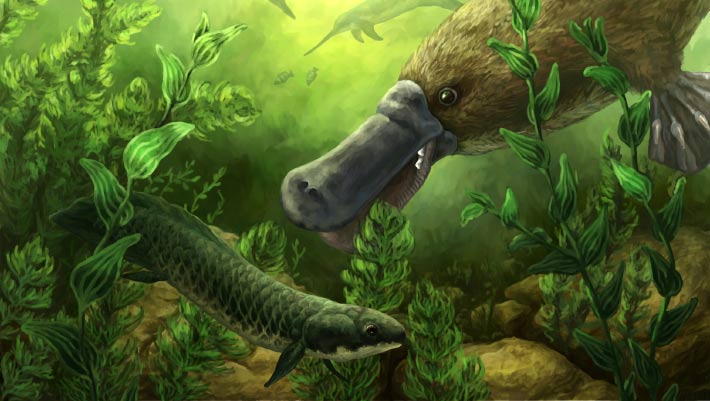
Early Platypuses Had Strong Teeth and Powerful Jaws, Fossils Show
Les premiers ornithorynques avaient des dents solides et des mâchoires puissantes, selon des fossiles
mâchoire dent Australie fossile formation
De nouveaux fossiles de la Formation de Namba, en Australie méridionale, révèlent qu'il y a 25 millions d'années, Obdurodon insignis prospérait dans les lacs intérieurs luxuriants aux côtés de dauphins d'eau douce et d'autres espèces aujourd'hui disparues. L'article Les premiers ornithorynques avaient des dents solides et des mâchoires puissantes, Fossils Show est apparu en premier sur Sci.News : Breaking Science News.
28/04/2026 sci-news ⚙ Traduction automatique
Des scientifiques viennent de découvrir que l’Afrique est plus proche de l’éclatement que nous le pensions
fossile formation
Sous le rift Turkana, en Afrique de l’Est, les scientifiques ont découvert que la croûte s’amincit jusqu’à atteindre un point critique, ce qui suggère que le continent se désagrège progressivement. Ce processus de « rétrécissement » marque un stade avancé de rifting qui pourrait éventuellement conduire à la formation d’un nouvel océan dans des millions d’années. Étonnamment, les mêmes forces géologiques qui divisent la terre peuvent également expliquer pourquoi la région détient un registre fossile si riche. Au lieu d'être le berceau de l'humanité, Turkana pourrait bien être simplement le lieu où
25/04/2026 sciencedaily-paleo ⚙ Traduction automatique
D’étranges roches en « peau d’éléphant » révèlent une vie ancienne dans l’océan sombre
Maroc fossile découverte formation
Une étrange formation rocheuse ridée au Maroc a amené les scientifiques à repenser l'endroit où pourraient vivre d'anciens microbes. Au lieu d’eaux peu profondes et ensoleillées, ces microbes pourraient avoir prospéré dans les profondeurs de l’océan, alimentés par les produits chimiques libérés par les glissements de terrain sous-marins. La découverte suggère que les environnements sombres et riches en nutriments ont abrité des écosystèmes prospères beaucoup plus tôt que prévu. Cela soulève également la possibilité que de nombreux fossiles similaires aient été négligés ou mal interprétés.
03/04/2026 sciencedaily-paleo ⚙ Traduction automatique
Épisode 173 : Forêt pétrifiée
États-Unis Chinle Trias supérieur Trias formation
Le parc national de la Forêt Pétrifiée, dans le nord-est de l'Arizona, aux États-Unis, est une plaque tournante de la paléontologie du Trias et présente des affleurements représentant 20 millions d'années de la formation Chinle du Trias supérieur. Les visiteurs s'émerveillent devant les arbres fossilisés colorés dont le parc tire son nom, mais toute une série d'animaux ont élu domicile dans ces forêts marécageuses il y a 225 millions d'années [&hellip
17/03/2026 palaeocast ⚙ Traduction automatique
1 2 3