formation

Thématique

154 image(s) · 9 Actualités

Galerie d'images

This reconstruction of Marambionectes molinai, found from the Lopez de Bertodano Formation, is based off of other related elasmosaurs such as Aristonectes and Nakonanectes.
Taxons Marambionectes

This reconstruction of Marambionectes molinai, found from the Lopez de Bertodano Formation, is based off of other related elasmosaurs such as Aristonectes and Nakonanectes.

Aristonectes Marambionectes Nakonanectes formation
Jeholopterus ningchengensus Wang, Zhou, Zhang, and Xu, 2002, IVPP V 12705, Lower Yixian Formation (Early Cretaceous), China.
Taxons Jeholopterus

Jeholopterus ningchengensus Wang, Zhou, Zhang, and Xu, 2002, IVPP V 12705, Lower Yixian Formation (Early Cretaceous), China.

Chine Yixian Crétacé Crétacé inférieur +2
New wing skeleton of Forfexopterus (SDUST-V1003) from Jiufotang Formation of Early Cretaceous Jehol Biota in Jianchang, western Liaoning, northeastern China. Abbreviations: ca, carpus; co, coracoid portion; hu, humerus; mc, metacarpals I–IV; mdI–III, manual digits I–III; pt, pteroid; ra, radius; sc, scapular portion; ul, ulna; wp1–4, wing phalanges 1–4.
Taxons Forfexopterus

New wing skeleton of Forfexopterus (SDUST-V1003) from Jiufotang Formation of Early Cretaceous Jehol Biota in Jianchang, western Liaoning, northeastern China. Abbreviations: ca, carpus; co, coracoid portion; hu, humerus; mc, metacarpals I–IV; mdI–III, manual digits I–III; pt, pteroid; ra, radius; sc, scapular portion; ul, ulna; wp1–4, wing phalanges 1–4.

humérus Chine Jiufotang Crétacé +4
Bakonydraco galaczi gen. et sp. nov.MTMGyn/3, Iharkút, Bakony Mts., Hungary, Csehbánya Formation, Santonian (Upper Cretaceous). Mandible

in dorsal (A, B), ventral (C, D), and lateral (E, F) views.
Taxons Bakonydraco

Bakonydraco galaczi gen. et sp. nov.MTMGyn/3, Iharkút, Bakony Mts., Hungary, Csehbánya Formation, Santonian (Upper Cretaceous). Mandible in dorsal (A, B), ventral (C, D), and lateral (E, F) views.

Hongrie Crétacé Santonien Bakonydraco +1
Aralazhdarcho bostobensis, ZIN PH 57/43, a proximal fragment of a left humerus in proximal (a), ventral (b), anterior (c), dorsal (d), and posterior (e) views. This specimen is from the Shakh Shakh II locality in the northeasten Aral Sea region of Kazakhstan; Bostobe Formation, Upper Cretaceous (Santonian – lower Campanian). Abbreviations: h, humeral head; pf, pneumatic foramen; uc, ulnar crest. Scale bar is 10 mm.
Taxons Aralazhdarcho

Aralazhdarcho bostobensis, ZIN PH 57/43, a proximal fragment of a left humerus in proximal (a), ventral (b), anterior (c), dorsal (d), and posterior (e) views. This specimen is from the Shakh Shakh II locality in the northeasten Aral Sea region of Kazakhstan; Bostobe Formation, Upper Cretaceous (Santonian – lower Campanian). Abbreviations: h, humeral head; pf, pneumatic foramen; uc, ulnar crest. Scale bar is 10 mm.

crête humérus écaille Kazakhstan +7
Abelisaurid theropod Kryptops palaios gen. et sp. nov. MNN GAD1−1 from the Lower Cretaceous Elrhaz Formation of Niger. Left maxilla in lateral

view; stereopair (A) and line drawing (B). Cross−hatching indicates broken bone; dashed lines indicate estimated edges.
Taxons Kryptops

Abelisaurid theropod Kryptops palaios gen. et sp. nov. MNN GAD1−1 from the Lower Cretaceous Elrhaz Formation of Niger. Left maxilla in lateral view; stereopair (A) and line drawing (B). Cross−hatching indicates broken bone; dashed lines indicate estimated edges.

os dessin Niger Crétacé +3
Ceratosaurian theropod Camarillasaurus cirugedae gen. et sp. nov. from the Camarillas Formation of Camarillas, Soria Province, Spain, presacral vertebra, MPG-KPC9,  in anterior (A), left lateral (B), and posterior (C) views; possible neural spine tips, MPG1116, 32, 33 in ?posterior (D) and transverse (E) views; and presacral rib MPG-KPC7, in ventral view (F) and detail of its proximal end (G). Scale bars are 10 mm (A-C, G), 20 mm (D-E) and 100 mm (F).
Taxons Camarillasaurus

Ceratosaurian theropod Camarillasaurus cirugedae gen. et sp. nov. from the Camarillas Formation of Camarillas, Soria Province, Spain, presacral vertebra, MPG-KPC9, in anterior (A), left lateral (B), and posterior (C) views; possible neural spine tips, MPG1116, 32, 33 in ?posterior (D) and transverse (E) views; and presacral rib MPG-KPC7, in ventral view (F) and detail of its proximal end (G). Scale bars are 10 mm (A-C, G), 20 mm (D-E) and 100 mm (F).

écaille vertèbre Espagne Camarillas +3
Diagram featuring the holotype (BNMNH-PV030) skull of the troodontid Papiliovenator neimengguensis, from the Bayan Mandahu Formation. Abbreviations: a, angular; d, dentary; f, frontal; j, jugal; l, lacrimal; m, maxilla; n, nasal; p, parietal; q, quadrate;  s, surangular;  sp, splenial.[1]
References

↑  (2022). "A new troodontid from the Upper Cretaceous Gobi Basin of inner Mongolia, China". Cretaceous Research 130: Article 105052. DOI:10.1016/j.cretres.2021.105052.
Taxons Papiliovenator

Diagram featuring the holotype (BNMNH-PV030) skull of the troodontid Papiliovenator neimengguensis, from the Bayan Mandahu Formation. Abbreviations: a, angular; d, dentary; f, frontal; j, jugal; l, lacrimal; m, maxilla; n, nasal; p, parietal; q, quadrate; s, surangular; sp, splenial.[1] References ↑ (2022). "A new troodontid from the Upper Cretaceous Gobi Basin of inner Mongolia, China". Cretaceous Research 130: Article 105052. DOI:10.1016/j.cretres.2021.105052.

Chine Mongolie Crétacé holotype +4
Plate 53. Borogovia gracilicrus gen. et sp. n.
1. Fragmentary right pes, in: a dorsal, b ventral, views; ZPAL MgD-11174, holotype, X 0.5.
2. Phalanx 11-1 of the left pes, medial view; same specimen, X 1.
3. Ungual of left second pedal digit, ventral view; same specimen, X 1.
4. Phalanx 111-3 of the left pes, lateral view; same specimen, X 1.
5. Phalanges IV-1 to IV-4 of the left pes, lateral view; same specimen, X 1.
6. Distal portion of right metatarsal 111, posterior view; same specimen, X 1.
7. Distal portion of left metatarsal IV, medial view; same specimen, X 1.
8. Distal portion of left metatarsal 11, lateral view; same specimen, X 1.
9. Right tibiotarsus, a distal portion and b proximal portion with fragment of the fibula attached, posterior views, c distal portion, anterior view, d distal portion, lateral view; same specimen, X 0.5.

Nemegt Formation, ?Late Campanian or ?Early Maastrichtian, Ultan Ula IV, Nemegt Basin, Gobi Desert, Mongolia
Taxons Borogovia

Plate 53. Borogovia gracilicrus gen. et sp. n. 1. Fragmentary right pes, in: a dorsal, b ventral, views; ZPAL MgD-11174, holotype, X 0.5. 2. Phalanx 11-1 of the left pes, medial view; same specimen, X 1. 3. Ungual of left second pedal digit, ventral view; same specimen, X 1. 4. Phalanx 111-3 of the left pes, lateral view; same specimen, X 1. 5. Phalanges IV-1 to IV-4 of the left pes, lateral view; same specimen, X 1. 6. Distal portion of right metatarsal 111, posterior view; same specimen, X 1. 7. Distal portion of left metatarsal IV, medial view; same specimen, X 1. 8. Distal portion of left metatarsal 11, lateral view; same specimen, X 1. 9. Right tibiotarsus, a distal portion and b proximal portion with fragment of the fibula attached, posterior views, c distal portion, anterior view, d distal portion, lateral view; same specimen, X 0.5. Nemegt Formation, ?Late Campanian or ?Early Maastrichtian, Ultan Ula IV, Nemegt Basin, Gobi Desert, Mongolia

Mongolie Campanien Maastrichtien holotype +4
Skull of troodontid theropod Xixiasaurus henanensis gen. et sp. nov. (HGM 41HIII−0201; holotype), lower–middle Majiacun Formation (Upper Cretaceous: Coniacian–Campanian), Henan Province, China; in dorsal (A); lateral (B), and ventral (C) views.

Note that this version of the image does not include the interpretative lines of the version in the paper.
Taxons Xixiasaurus

Skull of troodontid theropod Xixiasaurus henanensis gen. et sp. nov. (HGM 41HIII−0201; holotype), lower–middle Majiacun Formation (Upper Cretaceous: Coniacian–Campanian), Henan Province, China; in dorsal (A); lateral (B), and ventral (C) views. Note that this version of the image does not include the interpretative lines of the version in the paper.

Chine Campanien Coniacien Crétacé +5
Forearm and hand of Machairasaurus leptorhynchos Longrich et al. 2010 (Dinosauria: Theropoda: Oviraptoridae: Ingeniinae) from the Late Cretaceous Djadokhta Formation beds of Bayan Mandahu, Inner Mongolia, China. Digital photography and editing by Nick Longrich
Taxons Machairasaurus

Forearm and hand of Machairasaurus leptorhynchos Longrich et al. 2010 (Dinosauria: Theropoda: Oviraptoridae: Ingeniinae) from the Late Cretaceous Djadokhta Formation beds of Bayan Mandahu, Inner Mongolia, China. Digital photography and editing by Nick Longrich

Chine Mongolie Djadokhta Crétacé +8
Alvarezsauridae gen. et sp. indet., posterior caudal vertebrae. Dzharakuduk, Uzbekistan; Bissekty Formation, Upper Cretaceous (Turonian). a-e, ZIN PH 2441/16, two vertebrae preserved in articulation, in anterior (a), dorsal (b), posterior (c), lateral (d), and ventral (e) views. f-j, ZIN PH 2442/16, vertebra missing ventral part of the centrum, in dorsal (f), lateral (g), ventral (h), anterior (i), and posterior (j).
Taxons Dzharaonyx

Alvarezsauridae gen. et sp. indet., posterior caudal vertebrae. Dzharakuduk, Uzbekistan; Bissekty Formation, Upper Cretaceous (Turonian). a-e, ZIN PH 2441/16, two vertebrae preserved in articulation, in anterior (a), dorsal (b), posterior (c), lateral (d), and ventral (e) views. f-j, ZIN PH 2442/16, vertebra missing ventral part of the centrum, in dorsal (f), lateral (g), ventral (h), anterior (i), and posterior (j).

vertèbre Ouzbékistan Bissekty Crétacé +4
Mandible in Bagaraatan ostromi gen. et sp. n. from the mid-Maastrichtian Nemegt Formation at Nemegt, Mongolia. A-B. Reconstruction on left mandible in lateral and medial views. Left dentary in dorsal view. D-E. Posterior part of left mandible in dorsal and posterior views. F. Cross-section through dentary at the end of preserved fragment.

Mandible in Bagaraatan ostromi gen. et sp. n. from the mid-Maastrichtian Nemegt Formation at Nemegt, Mongolia. A-B. Reconstruction on left mandible in lateral and medial views. Left dentary in dorsal view. D-E. Posterior part of left mandible in dorsal and posterior views. F. Cross-section through dentary at the end of preserved fragment.

Mongolie Maastrichtien Bagaraatan Nemegtia +1
Tetanuran theropod Cruxicheiros newmanorum gen. et sp. nov. axial vertebrae (WARMS 15771) from the Chipping Norton Limestone Formation,
Bathonian of the United Kingdom. A. Posterior cervical or anterior dorsal vertebra in posterior view. B. Partial middle−posterior dorsal vertebra in right lat−
eral view showing a sagittal cross−section (B1) and in dorsal view (B2). C. Middle−distal caudal vertebra in left lateral (C1) and posterior (C2) views. D. Mid−
dle−posterior dorsal neural arch in anterior (D1), right lateral (D2, D3), and posterior (D4) views. Photographs (A, B1, B2, C1, C2, D1, D2, D4) and line drawing

(D3). Crossed−hatching indicates matrix and grey tone indicates broken bone.
Taxons Cruxicheiros

Tetanuran theropod Cruxicheiros newmanorum gen. et sp. nov. axial vertebrae (WARMS 15771) from the Chipping Norton Limestone Formation, Bathonian of the United Kingdom. A. Posterior cervical or anterior dorsal vertebra in posterior view. B. Partial middle−posterior dorsal vertebra in right lat− eral view showing a sagittal cross−section (B1) and in dorsal view (B2). C. Middle−distal caudal vertebra in left lateral (C1) and posterior (C2) views. D. Mid− dle−posterior dorsal neural arch in anterior (D1), right lateral (D2, D3), and posterior (D4) views. Photographs (A, B1, B2, C1, C2, D1, D2, D4) and line drawing (D3). Crossed−hatching indicates matrix and grey tone indicates broken bone.

os vertèbre dessin Royaume-Uni +4
Reconstruction of the terrestrial paleoenvironmental setting of the Sao Khua Formation by Renata Cunha.
In the center, a generalized spinosaurid feeds on a sauropod. This trophic relationship is hypothesized based on isolated tooth crowns found in association with a sauropod skeleton [67]. In the background, a small pack of the ornithomimosaur theropod Kinnareemimus. Both sauropods and ornithomimosaurs (as part of the “herbivorous” theropods) were found to be positively associated with terrestrial paleoenvironments by Butler and Barrett [15].

(cropped from File:Spinosaurid and Kinnareemimus.PNG)
Taxons Kinnareemimus

Reconstruction of the terrestrial paleoenvironmental setting of the Sao Khua Formation by Renata Cunha. In the center, a generalized spinosaurid feeds on a sauropod. This trophic relationship is hypothesized based on isolated tooth crowns found in association with a sauropod skeleton [67]. In the background, a small pack of the ornithomimosaur theropod Kinnareemimus. Both sauropods and ornithomimosaurs (as part of the “herbivorous” theropods) were found to be positively associated with terrestrial paleoenvironments by Butler and Barrett [15]. (cropped from File:Spinosaurid and Kinnareemimus.PNG)

dent Sao Khua Kinnareemimus Ornithomimosauria +3
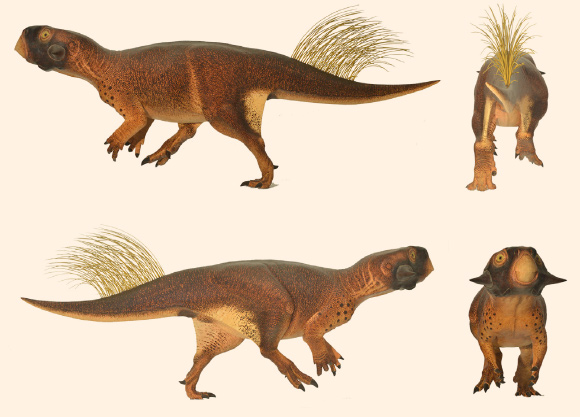
Menefeeceratops is a genus of ceratopsid dinosaur from the Menefee Formation in the United States. It is is believed to have been approximately 4 m long, and had two large horns above the eyes like other ceratopsians. Menefeeceratops was one of the earliest and most basal known members of the ceratopsids, and the oldest known centrosaurine. Its age and location was instrumental in helping to understand the evolution and diversification of the centrosaurine dinosaurs.
Taxons Menefeeceratops

Menefeeceratops is a genus of ceratopsid dinosaur from the Menefee Formation in the United States. It is is believed to have been approximately 4 m long, and had two large horns above the eyes like other ceratopsians. Menefeeceratops was one of the earliest and most basal known members of the ceratopsids, and the oldest known centrosaurine. Its age and location was instrumental in helping to understand the evolution and diversification of the centrosaurine dinosaurs.

États-Unis Ceratopsia Ceratopsidae Dinosauria +3
1 2 3 4 5 6 7 8 9 10

Actualités

Un nouveau dinosaure Unenlagiid de Patagonie (Argentine)
Argentine Japon Crétacé Crétacé supérieur fossile Dinosauria Kank Unenlagiidae découverte formation nouvelle espèce
Une équipe de scientifiques argentins et japonais a décrit une nouvelle espèce de dinosaure unenlagiidé du sud de la Patagonie. Nommé Kank australis, ce petit dinosaure théropode vivait il y a environ 70 millions d'années à la fin du Crétacé. Les restes fossiles ont été découverts dans la formation Chorrillo de la province de Santa Cruz, en Argentine. La découverte aide mieux les paléontologues
02/06/2026 everythingdinosaur ⚙ Traduction automatique
La Terre cache un mécanisme profond qui pourrait expliquer la formation des continents depuis des milliards d’années
formation étude
Une étude récente met en lumière un processus géologique méconnu, la relamination, qui permet à des fragments de croûte continentale de s’incorporer au manteau terrestre lors des collisions de plaques. Ce mécanisme pourrait expliquer l’origine de certains magmas et jouer un rôle clé dans...
17/05/2026 futura-terre
Early Platypuses Had Strong Teeth and Powerful Jaws, Fossils Show
Les premiers ornithorynques avaient des dents solides et des mâchoires puissantes, selon des fossiles
mâchoire dent Australie fossile formation
De nouveaux fossiles de la Formation de Namba, en Australie méridionale, révèlent qu'il y a 25 millions d'années, Obdurodon insignis prospérait dans les lacs intérieurs luxuriants aux côtés de dauphins d'eau douce et d'autres espèces aujourd'hui disparues. L'article Les premiers ornithorynques avaient des dents solides et des mâchoires puissantes, Fossils Show est apparu en premier sur Sci.News : Breaking Science News.
28/04/2026 sci-news ⚙ Traduction automatique
Des scientifiques viennent de découvrir que l’Afrique est plus proche de l’éclatement que nous le pensions
fossile formation
Sous le rift Turkana, en Afrique de l’Est, les scientifiques ont découvert que la croûte s’amincit jusqu’à atteindre un point critique, ce qui suggère que le continent se désagrège progressivement. Ce processus de « rétrécissement » marque un stade avancé de rifting qui pourrait éventuellement conduire à la formation d’un nouvel océan dans des millions d’années. Étonnamment, les mêmes forces géologiques qui divisent la terre peuvent également expliquer pourquoi la région détient un registre fossile si riche. Au lieu d'être le berceau de l'humanité, Turkana pourrait bien être simplement le lieu où
25/04/2026 sciencedaily-paleo ⚙ Traduction automatique
D’étranges roches en « peau d’éléphant » révèlent une vie ancienne dans l’océan sombre
Maroc fossile découverte formation
Une étrange formation rocheuse ridée au Maroc a amené les scientifiques à repenser l'endroit où pourraient vivre d'anciens microbes. Au lieu d’eaux peu profondes et ensoleillées, ces microbes pourraient avoir prospéré dans les profondeurs de l’océan, alimentés par les produits chimiques libérés par les glissements de terrain sous-marins. La découverte suggère que les environnements sombres et riches en nutriments ont abrité des écosystèmes prospères beaucoup plus tôt que prévu. Cela soulève également la possibilité que de nombreux fossiles similaires aient été négligés ou mal interprétés.
03/04/2026 sciencedaily-paleo ⚙ Traduction automatique
1 2