←

Jurassique

Intervalle géologique

117 image(s) · 38 Actualités

Voir la fiche

Galerie d'images

Paddle of the British Jurassic pliosaurid plesiosaur Eardasaurus housed at the Oxford University Natural History Museum.

Paddle of the British Jurassic pliosaurid plesiosaur Eardasaurus housed at the Oxford University Natural History Museum.

musée Jurassique Peloneustes Plesiosauria +1
Drawings of Dryolestida left upper−molar, modified from the original descriptions. A–C, Kimmeridgian; D–F, Tithonian–Berriasian; G–H, early Barremian; I, late Barremian. A. Left M4 or M5 of Comotherium richi Prothero, 1981, from the Upper Jurassic Morrison Formation, Como Bluff locality, Wyoming, USA. B. Right M5, reversed, of Dryolestes leiriensis Martin, 1999, from Guimarota, Portugal.C. Left M6 of Krebsotherium lusitanicum Martin, 1999, from Guimarota, Portugal. D. Right M4 or M 6 (reversed) of Portopinheirodon asymmetricus Martin, 1999, Porto Pinheiro, Lourinha, Portugal. E. Right M5 (reversed) of Laolestes andresi Martin, 1999, from Porto Pinheiro, Lourinha, Portugal. F. Right upper molar of Donodon perscriptoris Sigogneau−Russell, 1991, Anoual, Morocco.G. Left M4 orM5 of Crusafontia amoae sp. nov., holotype, Cuesta Corrales 2, El Castellar Formation, Galve, Teruel, Spain. H. Right M6 orM7 (reversed) of Crusafontia amoae sp. nov., first described as upper molar of Crusafontia cuencana by Krebs (1993), P−2 H4 Pelejón 2, Galve, Teruel, Spain. I. Left M2 or M3, of Crusafontia cuencana Henkel and Krebs, 1969, Uña, La Huérguina Formation, Cuenca, Spain, (from Krebs 1993). Scale bars 1 mm.

Drawings of Dryolestida left upper−molar, modified from the original descriptions. A–C, Kimmeridgian; D–F, Tithonian–Berriasian; G–H, early Barremian; I, late Barremian. A. Left M4 or M5 of Comotherium richi Prothero, 1981, from the Upper Jurassic Morrison Formation, Como Bluff locality, Wyoming, USA. B. Right M5, reversed, of Dryolestes leiriensis Martin, 1999, from Guimarota, Portugal.C. Left M6 of Krebsotherium lusitanicum Martin, 1999, from Guimarota, Portugal. D. Right M4 or M 6 (reversed) of Portopinheirodon asymmetricus Martin, 1999, Porto Pinheiro, Lourinha, Portugal. E. Right M5 (reversed) of Laolestes andresi Martin, 1999, from Porto Pinheiro, Lourinha, Portugal. F. Right upper molar of Donodon perscriptoris Sigogneau−Russell, 1991, Anoual, Morocco.G. Left M4 orM5 of Crusafontia amoae sp. nov., holotype, Cuesta Corrales 2, El Castellar Formation, Galve, Teruel, Spain. H. Right M6 orM7 (reversed) of Crusafontia amoae sp. nov., first described as upper molar of Crusafontia cuencana by Krebs (1993), P−2 H4 Pelejón 2, Galve, Teruel, Spain. I. Left M2 or M3, of Crusafontia cuencana Henkel and Krebs, 1969, Uña, La Huérguina Formation, Cuenca, Spain, (from Krebs 1993). Scale bars 1 mm.

description dessin Maroc Portugal +11
Attenborosaurus conybeari, a plesiosaur from the Early Jurassic of England, pencil drawing
Taxons Dactylosaurus

Attenborosaurus conybeari, a plesiosaur from the Early Jurassic of England, pencil drawing

dessin Jurassique inférieur Jurassique Attenborosaurus +5
Attenborosaurus conybeari, a plesiosaur from the Early Jurassic of England, pencil drawing
Taxons Eromangasaurus

Attenborosaurus conybeari, a plesiosaur from the Early Jurassic of England, pencil drawing

dessin Jurassique inférieur Jurassique Attenborosaurus +5
Attenborosaurus conybeari, a plesiosaur from the Early Jurassic of England, pencil drawing
Taxons Eurycleidus

Attenborosaurus conybeari, a plesiosaur from the Early Jurassic of England, pencil drawing

dessin Jurassique inférieur Jurassique Attenborosaurus +5
Pleuroceras solare, Amaltheidae; Pyritic specimen; Diameter 3.2 cm; Upper Pliensbachian, Lower Jurassic; Little Switzerland, Bavaria, Germany. own collection, therefore not geocoded.
Taxons Coralloidoolithus

Pleuroceras solare, Amaltheidae; Pyritic specimen; Diameter 3.2 cm; Upper Pliensbachian, Lower Jurassic; Little Switzerland, Bavaria, Germany. own collection, therefore not geocoded.

Allemagne Suisse Jurassique Pliensbachien +3
Pleuroceras solare, Amaltheidae; Pyritic specimen; Diameter 3.2 cm; Upper Pliensbachian, Lower Jurassic; Little Switzerland, Bavaria, Germany. own collection, therefore not geocoded.
Taxons Dispersituberoolithus

Pleuroceras solare, Amaltheidae; Pyritic specimen; Diameter 3.2 cm; Upper Pliensbachian, Lower Jurassic; Little Switzerland, Bavaria, Germany. own collection, therefore not geocoded.

Allemagne Suisse Jurassique Pliensbachien +3
In 2000 a virtually complete Scelidosaurus skeleton was discovered in England. This fossil's hundreds of armor plates and spikes are preserved in their life positions, providing extraordinary details about how this dinosaur looked. St. George is the only place anywhere in the Western Hemisphere that the 11-foot long Scelidosaurus replica has been on display.
The St. George Dinosaur Discovery Site at Johnson Farm (St. George, Utah) is home to exceptionally well-preserved dinosaur tracks, some displaying skin impressions. These tracks, along with hundreds of fossil fish, plants, rare dinosaur remains, invertebrates traces and important sedimentary structures, show evidence that this site was produced along the western edge of a large, Early Jurassic (age between 195-198 million years ago) freshwater lake named Lake Dixie. 

Source: www.sgcity.org/dinotrax/
Taxons Scelidosaurus

In 2000 a virtually complete Scelidosaurus skeleton was discovered in England. This fossil's hundreds of armor plates and spikes are preserved in their life positions, providing extraordinary details about how this dinosaur looked. St. George is the only place anywhere in the Western Hemisphere that the 11-foot long Scelidosaurus replica has been on display. The St. George Dinosaur Discovery Site at Johnson Farm (St. George, Utah) is home to exceptionally well-preserved dinosaur tracks, some displaying skin impressions. These tracks, along with hundreds of fossil fish, plants, rare dinosaur remains, invertebrates traces and important sedimentary structures, show evidence that this site was produced along the western edge of a large, Early Jurassic (age between 195-198 million years ago) freshwater lake named Lake Dixie. Source: www.sgcity.org/dinotrax/

armure peau Jurassique inférieur Jurassique +8
In 2000 a virtually complete Scelidosaurus skeleton was discovered in England. This fossil's hundreds of armor plates and spikes are preserved in their life positions, providing extraordinary details about how this dinosaur looked. St. George is the only place anywhere in the Western Hemisphere that the 11-foot long Scelidosaurus replica has been on display.
The St. George Dinosaur Discovery Site at Johnson Farm (St. George, Utah) is home to exceptionally well-preserved dinosaur tracks, some displaying skin impressions. These tracks, along with hundreds of fossil fish, plants, rare dinosaur remains, invertebrates traces and important sedimentary structures, show evidence that this site was produced along the western edge of a large, Early Jurassic (age between 195-198 million years ago) freshwater lake named Lake Dixie. 

Source: www.sgcity.org/dinotrax/
Taxons Scelidosauridae

In 2000 a virtually complete Scelidosaurus skeleton was discovered in England. This fossil's hundreds of armor plates and spikes are preserved in their life positions, providing extraordinary details about how this dinosaur looked. St. George is the only place anywhere in the Western Hemisphere that the 11-foot long Scelidosaurus replica has been on display. The St. George Dinosaur Discovery Site at Johnson Farm (St. George, Utah) is home to exceptionally well-preserved dinosaur tracks, some displaying skin impressions. These tracks, along with hundreds of fossil fish, plants, rare dinosaur remains, invertebrates traces and important sedimentary structures, show evidence that this site was produced along the western edge of a large, Early Jurassic (age between 195-198 million years ago) freshwater lake named Lake Dixie. Source: www.sgcity.org/dinotrax/

armure peau Jurassique inférieur Jurassique +8
Camarasaurus lentus (Marsh, 1889) sauropod dinosaur from the Jurassic of Utah, USA (public display, CM 11338, Carnegie Museum of Natural History, Pittsburgh, Pennsylvania, USA).
This is a near-complete juvenile sauropod dinosaur in the original fluvial sandstone matrix - such skeletons are extremely rare.
Classification: Animalia, Chordata, Vertebrata, Dinosauria, Sauropodomorpha, Camarasauridae
Stratigraphy: Brushy Basin Member, Morrison Formation, Upper Jurassic, 151 Ma
Locality: Carnegie Quarry, Dinosaur National Monument, northeastern Utah, USA


Sauropod dinosaurs were the largest terrestrial animals ever.  They all have the same basic body plan: large body with four walking legs, very long neck & tail, and a small head relative to body size.  Sauropods were herbivores, and are often perceived as holding their heads & necks up high to reach vegetation normally out of reach to other organisms.  Modern reconstructions of many sauropod species depict them with heads and necks held close to the horizontal, or at low angles above the horizontal.
Taxons Camarasaurus

Camarasaurus lentus (Marsh, 1889) sauropod dinosaur from the Jurassic of Utah, USA (public display, CM 11338, Carnegie Museum of Natural History, Pittsburgh, Pennsylvania, USA). This is a near-complete juvenile sauropod dinosaur in the original fluvial sandstone matrix - such skeletons are extremely rare. Classification: Animalia, Chordata, Vertebrata, Dinosauria, Sauropodomorpha, Camarasauridae Stratigraphy: Brushy Basin Member, Morrison Formation, Upper Jurassic, 151 Ma Locality: Carnegie Quarry, Dinosaur National Monument, northeastern Utah, USA Sauropod dinosaurs were the largest terrestrial animals ever. They all have the same basic body plan: large body with four walking legs, very long neck & tail, and a small head relative to body size. Sauropods were herbivores, and are often perceived as holding their heads & necks up high to reach vegetation normally out of reach to other organisms. Modern reconstructions of many sauropod species depict them with heads and necks held close to the horizontal, or at low angles above the horizontal.

musée États-Unis Morrison Jurassique +10
Camarasaurus lentus (Marsh, 1889) sauropod dinosaur from the Jurassic of Utah, USA (public display, CM 11338, Carnegie Museum of Natural History, Pittsburgh, Pennsylvania, USA).
This is a near-complete juvenile sauropod dinosaur in the original fluvial sandstone matrix - such skeletons are extremely rare.
Classification: Animalia, Chordata, Vertebrata, Dinosauria, Sauropodomorpha, Camarasauridae
Stratigraphy: Brushy Basin Member, Morrison Formation, Upper Jurassic, 151 Ma
Locality: Carnegie Quarry, Dinosaur National Monument, northeastern Utah, USA


Sauropod dinosaurs were the largest terrestrial animals ever.  They all have the same basic body plan: large body with four walking legs, very long neck & tail, and a small head relative to body size.  Sauropods were herbivores, and are often perceived as holding their heads & necks up high to reach vegetation normally out of reach to other organisms.  Modern reconstructions of many sauropod species depict them with heads and necks held close to the horizontal, or at low angles above the horizontal.
Taxons Camarasauridae

Camarasaurus lentus (Marsh, 1889) sauropod dinosaur from the Jurassic of Utah, USA (public display, CM 11338, Carnegie Museum of Natural History, Pittsburgh, Pennsylvania, USA). This is a near-complete juvenile sauropod dinosaur in the original fluvial sandstone matrix - such skeletons are extremely rare. Classification: Animalia, Chordata, Vertebrata, Dinosauria, Sauropodomorpha, Camarasauridae Stratigraphy: Brushy Basin Member, Morrison Formation, Upper Jurassic, 151 Ma Locality: Carnegie Quarry, Dinosaur National Monument, northeastern Utah, USA Sauropod dinosaurs were the largest terrestrial animals ever. They all have the same basic body plan: large body with four walking legs, very long neck & tail, and a small head relative to body size. Sauropods were herbivores, and are often perceived as holding their heads & necks up high to reach vegetation normally out of reach to other organisms. Modern reconstructions of many sauropod species depict them with heads and necks held close to the horizontal, or at low angles above the horizontal.

musée États-Unis Morrison Jurassique +10
Camarasaurus lentus (Marsh, 1889) sauropod dinosaur from the Jurassic of Utah, USA (public display, CM 11338, Carnegie Museum of Natural History, Pittsburgh, Pennsylvania, USA).
This is a near-complete juvenile sauropod dinosaur in the original fluvial sandstone matrix - such skeletons are extremely rare.
Classification: Animalia, Chordata, Vertebrata, Dinosauria, Sauropodomorpha, Camarasauridae
Stratigraphy: Brushy Basin Member, Morrison Formation, Upper Jurassic, 151 Ma
Locality: Carnegie Quarry, Dinosaur National Monument, northeastern Utah, USA


Sauropod dinosaurs were the largest terrestrial animals ever.  They all have the same basic body plan: large body with four walking legs, very long neck & tail, and a small head relative to body size.  Sauropods were herbivores, and are often perceived as holding their heads & necks up high to reach vegetation normally out of reach to other organisms.  Modern reconstructions of many sauropod species depict them with heads and necks held close to the horizontal, or at low angles above the horizontal.
Taxons Camarasaurinae

Camarasaurus lentus (Marsh, 1889) sauropod dinosaur from the Jurassic of Utah, USA (public display, CM 11338, Carnegie Museum of Natural History, Pittsburgh, Pennsylvania, USA). This is a near-complete juvenile sauropod dinosaur in the original fluvial sandstone matrix - such skeletons are extremely rare. Classification: Animalia, Chordata, Vertebrata, Dinosauria, Sauropodomorpha, Camarasauridae Stratigraphy: Brushy Basin Member, Morrison Formation, Upper Jurassic, 151 Ma Locality: Carnegie Quarry, Dinosaur National Monument, northeastern Utah, USA Sauropod dinosaurs were the largest terrestrial animals ever. They all have the same basic body plan: large body with four walking legs, very long neck & tail, and a small head relative to body size. Sauropods were herbivores, and are often perceived as holding their heads & necks up high to reach vegetation normally out of reach to other organisms. Modern reconstructions of many sauropod species depict them with heads and necks held close to the horizontal, or at low angles above the horizontal.

musée États-Unis Morrison Jurassique +10
Camarasaurus lentus (Marsh, 1889) sauropod dinosaur from the Jurassic of Utah, USA (public display, CM 11338, Carnegie Museum of Natural History, Pittsburgh, Pennsylvania, USA).
This is a near-complete juvenile sauropod dinosaur in the original fluvial sandstone matrix - such skeletons are extremely rare.
Classification: Animalia, Chordata, Vertebrata, Dinosauria, Sauropodomorpha, Camarasauridae
Stratigraphy: Brushy Basin Member, Morrison Formation, Upper Jurassic, 151 Ma
Locality: Carnegie Quarry, Dinosaur National Monument, northeastern Utah, USA


Sauropod dinosaurs were the largest terrestrial animals ever.  They all have the same basic body plan: large body with four walking legs, very long neck & tail, and a small head relative to body size.  Sauropods were herbivores, and are often perceived as holding their heads & necks up high to reach vegetation normally out of reach to other organisms.  Modern reconstructions of many sauropod species depict them with heads and necks held close to the horizontal, or at low angles above the horizontal.
Taxons Morosauridae

Camarasaurus lentus (Marsh, 1889) sauropod dinosaur from the Jurassic of Utah, USA (public display, CM 11338, Carnegie Museum of Natural History, Pittsburgh, Pennsylvania, USA). This is a near-complete juvenile sauropod dinosaur in the original fluvial sandstone matrix - such skeletons are extremely rare. Classification: Animalia, Chordata, Vertebrata, Dinosauria, Sauropodomorpha, Camarasauridae Stratigraphy: Brushy Basin Member, Morrison Formation, Upper Jurassic, 151 Ma Locality: Carnegie Quarry, Dinosaur National Monument, northeastern Utah, USA Sauropod dinosaurs were the largest terrestrial animals ever. They all have the same basic body plan: large body with four walking legs, very long neck & tail, and a small head relative to body size. Sauropods were herbivores, and are often perceived as holding their heads & necks up high to reach vegetation normally out of reach to other organisms. Modern reconstructions of many sauropod species depict them with heads and necks held close to the horizontal, or at low angles above the horizontal.

musée États-Unis Morrison Jurassique +10
Ophthalmosaurus icenius, from the time of the Callovian period of the Middle Jurassic. This specimen was found in Oxford Clay, in Peterborough, England. Photo lightly touched up to remove lighting flares.
Taxons Ophthalmosaurus

Ophthalmosaurus icenius, from the time of the Callovian period of the Middle Jurassic. This specimen was found in Oxford Clay, in Peterborough, England. Photo lightly touched up to remove lighting flares.

Oxford Clay Callovien Jurassique Jurassique moyen +5
Ophthalmosaurus icenius, from the time of the Callovian period of the Middle Jurassic. This specimen was found in Oxford Clay, in Peterborough, England. Photo lightly touched up to remove lighting flares.
Taxons Ophthalmosauridae

Ophthalmosaurus icenius, from the time of the Callovian period of the Middle Jurassic. This specimen was found in Oxford Clay, in Peterborough, England. Photo lightly touched up to remove lighting flares.

Oxford Clay Callovien Jurassique Jurassique moyen +5
Ophthalmosaurus icenius, from the time of the Callovian period of the Middle Jurassic. This specimen was found in Oxford Clay, in Peterborough, England. Photo lightly touched up to remove lighting flares.
Taxons Ophthalmosaurinae

Ophthalmosaurus icenius, from the time of the Callovian period of the Middle Jurassic. This specimen was found in Oxford Clay, in Peterborough, England. Photo lightly touched up to remove lighting flares.

Oxford Clay Callovien Jurassique Jurassique moyen +5
1 2 3 4 5 6 7 8

Actualités

Ce petit prédateur jurassique a ouvert la voie au cerveau humain
chasse prédateur proie Jurassique fossile anatomie évolution mammifères
Un fossile vieux de 165 millions d'années a révélé un extraordinaire prédateur jurassique qui pourrait aider à expliquer comment les mammifères ont développé l'un de leurs avantages évolutifs les plus importants. Bien que mesurant seulement 20 pouces de long, Megacauda sungei était un poids lourd parmi les premiers mammifères apparentés, nageant dans d'anciennes voies navigables et chassant des proies avec des dents spécialisées. Son anatomie avancée de déglutition révèle une première étape vers la capacité d’allaiter du lait en toute sécurité, un développement clé dans l’évolution des mammifères.
13/10/2026 sciencedaily ⚙ Traduction automatique
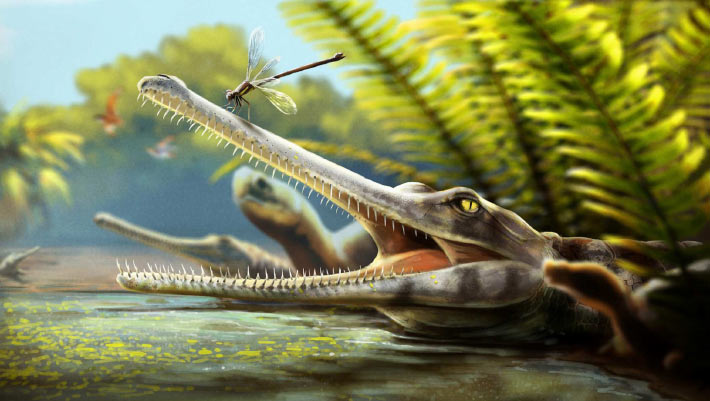
Jurassic Crocodile Relative from Morocco Had Needle-Thin Teeth
Un parent du crocodile jurassique du Maroc avait des dents fines comme des aiguilles
Maroc Jurassique spécimen
Les paléontologues ont décrit un nouveau genre et une nouvelle espèce de téléosauridé thalattosuchien sur la base de deux spécimens trouvés dans l'est du Maroc. L'article Un parent du crocodile jurassique du Maroc avait des dents fines comme des aiguilles est apparu en premier sur Sci.News : Breaking Science News.
09/10/2026 sci-news ⚙ Traduction automatique
Un magnifique fossile de mammifère du Jurassique révèle une percée évolutive
alimentation Chine Jurassique fossile évolution mammifères squelette
Les scientifiques ont décrit un remarquable fossile de mammifère du Jurassique provenant de Chine qui fournit de nouvelles informations sur l'évolution des mammifères. L'animal vieux de 165 millions d'années, nommé Megacauda sungei, a été adapté à la vie aquatique. De plus, son squelette exceptionnellement préservé révèle des preuves importantes concernant l’évolution de l’alimentation et de la déglutition des mammifères. L'équipe de recherche internationale, dirigée par des scientifiques
09/10/2026 everythingdinosaur ⚙ Traduction automatique
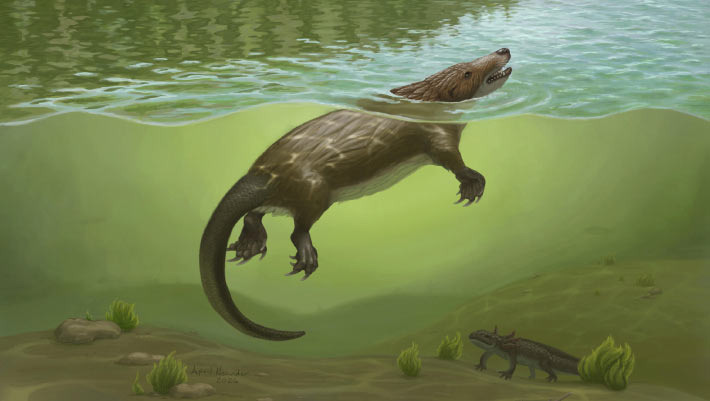
Jurassic Fossil Shows Mammal-Like Throat Evolved Far Earlier Than Thought
Un fossile jurassique montre qu'une gorge semblable à un mammifère a évolué bien plus tôt qu'on ne le pensait
Chine Mongolie Jurassique fossile
Megacauda sungei, un mammifère à fourrure de la taille d'une loutre qui vivait dans ce qui est aujourd'hui la Mongolie intérieure, en Chine, il y a environ 165 millions d'années, était semi-aquatique, nageant et se nourrissant dans l'eau, avec un mode de vie analogue à celui de l'ornithorynque vivant. L'article Un fossile du Jurassique montre qu'une gorge semblable à celle d'un mammifère a évolué bien plus tôt que prévu apparaît en premier sur Sci.News : Breaking Science News.
08/10/2026 sci-news ⚙ Traduction automatique
Son crâne mesure 2 mètres et compte encore 130 dents : découvrez ce redoutable prédateur du Jurassique
dent prédateur livre Jurassique Pliosaurus découverte crâne
Une découverte paléontologique majeure vient de secouer la communauté scientifique mondiale. Un crâne gigantesque de pliosaure, reptile marin datant de 150 millions d'années, a récemment été inscrit au Guinness Book des records. Cette relique exceptionnellement préservée nous offre une fenêtre...
04/10/2026 futura-terre
1 2 3 4 5 6 7 8