←

China

Country

95 image(s) · 48 News

Image gallery

Mounted specimen of Archaeornithomimus asiaticus on display at the Paleozoological Museum of China.
Taxa Archaeornithomimus

Mounted specimen of Archaeornithomimus asiaticus on display at the Paleozoological Museum of China.

museum China specimen Archaeornithomimus
Holotype scapula of Tienshanosaurus chitaiensis on display at the Paleozoological Museum of China.
Taxa Tienshanosaurus

Holotype scapula of Tienshanosaurus chitaiensis on display at the Paleozoological Museum of China.

museum China holotype Tienshanosaurus
Fossil skeleton of Qianichthyosaurus zhoui on display at the Geological Museum of China.
Taxa Qianichthyosaurus

Fossil skeleton of Qianichthyosaurus zhoui on display at the Geological Museum of China.

museum China fossil Qianichthyosaurus +1
Skeleton of '"Gyposaurus" sinensis on display at the Geological Museum of China.
Taxa Gyposaurus

Skeleton of '"Gyposaurus" sinensis on display at the Geological Museum of China.

museum China Gyposaurus skeleton
Reversed-impression footptints (ichnites) of Jialingpus yuechiensis, on display at the Paleozoological Museum of China.
Taxa Jialingpus

Reversed-impression footptints (ichnites) of Jialingpus yuechiensis, on display at the Paleozoological Museum of China.

museum China Ichnites Jialingpus
Lufengosaurus huenei holotype (IVPP V15) at the Paleozoological Museum of China.
Taxa Lufengosaurus

Lufengosaurus huenei holotype (IVPP V15) at the Paleozoological Museum of China.

museum China holotype Lufengosaurus
Gandititan is a basal titanosaurian sauropod dinosaur from the Late Cretaceous of what is now China. It was a long-necked herbivore, typical of sauropods, with a relatively short tail, a characteristic of titanosaurs compared to other sauropods. Titanosauria have a wide range of body sizes, and Gandititan falls around the middle, slightly on the smaller side. Discovered with a fairly well articluated spine from neck to tail, Gandititan is estimated at about 14 m in total body length.
Taxa Gandititan

Gandititan is a basal titanosaurian sauropod dinosaur from the Late Cretaceous of what is now China. It was a long-necked herbivore, typical of sauropods, with a relatively short tail, a characteristic of titanosaurs compared to other sauropods. Titanosauria have a wide range of body sizes, and Gandititan falls around the middle, slightly on the smaller side. Discovered with a fairly well articluated spine from neck to tail, Gandititan is estimated at about 14 m in total body length.

China Cretaceous Late Cretaceous Dinosauria +2
Diagram featuring the holotype (BNMNH-PV030) skull of the troodontid Papiliovenator neimengguensis, from the Bayan Mandahu Formation. Abbreviations: a, angular; d, dentary; f, frontal; j, jugal; l, lacrimal; m, maxilla; n, nasal; p, parietal; q, quadrate;  s, surangular;  sp, splenial.[1]
References

↑  (2022). "A new troodontid from the Upper Cretaceous Gobi Basin of inner Mongolia, China". Cretaceous Research 130: Article 105052. DOI:10.1016/j.cretres.2021.105052.
Taxa Papiliovenator

Diagram featuring the holotype (BNMNH-PV030) skull of the troodontid Papiliovenator neimengguensis, from the Bayan Mandahu Formation. Abbreviations: a, angular; d, dentary; f, frontal; j, jugal; l, lacrimal; m, maxilla; n, nasal; p, parietal; q, quadrate; s, surangular; sp, splenial.[1] References ↑ (2022). "A new troodontid from the Upper Cretaceous Gobi Basin of inner Mongolia, China". Cretaceous Research 130: Article 105052. DOI:10.1016/j.cretres.2021.105052.

China Mongolia Cretaceous holotype +4
Partial skeleton of the heterodontosaurid Tianyulong confuciusi from the Lower Cretaceous Jehol Group of China. Partial skeleton mainly in right lateral view (IVPP V17090). Enlargements of subsequent figures are shown in red. Scale bar equals 10 cm.

Partial skeleton of the heterodontosaurid Tianyulong confuciusi from the Lower Cretaceous Jehol Group of China. Partial skeleton mainly in right lateral view (IVPP V17090). Enlargements of subsequent figures are shown in red. Scale bar equals 10 cm.

scale China Cretaceous Heterodontosauridae +3
Aurornis xui, a basal member of Avialae from northern China, which lived 160 mya
Taxa Aurornis

Aurornis xui, a basal member of Avialae from northern China, which lived 160 mya

China Aurornis Avialae
Reconstructed skull of the holotype and only specimen of Leshansaurus qianweiensis based on the possibly related megalosaurid Dubreuillosaurus valesdunensis. Scale bar is 10cm, image is 10px/cm. Cranial anatomy from figures in Fei et al. (2009) "A new carnosaur from the Late Jurassic of Qianwei, Sichuan, China". White bones are figured, light grey bones are unfigured and minimally described.
Taxa Leshansaurus

Reconstructed skull of the holotype and only specimen of Leshansaurus qianweiensis based on the possibly related megalosaurid Dubreuillosaurus valesdunensis. Scale bar is 10cm, image is 10px/cm. Cranial anatomy from figures in Fei et al. (2009) "A new carnosaur from the Late Jurassic of Qianwei, Sichuan, China". White bones are figured, light grey bones are unfigured and minimally described.

bone scale China Jurassic +9
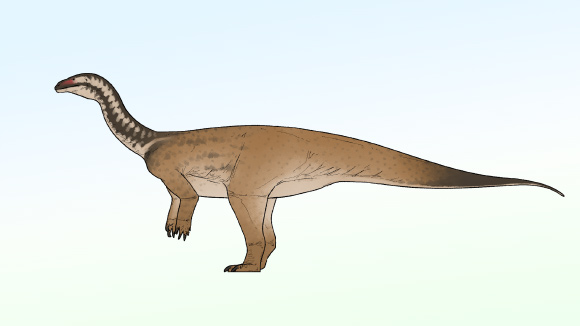
Huashanosaurus is a basal sauropod dinosaur that lived from the Early to Middle Jurassic periods of what is now China. It was a long-necked herbivore which still exhibited many basal traits of the earlier sauropodomorphs, while transitioning to obligate quardupedality. Huashanosaurus grew to approximately 12 m in length, and weighed around 10 t.

Huashanosaurus is a basal sauropod dinosaur that lived from the Early to Middle Jurassic periods of what is now China. It was a long-necked herbivore which still exhibited many basal traits of the earlier sauropodomorphs, while transitioning to obligate quardupedality. Huashanosaurus grew to approximately 12 m in length, and weighed around 10 t.

China Jurassic Middle Jurassic Dinosauria +1
Fujianvenator is an anchiornithid avialan from the Late Jurassic of China, whose discovery gave important insight to the evolution of birds. It had proportionately long legs, with the tibia twice the length of the femur. This suggests it may have been a strong runner, and possibly had a terrestrial or wading lifestyle. Fujianvenator was a small dinosaur, weighing about 640 g. As an avialan, it was almost certainly covered in feathers, though it does not seem likely to have been capable of flight.

Fujianvenator is an anchiornithid avialan from the Late Jurassic of China, whose discovery gave important insight to the evolution of birds. It had proportionately long legs, with the tibia twice the length of the femur. This suggests it may have been a strong runner, and possibly had a terrestrial or wading lifestyle. Fujianvenator was a small dinosaur, weighing about 640 g. As an avialan, it was almost certainly covered in feathers, though it does not seem likely to have been capable of flight.

feather flight China Jurassic +7
Skull of troodontid theropod Xixiasaurus henanensis gen. et sp. nov. (HGM 41HIII−0201; holotype), lower–middle Majiacun Formation (Upper Cretaceous: Coniacian–Campanian), Henan Province, China; in dorsal (A); lateral (B), and ventral (C) views.

Note that this version of the image does not include the interpretative lines of the version in the paper.
Taxa Xixiasaurus

Skull of troodontid theropod Xixiasaurus henanensis gen. et sp. nov. (HGM 41HIII−0201; holotype), lower–middle Majiacun Formation (Upper Cretaceous: Coniacian–Campanian), Henan Province, China; in dorsal (A); lateral (B), and ventral (C) views. Note that this version of the image does not include the interpretative lines of the version in the paper.

China Campanian Coniacian Cretaceous +5
Holotype skull of Wannanosaurus yansiensis on display at the Paleozoological Museum of China.
Taxa Wannanosaurus

Holotype skull of Wannanosaurus yansiensis on display at the Paleozoological Museum of China.

museum China holotype Wannanosaurus +1
Restoration of Zhuchengtitan zangjiazhuangensis from the Late Cretaceous of China
Taxa Zhuchengtitan

Restoration of Zhuchengtitan zangjiazhuangensis from the Late Cretaceous of China

China Cretaceous Late Cretaceous Zhuchengtitan
1 2 3 4 5 6

News

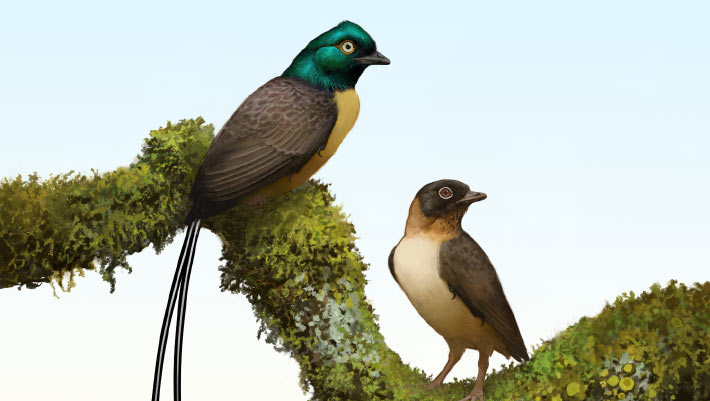
Cretaceous Bird from China Had Pair of Tail Feathers Twice as Long as Its Body
feather China Cretaceous bird
Named Plumadraco bankoorum, the newly-described species of enantiornithine bird lived in what is now northeastern China during the Cretaceous period, roughly 121 million years ago. The post Cretaceous Bird from China Had Pair of Tail Feathers Twice as Long as Its Body appeared first on Sci.News: Breaking Science News.
28/05/2026 sci-news
Gongshuilong: Beast of the Week
bone China Cretaceous Late Cretaceous Gongshuilong Hadrosauria
 Today we're checking out a recently described hadrosaur with a unique look, Gongshuilong fanwei!Gongshuilong lived in what is now eastern China, during the late Cretaceous period, between 68 and 66 million years ago.  From beak to tail it measured about 23 feet (7m) long and would have been a plant-eater when alive.  The genus name translates from Mandarin to "Gong River Dragon" in reference to the Gong River near where its bones were discovered.Gongshuilong life reconstruction in watercolors b
10/05/2026 prehistoricbeastoftheweek
Ice age humans in China crafted surprisingly advanced stone tools 146,000 years ago
bone China discovery
Scientists in China discovered that ancient humans were making surprisingly advanced stone tools during a harsh ice age 146,000 years ago. The tools, created by Homo juluensis, show careful planning and complex thinking rather than simple stone-chipping. Researchers dated the site using tiny calcite crystals inside animal bones, revealing the tools are much older than expected. The discovery challenges the idea that human creativity only thrives in easy, prosperous times.
09/05/2026 sciencedaily-paleo
Early Sauropodomorph Dinosaur Unearthed in China
China Early Jurassic Jurassic Dinosauria Massopoda new species partial skeleton
A new genus and species of massopodan sauropodomorph that lived during the Early Jurassic epoch has been identified from a partial skeleton unearthed in southwestern China. The post Early Sauropodomorph Dinosaur Unearthed in China appeared first on Sci.News: Breaking Science News.
04/05/2026 sci-news
400 million-year-old fish fossils reveal how life began moving onto land
Australia China fossil formation skull
Scientists have uncovered new clues about some of Earth’s earliest fish, shedding light on the ancient origins of vertebrates that eventually moved onto land. By reanalyzing mysterious fossils from Australia’s famed Gogo Formation and studying a newly reconstructed 410-million-year-old lungfish skull from China, researchers are revealing how these primitive creatures evolved.
12/03/2026 sciencedaily
1 2 3 4 5 6 7 8 9 10