Germany

Country

19 image(s) · 3 News

Image gallery

Lower Triassic fossil footprint (ichnite) of the ichnogenus Chirotherium, probably caused by an early archosaur, and first discovered 1833 in Hildburghausen (Thuringia, Germany). This specimen, however, ist from the Helsby Sandstone of the Storeton Quarry near Liverpool. Its species name is Chirotherium storetonense.[1]
Taxa Abelichnus

Lower Triassic fossil footprint (ichnite) of the ichnogenus Chirotherium, probably caused by an early archosaur, and first discovered 1833 in Hildburghausen (Thuringia, Germany). This specimen, however, ist from the Helsby Sandstone of the Storeton Quarry near Liverpool. Its species name is Chirotherium storetonense.[1]

Germany Triassic fossil specimen +9
Lower Triassic fossil footprint (ichnite) of the ichnogenus Chirotherium, probably caused by an early archosaur, and first discovered 1833 in Hildburghausen (Thuringia, Germany). This specimen, however, ist from the Helsby Sandstone of the Storeton Quarry near Liverpool. Its species name is Chirotherium storetonense.[1]
Taxa Anticheiropus

Lower Triassic fossil footprint (ichnite) of the ichnogenus Chirotherium, probably caused by an early archosaur, and first discovered 1833 in Hildburghausen (Thuringia, Germany). This specimen, however, ist from the Helsby Sandstone of the Storeton Quarry near Liverpool. Its species name is Chirotherium storetonense.[1]

Germany Triassic fossil specimen +9
Lower Triassic fossil footprint (ichnite) of the ichnogenus Chirotherium, probably caused by an early archosaur, and first discovered 1833 in Hildburghausen (Thuringia, Germany). This specimen, however, ist from the Helsby Sandstone of the Storeton Quarry near Liverpool. Its species name is Chirotherium storetonense.[1]
Taxa Argoides

Lower Triassic fossil footprint (ichnite) of the ichnogenus Chirotherium, probably caused by an early archosaur, and first discovered 1833 in Hildburghausen (Thuringia, Germany). This specimen, however, ist from the Helsby Sandstone of the Storeton Quarry near Liverpool. Its species name is Chirotherium storetonense.[1]

Germany Triassic fossil specimen +9
Lower Triassic fossil footprint (ichnite) of the ichnogenus Chirotherium, probably caused by an early archosaur, and first discovered 1833 in Hildburghausen (Thuringia, Germany). This specimen, however, ist from the Helsby Sandstone of the Storeton Quarry near Liverpool. Its species name is Chirotherium storetonense.[1]
Taxa Atreipus

Lower Triassic fossil footprint (ichnite) of the ichnogenus Chirotherium, probably caused by an early archosaur, and first discovered 1833 in Hildburghausen (Thuringia, Germany). This specimen, however, ist from the Helsby Sandstone of the Storeton Quarry near Liverpool. Its species name is Chirotherium storetonense.[1]

Germany Triassic fossil specimen +9
Lower Triassic fossil footprint (ichnite) of the ichnogenus Chirotherium, probably caused by an early archosaur, and first discovered 1833 in Hildburghausen (Thuringia, Germany). This specimen, however, ist from the Helsby Sandstone of the Storeton Quarry near Liverpool. Its species name is Chirotherium storetonense.[1]
Taxa Delatorrichnus

Lower Triassic fossil footprint (ichnite) of the ichnogenus Chirotherium, probably caused by an early archosaur, and first discovered 1833 in Hildburghausen (Thuringia, Germany). This specimen, however, ist from the Helsby Sandstone of the Storeton Quarry near Liverpool. Its species name is Chirotherium storetonense.[1]

Germany Triassic fossil specimen +9
Lower Triassic fossil footprint (ichnite) of the ichnogenus Chirotherium, probably caused by an early archosaur, and first discovered 1833 in Hildburghausen (Thuringia, Germany). This specimen, however, ist from the Helsby Sandstone of the Storeton Quarry near Liverpool. Its species name is Chirotherium storetonense.[1]
Taxa Dinehichnus

Lower Triassic fossil footprint (ichnite) of the ichnogenus Chirotherium, probably caused by an early archosaur, and first discovered 1833 in Hildburghausen (Thuringia, Germany). This specimen, however, ist from the Helsby Sandstone of the Storeton Quarry near Liverpool. Its species name is Chirotherium storetonense.[1]

Germany Triassic fossil specimen +9
Lower Triassic fossil footprint (ichnite) of the ichnogenus Chirotherium, probably caused by an early archosaur, and first discovered 1833 in Hildburghausen (Thuringia, Germany). This specimen, however, ist from the Helsby Sandstone of the Storeton Quarry near Liverpool. Its species name is Chirotherium storetonense.[1]
Taxa Dromaeosauripus

Lower Triassic fossil footprint (ichnite) of the ichnogenus Chirotherium, probably caused by an early archosaur, and first discovered 1833 in Hildburghausen (Thuringia, Germany). This specimen, however, ist from the Helsby Sandstone of the Storeton Quarry near Liverpool. Its species name is Chirotherium storetonense.[1]

Germany Triassic fossil specimen +9
Lower Triassic fossil footprint (ichnite) of the ichnogenus Chirotherium, probably caused by an early archosaur, and first discovered 1833 in Hildburghausen (Thuringia, Germany). This specimen, however, ist from the Helsby Sandstone of the Storeton Quarry near Liverpool. Its species name is Chirotherium storetonense.[1]
Taxa Eutynichnium

Lower Triassic fossil footprint (ichnite) of the ichnogenus Chirotherium, probably caused by an early archosaur, and first discovered 1833 in Hildburghausen (Thuringia, Germany). This specimen, however, ist from the Helsby Sandstone of the Storeton Quarry near Liverpool. Its species name is Chirotherium storetonense.[1]

Germany Triassic fossil specimen +9
Exhibit in the Naturhistorisches Museum, Braunschweig, Germany.
Taxa Spinophorosaurus

Exhibit in the Naturhistorisches Museum, Braunschweig, Germany.

museum Germany Spinophorosaurus
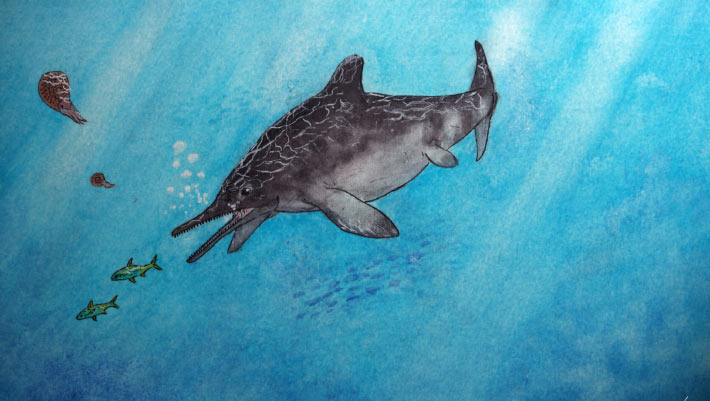
A 6.4 meter (21ft) Eurhinosaurus species specimen from the Holzmaden Formation, Baden-Wurttenburg, Germany.  ~185 million years old.
Taxa Eurhinosaurus

A 6.4 meter (21ft) Eurhinosaurus species specimen from the Holzmaden Formation, Baden-Wurttenburg, Germany. ~185 million years old.

Germany specimen Eurhinosauria formation
Cast of a Scaphognathus crassirostris, a kind of pterosaur. On display as part of the exhibit "Pterosaurs: Flight in the Age of Dinosaurs" at the Cleveland Natural History Museum in Cleveland, Ohio, in the United States.
This animal lived about 150 million years ago. This fossil was found in the Solnhofen formation in Germany. This is a cast; the fossil itself is held by the Institute of Geology and Paleontology at the University of Bonn.
Taxa Scaphognathus

Cast of a Scaphognathus crassirostris, a kind of pterosaur. On display as part of the exhibit "Pterosaurs: Flight in the Age of Dinosaurs" at the Cleveland Natural History Museum in Cleveland, Ohio, in the United States. This animal lived about 150 million years ago. This fossil was found in the Solnhofen formation in Germany. This is a cast; the fossil itself is held by the Institute of Geology and Paleontology at the University of Bonn.

flight museum Germany United States +7
Germanodactylus cristatus specimen SMNK PAL 6592. Germanodactylidae; Upper Jurassic, Eichstätt, Germany; Staatliches Museum für Naturkunde Karlsruhe, Germany.
Taxa Germanodactylus

Germanodactylus cristatus specimen SMNK PAL 6592. Germanodactylidae; Upper Jurassic, Eichstätt, Germany; Staatliches Museum für Naturkunde Karlsruhe, Germany.

museum Germany Jurassic specimen +2
Cast of Gorgosaurus specimen ROM 1247 (sometimes labelled as Albertosaurus) at the Royal Tyrrell Museum.
Taxa Gorgosaurus

Cast of Gorgosaurus specimen ROM 1247 (sometimes labelled as Albertosaurus) at the Royal Tyrrell Museum.

museum Germany cast specimen +2
Plateosaurus engelhardti skeletons "Skelett 2" on exhibit at the museum of the Institute for Geosciences of the Eberhard-Karls-University Tübingen, Germany. "Skelett 2" is a composite from 2 individuals from Trossingen, Germany. Mounts created under the direction of Friedrich von Huene.
Taxa Plateosaurus

Plateosaurus engelhardti skeletons "Skelett 2" on exhibit at the museum of the Institute for Geosciences of the Eberhard-Karls-University Tübingen, Germany. "Skelett 2" is a composite from 2 individuals from Trossingen, Germany. Mounts created under the direction of Friedrich von Huene.

museum Germany Plateosauria skeleton
1 2

News

New Jurassic Pterosaur Unearthed in Germany
Germany Jurassic fossil Monofenestrata Pterosauria new species skeleton
Paleontologists have described a new genus and species of early monofenestratan pterosaur based on a nearly complete and well-preserved fossil skeleton discovered in Bavaria, Germany. The post New Jurassic Pterosaur Unearthed in Germany appeared first on Sci.News: Breaking Science News.
19/05/2026 sci-news
Torvosaurus: Beast of the Week
bone predator Germany Portugal United States Jurassic Late Jurassic Dinosauria Torvosaurus
Today we are going to look at a huge Jurassic predatory dinosaur, Torvosaurus tanneri!  Torvosaurus lived about 150 million years ago during the Late Jurassic period. Its bones have been unearthed in Colorado, USA, Portugal, and possibly Germany (Europe and North America were not as vastly separated back then, remember, so a lot of the dinosaurs on each of them from that time shared recent ancestors).  From nose to tail it measured up to 36 feet (about 11m) and would have been among the largest,
08/02/2026 prehistoricbeastoftheweek
Anurognathus: Beast of the Week
Germany Jurassic Late Jurassic Anurognathus Pterosauria skull
This week we will be checking out a unique little pterosaur, Anurognathus ammoni!  Anurognathus lived in what is now Germany during the late Jurassic period, about 150 million years ago.  It was tiny, sporting a 14 inch (35.5 cm) wingspan, and would have likely eaten insects.  It's genus name translates to "Frog Jaw" since its skull was similar looking to a frog's, being extremely blunt with a wide mouth.  Watercolor reconstruction of Anurognathus ammoni by Christopher DiPiazza.Anurognathus' sku
14/12/2025 prehistoricbeastoftheweek