Allemagne

Pays

19 image(s) · 3 Actualités

Galerie d'images

Remake of the original picture of the Drzewica Formation. Terrestrial environment of the Pliensbachian-Toarcian boundary of Fennoscandinavia  Inland environment of the  Bornholm Coast, nearby the German realm of the Ciechocinek Formation. Includes
Ciechocinek Formation (Lower Toarcian, Bones) and Drzwica Formation (Latest Pliensbachian, Footprints) Fauna
Sorthat Formation environment, fluvial influenced mainland with Cheirolepidaceae and Bennetitales as dominant flora
Dinosaurs are based on material found on various locations of Northern Germany, and Footprints of the underliying Drzewica Formation at the Holy Cross Mountains, connected with Bornholm at the time.
Dinosaur Species appeared: 

Megalosauripus isp. Large Footprints (+65 cm) found on the Drzewica Formation. There is a dorsal vertebrae on the German Margin of the Ciechocinek Formation assigend to Megalosauria (Huene, 1966).
Gravisauria spp. representing the Grimmen Sauropod reported on 2014, as a taxon related with Tazoudasaurus. Barapasaurus-like footprints are know from the Drzewica Formation.
Coelophysoidea spp. based on coeval Anchisauripus tracks from the Holy Cross Mountains.
Basal Ornithischan, related to Eocursor, based on a crouching trace (Gerard Dariusz Gierlinski, Martin G. Lockley, Grzegorz Niedźwiedzki:2009).
Massospondylidae spp. based on Otozum-like tracks.

Remake of the original picture of the Drzewica Formation. Terrestrial environment of the Pliensbachian-Toarcian boundary of Fennoscandinavia Inland environment of the Bornholm Coast, nearby the German realm of the Ciechocinek Formation. Includes Ciechocinek Formation (Lower Toarcian, Bones) and Drzwica Formation (Latest Pliensbachian, Footprints) Fauna Sorthat Formation environment, fluvial influenced mainland with Cheirolepidaceae and Bennetitales as dominant flora Dinosaurs are based on material found on various locations of Northern Germany, and Footprints of the underliying Drzewica Formation at the Holy Cross Mountains, connected with Bornholm at the time. Dinosaur Species appeared: Megalosauripus isp. Large Footprints (+65 cm) found on the Drzewica Formation. There is a dorsal vertebrae on the German Margin of the Ciechocinek Formation assigend to Megalosauria (Huene, 1966). Gravisauria spp. representing the Grimmen Sauropod reported on 2014, as a taxon related with Tazoudasaurus. Barapasaurus-like footprints are know from the Drzewica Formation. Coelophysoidea spp. based on coeval Anchisauripus tracks from the Holy Cross Mountains. Basal Ornithischan, related to Eocursor, based on a crouching trace (Gerard Dariusz Gierlinski, Martin G. Lockley, Grzegorz Niedźwiedzki:2009). Massospondylidae spp. based on Otozum-like tracks.

os Allemagne Pliensbachien Toarcien +7
Ctenochasma elegans (syn. Pterodactylus elegans) fossil from Solnhofen, Germany

American Museum of Natural History, New York, FR-5147
Received in exchange from the Paläontologisches Museum München, 1909
Taxons Ctenochasmatidae

Ctenochasma elegans (syn. Pterodactylus elegans) fossil from Solnhofen, Germany American Museum of Natural History, New York, FR-5147 Received in exchange from the Paläontologisches Museum München, 1909

musée Allemagne fossile Ctenochasma +5
Ctenochasma elegans (syn. Pterodactylus elegans) fossil from Solnhofen, Germany

American Museum of Natural History, New York, FR-5147
Received in exchange from the Paläontologisches Museum München, 1909
Taxons Gnathosaurinae

Ctenochasma elegans (syn. Pterodactylus elegans) fossil from Solnhofen, Germany American Museum of Natural History, New York, FR-5147 Received in exchange from the Paläontologisches Museum München, 1909

musée Allemagne fossile Ctenochasma +5
Ctenochasma elegans (syn. Pterodactylus elegans) fossil from Solnhofen, Germany

American Museum of Natural History, New York, FR-5147
Received in exchange from the Paläontologisches Museum München, 1909
Taxons Moganopterinae

Ctenochasma elegans (syn. Pterodactylus elegans) fossil from Solnhofen, Germany American Museum of Natural History, New York, FR-5147 Received in exchange from the Paläontologisches Museum München, 1909

musée Allemagne fossile Ctenochasma +5
Ctenochasma elegans (syn. Pterodactylus elegans) fossil from Solnhofen, Germany

American Museum of Natural History, New York, FR-5147
Received in exchange from the Paläontologisches Museum München, 1909
Taxons Ctenochasmatinae

Ctenochasma elegans (syn. Pterodactylus elegans) fossil from Solnhofen, Germany American Museum of Natural History, New York, FR-5147 Received in exchange from the Paläontologisches Museum München, 1909

musée Allemagne fossile Ctenochasma +5
Fossil specimen of Ornithomimus sp. (TMP 1995.110.1), Royal Tyrrell Museum. This specimen was recovered from the middle Dinosaur Park Formation of Alberta, Canada.
Taxons Ornithomimidae

Fossil specimen of Ornithomimus sp. (TMP 1995.110.1), Royal Tyrrell Museum. This specimen was recovered from the middle Dinosaur Park Formation of Alberta, Canada.

musée Canada Allemagne Dinosaur Park +6
Nichollssaura at the Royal Tyrrell Museum.
Taxons Nichollssaura

Nichollssaura at the Royal Tyrrell Museum.

musée Allemagne Nichollssaura
Meyerasaurus victor (jr synonym Rhomaleosaurus victor) holotype. Specimen # SMNS 12478, Museum am Löwentor, Stuttgart, Germany
Taxons Meyerasaurus

Meyerasaurus victor (jr synonym Rhomaleosaurus victor) holotype. Specimen # SMNS 12478, Museum am Löwentor, Stuttgart, Germany

musée Allemagne holotype spécimen +2
Fossil with teeth of Macroplacus raeticus from Triassic of Germany, on display at the Museo Civico di Storia Naturale di Milano
Taxons Macroplacus

Fossil with teeth of Macroplacus raeticus from Triassic of Germany, on display at the Museo Civico di Storia Naturale di Milano

Allemagne Trias fossile Macroplacus
Reconstructed skull of Wiehenvenator albati based on holotype specimen (white). Scale bar is 10cm, image if 10px/cm. Unknown material based on related Torvosaurus tanneri. Cranial anatomy based on Rauhut et al (2016) "A new megalosaurid theropod dinosaur from the late Middle Jurassic (Callovian) of north-western Germany: implications for theropod evolution and faunal turnover in the Jurassic"
Taxons Wiehenvenator

Reconstructed skull of Wiehenvenator albati based on holotype specimen (white). Scale bar is 10cm, image if 10px/cm. Unknown material based on related Torvosaurus tanneri. Cranial anatomy based on Rauhut et al (2016) "A new megalosaurid theropod dinosaur from the late Middle Jurassic (Callovian) of north-western Germany: implications for theropod evolution and faunal turnover in the Jurassic"

écaille Allemagne Callovien Jurassique +10
Ornithischian dinosaur Stenopelix valdensis Meyer, 1857, holotype (GZG 741/2, formerly GPI Gö 741−2), from the Obernkirchen Sandstone (Early
Cretaceous: Berriasian), near Bückeburg, Niedersachsen, Germany. A. Large sandstone slab. B. Interpretative outline drawing of large latex cast (prepared
from large sandstone slab), showing majority of postcranial skeleton in dorsal view. C. Small sandstone slab. D. Interpretative outline drawing of small la−
tex cast (prepared from small sandstone slab), showing sacrum and caudals, pelvic region and partial hindlimbs in ventral view. For clarity elements in and
around the sacral region have not been labelled—these areas are shown in greater detail in Fig. 3. Roman numerals II–IV correspond to respective digits.

Abbreviations: mt, metatarsals; f, femur; ?, unidentified element.
Taxons Stenopelix

Ornithischian dinosaur Stenopelix valdensis Meyer, 1857, holotype (GZG 741/2, formerly GPI Gö 741−2), from the Obernkirchen Sandstone (Early Cretaceous: Berriasian), near Bückeburg, Niedersachsen, Germany. A. Large sandstone slab. B. Interpretative outline drawing of large latex cast (prepared from large sandstone slab), showing majority of postcranial skeleton in dorsal view. C. Small sandstone slab. D. Interpretative outline drawing of small la− tex cast (prepared from small sandstone slab), showing sacrum and caudals, pelvic region and partial hindlimbs in ventral view. For clarity elements in and around the sacral region have not been labelled—these areas are shown in greater detail in Fig. 3. Roman numerals II–IV correspond to respective digits. Abbreviations: mt, metatarsals; f, femur; ?, unidentified element.

dessin Allemagne Berriasien Crétacé +8
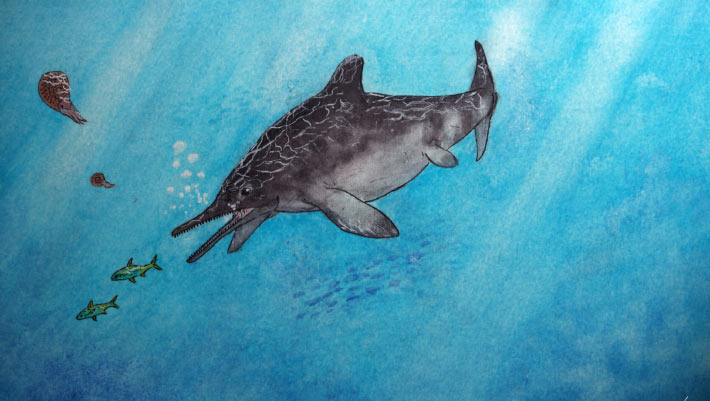
Life restoration of the German Jurassic ichthyosaur Suevoleviathan disinteger. The dorsal and caudal fins are loosely based on those of Stenopterygius.
References
Maisch, M.W. (2020). "The best-preserved skeleton of Suevoleviathan integer (Bronn, 1844)(Reptilia: Ichthyosauria) from the lower Jurassic of south-western Germany, with a discussion of the genus". Neues Jahrbuch für Geologie und Paläontologie, Abhandlungen 297 (2): 153–172.
Maisch, M.W. (1998). "A new ichthyosaur genus from the Posidonia Shale (Lower Toarcian, Jurassic) of Holzmaden, SW-Germany with comments on the phylogeny of post-Triassic ichthyosaurs". Neues Jahrbuch für Geologie und Paläontologie-Abhandlungen 209 (1): 47–78.
Taxons Suevoleviathan

Life restoration of the German Jurassic ichthyosaur Suevoleviathan disinteger. The dorsal and caudal fins are loosely based on those of Stenopterygius. References Maisch, M.W. (2020). "The best-preserved skeleton of Suevoleviathan integer (Bronn, 1844)(Reptilia: Ichthyosauria) from the lower Jurassic of south-western Germany, with a discussion of the genus". Neues Jahrbuch für Geologie und Paläontologie, Abhandlungen 297 (2): 153–172. Maisch, M.W. (1998). "A new ichthyosaur genus from the Posidonia Shale (Lower Toarcian, Jurassic) of Holzmaden, SW-Germany with comments on the phylogeny of post-Triassic ichthyosaurs". Neues Jahrbuch für Geologie und Paläontologie-Abhandlungen 209 (1): 47–78.

Allemagne Posidonia Shale Jurassique Toarcien +6
The Naturmuseum Senckenberg in Frankfurt is the second largest museum of natural history in Germany. It is particularly popular with children, who enjoy the extensive collection of dinosaur skeletons: Senckenberg boasts the largest exhibition of large dinosaurs in Europe. One particular treasure is a dinosaur fossil with unique, preserved scaled skin. The museum contains the world's largest and most diverse collection of stuffed birds with about 2000 specimens.

The Naturmuseum Senckenberg in Frankfurt is the second largest museum of natural history in Germany. It is particularly popular with children, who enjoy the extensive collection of dinosaur skeletons: Senckenberg boasts the largest exhibition of large dinosaurs in Europe. One particular treasure is a dinosaur fossil with unique, preserved scaled skin. The museum contains the world's largest and most diverse collection of stuffed birds with about 2000 specimens.

musée Allemagne fossile spécimen +4
Remake of the original picture of the Drzewica Formation. Terrestrial environment of the Pliensbachian-Toarcian boundary of Fennoscandinavia  Inland environment of the  Bornholm Coast, nearby the German realm of the Ciechocinek Formation. Includes
Ciechocinek Formation (Lower Toarcian, Bones) and Drzwica Formation (Latest Pliensbachian, Footprints) Fauna
Sorthat Formation environment, fluvial influenced mainland with Cheirolepidaceae and Bennetitales as dominant flora
Dinosaurs are based on material found on various locations of Northern Germany, and Footprints of the underliying Drzewica Formation at the Holy Cross Mountains, connected with Bornholm at the time.
Dinosaur Species appeared: 

Megalosauripus isp. Large Footprints (+65 cm) found on the Drzewica Formation. There is a dorsal vertebrae on the German Margin of the Ciechocinek Formation assigend to Megalosauria (Huene, 1966).
Gravisauria spp. representing the Grimmen Sauropod reported on 2014, as a taxon related with Tazoudasaurus. Barapasaurus-like footprints are know from the Drzewica Formation.
Coelophysoidea spp. based on coeval Anchisauripus tracks from the Holy Cross Mountains.
Basal Ornithischan, related to Eocursor, based on a crouching trace (Gerard Dariusz Gierlinski, Martin G. Lockley, Grzegorz Niedźwiedzki:2009).
Massospondylidae spp. based on Otozum-like tracks.
Taxons Megalosauripus

Remake of the original picture of the Drzewica Formation. Terrestrial environment of the Pliensbachian-Toarcian boundary of Fennoscandinavia Inland environment of the Bornholm Coast, nearby the German realm of the Ciechocinek Formation. Includes Ciechocinek Formation (Lower Toarcian, Bones) and Drzwica Formation (Latest Pliensbachian, Footprints) Fauna Sorthat Formation environment, fluvial influenced mainland with Cheirolepidaceae and Bennetitales as dominant flora Dinosaurs are based on material found on various locations of Northern Germany, and Footprints of the underliying Drzewica Formation at the Holy Cross Mountains, connected with Bornholm at the time. Dinosaur Species appeared: Megalosauripus isp. Large Footprints (+65 cm) found on the Drzewica Formation. There is a dorsal vertebrae on the German Margin of the Ciechocinek Formation assigend to Megalosauria (Huene, 1966). Gravisauria spp. representing the Grimmen Sauropod reported on 2014, as a taxon related with Tazoudasaurus. Barapasaurus-like footprints are know from the Drzewica Formation. Coelophysoidea spp. based on coeval Anchisauripus tracks from the Holy Cross Mountains. Basal Ornithischan, related to Eocursor, based on a crouching trace (Gerard Dariusz Gierlinski, Martin G. Lockley, Grzegorz Niedźwiedzki:2009). Massospondylidae spp. based on Otozum-like tracks.

os Allemagne Pliensbachien Toarcien +7
Pleuroceras solare, Amaltheidae; Pyritic specimen; Diameter 3.2 cm; Upper Pliensbachian, Lower Jurassic; Little Switzerland, Bavaria, Germany. own collection, therefore not geocoded.
Taxons Coralloidoolithus

Pleuroceras solare, Amaltheidae; Pyritic specimen; Diameter 3.2 cm; Upper Pliensbachian, Lower Jurassic; Little Switzerland, Bavaria, Germany. own collection, therefore not geocoded.

Allemagne Suisse Jurassique Pliensbachien +3
Pleuroceras solare, Amaltheidae; Pyritic specimen; Diameter 3.2 cm; Upper Pliensbachian, Lower Jurassic; Little Switzerland, Bavaria, Germany. own collection, therefore not geocoded.
Taxons Dispersituberoolithus

Pleuroceras solare, Amaltheidae; Pyritic specimen; Diameter 3.2 cm; Upper Pliensbachian, Lower Jurassic; Little Switzerland, Bavaria, Germany. own collection, therefore not geocoded.

Allemagne Suisse Jurassique Pliensbachien +3
1 2

Actualités

New Jurassic Pterosaur Unearthed in Germany
Un nouveau ptérosaure du Jurassique découvert en Allemagne
Allemagne Jurassique fossile Monofenestrata Pterosauria nouvelle espèce squelette
Les paléontologues ont décrit un nouveau genre et une nouvelle espèce de ptérosaure monofenestratan précoce sur la base d'un squelette fossile presque complet et bien conservé découvert en Bavière, en Allemagne. L'article Un nouveau ptérosaure jurassique découvert en Allemagne est apparu en premier sur Sci.News : Breaking Science News.
19/05/2026 sci-news ⚙ Traduction automatique
Torvosaurus: Beast of the Week
Torvosaurus : Bête de la semaine
os prédateur Allemagne Portugal États-Unis Jurassique Jurassique supérieur Dinosauria Torvosaurus
Aujourd'hui, nous allons nous intéresser à un énorme dinosaure prédateur du Jurassique, Torvosaurus tanneri !  Torvosaurus vivait il y a environ 150 millions d’années à la fin du Jurassique. Ses ossements ont été découverts dans le Colorado, aux États-Unis, au Portugal et peut-être en Allemagne (l'Europe et l'Amérique du Nord n'étaient pas aussi éloignées à l'époque, rappelez-vous, donc beaucoup de dinosaures présents sur chacun d'eux partageaient des ancêtres récents).  Du nez à la queue, il mesurait jusqu'à 36 pieds (environ 11 m) et aurait été parmi les plus grands,
08/02/2026 prehistoricbeastoftheweek ⚙ Traduction automatique
Anurognathus: Beast of the Week
Anurognathus : la bête de la semaine
Allemagne Jurassique Jurassique supérieur Anurognathus Pterosauria crâne
Cette semaine, nous allons découvrir un petit ptérosaure unique, Anurognathus ammoni !  Anurognathus vivait dans ce qui est aujourd'hui l'Allemagne à la fin du Jurassique, il y a environ 150 millions d'années.  Il était minuscule, avait une envergure de 35,5 cm (14 pouces) et aurait probablement mangé des insectes.  Son nom de genre se traduit par "Frog Jaw" puisque son crâne ressemblait à celui d'une grenouille, étant extrêmement émoussé avec une bouche large.  Reconstitution à l'aquarelle d'Anurognathus ammoni par Christopher DiPiazza.Sku d'Anurognathus
14/12/2025 prehistoricbeastoftheweek ⚙ Traduction automatique