Dinosauria

Taxon

412 image(s) · 210 Actualités

Voir la fiche

Galerie d'images

Skull of Lesothosaurus - ornithischian dinosaur
Taxons Lesothosaurus

Skull of Lesothosaurus - ornithischian dinosaur

Dinosauria Lesothosauria Ornithischia crâne
The nodosaurid dinosaur, Glyptodontopelta is mostly known from isolated osteoderms ("armor plates"). The specimen SMP VP-1580 (State Museum of Pennysylvania) is however, the most complete known specimen, comprising parts of the skull, hundreds of osteoderms and fragments. This specimen was discovered in 2003 by Warwick Fowler, in the Naashoibito Member of the Ojo Alamo Formation (Maatrichtian, Late Cretaceous) of the San Juan Basin, New Mexico, during an expedition led by Dr. Robert Sullivan.
Taxons Glyptodontopelta

The nodosaurid dinosaur, Glyptodontopelta is mostly known from isolated osteoderms ("armor plates"). The specimen SMP VP-1580 (State Museum of Pennysylvania) is however, the most complete known specimen, comprising parts of the skull, hundreds of osteoderms and fragments. This specimen was discovered in 2003 by Warwick Fowler, in the Naashoibito Member of the Ojo Alamo Formation (Maatrichtian, Late Cretaceous) of the San Juan Basin, New Mexico, during an expedition led by Dr. Robert Sullivan.

armure musée Mexique Denver +9
Tracks of the dinosaur Pseudotetrasauropus bipedoida.
Taxons Pseudotetrasauropus

Tracks of the dinosaur Pseudotetrasauropus bipedoida.

empreintes Dinosauria Pseudotetrasauropus
In 2000 a virtually complete Scelidosaurus skeleton was discovered in England. This fossil's hundreds of armor plates and spikes are preserved in their life positions, providing extraordinary details about how this dinosaur looked. St. George is the only place anywhere in the Western Hemisphere that the 11-foot long Scelidosaurus replica has been on display.
The St. George Dinosaur Discovery Site at Johnson Farm (St. George, Utah) is home to exceptionally well-preserved dinosaur tracks, some displaying skin impressions. These tracks, along with hundreds of fossil fish, plants, rare dinosaur remains, invertebrates traces and important sedimentary structures, show evidence that this site was produced along the western edge of a large, Early Jurassic (age between 195-198 million years ago) freshwater lake named Lake Dixie. 

Source: www.sgcity.org/dinotrax/
Taxons Scelidosaurus

In 2000 a virtually complete Scelidosaurus skeleton was discovered in England. This fossil's hundreds of armor plates and spikes are preserved in their life positions, providing extraordinary details about how this dinosaur looked. St. George is the only place anywhere in the Western Hemisphere that the 11-foot long Scelidosaurus replica has been on display. The St. George Dinosaur Discovery Site at Johnson Farm (St. George, Utah) is home to exceptionally well-preserved dinosaur tracks, some displaying skin impressions. These tracks, along with hundreds of fossil fish, plants, rare dinosaur remains, invertebrates traces and important sedimentary structures, show evidence that this site was produced along the western edge of a large, Early Jurassic (age between 195-198 million years ago) freshwater lake named Lake Dixie. Source: www.sgcity.org/dinotrax/

armure peau Jurassique inférieur Jurassique +7
Cairanoolithus, a fossil dinosaur egg. Took the photo at Fossil Show, Munich
Taxons Cairanoolithus

Cairanoolithus, a fossil dinosaur egg. Took the photo at Fossil Show, Munich

fossile Cairanoolithus Dinosauria
Struthiomimus altus complete reconstruction in the Rocky Mountain Dinosaur Resource Center, Woodland Park, Colorado
Taxons Struthiomimus

Struthiomimus altus complete reconstruction in the Rocky Mountain Dinosaur Resource Center, Woodland Park, Colorado

Dinosauria Struthiomimus
Dinosaur eggs (Dendroolithus sp.) from Kaoguo Formation, Henan, China, on display at the San Diego County Fair, California, USA.
Taxons Dendroolithus

Dinosaur eggs (Dendroolithus sp.) from Kaoguo Formation, Henan, China, on display at the San Diego County Fair, California, USA.

Chine États-Unis Dendroolithus Dinosauria +1
Drawing of lectoholotype skull BMNH R.3386 (desigated by Weishampel et al., 1993)[1][2] of Limnosaurus transsylvanicus NOPCSA 1900 (later renamed Telmatosaurus transsylvanicus), a basal hadrosaurid dinosaur from the Late Maastrichtian (latest Upper Cretaceous) Sanpetru Formation of West Central Romania.
Taxons Telmatosaurus

Drawing of lectoholotype skull BMNH R.3386 (desigated by Weishampel et al., 1993)[1][2] of Limnosaurus transsylvanicus NOPCSA 1900 (later renamed Telmatosaurus transsylvanicus), a basal hadrosaurid dinosaur from the Late Maastrichtian (latest Upper Cretaceous) Sanpetru Formation of West Central Romania.

dessin Roumanie Crétacé Maastrichtien +6
Magnoavipes sp. - dinosaur track from the Cretaceous of Colorado, USA. (replica; public display, Red Rocks Amphitheater visitor center, west of Denver, Colorado, USA)
Dinosaur Ridge, Colorado has numerous dinosaur fossils, including bones and tracks.  The most common track type at the site is Caririchnium leonardii, which was made by an iguanodontid dinosaur.  A less common track is this - a slender, three-toed print called Magnoavipes, which was made by a theropod dinosaur.
Stratigraphy: Dakota Sandstone, upper Lower Cretaceous

Provenance: eastern side of Dinosaur Ridge, Dakota Hogback, west of Denver, north-central Colorado, USA
Taxons Magnoavipes

Magnoavipes sp. - dinosaur track from the Cretaceous of Colorado, USA. (replica; public display, Red Rocks Amphitheater visitor center, west of Denver, Colorado, USA) Dinosaur Ridge, Colorado has numerous dinosaur fossils, including bones and tracks. The most common track type at the site is Caririchnium leonardii, which was made by an iguanodontid dinosaur. A less common track is this - a slender, three-toed print called Magnoavipes, which was made by a theropod dinosaur. Stratigraphy: Dakota Sandstone, upper Lower Cretaceous Provenance: eastern side of Dinosaur Ridge, Dakota Hogback, west of Denver, north-central Colorado, USA

os États-Unis Denver Crétacé +7
Otozoum tracks in the Dinosaur State Park and Arboretum, Rocky Hill, Connecticut, USA. The exhibit sign reads: "These large negative tracks were made by a heavy animal that walked on four toes and had a short stride. It may have been a prosauropod. All of these tracks have rare skin impressions. This specimen was removed from the Portland Quarry in 1896. Donated by Wesleyan University."
Taxons Otozoum

Otozoum tracks in the Dinosaur State Park and Arboretum, Rocky Hill, Connecticut, USA. The exhibit sign reads: "These large negative tracks were made by a heavy animal that walked on four toes and had a short stride. It may have been a prosauropod. All of these tracks have rare skin impressions. This specimen was removed from the Portland Quarry in 1896. Donated by Wesleyan University."

peau États-Unis Portland spécimen +3
Halisaurus mosasaur, Wyoming Dinosaur Center, Thermopolis / 2006
Taxons Halisaurus

Halisaurus mosasaur, Wyoming Dinosaur Center, Thermopolis / 2006

États-Unis Dinosauria Halisaurus
Cetiosaurus oxoniensis, "Rutland Dinosaur". New Walk Museum, Leicester. Tuesday, 17 July, 2012
Taxons Cetiosaurus

Cetiosaurus oxoniensis, "Rutland Dinosaur". New Walk Museum, Leicester. Tuesday, 17 July, 2012

musée Royaume-Uni Cetiosauria Dinosauria
Fossil bone of Procerosaurus exogyrarum, possible dinosaur from the Czech Republic. National Museum, Prague (2007).
Taxons Ponerosteus

Fossil bone of Procerosaurus exogyrarum, possible dinosaur from the Czech Republic. National Museum, Prague (2007).

os musée Tchéquie fossile +3
Fossil of Pinacosaurus, an ankylosaurian  dinosaur
Took the photo at Musee d'Histoire Naturelle, Brussels
Taxons Eopinacosaurus

Fossil of Pinacosaurus, an ankylosaurian dinosaur Took the photo at Musee d'Histoire Naturelle, Brussels

fossile Ankylosauria Dinosauria Eopinacosaurus +1
Reconstruction of Bissektipelta archibaldi an ankylosaurid dinosaur from the Late Cretaceous of Uzbekistan
Taxons Bissektipelta

Reconstruction of Bissektipelta archibaldi an ankylosaurid dinosaur from the Late Cretaceous of Uzbekistan

Ouzbékistan Crétacé Crétacé supérieur Ankylosauridae +2
Ornithischian dinosaur Stenopelix valdensis Meyer, 1857, holotype (GZG 741/2, formerly GPI Gö 741−2), from the Obernkirchen Sandstone (Early
Cretaceous: Berriasian), near Bückeburg, Niedersachsen, Germany. A. Large sandstone slab. B. Interpretative outline drawing of large latex cast (prepared
from large sandstone slab), showing majority of postcranial skeleton in dorsal view. C. Small sandstone slab. D. Interpretative outline drawing of small la−
tex cast (prepared from small sandstone slab), showing sacrum and caudals, pelvic region and partial hindlimbs in ventral view. For clarity elements in and
around the sacral region have not been labelled—these areas are shown in greater detail in Fig. 3. Roman numerals II–IV correspond to respective digits.

Abbreviations: mt, metatarsals; f, femur; ?, unidentified element.
Taxons Stenopelix

Ornithischian dinosaur Stenopelix valdensis Meyer, 1857, holotype (GZG 741/2, formerly GPI Gö 741−2), from the Obernkirchen Sandstone (Early Cretaceous: Berriasian), near Bückeburg, Niedersachsen, Germany. A. Large sandstone slab. B. Interpretative outline drawing of large latex cast (prepared from large sandstone slab), showing majority of postcranial skeleton in dorsal view. C. Small sandstone slab. D. Interpretative outline drawing of small la− tex cast (prepared from small sandstone slab), showing sacrum and caudals, pelvic region and partial hindlimbs in ventral view. For clarity elements in and around the sacral region have not been labelled—these areas are shown in greater detail in Fig. 3. Roman numerals II–IV correspond to respective digits. Abbreviations: mt, metatarsals; f, femur; ?, unidentified element.

dessin Allemagne Berriasien Crétacé +8
1 2 3 4 5 6 7 8 9 10 11 12 13 14 15 16 17 18 19 20 21 22 23 24 25 26

Actualités

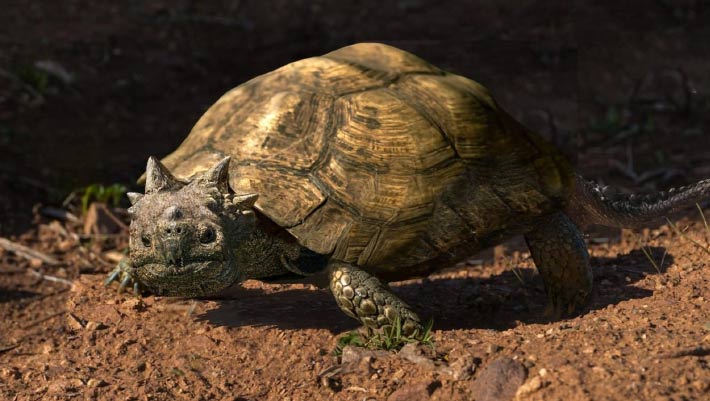
Fossil Discovery in Patagonia Reveals New Species of Horned Turtle
La découverte de fossiles en Patagonie révèle de nouvelles espèces de tortues à cornes
Argentine Maastrichtien fossile Dinosauria découverte extinction nouvelle espèce autres reptiles
Les paléontologues ont identifié une nouvelle espèce de tortue méiolaniforme du nord de la Patagonie, en Argentine, qui vivait à l'époque maastrichtienne, juste avant l'extinction massive déclenchée par un astéroïde qui a anéanti tous les dinosaures non aviaires. L'article La découverte de fossiles en Patagonie révèle de nouvelles espèces de tortues à cornes apparaît en premier sur Sci.News : Breaking Science News.
09/06/2026 sci-news ⚙ Traduction automatique
Un nouveau modèle de paraceratherium Haolonggood arrive en stock
jouet Oligocène Dinosauria mammifères
Everything Dinosaur proposera le nouveau modèle Haolonggood Paraceratherium pour 2026.  Il s’agit de la deuxième figure de mammifère préhistorique introduite par cette société. Récemment, une figurine de rhinocéros laineux (Coelodonta) a été annoncée.  Curieusement, le géant Paraceratherium est lointainement apparenté à Coelodonta.  Les deux animaux sont des ongulés aux doigts impairs (Perissodactyla). Patrouiller le paysage oligocène. Le nouveau
09/06/2026 everythingdinosaur ⚙ Traduction automatique
Description d'un nouveau dinosaure à quatre ailes en provenance de Chine
plume membre description Chine Crétacé Crétacé inférieur fossile Dinosauria Microraptorinae nouvelle espèce partiel
Les paléontologues ont décrit une nouvelle espèce de théropode microraptorine du nord-ouest de la Chine. Nommé Jian changmaensis, ce petit dinosaure à plumes planait probablement sur quatre ailes. Le fossile fournit de nouvelles informations sur les écosystèmes du Crétacé inférieur et étend l’aire de répartition connue des Microraptorinae. Le matériau fossile est constitué d'une ceinture pectorale gauche partielle articulée et d'un membre antérieur. Il
08/06/2026 everythingdinosaur ⚙ Traduction automatique
Leptoceratops: Beast of the Week
Leptocératops : la bête de la semaine
membre Canada Crétacé Crétacé supérieur Ceratopsia Dinosauria Leptoceratops
 Aujourd'hui, nous allons nous intéresser au petit dinosaure cératopsien, Leptoceratops gracilis ! Leptoceratops était un dinosaure cératopsien herbivore qui vivait dans ce qui est aujourd'hui l'Alberta, au Canada, à la fin du Crétacé, il y a entre 68 et 66 millions d'années.  Du bec à la queue, il mesurait environ 6,5 pieds (environ 2 m) et aurait pu marcher sur quatre ou deux membres de son vivant. Le nom du genre se traduit par « petit visage cornu ». Reconstitution de la vie du Leptoceratops à l'aquarelle par Christopher DiPiazza.L
08/06/2026 prehistoricbeastoftheweek ⚙ Traduction automatique
Oubliez le T. rex : ce dinosaure géant aux bras monstrueux pourrait bien avoir été encore plus terrifiant
prédateur Dinosauria Joaquinraptor fouille
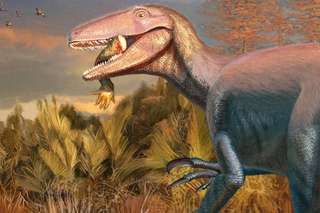
Découvert en Patagonie après trois saisons de fouilles, Joaquinraptor casali redistribue les cartes de la paléontologie. Ce prédateur d'une tonne aux bras démesurés faisait passer le T. rex pour un boxeur manchot. Et si la force brute n'était pas la meilleure arme de l'ère des dinosaures ?
07/06/2026 futura-terre
1 2 3 4 5 6 7 8 9 10 11 12 13 14 15 16 17 18 19 20 21 22 23 24 25 26 27 28 29 30 31 32 33 34 35 36 37 38 39 40 41 42