Dinosauria

Taxon

412 image(s) · 210 Actualités

Voir la fiche

Galerie d'images

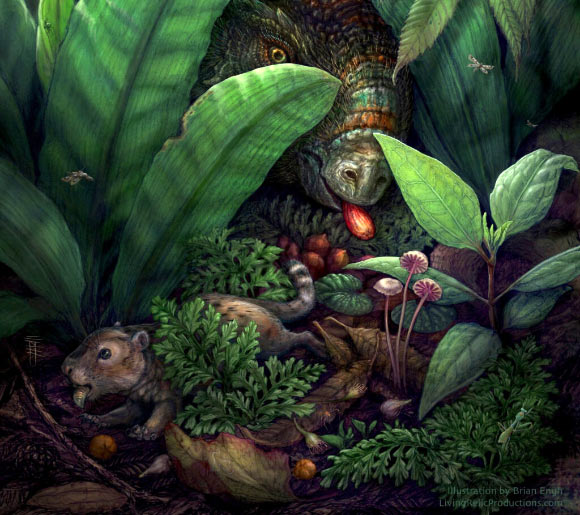
Notohypsilodon comodorensis, an elasmarian ornithopod dinosaur.

Notohypsilodon comodorensis, an elasmarian ornithopod dinosaur.

Dinosauria Elasmaria Notohypsilophodon
Braincase of WSC 10058, holotype of Ornatops 
Braincase of Ornatops incantatus in digital 3D model in right lateral (A and C) and left lateral (D and F) views, with enlarged images of the right (B) and left (E) auditory regions.

Credit: McDonald AT, Wolfe DG, Freedman Fowler EA, Gates TA. 2021. A new brachylophosaurin (Dinosauria: Hadrosauridae) from the Upper Cretaceous Menefee Formation of New Mexico. PeerJ 9:e11084 https://doi.org/10.7717/peerj.11084

Braincase of WSC 10058, holotype of Ornatops Braincase of Ornatops incantatus in digital 3D model in right lateral (A and C) and left lateral (D and F) views, with enlarged images of the right (B) and left (E) auditory regions. Credit: McDonald AT, Wolfe DG, Freedman Fowler EA, Gates TA. 2021. A new brachylophosaurin (Dinosauria: Hadrosauridae) from the Upper Cretaceous Menefee Formation of New Mexico. PeerJ 9:e11084 https://doi.org/10.7717/peerj.11084

Mexique Crétacé holotype Dinosauria +3
The hadrosaurid dinosaur Wulagasaurus dongi gen. et sp. nov. from the Upper Cretaceous Yuliangze Formation at the Wulaga quarry, China.

A. Holotype GMH W184, right dentary in lateral (A1) and medial (A2) views. B. GMH W217, right dentary in lateral (B1) and medial (B2) views.

The hadrosaurid dinosaur Wulagasaurus dongi gen. et sp. nov. from the Upper Cretaceous Yuliangze Formation at the Wulaga quarry, China. A. Holotype GMH W184, right dentary in lateral (A1) and medial (A2) views. B. GMH W217, right dentary in lateral (B1) and medial (B2) views.

Chine Crétacé holotype Dinosauria +3
Malefica is a hadrosaurid dinosaur from the Late Cretaceous of Texas in the United States. Like other hadrosaurs, Malefica was herbivorous, processing plant matter with their broad beaks and battery of teeth in the back of the mouth. It could grow to around 6 m in length, and weighed about 1 t. The discovery of Malefica helped to understand the distribution of hadrosaurs in Cretaceous North America, as well as evolutionary lineages between basal hadrosaurs and the more derived saurolophids.

Malefica is a hadrosaurid dinosaur from the Late Cretaceous of Texas in the United States. Like other hadrosaurs, Malefica was herbivorous, processing plant matter with their broad beaks and battery of teeth in the back of the mouth. It could grow to around 6 m in length, and weighed about 1 t. The discovery of Malefica helped to understand the distribution of hadrosaurs in Cretaceous North America, as well as evolutionary lineages between basal hadrosaurs and the more derived saurolophids.

États-Unis Crétacé Crétacé supérieur Dinosauria +5
Dentary of the hadrosauroid dinosaur Fylax thyrakolasus gen. et sp. nov. (IPS-36338, holotype) from the uppermost Maastrichtian Fontllonga-R locality; in posterior (A1), medial (A2), dorsal (A4), anterior (A5), lateral (A6), and ventral (A7) views. A detailed lingual view of the tooth crowns appears in A3.

Dentary of the hadrosauroid dinosaur Fylax thyrakolasus gen. et sp. nov. (IPS-36338, holotype) from the uppermost Maastrichtian Fontllonga-R locality; in posterior (A1), medial (A2), dorsal (A4), anterior (A5), lateral (A6), and ventral (A7) views. A detailed lingual view of the tooth crowns appears in A3.

dent Maastrichtien holotype Dinosauria +1
Theiophytalia kerri Brill & Carpenter, 2006 - ornithopod dinosaur skull from the Cretaceous of Colorado, USA. (YPM 1887, public display, Garden of the Gods visitor center, Colorado Springs, Colorado, USA)
This skull is the holotype and only known specimen of an entire genus of ornithopod dinosaurs, Theiophytalia.  Ornithopods were herbivorous dinosaurs.


From exhibit signage:
A Brand New Dinosaur Species Theiophytalia kerri
What we know about the dinosaur fossil - so far:
It is the only Theiophytalia kerri fossil known to exist in the world.
It is a brand new genus and species of dinosaur.
Theiophytalia kerri means "belonging to the Garden of the Gods".  "Theios" is a Greek word that means "belonging to the gods" and "phytalia" means "garden".  "kerri" honors James Hutchinson Kerr (pronounced "Care"), who discovered the dinosaur fossil.
Theiophytalia was a medium-sized dinosaur, measuring about 30 feet from head to tail.
It was found in 1878 in the Garden of the Gods in the lower Lytle Member of the Purgatoire Rock Formation of the Dakota Group.
The dinosaur fossil skull is from the Aptian-Albian Age of the Cretaceous Ear, 125 - 100 million years old.
Look closely at the fossil skull.  Where are the teeth located?  You can see the teeth in the back of the jaw.  There are no teeth in the front of the dinosaur's beak-like mouth.  This is evidence that the Theiophytalia was a plant eater.  It could nip and tear plants, then grind them between its tightly-packed back teeth, similar to plant-eaters of today.
Timeline:
Dinosaur Fossil Discovered, then Forgotten
1878 - James Kerr, geology professor at Colorado College, finds a fossil skull "in one of the ridges east of the red rocks of the Garden of the Gods."
1886 - O.C. Marsh, famous 1800s dinosaur collector from Yale University, obtains the fossil skull from James Kerr, identifies it as a Camptosaurus dinosaur, and sends the fossil to the Yale Peabody Museum in New Haven, Connecticut.
1886 - 1995 - While the dinosaur fossil skull safely rests in the Yale Museum for many decades, knowledge of its existence is forgotten in Colorado Springs.
Rediscovery - 117 years later
1994 - Colorado Springs City park staff research new exhibits for the Garden of the Gods Visitor and Nature Center, set to open in 1995.  They meet with Doctor Kirk Johnson, curator of paleontology at the Denver Museum of Nature & Science.
1995 - Kirk Johnson refers the park staff to his museum colleague Doctor Ken Carpenter, expert dinosaur scientist.  Doctor Carpenter remembers seeing in his files "something about a dinosaur fossil found in Garden of the Gods" and mails the following article to park staff.
Camptosaurus amplus No. 1887, Yale Museum, consisting of portions of the skull and lower jaw.  It was collected from deposits in the Garden of the Gods, Colorado Springs, Colorado.  With this specimen was found the following note in Professor O.C. Marsh's handwriting, "Part of this animal and various Sauropoda bones were taken out by Professor Kerr in 1878."
A Case of Mistaken Identity Reveals a Brand New Dinosaur!
1996 - Kirk Johnson (a Yale alumnus) secures permission to hand-carry the Camptosaurus fossil from the Yale Peabody Museum to Denver so that Ken Carpenter can make a cast (a precise replica) of the fossil.
Doctor Carpenter notices irregularities in the Camptosaurus fossil and decides to re-examine the fossil when his schedule permits.
1997 - The Camptosaurus fossil replica is given to the City of Colorado Springs and is exhibited at the Garden of the Gods Visitor and Nature Center.
2006 - Doctor Carpenter and his associate Kathleen Brill reassess the fossil skull and note that it differs from other Camptosaurus skulls in several significant ways, such as the narrower mouth and snout, and the position of the nasal openings, and the bony structures over the eyes.
Also, microscopic identification of the rock matrix clinging to the fossil, and research of archival maps, reveal that the fossil skull was actually found in the lower Dakota Rock Formation, not the Morrison Formation as originally reported in the 1800s.  The skull is from a dinosaur that lived in the Cretaceous Ear and can't be a Jurassic Era Camptosaurus.
Doctor Carpenter's exacting research reveals that the dinosaur skull is a brand new genus and species of dinosaur!  He names it Theiophytalia kerri.
2008 - The Theiophytalia kerri is proudly re-exhibited at the Garden of the Gods Visitor and Nature Center.


Classification: Animalia, Chordata, Vertebrata, Dinosauria, Ornithischia, Ornithopoda
Stratigraphy: lower Lytle Member, Purgatoire Formation, Dakota Group, Aptian to Albian Stages, upper Lower Cretaceous
Locality: Garden of the Gods, Colorado Springs, Colorado, USA


See info. at:
en.wikipedia.org/wiki/Theiophytalia
and

en.wikipedia.org/wiki/Ornithopoda

Theiophytalia kerri Brill & Carpenter, 2006 - ornithopod dinosaur skull from the Cretaceous of Colorado, USA. (YPM 1887, public display, Garden of the Gods visitor center, Colorado Springs, Colorado, USA) This skull is the holotype and only known specimen of an entire genus of ornithopod dinosaurs, Theiophytalia. Ornithopods were herbivorous dinosaurs. From exhibit signage: A Brand New Dinosaur Species Theiophytalia kerri What we know about the dinosaur fossil - so far: It is the only Theiophytalia kerri fossil known to exist in the world. It is a brand new genus and species of dinosaur. Theiophytalia kerri means "belonging to the Garden of the Gods". "Theios" is a Greek word that means "belonging to the gods" and "phytalia" means "garden". "kerri" honors James Hutchinson Kerr (pronounced "Care"), who discovered the dinosaur fossil. Theiophytalia was a medium-sized dinosaur, measuring about 30 feet from head to tail. It was found in 1878 in the Garden of the Gods in the lower Lytle Member of the Purgatoire Rock Formation of the Dakota Group. The dinosaur fossil skull is from the Aptian-Albian Age of the Cretaceous Ear, 125 - 100 million years old. Look closely at the fossil skull. Where are the teeth located? You can see the teeth in the back of the jaw. There are no teeth in the front of the dinosaur's beak-like mouth. This is evidence that the Theiophytalia was a plant eater. It could nip and tear plants, then grind them between its tightly-packed back teeth, similar to plant-eaters of today. Timeline: Dinosaur Fossil Discovered, then Forgotten 1878 - James Kerr, geology professor at Colorado College, finds a fossil skull "in one of the ridges east of the red rocks of the Garden of the Gods." 1886 - O.C. Marsh, famous 1800s dinosaur collector from Yale University, obtains the fossil skull from James Kerr, identifies it as a Camptosaurus dinosaur, and sends the fossil to the Yale Peabody Museum in New Haven, Connecticut. 1886 - 1995 - While the dinosaur fossil skull safely rests in the Yale Museum for many decades, knowledge of its existence is forgotten in Colorado Springs. Rediscovery - 117 years later 1994 - Colorado Springs City park staff research new exhibits for the Garden of the Gods Visitor and Nature Center, set to open in 1995. They meet with Doctor Kirk Johnson, curator of paleontology at the Denver Museum of Nature & Science. 1995 - Kirk Johnson refers the park staff to his museum colleague Doctor Ken Carpenter, expert dinosaur scientist. Doctor Carpenter remembers seeing in his files "something about a dinosaur fossil found in Garden of the Gods" and mails the following article to park staff. Camptosaurus amplus No. 1887, Yale Museum, consisting of portions of the skull and lower jaw. It was collected from deposits in the Garden of the Gods, Colorado Springs, Colorado. With this specimen was found the following note in Professor O.C. Marsh's handwriting, "Part of this animal and various Sauropoda bones were taken out by Professor Kerr in 1878." A Case of Mistaken Identity Reveals a Brand New Dinosaur! 1996 - Kirk Johnson (a Yale alumnus) secures permission to hand-carry the Camptosaurus fossil from the Yale Peabody Museum to Denver so that Ken Carpenter can make a cast (a precise replica) of the fossil. Doctor Carpenter notices irregularities in the Camptosaurus fossil and decides to re-examine the fossil when his schedule permits. 1997 - The Camptosaurus fossil replica is given to the City of Colorado Springs and is exhibited at the Garden of the Gods Visitor and Nature Center. 2006 - Doctor Carpenter and his associate Kathleen Brill reassess the fossil skull and note that it differs from other Camptosaurus skulls in several significant ways, such as the narrower mouth and snout, and the position of the nasal openings, and the bony structures over the eyes. Also, microscopic identification of the rock matrix clinging to the fossil, and research of archival maps, reveal that the fossil skull was actually found in the lower Dakota Rock Formation, not the Morrison Formation as originally reported in the 1800s. The skull is from a dinosaur that lived in the Cretaceous Ear and can't be a Jurassic Era Camptosaurus. Doctor Carpenter's exacting research reveals that the dinosaur skull is a brand new genus and species of dinosaur! He names it Theiophytalia kerri. 2008 - The Theiophytalia kerri is proudly re-exhibited at the Garden of the Gods Visitor and Nature Center. Classification: Animalia, Chordata, Vertebrata, Dinosauria, Ornithischia, Ornithopoda Stratigraphy: lower Lytle Member, Purgatoire Formation, Dakota Group, Aptian to Albian Stages, upper Lower Cretaceous Locality: Garden of the Gods, Colorado Springs, Colorado, USA See info. at: en.wikipedia.org/wiki/Theiophytalia and en.wikipedia.org/wiki/Ornithopoda

États-Unis Crétacé fossile holotype +4
Sanxiasaurus modaoxiensis, a neornithischian dinosaur.

Sanxiasaurus modaoxiensis, a neornithischian dinosaur.

Dinosauria Neornithischia Sanxiasaurus
Nevadadromeus schmitti, a neornithischian dinosaur.

Nevadadromeus schmitti, a neornithischian dinosaur.

Dinosauria Neornithischia Nevadadromeus
Changmiania liaoningensis, an ornithopod dinosaur from the Lower Cretaceous of Lujiatun (Liaoning Province, China).
(A) Holotype PMOL AD00114 in dorsal view; (B) anterior part of the holotype PMOL AD00114 in caudolateral view; (C) referred specimen PMOL LFV022 in dorsal view. Red arrows indicate the emplacement of the gastrolith clusters.

Changmiania liaoningensis, an ornithopod dinosaur from the Lower Cretaceous of Lujiatun (Liaoning Province, China). (A) Holotype PMOL AD00114 in dorsal view; (B) anterior part of the holotype PMOL AD00114 in caudolateral view; (C) referred specimen PMOL LFV022 in dorsal view. Red arrows indicate the emplacement of the gastrolith clusters.

Chine Crétacé holotype spécimen +2
Changchunsaurus parvus, a neornithischian dinosaur.

Changchunsaurus parvus, a neornithischian dinosaur.

Changchunsaurus Dinosauria Neornithischia
Impression in stone of small dinosaur "nodosaur".

Impression in stone of small dinosaur "nodosaur".

Dinosauria Propanoplosaurus
Vectipelta at Dinosaur Isle Museum, Isle of Wight, England

Vectipelta at Dinosaur Isle Museum, Isle of Wight, England

musée Dinosauria Vectipelta
Jiangxititan a titanosaurian sauropod from the Late Cretaceous of China. Typical for a sauropod, it had a long neck and stood on four pillar-like legs to support its massive body. Jiangxititan is a member of the Lognkosauria, which include some of the largest dinosaurs known, and is one of the few from mainland Asia. The discovery of Jiangxititan demonstrates the presence of both early-diverging and late-diverging titanosauriform sauropods in that area during the Late Cretaceous.

Jiangxititan a titanosaurian sauropod from the Late Cretaceous of China. Typical for a sauropod, it had a long neck and stood on four pillar-like legs to support its massive body. Jiangxititan is a member of the Lognkosauria, which include some of the largest dinosaurs known, and is one of the few from mainland Asia. The discovery of Jiangxititan demonstrates the presence of both early-diverging and late-diverging titanosauriform sauropods in that area during the Late Cretaceous.

Chine Crétacé Crétacé supérieur Dinosauria +5
Garumbatitan is a sauropod dinosaur from the Early Cretaceous of what is now Spain. It is classified as a basal somphospondylan - a Titanosauriform, but not a true Titanosaur.

Garumbatitan is a sauropod dinosaur from the Early Cretaceous of what is now Spain. It is classified as a basal somphospondylan - a Titanosauriform, but not a true Titanosaur.

Espagne Crétacé Crétacé inférieur Dinosauria +4
Blue Dinosaur Royal Ontario Museum
Taxons Argentinosauridae

Blue Dinosaur Royal Ontario Museum

musée États-Unis Argentinosauria Argentinosauridae +3
Blue Dinosaur Royal Ontario Museum
Taxons Argentinosauria

Blue Dinosaur Royal Ontario Museum

musée États-Unis Argentinosauria Argentinosauridae +3
1 2 3 4 5 6 7 8 9 10 11 12 13 14 15 16 17 18 19 20 21 22 23 24 25 26

Actualités

Tout ce que les dinosaures sont prêts pour les changements de minimis de l’Union européenne
Dinosauria
À partir de demain (1er juillet), de nouveaux changements de minimis de l’UE entrent en vigueur pour les colis entrant dans l’Union européenne en provenance de pays tiers. Bien que la réglementation ait changé, Everything Dinosaur se prépare depuis de nombreux mois à ces nouvelles exigences. Ainsi, nos clients à travers l’Europe peuvent continuer à commander en toute confiance. La suppression
30/06/2026 everythingdinosaur ⚙ Traduction automatique
Des scientifiques décrivent officiellement le premier fossile de dinosaure découvert en Antarctique
vertèbre Antarctique Crétacé Crétacé supérieur fossile Dinosauria Titanosauria découverte
Les scientifiques ont officiellement décrit le premier fossile de dinosaure découvert en Antarctique. La découverte remarquable est une seule vertèbre provenant d’un titanosaure du Crétacé supérieur. Bien que le fossile ait été collecté il y a plus de quarante ans, les chercheurs n’ont confirmé son identité que récemment.  Le premier fossile de dinosaure découvert en Antarctique est décrit dans la revue Acta Palaeontologica Polonica.
29/06/2026 everythingdinosaur ⚙ Traduction automatique
Flowering Plants Were Already Thriving before Dinosaur-Killing Asteroid Hit
Les plantes à fleurs prospéraient déjà avant l’impact de l’astéroïde tueur de dinosaures
Mexique Crétacé fossile Dinosauria extinction formation
Les fossiles de la formation Jose Creek au Nouveau-Mexique révèlent que les angiospermes (plantes à fleurs) avaient construit des forêts denses et fruitières il y a près de 75 millions d'années - près de 9 millions d'années avant l'extinction massive de la fin du Crétacé qui a tué les dinosaures - remettant en question un récit évolutif de longue date sur la façon dont ils sont parvenus à dominer la planète. L'article Les plantes à fleurs prospéraient déjà avant l'attaque d'un astéroïde tueur de dinosaures apparaît en premier sur Sci.News : Breaking Science News.
29/06/2026 sci-news ⚙ Traduction automatique
Aider la faune locale grâce à la durabilité
Dinosauria
La nature nous entoure.  Une petite grenouille (Rana temporaria) a récemment émergé de l'étang de notre bureau.  Cependant, mesurant un peu plus d'un centimètre de long, ce jeune amphibien nous a rappelé pourquoi la protection de l'environnement est importante. Chez Everything Dinosaur, nous aidons la faune grâce au développement durable.  Nous reconnaissons nos responsabilités et avons modifié nos pratiques commerciales pour réduire l’impact environnemental. La grenouille a
28/06/2026 everythingdinosaur ⚙ Traduction automatique
Préparation d'une présentation exclusive lors du prestigieux événement DinoCon
Dinosauria Triceratops évolution
Sue de Everything Dinosaur a été occupée à préparer les détails de la conférence sur le Triceratops avant sa toute première présentation sur les dinosaures. L'événement spécial aura lieu à la DinoCon, où Sue expliquera comment la gamme Everything Dinosaur Evolution a été créée. La présentation, intitulée « Il faut une équipe pour construire un T. rex », offre un aperçu unique
27/06/2026 everythingdinosaur ⚙ Traduction automatique
1 2 3 4 5 6 7 8 9 10 11 12 13 14 15 16 17 18 19 20 21 22 23 24 25 26 27 28 29 30 31 32 33 34 35 36 37 38 39 40 41 42