Dinosauria

Taxon

211 image(s) · 103 Actualités

Voir la fiche

Galerie d'images

Blue Dinosaur Royal Ontario Museum
Taxons Futalognkosaurus

Blue Dinosaur Royal Ontario Museum

musée États-Unis Argentinosauria Argentinosauridae +3
Blue Dinosaur Royal Ontario Museum
Taxons Lognkosauria

Blue Dinosaur Royal Ontario Museum

musée États-Unis Argentinosauria Argentinosauridae +3
Blue Dinosaur Royal Ontario Museum
Taxons Argentinosauridae

Blue Dinosaur Royal Ontario Museum

musée États-Unis Argentinosauria Argentinosauridae +3
Blue Dinosaur Royal Ontario Museum
Taxons Argentinosauria

Blue Dinosaur Royal Ontario Museum

musée États-Unis Argentinosauria Argentinosauridae +3
Reconstruction of Bravasaurus arreirosorum a titanosaur dinosaur from the Late Cretaceous of Argentina
Taxons Bravasaurus

Reconstruction of Bravasaurus arreirosorum a titanosaur dinosaur from the Late Cretaceous of Argentina

Argentine Crétacé Crétacé supérieur Bravasaurus +2
Gandititan is a basal titanosaurian sauropod dinosaur from the Late Cretaceous of what is now China. It was a long-necked herbivore, typical of sauropods, with a relatively short tail, a characteristic of titanosaurs compared to other sauropods. Titanosauria have a wide range of body sizes, and Gandititan falls around the middle, slightly on the smaller side. Discovered with a fairly well articluated spine from neck to tail, Gandititan is estimated at about 14 m in total body length.
Taxons Gandititan

Gandititan is a basal titanosaurian sauropod dinosaur from the Late Cretaceous of what is now China. It was a long-necked herbivore, typical of sauropods, with a relatively short tail, a characteristic of titanosaurs compared to other sauropods. Titanosauria have a wide range of body sizes, and Gandititan falls around the middle, slightly on the smaller side. Discovered with a fairly well articluated spine from neck to tail, Gandititan is estimated at about 14 m in total body length.

Chine Crétacé Crétacé supérieur Dinosauria +2
Skeletal reconstruction of the Sauropod dinosaur Abdarainurus barsboldi based on holotype PIN 5669/1, as figured in Averianov and Lopatin, 2020. Outline is based on related Sauropods, modified from SlvrHwk.
Taxons Abdarainurus

Skeletal reconstruction of the Sauropod dinosaur Abdarainurus barsboldi based on holotype PIN 5669/1, as figured in Averianov and Lopatin, 2020. Outline is based on related Sauropods, modified from SlvrHwk.

holotype Abdarainurus Dinosauria
This file represents a possible life appearance of the Indian Titanosaurian Sauropod dinosaur Jainosaurus septentrionalis from the Late Cretaceous (Maastrichtian) of India, belonging to the Lameta Formation.
References used: 
Huene & Matley (1933)
Hunt et al. (1995)
Gunnar Bivens' skeletal diagram

Wilson et al. (2008) "Reassessment of Sauropod Dinosaur Jainosaurus (="Antarctosaurus") Septentrionalis from the Upper Cretaceous of India"
Taxons Jainosaurus

This file represents a possible life appearance of the Indian Titanosaurian Sauropod dinosaur Jainosaurus septentrionalis from the Late Cretaceous (Maastrichtian) of India, belonging to the Lameta Formation. References used: Huene & Matley (1933) Hunt et al. (1995) Gunnar Bivens' skeletal diagram Wilson et al. (2008) "Reassessment of Sauropod Dinosaur Jainosaurus (="Antarctosaurus") Septentrionalis from the Upper Cretaceous of India"

Inde Lameta Crétacé Crétacé supérieur +6
Qunkasaura is a titanosaurian sauropod dinosaur that lived approximately 75 million years ago in the Late Cretaceous of what is now Spain. Specifically, it is a saltasaurid titanosaur, and its discovery marks the first instance of two distinct lineages of this group present in the same locality. In the Late Cretaceous, Europe was a large archipelago, and the coexistence of these differing lineages indicates that saltasaurids arrived in the Iberian Peninsula much later than other groups of dinosaurs.
Taxons Qunkasaura

Qunkasaura is a titanosaurian sauropod dinosaur that lived approximately 75 million years ago in the Late Cretaceous of what is now Spain. Specifically, it is a saltasaurid titanosaur, and its discovery marks the first instance of two distinct lineages of this group present in the same locality. In the Late Cretaceous, Europe was a large archipelago, and the coexistence of these differing lineages indicates that saltasaurids arrived in the Iberian Peninsula much later than other groups of dinosaurs.

Espagne Crétacé Crétacé supérieur Dinosauria +4
Saltasaurus (which means "lizard from Salta") was a sauropod dinosaur of the Late Cretaceous Period. Relatively small among sauropods, though still massive by human standards, it was characterized by a diplodocid-like head
Taxons Saltasaurus

Saltasaurus (which means "lizard from Salta") was a sauropod dinosaur of the Late Cretaceous Period. Relatively small among sauropods, though still massive by human standards, it was characterized by a diplodocid-like head

Crétacé Crétacé supérieur Balochisauridae Dinosauria +7
Saltasaurus (which means "lizard from Salta") was a sauropod dinosaur of the Late Cretaceous Period. Relatively small among sauropods, though still massive by human standards, it was characterized by a diplodocid-like head
Taxons Lithostrotia

Saltasaurus (which means "lizard from Salta") was a sauropod dinosaur of the Late Cretaceous Period. Relatively small among sauropods, though still massive by human standards, it was characterized by a diplodocid-like head

Crétacé Crétacé supérieur Balochisauridae Dinosauria +7
Saltasaurus (which means "lizard from Salta") was a sauropod dinosaur of the Late Cretaceous Period. Relatively small among sauropods, though still massive by human standards, it was characterized by a diplodocid-like head
Taxons Titanosauridae

Saltasaurus (which means "lizard from Salta") was a sauropod dinosaur of the Late Cretaceous Period. Relatively small among sauropods, though still massive by human standards, it was characterized by a diplodocid-like head

Crétacé Crétacé supérieur Balochisauridae Dinosauria +7
Saltasaurus (which means "lizard from Salta") was a sauropod dinosaur of the Late Cretaceous Period. Relatively small among sauropods, though still massive by human standards, it was characterized by a diplodocid-like head
Taxons Saltasauridae

Saltasaurus (which means "lizard from Salta") was a sauropod dinosaur of the Late Cretaceous Period. Relatively small among sauropods, though still massive by human standards, it was characterized by a diplodocid-like head

Crétacé Crétacé supérieur Balochisauridae Dinosauria +7
Saltasaurus (which means "lizard from Salta") was a sauropod dinosaur of the Late Cretaceous Period. Relatively small among sauropods, though still massive by human standards, it was characterized by a diplodocid-like head
Taxons Saltasaurinae

Saltasaurus (which means "lizard from Salta") was a sauropod dinosaur of the Late Cretaceous Period. Relatively small among sauropods, though still massive by human standards, it was characterized by a diplodocid-like head

Crétacé Crétacé supérieur Balochisauridae Dinosauria +7
Saltasaurus (which means "lizard from Salta") was a sauropod dinosaur of the Late Cretaceous Period. Relatively small among sauropods, though still massive by human standards, it was characterized by a diplodocid-like head
Taxons Balochisauridae

Saltasaurus (which means "lizard from Salta") was a sauropod dinosaur of the Late Cretaceous Period. Relatively small among sauropods, though still massive by human standards, it was characterized by a diplodocid-like head

Crétacé Crétacé supérieur Balochisauridae Dinosauria +7
Saltasaurus (which means "lizard from Salta") was a sauropod dinosaur of the Late Cretaceous Period. Relatively small among sauropods, though still massive by human standards, it was characterized by a diplodocid-like head
Taxons Saltasaurini

Saltasaurus (which means "lizard from Salta") was a sauropod dinosaur of the Late Cretaceous Period. Relatively small among sauropods, though still massive by human standards, it was characterized by a diplodocid-like head

Crétacé Crétacé supérieur Balochisauridae Dinosauria +7
1 2 3 4 5 6 7 8 9 10 11 12 13 14

Actualités

Des scientifiques découvrent le dinosaure géant du « dernier titan », le plus grand d’Asie du Sud-Est jamais vu
Thaïlande Dinosauria
Un nouveau dinosaure massif découvert en Thaïlande est en train de réécrire l’histoire préhistorique de l’Asie du Sud-Est. Le nouveau nom Nagatitan chaiyaphumensis était un sauropode colossal au long cou qui pesait environ 27 tonnes et vivait il y a plus de 100 millions d'années. Les scientifiques pensent qu’il s’agit peut-être du dernier sauropode géant à parcourir la région avant que la montée des eaux ne transforme le paysage.
15/05/2026 sciencedaily ⚙ Traduction automatique
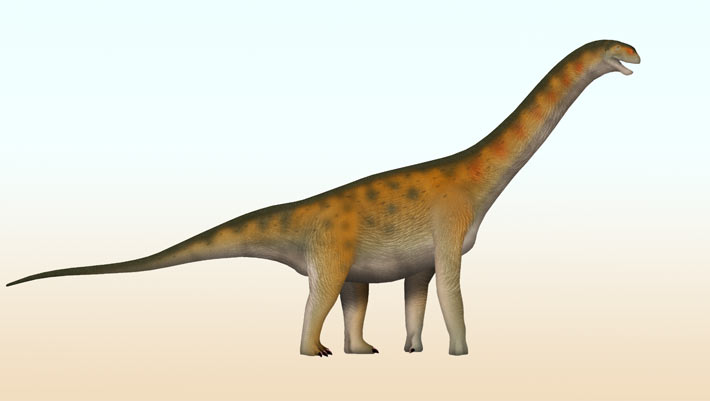
27 mètres, 30 tonnes : le nagatitan, « dernier titan de Thaïlande », est l’un des plus grands dinosaures découvert en Asie
Thaïlande Dinosauria
Il y a 113 millions d’années, un géant parcourait ce qui correspond aujourd’hui au nord-est de la Thaïlande. Long de plus de 27 mètres et pesant près de 30 tonnes, ce dinosaure inédit pourrait bien être le plus grand jamais découvert en Asie du Sud-Est. Mais au-delà de ses dimensions...
15/05/2026 futura-terre
"Objectivement énorme" : un nouveau dinosaure géant identifié en Thaïlande
Thaïlande Dinosauria fouille
Les premiers restes de l'énorme créature ont été découverts il y a une décennie par des habitants du nord-est de la Thaïlande, mais la fouille n'a été achevée qu'en 2024.
15/05/2026 sciencesetavenir
Un nouveau dinosaure sauropode du Crétacé inférieur du Brésil
Brésil Crétacé Crétacé inférieur Dasosaurus Dinosauria
Un nouveau genre de dinosaure sauropode a été nommé au Brésil.  Il élargit la diversité connue des sauropodes du Crétacé inférieur dans la partie nord de l'Amérique du Sud. En outre, le nouveau dinosaure Dasosaurus tocantinensis fournit de nouvelles preuves de la dispersion des dinosaures entre l’Europe, l’Afrique et l’Amérique du Sud. L'article scientifique décrivant le nouveau taxon a été
15/05/2026 everythingdinosaur ⚙ Traduction automatique
Giant New Dinosaur Species Discovered in Thailand Reveals Hidden Diversity of Asian Titans
Une nouvelle espèce de dinosaure géant découverte en Thaïlande révèle la diversité cachée des titans asiatiques
os Thaïlande Crétacé Crétacé inférieur Dinosauria Somphospondyli Titanosauriformes découverte nouvelle espèce
Les paléontologues ont identifié un nouveau genre et une nouvelle espèce de dinosaure titanosauriforme somphospondylan - le plus grand jamais découvert en Asie du Sud-Est - à partir d'ossements fossilisés trouvés en Thaïlande, offrant ainsi une nouvelle preuve que la région abritait un groupe étonnamment diversifié d'énormes herbivores au début du Crétacé. L'article Une nouvelle espèce de dinosaure géant découverte en Thaïlande révèle la diversité cachée des titans asiatiques apparaît en premier sur Sci.News : Breaking Science News.
14/05/2026 sci-news ⚙ Traduction automatique
1 2 3 4 5 6 7 8 9 10 11 12 13 14 15 16 17 18 19 20 21