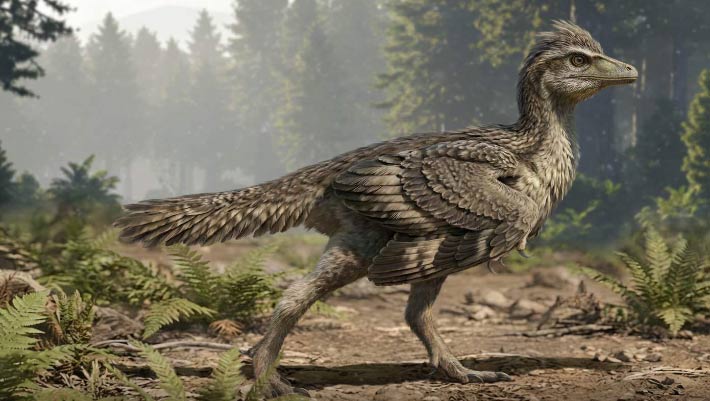
Dinosauria

Taxon

412 image(s) · 210 Actualités

Voir la fiche

Galerie d'images

Moyeni dinosaur tracks.

Photographs of plaster casts (positives) of Grallator track 6 (A) and Anomoepus track 8 (B) made at the Moyeni tracksite by the authors. Tracks are shown at the same scale (10 cm), and hatching pattern indicates broken surfaces. The Grallator hind foot print was made by pedal digits II–IV; the trackmaker's phalangeal formula was 3–4–5. Digits I and V did not contact the substrate. The rugose texture surrounding the print is the algal mat. The Anomoepus manus–pes couple registers all five manual digits (i–v), four pedal digits (I–IV), the metatarsus (mt), and toe drag marks (dm). Additional structures to the left of the pes are incidental marks made by a different trackmaker.
Taxons Anomoepus

Moyeni dinosaur tracks. Photographs of plaster casts (positives) of Grallator track 6 (A) and Anomoepus track 8 (B) made at the Moyeni tracksite by the authors. Tracks are shown at the same scale (10 cm), and hatching pattern indicates broken surfaces. The Grallator hind foot print was made by pedal digits II–IV; the trackmaker's phalangeal formula was 3–4–5. Digits I and V did not contact the substrate. The rugose texture surrounding the print is the algal mat. The Anomoepus manus–pes couple registers all five manual digits (i–v), four pedal digits (I–IV), the metatarsus (mt), and toe drag marks (dm). Additional structures to the left of the pes are incidental marks made by a different trackmaker.

écaille moulage empreintes Anomoepus +2
Camarasaurus lentus (Marsh, 1889) sauropod dinosaur from the Jurassic of Utah, USA (public display, CM 11338, Carnegie Museum of Natural History, Pittsburgh, Pennsylvania, USA).
This is a near-complete juvenile sauropod dinosaur in the original fluvial sandstone matrix - such skeletons are extremely rare.
Classification: Animalia, Chordata, Vertebrata, Dinosauria, Sauropodomorpha, Camarasauridae
Stratigraphy: Brushy Basin Member, Morrison Formation, Upper Jurassic, 151 Ma
Locality: Carnegie Quarry, Dinosaur National Monument, northeastern Utah, USA


Sauropod dinosaurs were the largest terrestrial animals ever.  They all have the same basic body plan: large body with four walking legs, very long neck & tail, and a small head relative to body size.  Sauropods were herbivores, and are often perceived as holding their heads & necks up high to reach vegetation normally out of reach to other organisms.  Modern reconstructions of many sauropod species depict them with heads and necks held close to the horizontal, or at low angles above the horizontal.
Taxons Camarasauridae

Camarasaurus lentus (Marsh, 1889) sauropod dinosaur from the Jurassic of Utah, USA (public display, CM 11338, Carnegie Museum of Natural History, Pittsburgh, Pennsylvania, USA). This is a near-complete juvenile sauropod dinosaur in the original fluvial sandstone matrix - such skeletons are extremely rare. Classification: Animalia, Chordata, Vertebrata, Dinosauria, Sauropodomorpha, Camarasauridae Stratigraphy: Brushy Basin Member, Morrison Formation, Upper Jurassic, 151 Ma Locality: Carnegie Quarry, Dinosaur National Monument, northeastern Utah, USA Sauropod dinosaurs were the largest terrestrial animals ever. They all have the same basic body plan: large body with four walking legs, very long neck & tail, and a small head relative to body size. Sauropods were herbivores, and are often perceived as holding their heads & necks up high to reach vegetation normally out of reach to other organisms. Modern reconstructions of many sauropod species depict them with heads and necks held close to the horizontal, or at low angles above the horizontal.

musée États-Unis Morrison Jurassique +8
Camarasaurus lentus (Marsh, 1889) sauropod dinosaur from the Jurassic of Utah, USA (public display, CM 11338, Carnegie Museum of Natural History, Pittsburgh, Pennsylvania, USA).
This is a near-complete juvenile sauropod dinosaur in the original fluvial sandstone matrix - such skeletons are extremely rare.
Classification: Animalia, Chordata, Vertebrata, Dinosauria, Sauropodomorpha, Camarasauridae
Stratigraphy: Brushy Basin Member, Morrison Formation, Upper Jurassic, 151 Ma
Locality: Carnegie Quarry, Dinosaur National Monument, northeastern Utah, USA


Sauropod dinosaurs were the largest terrestrial animals ever.  They all have the same basic body plan: large body with four walking legs, very long neck & tail, and a small head relative to body size.  Sauropods were herbivores, and are often perceived as holding their heads & necks up high to reach vegetation normally out of reach to other organisms.  Modern reconstructions of many sauropod species depict them with heads and necks held close to the horizontal, or at low angles above the horizontal.
Taxons Camarasaurus

Camarasaurus lentus (Marsh, 1889) sauropod dinosaur from the Jurassic of Utah, USA (public display, CM 11338, Carnegie Museum of Natural History, Pittsburgh, Pennsylvania, USA). This is a near-complete juvenile sauropod dinosaur in the original fluvial sandstone matrix - such skeletons are extremely rare. Classification: Animalia, Chordata, Vertebrata, Dinosauria, Sauropodomorpha, Camarasauridae Stratigraphy: Brushy Basin Member, Morrison Formation, Upper Jurassic, 151 Ma Locality: Carnegie Quarry, Dinosaur National Monument, northeastern Utah, USA Sauropod dinosaurs were the largest terrestrial animals ever. They all have the same basic body plan: large body with four walking legs, very long neck & tail, and a small head relative to body size. Sauropods were herbivores, and are often perceived as holding their heads & necks up high to reach vegetation normally out of reach to other organisms. Modern reconstructions of many sauropod species depict them with heads and necks held close to the horizontal, or at low angles above the horizontal.

musée États-Unis Morrison Jurassique +8
Montage of four pachycephalosaurs. Clockwise from top left: Stegoceras, Prenocephale, Pachycephalosaurus and Homalocephale. These files are already on Commons with their respective licenses. This montage was made for the article Pachycephalosauria on Wikipedia.
File:Stegoceras mount.jpg
File:Dinosauria - Prenocephale.jpg
File:Fossil Pachycephalosaurus.jpg
File:Homalocephale skull.jpg
Taxons Pachycephalosauria

Montage of four pachycephalosaurs. Clockwise from top left: Stegoceras, Prenocephale, Pachycephalosaurus and Homalocephale. These files are already on Commons with their respective licenses. This montage was made for the article Pachycephalosauria on Wikipedia. File:Stegoceras mount.jpg File:Dinosauria - Prenocephale.jpg File:Fossil Pachycephalosaurus.jpg File:Homalocephale skull.jpg

fossile Dinosauria Homalocephale Pachycephalosauria +3
Saltasaurus (which means "lizard from Salta") was a sauropod dinosaur of the Late Cretaceous Period. Relatively small among sauropods, though still massive by human standards, it was characterized by a diplodocid-like head
Taxons Lithostrotia

Saltasaurus (which means "lizard from Salta") was a sauropod dinosaur of the Late Cretaceous Period. Relatively small among sauropods, though still massive by human standards, it was characterized by a diplodocid-like head

Crétacé Crétacé supérieur Dinosauria Diplodocidae +4
Saltasaurus (which means "lizard from Salta") was a sauropod dinosaur of the Late Cretaceous Period. Relatively small among sauropods, though still massive by human standards, it was characterized by a diplodocid-like head
Taxons Saltasauridae

Saltasaurus (which means "lizard from Salta") was a sauropod dinosaur of the Late Cretaceous Period. Relatively small among sauropods, though still massive by human standards, it was characterized by a diplodocid-like head

Crétacé Crétacé supérieur Dinosauria Diplodocidae +4
Saltasaurus (which means "lizard from Salta") was a sauropod dinosaur of the Late Cretaceous Period. Relatively small among sauropods, though still massive by human standards, it was characterized by a diplodocid-like head
Taxons Saltasaurinae

Saltasaurus (which means "lizard from Salta") was a sauropod dinosaur of the Late Cretaceous Period. Relatively small among sauropods, though still massive by human standards, it was characterized by a diplodocid-like head

Crétacé Crétacé supérieur Dinosauria Diplodocidae +4
Saltasaurus (which means "lizard from Salta") was a sauropod dinosaur of the Late Cretaceous Period. Relatively small among sauropods, though still massive by human standards, it was characterized by a diplodocid-like head
Taxons Saltasaurus

Saltasaurus (which means "lizard from Salta") was a sauropod dinosaur of the Late Cretaceous Period. Relatively small among sauropods, though still massive by human standards, it was characterized by a diplodocid-like head

Crétacé Crétacé supérieur Dinosauria Diplodocidae +4
Elangatoolithidae fossil dinosaur eggs, from China. Exhibit in the Academy of Natural Sciences, 1900 Benjamin Franklin Parkway, Philadelphia, Pennsylvania, USA. Photography was permitted in this area of the museum without restrictions.
Taxons Elongatoolithidae

Elangatoolithidae fossil dinosaur eggs, from China. Exhibit in the Academy of Natural Sciences, 1900 Benjamin Franklin Parkway, Philadelphia, Pennsylvania, USA. Photography was permitted in this area of the museum without restrictions.

musée Chine États-Unis fossile +2
Fossil specimen of Ornithomimus sp. (TMP 1995.110.1), Royal Tyrrell Museum. This specimen was recovered from the middle Dinosaur Park Formation of Alberta, Canada.
Taxons Ornithomimidae

Fossil specimen of Ornithomimus sp. (TMP 1995.110.1), Royal Tyrrell Museum. This specimen was recovered from the middle Dinosaur Park Formation of Alberta, Canada.

musée Canada Allemagne Dinosaur Park +6
Dinosaur State Park and Arboretum, Rocky Hill, Connecticut, USA. Close-up of dinosaur prints.
Taxons Eubrontes

Dinosaur State Park and Arboretum, Rocky Hill, Connecticut, USA. Close-up of dinosaur prints.

États-Unis Dinosauria Eubrontes
Chasmosaurus belli ROM 843, Royal Tyrrell Museum of Paleontology. Late Cretaceous 75-74.5 millions years ago. Found at Dinosaur Provincial Park, Alberta, and prepared at the Royal Tyrrell Museum of Paleontology, Drumheller, Alberta.
Taxons Chasmosaurinae

Chasmosaurus belli ROM 843, Royal Tyrrell Museum of Paleontology. Late Cretaceous 75-74.5 millions years ago. Found at Dinosaur Provincial Park, Alberta, and prepared at the Royal Tyrrell Museum of Paleontology, Drumheller, Alberta.

musée Canada Crétacé Crétacé supérieur +4
Elasmosaurus platyurus in the Rocky Mountain Dinosaur Resource Center in Woodland Park, Colorado
Taxons Elasmosauridae

Elasmosaurus platyurus in the Rocky Mountain Dinosaur Resource Center in Woodland Park, Colorado

Dinosauria Elasmosauridae Elasmosaurus
Elasmosaurus platyurus in the Rocky Mountain Dinosaur Resource Center in Woodland Park, Colorado
Taxons Elasmosaurus

Elasmosaurus platyurus in the Rocky Mountain Dinosaur Resource Center in Woodland Park, Colorado

Dinosauria Elasmosauridae Elasmosaurus
Taken at the Minnosota Science Museum: Dinosaurs and Fossils Gallery.

Creative Commons licensed photo by ideonexus.com. Please feel free to take and reuse for any purpose.
Taxons Mosasaurinae

Taken at the Minnosota Science Museum: Dinosaurs and Fossils Gallery. Creative Commons licensed photo by ideonexus.com. Please feel free to take and reuse for any purpose.

musée fossile Dinosauria Mosasaurinae
Montage of six dinosaur fossils: (clockwise from top left) Deinonychus antirrhopus, Buitreraptor gonzalezorum, Velociraptor mongoliensis, Microraptor gui, Halszkaraptor escuilliei, and Zhenyuanlong suni. This is a collection of six different works already found in Wikimedia Commons:
File:Deinonychus FMNH.jpg
File:Buitreraptor FMNH.jpg
File:Velociraptor Wyoming Dinosaur Center.jpg
File:MicroraptorGui-PaleozoologicalMuseumOfChina-May23-08.jpg
File:Halszkaraptor escuilliei.jpg
File:Zhenyuanlong.jpg
All of them are either under a free license already in Wikimedia Commons or in the public domain
Taxons Dromaeosauridae

Montage of six dinosaur fossils: (clockwise from top left) Deinonychus antirrhopus, Buitreraptor gonzalezorum, Velociraptor mongoliensis, Microraptor gui, Halszkaraptor escuilliei, and Zhenyuanlong suni. This is a collection of six different works already found in Wikimedia Commons: File:Deinonychus FMNH.jpg File:Buitreraptor FMNH.jpg File:Velociraptor Wyoming Dinosaur Center.jpg File:MicroraptorGui-PaleozoologicalMuseumOfChina-May23-08.jpg File:Halszkaraptor escuilliei.jpg File:Zhenyuanlong.jpg All of them are either under a free license already in Wikimedia Commons or in the public domain

fossile Buitreraptor Deinonychus Dinosauria +6
1 2 3 4 5 6 7 8 9 10 11 12 13 14 15 16 17 18 19 20 21 22 23 24 25 26

Actualités

Mystery of Tyrannosaurus rex’s Tiny Arms May Finally Have an Answer
Le mystère des petits bras du Tyrannosaurus rex pourrait enfin avoir une réponse
os mâchoire prédateur proie Dinosauria Tyrannosaurus
Les paléontologues de l'University College de Londres et de l'Université de Cambridge affirment que les bras minuscules des grands dinosaures prédateurs ont évolué aux côtés de têtes massives et de mâchoires broyantes, ce qui suggère que les anciens prédateurs comptaient de plus en plus sur la morsure plutôt que sur la saisie de leurs proies. L’article Le mystère des petits bras du Tyrannosaurus rex pourrait enfin avoir une réponse apparaît en premier sur Sci.News : Breaking Science News.
20/05/2026 sci-news ⚙ Traduction automatique
Les petits bras du T. rex pourraient avoir évolué pour une raison étonnamment brutale
mâchoire membre chasse prédateur proie Dinosauria crâne
Pourquoi le T. rex avait-il des bras si petits ? Les scientifiques pensent désormais que c’est parce que sa tête géante est devenue l’outil de chasse ultime. Dans plusieurs groupes de dinosaures, des crânes plus forts et des mâchoires écrasantes ont évolué parallèlement à des membres antérieurs rétrécis, en particulier chez les prédateurs chassant d'énormes proies. En d’autres termes, une fois que la morsure est devenue suffisamment mortelle, les bras ont peut-être cessé d’avoir de l’importance.
20/05/2026 sciencedaily ⚙ Traduction automatique
Bonne Journée internationale des musées (2026)
musée Dinosauria communication
Aujourd'hui, c'est la Journée internationale des musées et, ici à Everything Dinosaur, nous souhaitons célébrer le travail incroyable réalisé par les musées du monde entier. Les musées contribuent à inspirer la curiosité, à encourager l’apprentissage et à connecter les gens avec la nature. Ils jouent également un rôle crucial dans l’éducation, la communication scientifique et la sensibilisation. Nous avons toujours aimé visiter les musées, notamment
18/05/2026 everythingdinosaur ⚙ Traduction automatique
Eocursor: Prehistoric Beast of the Week
Eocursor : Bête préhistorique de la semaine
Afrique du Sud Dinosauria Eocursor
Cette semaine, nous allons découvrir un petit dinosaure qui nous donne un aperçu des origines de certains des dinosaures les plus emblématiques, Eocursor parvus !  Eocursor se traduit par "Dawn Runner" car c'était un très ancien dinosaure et ses pattes extrêmement longues nous montrent qu'il s'agissait probablement d'un coureur rapide.  Du museau à la queue, il mesurait seulement environ 3 pieds (environ 1 m) et était un herbivore.  Il vivait il y a environ 210 millions d'années dans ce qui est aujourd'hui l'Afrique du Sud et a été découvert dans les années 1990, mais n'a pas été officiellement découvert.
17/05/2026 prehistoricbeastoftheweek ⚙ Traduction automatique
Un superbe crâne de stégosaure vieux de 150 millions d'années réécrit l'évolution des dinosaures
fossile Dacentrurus Dinosauria Stegosauria découverte évolution crâne
Une découverte spectaculaire de dinosaures en Espagne donne aux scientifiques un nouveau regard rare sur le monde des stégosaures. Les paléontologues ont découvert le crâne de stégosaure le mieux conservé jamais découvert en Europe, appartenant à l'emblématique dinosaure plaqué Dacentrurus armatus, qui parcourait la Terre il y a environ 150 millions d'années. Parce que les crânes de stégosaures sont extrêmement fragiles et ne survivent presque jamais intacts, le fossile aide les chercheurs à découvrir des détails jusqu'alors inconnus sur l'évolution de ces géants blindés.
17/05/2026 sciencedaily ⚙ Traduction automatique
1 2 3 4 5 6 7 8 9 10 11 12 13 14 15 16 17 18 19 20 21 22 23 24 25 26 27 28 29 30 31 32 33 34 35 36 37 38 39 40 41 42