48 image(s) · 6 Actualités
Voir la ficheRepresentative taxa from the Santonian Iharkút fauna from the Csehbánya Formation, Bakony Mountains, western Hungary. A Pannoniasaurus inexpectatus (Squamata, Mosasauroidea), dorsal vertebra (MTM uncatalogued) in dorsal view (photo by Réka Kalmár) B Foxemys trabanti (Pleurodira, Bothremydidae), skull (MTM V 2010.215.1.) in dorsal view (photo by Márton Rabi). C Bicuspidon aff. hatzegiensis (Squamata, Borioteiioidea), left dentary (MTM 2006.112.1.) in medial view (photo by László Makádi) D Basal tetanuran (Theropoda, Tetanurae), tooth (MTM V.01.54) in ?lingual view E Indeterminate abelisaurid (Theropoda, Abelisauridae), pedal ungual phalanx (MTM V 2008.43.1.) in lateral view F Pneumatoraptor fodori (Theropoda, Paraves), left scapulocoracoid (holotype, MTM V 2008.38.1.) in lateral view G Mochlodon vorosi (Ornithopoda, Rhabdodontidae), left dentary (holotype, MTM V 2010.105.1) in lateral view H Bakonydraco galaczi (Pterosauria, Azhdarchidae), mandible (holotype, MTM 2007.110.1) in dorsal view I Iharkutosuchus makadii (Eusuchia, Hylaeochampsidae), skull (holotype, MTM 2006.52.1) in dorsal view J Hungarosaurus tormai (Ankylosauria, Nodosauridae), right dentary (MTM 2007.25.2) in lateral view K Bauxitornis mindszentyae (Aves, Enantiornithes), left tarsometatarsus (holotype, MTM V 2009.38.1) in anterior view L Ajkaceratops kozmai (Ceratopsia), fused rostral and premaxillae (holotype, MTM V 2009.192.1) in lateral view. Scale bars: 2 cm in A, V, G, H, I, J; 1 cm in D, E, F, K, L; 1 mm in C.
Sketch-drawing of the vertebrate faunal assemblage of the Lisowice site (modified from Niedźwiedzki)10. (a) Large, theropod-like predatory archosaur (Smok wawelski); (b) large temnospondyl amphibian (Cyclotosaurus sp.); (c) small predatory dinosaurs (Neotheropoda indet.); (d) temnospondyl amphibian (Gerrothorax sp.); (e) small basal crocodylomorph (Crocodylomorpha indet.); (f) small diapsid (Choristodere-like animal); (g) hybodont sharks (Polyacrodus and Hybodus); (h) coelacanth fish; (i) dipnoan fish (Ptychoceratodus sp.); (j) actinopterygian fish; (k) gigantic dicynodont; (l) dinosauriforms or early dinosaurs (Dinosauriformes indet. or Dinosauria indet.); (m) small lepidosauromorphs (Sphenodontia indet.); (n) pterosaurs (Pterosauria indet.); (o) early mammaliaform (Hallautherium sp.).
A cast replica of a skeletal mount of the prehistoric pterosaur Anhanguera blittersdorffi on display at Melbourne Museum in Victoria, Australia.
Life restoration of the Brazilian ornithocheiroid pterosaur Anhanguera blittersdorffi. Digital painting; credit Matt Martyniuk.
Duria Antiquior, célèbre aquarelle du géologue Henry de la Beche représentant la vie dans l'ancien Dorset d'après des fossiles trouvés par Mary Anning.
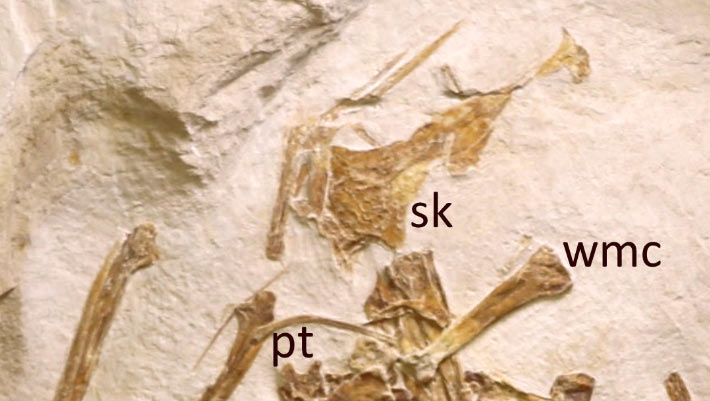
Holotype of Alcione elainus. Fig. 6 of: Longrich, N. R., Martill, D. M., & Andres, B. (2018). Late Maastrichtian pterosaurs from North Africa and mass extinction of Pterosauria at the Cretaceous-Paleogene boundary. PLoS biology, 16(3), e2001663. --- Original figure legend: A. elainus FSAC-OB 2, holotype partial skeleton and FSAC-OB 217, metacarpal IV. (A) Holotype right humerus in anterior view, (B) holotype right ulna and radius in anterior view, respectively, (C) holotype sternum in left lateral view, (D) referred metacarpal IV, (E) holotype, distal end of left metacarpal IV and left scapulocoracoid, and (F) holotype right femur in posterior view. Abbreviations: co, coracoid; cr, cristospine; dc, distal condyle; dpc, deltopectoral crest; ect, ectepicondyle; fh, femoral head; gl, glenoid; gt, greater trochanter; hh, humeral head; hum, humerus; mcIV, metacarpal IV, pc, proximal cotyle; pf, pneumatic foramen; rad, radius; scpr, supracondylar process; ste, sternum; uln, ulna.
This diagram illustrates how scientists believe the dinosaur group theropoda shall be classed in a phylogenetic tree, besides Sauropoda and Pterosauria. The main reason of this diagram is to show groups or families which had respiratory system like birds. AS in the diagram is abbreviations for "Airsacs", and ASW means "AirSacs supported by immobile femur and a knee-driven Walk". BL means "Bellow lungs". Airsacs are known in many different theropods, as well as in birds, which most scientists believe are descendants of dinosaurus. Air sacs are found in the primitive Tawa hallae,[1] the abelisaurid Majungasaurus,[2] as well as Allosauroids like Aerosteon.[3] There is also evidence for respiratory systems like penguinss in Deinonychosaurians.[4] The primitive bird Archaeopteryx also had airsacs (Bonde and Christiansen, 2000). It is very likely that Deinonychosaurians had airsacs. We don't know whether Deinonychosauria had a walking/breathing system with immobile thighbones, ASW (like birds) or movable thighbones. However, some people suggsest coeluosaurs had the same type of leg movement as birds ("kneedriven walking").[5] Bellow lungs are lungs like our own, which alternately is filled with air, and thereafter emptied, after which you take a new breath. This type of lungs exist in mammals, most reptiles, and most amphibians (although some frogs get their oxygen through the skin). There is no evidence for airsacs in Ornithischia, so the likely had bellow lungs. References.= ↑ (see the video at http://www.nsf.gov/news/special_reports/tawa/) ↑ (Claessens & O'connor, 2006). ↑ Alcober O.A, Sereno P.C, Larsson H.C.E et.al (2008), "Evidence for Avian Intrathoracic Air Sacs in a New Predatory Dinosaur from Argentina", Public Library of Science Journals. ↑ http://www.stumbleupon.com/su/20q5Z4/news.bbc.co.uk/2/hi/science/nature/7081166.stm ↑ http://www.geol.umd.edu/~tholtz/G104/lectures/104coelur.html.
cast of Quetzalcoatlus northropi humerus 03 - Pterosaurs Flight in the Age of Dinosaurs
cast of Quetzalcoatlus northropi humerus 02 - Pterosaurs Flight in the Age of Dinosaurs
Cast of Quetzalcoatlus northropi humerus 01 - Pterosaurs Flight in the Age of Dinosaurs
Figure 5: Measured and estimated azhdarchid pterosaur neck lengths against approximate wingspans.
Fossil of Quetzalcoatlus, an extinct pterosaur- Took the photo at Senckenberg Museum of Frankfurt
Several members of Pterodactyloidea (top to bottom): Pteranodon, Pterodaustro, the skulls of several pterosaurs (Guidraco, Anhanguera, Tupandactylus, and an unnamed dsungaripterid), Quetzalcoatlus, Aerodactylus, and Coloborhynchus