←

évolution

Thématique

17 image(s) · 72 Actualités

Galerie d'images

Rates of skeletal character evolution in the skull and postcranial skeleton of hadrosauroids. Cladograms illustrate the results from branch likelihood tests for two morphological partitions: skull (cranium and mandible) (A) and postcranial skeleton (B). In both cladograms, results from the branch likelihood tests are summarized on a strict consensus tree derived from four separately analyzed MPTs, each with 100 dating replicates (a total of 400 Hedman-dated phylogenies). Pie charts on branches illustrate the proportion of dating replicates that showed significantly high rates (red), slow rates (blue), or nonsignificant average rates (white). No pie charts are plotted on branches that showed nonsignificant rates in 100% of dating replicates. Branches that showed high rates (red) in more than 50% of dating replicates are doubled in length. See the Supplementary Material for Hedman-based results plotted separately for each MPT (Supplementary Fig. S2) and for results using the MBL dating method (Supplementary Fig. S3). Silhouettes were created by Scott Hartman and were downloaded from http://phylopic.org (Creative Commons license CC BY 3.0).

Rates of skeletal character evolution in the skull and postcranial skeleton of hadrosauroids. Cladograms illustrate the results from branch likelihood tests for two morphological partitions: skull (cranium and mandible) (A) and postcranial skeleton (B). In both cladograms, results from the branch likelihood tests are summarized on a strict consensus tree derived from four separately analyzed MPTs, each with 100 dating replicates (a total of 400 Hedman-dated phylogenies). Pie charts on branches illustrate the proportion of dating replicates that showed significantly high rates (red), slow rates (blue), or nonsignificant average rates (white). No pie charts are plotted on branches that showed nonsignificant rates in 100% of dating replicates. Branches that showed high rates (red) in more than 50% of dating replicates are doubled in length. See the Supplementary Material for Hedman-based results plotted separately for each MPT (Supplementary Fig. S2) and for results using the MBL dating method (Supplementary Fig. S3). Silhouettes were created by Scott Hartman and were downloaded from http://phylopic.org (Creative Commons license CC BY 3.0).

Protohadros datation évolution squelette +1
Phylogenetic affinities of Saltriovenator and evolution of the hand in Theropoda.

Reduced strict consensus of the shortest trees found by the phylogenetic analysis after pruning of Lewisuchus and Teleocrater. Numbers at nodes indicate decay index. Inferred manual phalangeal formula for selected nodes indicated below clade names. Hands of representative members of the avian stem (bold names) in extensor view (Herrerasaurus in flexor view), medial side at left, missing elements in white based on ancestral states inferred at least inclusive node containing the taxon. Red star indicates loss of metacarpal V, blue stars indicate multiple independent losses of metacarpal IV among tetanurans. Drawings by A. Cau.

Phylogenetic affinities of Saltriovenator and evolution of the hand in Theropoda. Reduced strict consensus of the shortest trees found by the phylogenetic analysis after pruning of Lewisuchus and Teleocrater. Numbers at nodes indicate decay index. Inferred manual phalangeal formula for selected nodes indicated below clade names. Hands of representative members of the avian stem (bold names) in extensor view (Herrerasaurus in flexor view), medial side at left, missing elements in white based on ancestral states inferred at least inclusive node containing the taxon. Red star indicates loss of metacarpal V, blue stars indicate multiple independent losses of metacarpal IV among tetanurans. Drawings by A. Cau.

dessin Herrerasaurus Lewisuchus Saltriovenator +2
Tylosaurus reconstruction. From Osborn, H. F. (1917). The origin and evolution of life, on the theory of action, reaction and interaction of energy.

Tylosaurus reconstruction. From Osborn, H. F. (1917). The origin and evolution of life, on the theory of action, reaction and interaction of energy.

Tylosaurus évolution
1 2

Actualités

Discutons de tout sur l'évolution des dinosaures dans une interview exclusive avec zoom en direct
Dinosauria évolution
Mike de Everything Dinosaur participera à une interview Zoom en direct le mois prochain. L'événement marque la première interview dédiée à la nouvelle gamme Everything Dinosaur Evolution. Animée par le paléoartiste Karim Zanaty d'Extinct Fine Art, la discussion en ligne explorera l'inspiration derrière le projet. De plus, les participants en apprendront davantage sur
31/05/2026 everythingdinosaur ⚙ Traduction automatique
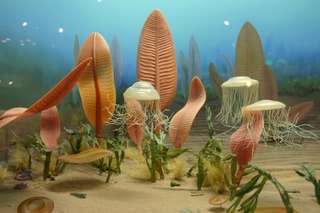
Découverte surprenante : ces fossiles vieux de 550 millions d'années réécrivent entièrement l'histoire des premiers animaux terrestres
fossile découverte évolution
Et si l’histoire des premiers animaux était à revoir ? La découverte de fossiles vieux de 567 millions d’années dans les Rocheuses canadiennes bouleverse le récit admis de l’évolution précoce de la vie complexe et suggère une diversification plus progressive qu’on ne l’imaginait.
25/05/2026 futura-terre
Des scientifiques découvrent le prédateur marin géant Tylosaurus rex qui terrorisait les océans anciens
prédateur fossile Mosasaurus Tylosaurus découverte évolution
Un nouveau prédateur marin colossal nommé Tylosaurus rex a été identifié à partir de fossiles trouvés au Texas, révélant un chasseur brutal de 43 pieds de long qui régnait sur les océans anciens il y a 80 millions d'années. Cette découverte présente non seulement l'un des plus grands mosasaures jamais connus, mais bouleverse également les idées de longue date sur l'évolution de ces reptiles marins.
23/05/2026 sciencedaily ⚙ Traduction automatique
Un superbe crâne de stégosaure vieux de 150 millions d'années réécrit l'évolution des dinosaures
fossile Dacentrurus Dinosauria Stegosauria découverte évolution crâne
Une découverte spectaculaire de dinosaures en Espagne donne aux scientifiques un nouveau regard rare sur le monde des stégosaures. Les paléontologues ont découvert le crâne de stégosaure le mieux conservé jamais découvert en Europe, appartenant à l'emblématique dinosaure plaqué Dacentrurus armatus, qui parcourait la Terre il y a environ 150 millions d'années. Parce que les crânes de stégosaures sont extrêmement fragiles et ne survivent presque jamais intacts, le fossile aide les chercheurs à découvrir des détails jusqu'alors inconnus sur l'évolution de ces géants blindés.
17/05/2026 sciencedaily ⚙ Traduction automatique
Une étonnante découverte de fossiles en Éthiopie réécrit les origines de l’humanité
Éthiopie fossile découverte évolution origine humaine
Une étonnante découverte de fossiles en Éthiopie montre que les premiers Homo et une espèce d'australopithèque jusqu'alors inconnue vivaient ensemble il y a environ 2,6 à 2,8 millions d'années. La découverte renverse la progression classique du « singe vers l’humain » et dépeint l’évolution humaine comme un arbre bondé et ramifié avec de multiples espèces coexistant. Les scientifiques ont daté les fossiles à l’aide de dépôts de cendres volcaniques et étudient actuellement ce que mangeaient ces anciens parents et s’ils se disputaient les ressources.
16/05/2026 sciencedaily ⚙ Traduction automatique
1 2 3 4 5 6 7 8 9 10 11 12 13 14 15