fossile

Nature du spécimen

224 image(s) · 140 Actualités

Galerie d'images

Lower Triassic fossil footprint (ichnite) of the ichnogenus Chirotherium, probably caused by an early archosaur, and first discovered 1833 in Hildburghausen (Thuringia, Germany). This specimen, however, ist from the Helsby Sandstone of the Storeton Quarry near Liverpool. Its species name is Chirotherium storetonense.[1]
Taxons Anticheiropus

Lower Triassic fossil footprint (ichnite) of the ichnogenus Chirotherium, probably caused by an early archosaur, and first discovered 1833 in Hildburghausen (Thuringia, Germany). This specimen, however, ist from the Helsby Sandstone of the Storeton Quarry near Liverpool. Its species name is Chirotherium storetonense.[1]

Allemagne Trias fossile spécimen +9
Lower Triassic fossil footprint (ichnite) of the ichnogenus Chirotherium, probably caused by an early archosaur, and first discovered 1833 in Hildburghausen (Thuringia, Germany). This specimen, however, ist from the Helsby Sandstone of the Storeton Quarry near Liverpool. Its species name is Chirotherium storetonense.[1]
Taxons Argoides

Lower Triassic fossil footprint (ichnite) of the ichnogenus Chirotherium, probably caused by an early archosaur, and first discovered 1833 in Hildburghausen (Thuringia, Germany). This specimen, however, ist from the Helsby Sandstone of the Storeton Quarry near Liverpool. Its species name is Chirotherium storetonense.[1]

Allemagne Trias fossile spécimen +9
Lower Triassic fossil footprint (ichnite) of the ichnogenus Chirotherium, probably caused by an early archosaur, and first discovered 1833 in Hildburghausen (Thuringia, Germany). This specimen, however, ist from the Helsby Sandstone of the Storeton Quarry near Liverpool. Its species name is Chirotherium storetonense.[1]
Taxons Delatorrichnus

Lower Triassic fossil footprint (ichnite) of the ichnogenus Chirotherium, probably caused by an early archosaur, and first discovered 1833 in Hildburghausen (Thuringia, Germany). This specimen, however, ist from the Helsby Sandstone of the Storeton Quarry near Liverpool. Its species name is Chirotherium storetonense.[1]

Allemagne Trias fossile spécimen +9
Lower Triassic fossil footprint (ichnite) of the ichnogenus Chirotherium, probably caused by an early archosaur, and first discovered 1833 in Hildburghausen (Thuringia, Germany). This specimen, however, ist from the Helsby Sandstone of the Storeton Quarry near Liverpool. Its species name is Chirotherium storetonense.[1]
Taxons Dinehichnus

Lower Triassic fossil footprint (ichnite) of the ichnogenus Chirotherium, probably caused by an early archosaur, and first discovered 1833 in Hildburghausen (Thuringia, Germany). This specimen, however, ist from the Helsby Sandstone of the Storeton Quarry near Liverpool. Its species name is Chirotherium storetonense.[1]

Allemagne Trias fossile spécimen +9
Lower Triassic fossil footprint (ichnite) of the ichnogenus Chirotherium, probably caused by an early archosaur, and first discovered 1833 in Hildburghausen (Thuringia, Germany). This specimen, however, ist from the Helsby Sandstone of the Storeton Quarry near Liverpool. Its species name is Chirotherium storetonense.[1]
Taxons Dromaeosauripus

Lower Triassic fossil footprint (ichnite) of the ichnogenus Chirotherium, probably caused by an early archosaur, and first discovered 1833 in Hildburghausen (Thuringia, Germany). This specimen, however, ist from the Helsby Sandstone of the Storeton Quarry near Liverpool. Its species name is Chirotherium storetonense.[1]

Allemagne Trias fossile spécimen +9
Lower Triassic fossil footprint (ichnite) of the ichnogenus Chirotherium, probably caused by an early archosaur, and first discovered 1833 in Hildburghausen (Thuringia, Germany). This specimen, however, ist from the Helsby Sandstone of the Storeton Quarry near Liverpool. Its species name is Chirotherium storetonense.[1]
Taxons Eutynichnium

Lower Triassic fossil footprint (ichnite) of the ichnogenus Chirotherium, probably caused by an early archosaur, and first discovered 1833 in Hildburghausen (Thuringia, Germany). This specimen, however, ist from the Helsby Sandstone of the Storeton Quarry near Liverpool. Its species name is Chirotherium storetonense.[1]

Allemagne Trias fossile spécimen +9
fossil Europasaurus, Aathal Dinosaur Museum.
Taxons Europasaurus

fossil Europasaurus, Aathal Dinosaur Museum.

musée fossile Dinosauria Europasaurus
Left humerus of Haestasaurus becklesii (NHMUK R1870). A, anterior view; B, posterior view; Abbreviations: af, anconeal fossa; dp, deltopectoral crest; hh, humeral head; ltf, lateral triceps fossa; mtf, medial triceps fossa.

This fossil was found in strata of the Hastings Beds (late Berriasian—Valanginian in age) on the coast near Hastings, East Sussex, England.
Taxons Haestasaurus

Left humerus of Haestasaurus becklesii (NHMUK R1870). A, anterior view; B, posterior view; Abbreviations: af, anconeal fossa; dp, deltopectoral crest; hh, humeral head; ltf, lateral triceps fossa; mtf, medial triceps fossa. This fossil was found in strata of the Hastings Beds (late Berriasian—Valanginian in age) on the coast near Hastings, East Sussex, England.

crête humérus Berriasien Valanginien +2
Holotype fossils of Glacialisaurus (PR 1823); metatarsals, tibia, fibula, ankle bones
Taxons Glacialisaurus

Holotype fossils of Glacialisaurus (PR 1823); metatarsals, tibia, fibula, ankle bones

os fossile holotype Glacialisaurus
Fossil Panphagia
Taxons Panphagia

Fossil Panphagia

fossile Panphagia
Fossil of Sthenarosaurus, an extinct reptile - Took the picture at Museum of Paleontology, Tuebingen
Taxons Sthenarosaurus

Fossil of Sthenarosaurus, an extinct reptile - Took the picture at Museum of Paleontology, Tuebingen

musée fossile Sthenarosaurus
fossil of seeleyosaurus
Taxons Seeleyosaurus

fossil of seeleyosaurus

fossile Seeleyosaurus
Fossil of Peteinosaurus zambellii (paratype MCSNB 3359), an extinct reptile
Taxons Peteinosaurus

Fossil of Peteinosaurus zambellii (paratype MCSNB 3359), an extinct reptile

fossile Peteinosaurus
Fossil at the Museo Argentino de Ciencias Naturales in Caballito, Buenos Aires, Argentina.
Taxons Pterodaustro

Fossil at the Museo Argentino de Ciencias Naturales in Caballito, Buenos Aires, Argentina.

Argentine fossile Pterodaustro
Fossil of Santanadactylus pricei and Anhanguera santanae, an extinct pterosaur- Took the photo at Senckenberg Museum of Frankfurt
Taxons Santanadactylus

Fossil of Santanadactylus pricei and Anhanguera santanae, an extinct pterosaur- Took the photo at Senckenberg Museum of Frankfurt

musée fossile Anhanguera Pterosauria +1
Fossil of Santanadactylus pricei and Anhanguera santanae, an extinct pterosaur- Took the photo at Senckenberg Museum of Frankfurt
Formations Romualdo

Fossil of Santanadactylus pricei and Anhanguera santanae, an extinct pterosaur- Took the photo at Senckenberg Museum of Frankfurt

musée fossile Anhanguera Pterosauria +1
1 2 3 4 5 6 7 8 9 10 11 12 13 14

Actualités

Earth’s Earliest Animals May Have Thrived Too Easily to Evolve
Les premiers animaux de la Terre ont peut-être prospéré trop facilement pour évoluer
reproduction Édiacarien fossile datation évolution
Les fossiles de certains des animaux les plus anciens connus sur Terre, datant d'il y a 574 millions d'années (période Édiacarienne), suggèrent que le clonage, et non la compétition, a dominé les mers de l'Édiacarien, ralentissant l'évolution jusqu'à ce que le stress environnemental contribue à l'essor de la reproduction sexuée et à un éclatement de la biodiversité. L’article Les premiers animaux de la Terre ont peut-être prospéré trop facilement pour évoluer est apparu en premier sur Sci.News : Breaking Science News.
10/06/2026 sci-news ⚙ Traduction automatique
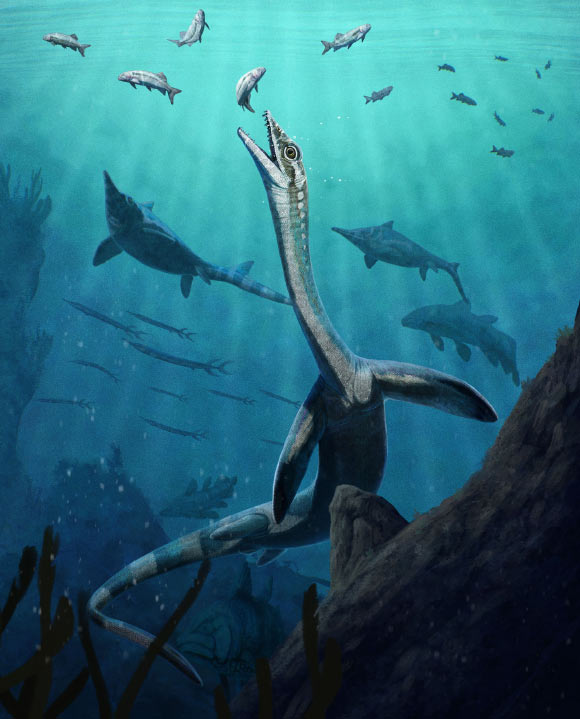
Description d'un fossile de dinosaure rare du groupe de Nanaimo du Crétacé supérieur
os vertèbre description Canada Colombie Crétacé Crétacé supérieur fossile Dinosauria Ornithomimosauria
Les chercheurs ont décrit une seule vertèbre caudale de dinosaure (coccyx) de l'île Denman (Colombie-Britannique, Canada).  Il a été identifié comme une vertèbre caudale d'ornithomimosaure. Le fossile, censé représenter un os de la partie médiane de la queue, n'est que le deuxième fossile de dinosaure identifié dans le groupe de Nanaimo du Crétacé supérieur. De plus, il
10/06/2026 everythingdinosaur ⚙ Traduction automatique
Fossil Discovery in Patagonia Reveals New Species of Horned Turtle
La découverte de fossiles en Patagonie révèle de nouvelles espèces de tortues à cornes
Argentine Maastrichtien fossile Dinosauria découverte extinction nouvelle espèce autres reptiles
Les paléontologues ont identifié une nouvelle espèce de tortue méiolaniforme du nord de la Patagonie, en Argentine, qui vivait à l'époque maastrichtienne, juste avant l'extinction massive déclenchée par un astéroïde qui a anéanti tous les dinosaures non aviaires. L'article La découverte de fossiles en Patagonie révèle de nouvelles espèces de tortues à cornes apparaît en premier sur Sci.News : Breaking Science News.
09/06/2026 sci-news ⚙ Traduction automatique
Description d'un nouveau dinosaure à quatre ailes en provenance de Chine
plume membre description Chine Crétacé Crétacé inférieur fossile Dinosauria Jian Microraptorinae nouvelle espèce partiel
Les paléontologues ont décrit une nouvelle espèce de théropode microraptorine du nord-ouest de la Chine. Nommé Jian changmaensis, ce petit dinosaure à plumes planait probablement sur quatre ailes. Le fossile fournit de nouvelles informations sur les écosystèmes du Crétacé inférieur et étend l’aire de répartition connue des Microraptorinae. Le matériau fossile est constitué d'une ceinture pectorale gauche partielle articulée et d'un membre antérieur. Il
08/06/2026 everythingdinosaur ⚙ Traduction automatique
Fish Fossils from Early Paleocene Fill 10-Million-Year Gap after Dinosaur Extinction
Des fossiles de poissons du début du Paléocène comblent un écart de 10 millions d'années après l'extinction des dinosaures
Égypte Paléocène fossile Dinosauria extinction
Les paléontologues ont décrit un assemblage de fossiles de poissons marins provenant du site de Qreiya 3, vieux de 62,2 millions d'années, dans le désert oriental d'Égypte, ouvrant ainsi une fenêtre sur cette transition. L'article Les fossiles de poissons du début du Paléocène comblent un écart de 10 millions d'années après l'extinction des dinosaures est apparu en premier sur Sci.News : Breaking Science News.
05/06/2026 sci-news ⚙ Traduction automatique
1 2 3 4 5 6 7 8 9 10 11 12 13 14 15 16 17 18 19 20 21 22 23 24 25 26 27 28