fossile

Nature du spécimen

371 image(s) · 183 Actualités

Galerie d'images

Tratayenia rosalesi restored in resting posture, based on fossil images.
Taxons Tratayenia

Tratayenia rosalesi restored in resting posture, based on fossil images.

fossile Tratayenia
A Berthasaura leopoldinae 3d Reconstruction by  Alex Pritchard Dinosauria - Dinosaur Fossil Replicas
Taxons Berthasaura

A Berthasaura leopoldinae 3d Reconstruction by Alex Pritchard Dinosauria - Dinosaur Fossil Replicas

fossile Berthasaura Dinosauria
Fossil - Took the picture at Museum of Natural History, Karlsruhe
Taxons Manemergus

Fossil - Took the picture at Museum of Natural History, Karlsruhe

musée fossile Manemergus
fossil of Isanosaurus attavipachi, an extinct sauropod
Taxons Isanosaurus

fossil of Isanosaurus attavipachi, an extinct sauropod

fossile Isanosaurus
Fossil of Tarascosaurus salluvicus, an extinct theropod discovered in the South of France
Taxons Tarascosaurus

Fossil of Tarascosaurus salluvicus, an extinct theropod discovered in the South of France

France fossile Tarascosaurus
The National history museum in Milan, Italy. Fossil of a juvenile individual of Scipionyx samniticus. The fossil (to date the first of this species ever) preserves in an exceptional way clear traces of soft tissues - a rather rare event. Picture by Giovanni Dall'Orto, April 22 2007.
Taxons Scipionyx

The National history museum in Milan, Italy. Fossil of a juvenile individual of Scipionyx samniticus. The fossil (to date the first of this species ever) preserves in an exceptional way clear traces of soft tissues - a rather rare event. Picture by Giovanni Dall'Orto, April 22 2007.

tissus musée Italie fossile +2
The ankle of Camposaurus arizonensis (UCMP 34998, reversed). The fossils is shown anterior, medial, posterior, lateral, and ventral views, from left to right. The arrow indicates anterior direction.
Taxons Camposaurus

The ankle of Camposaurus arizonensis (UCMP 34998, reversed). The fossils is shown anterior, medial, posterior, lateral, and ventral views, from left to right. The arrow indicates anterior direction.

fossile Camposaurus
Fossil of Thaisaurus - Took the picture at Museo di Storia Naturale, Milano
Taxons Thaisaurus

Fossil of Thaisaurus - Took the picture at Museo di Storia Naturale, Milano

fossile Thaisaurus
Ceratopsipes goldenensis Lockley & Hunt, 1995 - ceratopsian dinosaur trackway in the Cretaceous of Colorado, USA.
Ceratopsians are the "horned dinosaurs".  They were large, quadrupedal, herbivorous dinosaurs having a beaked skull and a frill - an extension of bone behind the skull that partially covered the neck.  Ceratopsian dinosaurs are known from the Jurassic and Cretaceous.  The last members of the group died out at the Cretaceous-Tertiary boundary, 65 million years ago.
Seen here is a ceratopsian dinosaur trackway.  Ceratopsian footprints are very rare.  The best examples are in Colorado's Laramie Formation, a nonmarine, coastal plain to deltaic succession of mostly mixed siliciclastic sedimentary rocks - sandstones, siltstones, claystones, and coals.  The footprints here consist of convex bulges on the basal surfaces of structurally-tilted sandstone beds.
The ichnospecies Ceratopsipes goldenensis was named based on footprints at this locality.  The trackmaker was very likely Triceratops, the # 1 most famous ceratopsian dinosaur.


From on-site signage:
Triceratops Tracks
Several tracks of Triceratops, or a closely related horned dinosaur were first discovered in this area and named Ceratopsipes goldenensis (meaning tracks of a horned dinosaur from Golden).  By happy coincidence, the first Triceratops known to science also comes from the greater Denver area near 13th Avenue and Federal Blvd.  Growing to a length of almost 25 feet, Triceratops and other members of the horned dinosaur family were herbivorous animals that roamed in herds.  Their trademark horns and frills that covered their necks probably served for defense.  A replica Triceratops skull is on display in the clubhouse at the Fossil Trace Golf Club.
These tracks (identified by small signs) help us understand that Triceratops walked with a narrow gait and erect front limbs  than with a wide, sprawling gait as previously depicted.  In 1887, the first Triceratops bones known to science were also discovered locally at a site near 13th Avenue and Federal Boulevard in Denver.
Nearby one may see many other traces of life such as burrows, probably made by invertebrates and impressions of plant debris.  Note that you are looking at all tracks and traces from the underside - in negative aspect - what one might call a worm’s eye view.  All of these trace fossils indicate that the Golden area once had a warm, temperate to subtropical climate.


Classification: Animalia, Chordata, Vertebrata, Reptilia, Archosauria, Dinosauria, Ornithischia, Marginocephalia, Ceratopsia, Ceratopsidae
Stratigraphy: Laramie Formation, Maastrichtian Stage, upper Upper Cretaceous
Locality: outcrop along Triceratops Trail, Parfet Prehistoric Preserve, southern side of the town of Golden, Colorado, USA (~vicinity of 39° 44' 35.24" North latitude, 105° 13’ 09.69" West longitude)


Some info. from:

Lockley & Hunt (1995) - Ceratopsid tracks and associated ichnofauna from the Laramie Formation (Upper Cretaceous: Maastrichtian) of Colorado.  Journal of Vertebrate Paleontology 15: 592-614.
Taxons Ceratopsipes

Ceratopsipes goldenensis Lockley & Hunt, 1995 - ceratopsian dinosaur trackway in the Cretaceous of Colorado, USA. Ceratopsians are the "horned dinosaurs". They were large, quadrupedal, herbivorous dinosaurs having a beaked skull and a frill - an extension of bone behind the skull that partially covered the neck. Ceratopsian dinosaurs are known from the Jurassic and Cretaceous. The last members of the group died out at the Cretaceous-Tertiary boundary, 65 million years ago. Seen here is a ceratopsian dinosaur trackway. Ceratopsian footprints are very rare. The best examples are in Colorado's Laramie Formation, a nonmarine, coastal plain to deltaic succession of mostly mixed siliciclastic sedimentary rocks - sandstones, siltstones, claystones, and coals. The footprints here consist of convex bulges on the basal surfaces of structurally-tilted sandstone beds. The ichnospecies Ceratopsipes goldenensis was named based on footprints at this locality. The trackmaker was very likely Triceratops, the # 1 most famous ceratopsian dinosaur. From on-site signage: Triceratops Tracks Several tracks of Triceratops, or a closely related horned dinosaur were first discovered in this area and named Ceratopsipes goldenensis (meaning tracks of a horned dinosaur from Golden). By happy coincidence, the first Triceratops known to science also comes from the greater Denver area near 13th Avenue and Federal Blvd. Growing to a length of almost 25 feet, Triceratops and other members of the horned dinosaur family were herbivorous animals that roamed in herds. Their trademark horns and frills that covered their necks probably served for defense. A replica Triceratops skull is on display in the clubhouse at the Fossil Trace Golf Club. These tracks (identified by small signs) help us understand that Triceratops walked with a narrow gait and erect front limbs than with a wide, sprawling gait as previously depicted. In 1887, the first Triceratops bones known to science were also discovered locally at a site near 13th Avenue and Federal Boulevard in Denver. Nearby one may see many other traces of life such as burrows, probably made by invertebrates and impressions of plant debris. Note that you are looking at all tracks and traces from the underside - in negative aspect - what one might call a worm’s eye view. All of these trace fossils indicate that the Golden area once had a warm, temperate to subtropical climate. Classification: Animalia, Chordata, Vertebrata, Reptilia, Archosauria, Dinosauria, Ornithischia, Marginocephalia, Ceratopsia, Ceratopsidae Stratigraphy: Laramie Formation, Maastrichtian Stage, upper Upper Cretaceous Locality: outcrop along Triceratops Trail, Parfet Prehistoric Preserve, southern side of the town of Golden, Colorado, USA (~vicinity of 39° 44' 35.24" North latitude, 105° 13’ 09.69" West longitude) Some info. from: Lockley & Hunt (1995) - Ceratopsid tracks and associated ichnofauna from the Laramie Formation (Upper Cretaceous: Maastrichtian) of Colorado. Journal of Vertebrate Paleontology 15: 592-614.

os membre défense États-Unis +16
Huaxiagnathus orientalis fossil displayed in Hong Kong Science Museum
Taxons Huaxiagnathus

Huaxiagnathus orientalis fossil displayed in Hong Kong Science Museum

musée fossile Huaxiagnathus
Holotype fossil specimen SMNS 12591 of Procompsognathus
Taxons Procompsognathus

Holotype fossil specimen SMNS 12591 of Procompsognathus

fossile holotype spécimen Procompsognathus
fossil Craspedodon
Taxons Craspedodon

fossil Craspedodon

fossile Craspedodon
Fossil of Lurdusaurus, an ornithopod dinosaur
Took the photo at Musee d'Histoire Naturelle, Brussels
Taxons Lurdusaurus

Fossil of Lurdusaurus, an ornithopod dinosaur Took the photo at Musee d'Histoire Naturelle, Brussels

fossile Dinosauria Lurdusaurus
Artistic reconstruction of the head of an early ceratopsian Xuanhuaceratops niei based on the currently known fossil material and the cranial remains of other chaoyangsaurids.
Taxons Xuanhuaceratops

Artistic reconstruction of the head of an early ceratopsian Xuanhuaceratops niei based on the currently known fossil material and the cranial remains of other chaoyangsaurids.

fossile Ceratopsia Chaoyangsauridae Xuanhuaceratops
Dinosaur National Monument is a United States National Monument located on the southeast flank of the Uinta Mountains on the border between Colorado and Utah at the confluence of the Green and Yampa Rivers. Although most of the monument area is in Moffat County, Colorado, the Dinosaur Quarry is located in Utah just to the north of the town of Jensen, Utah.
The nearest communities are Jensen, Utah, and Dinosaur, Colorado. The park contains over 800 paleontological sites and has fossils of dinosaurs including Allosaurus, Deinonychus, Abydosaurus (a nearly complete skull, lower jaws and first four neck vertebrae of the specimen DINO 16488 found here at the base of the Mussentuchit Member of the Cedar Mountain Formation is the holotype for the description) and various long-neck, long-tail sauropods. It was declared a National Monument on October 4, 1915.
The rock layer enclosing the fossils is a sandstone and conglomerate bed of alluvial or river bed origin known as the Morrison Formation from the Jurassic Period some 150 million years old. The dinosaurs and other ancient animals were carried by the river system which eventually entombed their remains in Utah.
The pile of sediments were later buried and lithified into solid rock. The layers of rock were later uplifted and tilted to their present angle by the mountain building forces that formed the Uintas during the Laramide orogeny. The relentless forces of erosion exposed the layers at the surface to be found by paleontologists.
The dinosaur fossil beds (bone beds) were discovered in 1909 by Earl Douglass, a paleontologist working and collecting for the Carnegie Museum of Natural History. He and his crews excavated thousands of fossils and shipped them back to the museum in Pittsburgh, Pennsylvania for study and display. President Woodrow Wilson proclaimed the dinosaur beds as Dinosaur National Monument in 1915. The monument boundaries were expanded in 1938 from the original 80-acre (320,000 m2) tract surrounding the dinosaur quarry in Utah, to its present extent of over 200,000 acres (800 km²) in Utah and Colorado, encompassing the spectacular river canyons of the Green and Yampa.
Though lesser-known than the fossil beds, the petroglyphs in Dinosaur National Monument are another treasure the monument holds. Due to problems with vandals, many of the sites are not listed on area maps.
The "Wall of Bones" located within the Dinosaur Quarry building in the park consists of a steeply tilted (67° from horizontal) rock layer which contains hundreds of dinosaur fossils. The enclosing rock has been chipped away to reveal the fossil bones intact for public viewing. In July 2006, the Quarry Visitor Center was closed due to structural problems that since 1957 had plagued the building because it was built on unstable clay. The decision was made to build a new facility elsewhere in the monument to house the visitor center and administrative functions, making it easier to resolve the structural problems of the quarry building while still retaining a portion of the historic Mission 66 era exhibit hall. It was announced in April 2009 that Dinosaur National Monument would receive $13.1 million to refurbish and reopen the gallery as part of the Obama administration's $750 billion stimulus plan. The Park Service successfully rebuilt the Quarry Exhibit Hall, supporting its weight on 70-foot steel micropile columns that extend to the bedrock below the unstable clay. The Dinosaur Quarry was reopened in Fall 2011.
en.wikipedia.org/wiki/Dinosaur_National_Monument

en.wikipedia.org/wiki/Wikipedia:Text_of_Creative_Commons_...
Taxons Abydosaurus

Dinosaur National Monument is a United States National Monument located on the southeast flank of the Uinta Mountains on the border between Colorado and Utah at the confluence of the Green and Yampa Rivers. Although most of the monument area is in Moffat County, Colorado, the Dinosaur Quarry is located in Utah just to the north of the town of Jensen, Utah. The nearest communities are Jensen, Utah, and Dinosaur, Colorado. The park contains over 800 paleontological sites and has fossils of dinosaurs including Allosaurus, Deinonychus, Abydosaurus (a nearly complete skull, lower jaws and first four neck vertebrae of the specimen DINO 16488 found here at the base of the Mussentuchit Member of the Cedar Mountain Formation is the holotype for the description) and various long-neck, long-tail sauropods. It was declared a National Monument on October 4, 1915. The rock layer enclosing the fossils is a sandstone and conglomerate bed of alluvial or river bed origin known as the Morrison Formation from the Jurassic Period some 150 million years old. The dinosaurs and other ancient animals were carried by the river system which eventually entombed their remains in Utah. The pile of sediments were later buried and lithified into solid rock. The layers of rock were later uplifted and tilted to their present angle by the mountain building forces that formed the Uintas during the Laramide orogeny. The relentless forces of erosion exposed the layers at the surface to be found by paleontologists. The dinosaur fossil beds (bone beds) were discovered in 1909 by Earl Douglass, a paleontologist working and collecting for the Carnegie Museum of Natural History. He and his crews excavated thousands of fossils and shipped them back to the museum in Pittsburgh, Pennsylvania for study and display. President Woodrow Wilson proclaimed the dinosaur beds as Dinosaur National Monument in 1915. The monument boundaries were expanded in 1938 from the original 80-acre (320,000 m2) tract surrounding the dinosaur quarry in Utah, to its present extent of over 200,000 acres (800 km²) in Utah and Colorado, encompassing the spectacular river canyons of the Green and Yampa. Though lesser-known than the fossil beds, the petroglyphs in Dinosaur National Monument are another treasure the monument holds. Due to problems with vandals, many of the sites are not listed on area maps. The "Wall of Bones" located within the Dinosaur Quarry building in the park consists of a steeply tilted (67° from horizontal) rock layer which contains hundreds of dinosaur fossils. The enclosing rock has been chipped away to reveal the fossil bones intact for public viewing. In July 2006, the Quarry Visitor Center was closed due to structural problems that since 1957 had plagued the building because it was built on unstable clay. The decision was made to build a new facility elsewhere in the monument to house the visitor center and administrative functions, making it easier to resolve the structural problems of the quarry building while still retaining a portion of the historic Mission 66 era exhibit hall. It was announced in April 2009 that Dinosaur National Monument would receive $13.1 million to refurbish and reopen the gallery as part of the Obama administration's $750 billion stimulus plan. The Park Service successfully rebuilt the Quarry Exhibit Hall, supporting its weight on 70-foot steel micropile columns that extend to the bedrock below the unstable clay. The Dinosaur Quarry was reopened in Fall 2011. en.wikipedia.org/wiki/Dinosaur_National_Monument en.wikipedia.org/wiki/Wikipedia:Text_of_Creative_Commons_...

os description musée États-Unis +13
fossil Europasaurus, Aathal Dinosaur Museum.
Taxons Europasaurus

fossil Europasaurus, Aathal Dinosaur Museum.

musée fossile Dinosauria Europasaurus
1 2 3 4 5 6 7 8 9 10 11 12 13 14 15 16 17 18 19 20 21 22 23 24

Actualités

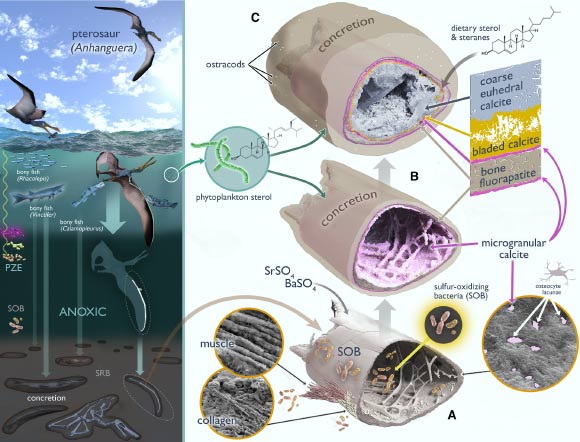
113-Million-Year-Old Pterosaur Fossil Reveals What Flying Reptiles Ate
Un fossile de ptérosaure vieux de 113 millions d'années révèle ce que mangeaient les reptiles volants
tissus alimentation Brésil fossile Anhangueridae Pterosauria poisson
Un fossile de ptérosaure vieux de 113 millions d'années provenant du nord-est du Brésil a fourni des preuves rares de tissus mous, de molécules organiques et de traces chimiques d'un régime alimentaire riche en poissons et en céphalopodes tels que les calmars ou les nautiles. L'article Un fossile de ptérosaure vieux de 113 millions d'années révèle ce que mangeaient les reptiles volants est apparu en premier sur Sci.News : Breaking Science News.
19/06/2026 sci-news ⚙ Traduction automatique
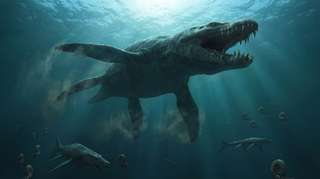
On le croyait roi des océans au Jurassique : une vertèbre percée raconte un combat d’une violence extrême
os dent vertèbre chasse musée Jurassique fossile Ichthyosauria Ichthyosaurus Pliosaurus comportement
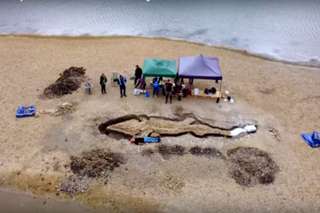
Oublié pendant plus d’un siècle dans les tiroirs d’un musée, un fossile refait aujourd’hui surface et raconte une scène de violence extrême dans les océans du Jurassique. Une vertèbre d’ichtyosaure, marquée par l’impact d’une dent brisée, révèle peut-être l’attaque d’un des plus redoutables...
17/06/2026 futura-terre
Un gigantesque « dragon des mers » vieux de 180 millions d’années découvert au Royaume-Uni
Royaume-Uni fossile Ichthyosauria découverte
180 millions d'années sous nos pieds. Un fossile d'ichtyosaure colossal vient d'être mis au jour en Angleterre, et il redessine ce que l'on croyait savoir sur ces reptiles marins préhistoriques. Une découverte qui a fait trembler le monde de la paléontologie britannique. 
16/06/2026 futura-terre
Fossils from Chinese Cave Fill Crucial Gap in History of Gigantopithecus blacki
Des fossiles provenant d'une grotte chinoise comblent une lacune cruciale dans l'histoire du Gigantopithecus blacki
dent Chine fossile origine humaine mammifères
Au fond d'une grotte calcaire du sud de la Chine, des paléontologues ont découvert un assemblage de treize dents fossilisées appartenant à Gigantopithecus blacki, la plus grande espèce de primate jamais connue. L'article Les fossiles des grottes chinoises comblent une lacune cruciale dans l'histoire de Gigantopithecus blacki apparaît en premier sur Sci.News : Breaking Science News.
15/06/2026 sci-news ⚙ Traduction automatique
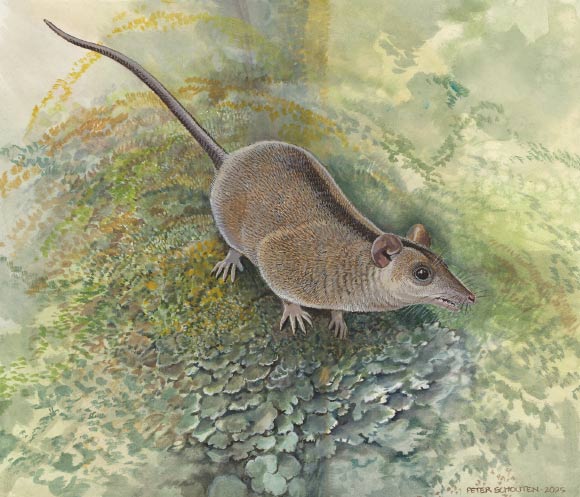
New Marsupial Lineage Emerges from Australian Fossils
Une nouvelle lignée marsupiale émerge des fossiles australiens
Australie Miocène fossile insecte mammifères nouvelle espèce
Les paléontologues ont décrit un nouveau genre et trois nouvelles espèces de petits marsupiaux insectivores provenant des dépôts du Miocène inférieur de la zone du patrimoine mondial de Riversleigh, dans le nord-ouest du Queensland, l'un des sites fossilifères les plus riches d'Australie. L'article Une nouvelle lignée marsupiale émerge des fossiles australiens apparaît en premier sur Sci.News : Breaking Science News.
15/06/2026 sci-news ⚙ Traduction automatique
1 2 3 4 5 6 7 8 9 10 11 12 13 14 15 16 17 18 19 20 21 22 23 24 25 26 27 28 29 30 31 32 33 34 35 36 37