←

fossile

Nature du spécimen

239 image(s) · 241 Actualités

Galerie d'images

Fossil specimen in the Natural History Museum of Utah, Salt Lake City, Utah, USA. Photography was permitted in the museum without restriction.
Taxons Hagryphus

Fossil specimen in the Natural History Museum of Utah, Salt Lake City, Utah, USA. Photography was permitted in the museum without restriction.

musée États-Unis fossile spécimen +1
fossil of juravenator
Taxons Juravenator

fossil of juravenator

fossile Juravenator
Fossil - Took the picture at Natural History Museum, Karlsruhe
Taxons Psephochelys

Fossil - Took the picture at Natural History Museum, Karlsruhe

musée fossile Psephochelys
Illustration of a fossil of Mongolosaurus
Taxons Mongolosaurus

Illustration of a fossil of Mongolosaurus

fossile Mongolosaurus
Chuanjiesaurus fossil in China Science and Technology Museum. The other two smaller suites of fossils are Lufengosaurus and Dilophosaurus.
Taxons Chuanjiesaurus

Chuanjiesaurus fossil in China Science and Technology Museum. The other two smaller suites of fossils are Lufengosaurus and Dilophosaurus.

musée Chine fossile Chuanjiesaurus +2
Fossil specimen of Liaoningosaurus paradoxus on display at the Beijing Museum of Natural History.
Taxons Liaoningosaurus

Fossil specimen of Liaoningosaurus paradoxus on display at the Beijing Museum of Natural History.

musée fossile spécimen Liaoningosaurus
Fossil with teeth of Macroplacus raeticus from Triassic of Germany, on display at the Museo Civico di Storia Naturale di Milano
Taxons Macroplacus

Fossil with teeth of Macroplacus raeticus from Triassic of Germany, on display at the Museo Civico di Storia Naturale di Milano

Allemagne Trias fossile Macroplacus
Tratayenia rosalesi restored in resting posture, based on fossil images.
Taxons Tratayenia

Tratayenia rosalesi restored in resting posture, based on fossil images.

fossile Tratayenia
A Berthasaura leopoldinae 3d Reconstruction by  Alex Pritchard Dinosauria - Dinosaur Fossil Replicas
Taxons Berthasaura

A Berthasaura leopoldinae 3d Reconstruction by Alex Pritchard Dinosauria - Dinosaur Fossil Replicas

fossile Berthasaura Dinosauria
Fossil - Took the picture at Museum of Natural History, Karlsruhe
Taxons Manemergus

Fossil - Took the picture at Museum of Natural History, Karlsruhe

musée fossile Manemergus
fossil of Isanosaurus attavipachi, an extinct sauropod
Taxons Isanosaurus

fossil of Isanosaurus attavipachi, an extinct sauropod

fossile Isanosaurus
Fossil of Tarascosaurus salluvicus, an extinct theropod discovered in the South of France
Taxons Tarascosaurus

Fossil of Tarascosaurus salluvicus, an extinct theropod discovered in the South of France

France fossile Tarascosaurus
The National history museum in Milan, Italy. Fossil of a juvenile individual of Scipionyx samniticus. The fossil (to date the first of this species ever) preserves in an exceptional way clear traces of soft tissues - a rather rare event. Picture by Giovanni Dall'Orto, April 22 2007.
Taxons Scipionyx

The National history museum in Milan, Italy. Fossil of a juvenile individual of Scipionyx samniticus. The fossil (to date the first of this species ever) preserves in an exceptional way clear traces of soft tissues - a rather rare event. Picture by Giovanni Dall'Orto, April 22 2007.

tissus musée Italie fossile +2
The ankle of Camposaurus arizonensis (UCMP 34998, reversed). The fossils is shown anterior, medial, posterior, lateral, and ventral views, from left to right. The arrow indicates anterior direction.
Taxons Camposaurus

The ankle of Camposaurus arizonensis (UCMP 34998, reversed). The fossils is shown anterior, medial, posterior, lateral, and ventral views, from left to right. The arrow indicates anterior direction.

fossile Camposaurus
Ceratopsipes goldenensis Lockley & Hunt, 1995 - ceratopsian dinosaur trackway in the Cretaceous of Colorado, USA.
Ceratopsians are the "horned dinosaurs".  They were large, quadrupedal, herbivorous dinosaurs having a beaked skull and a frill - an extension of bone behind the skull that partially covered the neck.  Ceratopsian dinosaurs are known from the Jurassic and Cretaceous.  The last members of the group died out at the Cretaceous-Tertiary boundary, 65 million years ago.
Seen here is a ceratopsian dinosaur trackway.  Ceratopsian footprints are very rare.  The best examples are in Colorado's Laramie Formation, a nonmarine, coastal plain to deltaic succession of mostly mixed siliciclastic sedimentary rocks - sandstones, siltstones, claystones, and coals.  The footprints here consist of convex bulges on the basal surfaces of structurally-tilted sandstone beds.
The ichnospecies Ceratopsipes goldenensis was named based on footprints at this locality.  The trackmaker was very likely Triceratops, the # 1 most famous ceratopsian dinosaur.


From on-site signage:
Triceratops Tracks
Several tracks of Triceratops, or a closely related horned dinosaur were first discovered in this area and named Ceratopsipes goldenensis (meaning tracks of a horned dinosaur from Golden).  By happy coincidence, the first Triceratops known to science also comes from the greater Denver area near 13th Avenue and Federal Blvd.  Growing to a length of almost 25 feet, Triceratops and other members of the horned dinosaur family were herbivorous animals that roamed in herds.  Their trademark horns and frills that covered their necks probably served for defense.  A replica Triceratops skull is on display in the clubhouse at the Fossil Trace Golf Club.
These tracks (identified by small signs) help us understand that Triceratops walked with a narrow gait and erect front limbs  than with a wide, sprawling gait as previously depicted.  In 1887, the first Triceratops bones known to science were also discovered locally at a site near 13th Avenue and Federal Boulevard in Denver.
Nearby one may see many other traces of life such as burrows, probably made by invertebrates and impressions of plant debris.  Note that you are looking at all tracks and traces from the underside - in negative aspect - what one might call a worm’s eye view.  All of these trace fossils indicate that the Golden area once had a warm, temperate to subtropical climate.


Classification: Animalia, Chordata, Vertebrata, Reptilia, Archosauria, Dinosauria, Ornithischia, Marginocephalia, Ceratopsia, Ceratopsidae
Stratigraphy: Laramie Formation, Maastrichtian Stage, upper Upper Cretaceous
Locality: outcrop along Triceratops Trail, Parfet Prehistoric Preserve, southern side of the town of Golden, Colorado, USA (~vicinity of 39° 44' 35.24" North latitude, 105° 13’ 09.69" West longitude)


Some info. from:

Lockley & Hunt (1995) - Ceratopsid tracks and associated ichnofauna from the Laramie Formation (Upper Cretaceous: Maastrichtian) of Colorado.  Journal of Vertebrate Paleontology 15: 592-614.
Taxons Ceratopsipes

Ceratopsipes goldenensis Lockley & Hunt, 1995 - ceratopsian dinosaur trackway in the Cretaceous of Colorado, USA. Ceratopsians are the "horned dinosaurs". They were large, quadrupedal, herbivorous dinosaurs having a beaked skull and a frill - an extension of bone behind the skull that partially covered the neck. Ceratopsian dinosaurs are known from the Jurassic and Cretaceous. The last members of the group died out at the Cretaceous-Tertiary boundary, 65 million years ago. Seen here is a ceratopsian dinosaur trackway. Ceratopsian footprints are very rare. The best examples are in Colorado's Laramie Formation, a nonmarine, coastal plain to deltaic succession of mostly mixed siliciclastic sedimentary rocks - sandstones, siltstones, claystones, and coals. The footprints here consist of convex bulges on the basal surfaces of structurally-tilted sandstone beds. The ichnospecies Ceratopsipes goldenensis was named based on footprints at this locality. The trackmaker was very likely Triceratops, the # 1 most famous ceratopsian dinosaur. From on-site signage: Triceratops Tracks Several tracks of Triceratops, or a closely related horned dinosaur were first discovered in this area and named Ceratopsipes goldenensis (meaning tracks of a horned dinosaur from Golden). By happy coincidence, the first Triceratops known to science also comes from the greater Denver area near 13th Avenue and Federal Blvd. Growing to a length of almost 25 feet, Triceratops and other members of the horned dinosaur family were herbivorous animals that roamed in herds. Their trademark horns and frills that covered their necks probably served for defense. A replica Triceratops skull is on display in the clubhouse at the Fossil Trace Golf Club. These tracks (identified by small signs) help us understand that Triceratops walked with a narrow gait and erect front limbs than with a wide, sprawling gait as previously depicted. In 1887, the first Triceratops bones known to science were also discovered locally at a site near 13th Avenue and Federal Boulevard in Denver. Nearby one may see many other traces of life such as burrows, probably made by invertebrates and impressions of plant debris. Note that you are looking at all tracks and traces from the underside - in negative aspect - what one might call a worm’s eye view. All of these trace fossils indicate that the Golden area once had a warm, temperate to subtropical climate. Classification: Animalia, Chordata, Vertebrata, Reptilia, Archosauria, Dinosauria, Ornithischia, Marginocephalia, Ceratopsia, Ceratopsidae Stratigraphy: Laramie Formation, Maastrichtian Stage, upper Upper Cretaceous Locality: outcrop along Triceratops Trail, Parfet Prehistoric Preserve, southern side of the town of Golden, Colorado, USA (~vicinity of 39° 44' 35.24" North latitude, 105° 13’ 09.69" West longitude) Some info. from: Lockley & Hunt (1995) - Ceratopsid tracks and associated ichnofauna from the Laramie Formation (Upper Cretaceous: Maastrichtian) of Colorado. Journal of Vertebrate Paleontology 15: 592-614.

os membre défense États-Unis +16
Huaxiagnathus orientalis fossil displayed in Hong Kong Science Museum
Taxons Huaxiagnathus

Huaxiagnathus orientalis fossil displayed in Hong Kong Science Museum

musée fossile Huaxiagnathus
1 2 3 4 5 6 7 8 9 10 11 12 13 14 15

Actualités

2,5 mètres seulement : voici la baleine miniature découverte au cœur du désert égyptien
Égypte Éocène fossile découverte mammifères
2,5 mètres, 187 kilos : voici la plus petite baleine jamais identifiée. Vieux de 41 millions d'années, ce fossile minuscule a refait surface en plein désert égyptien. Il en dit long sur cette période durant laquelle les ancêtres des cétacés quittaient la terre pour l'océan. 
27/06/2026 futura-terre
Que mangeaient les dinosaures ? Un guide utile sur les régimes alimentaires des dinosaures
os mâchoire dent fossile Dinosauria étude
Vous êtes-vous déjà demandé ce que mangeaient les dinosaures ? C’est l’une des questions les plus fréquemment posées chez Everything Dinosaur. La réponse est étonnamment variée. Certains dinosaures étaient de féroces mangeurs de viande, tandis que d’autres se nourrissaient de plantes. D'autres étaient omnivores (mangant à la fois des plantes et de la viande). Les scientifiques étudient les dents fossiles, les os de la mâchoire, le contenu de l'estomac et même les fossiles
22/06/2026 everythingdinosaur ⚙ Traduction automatique
Il a fallu 40 ans au T. rex pour atteindre sa taille maximale, selon les scientifiques
croissance prédateur fossile Tyrannosaurus étude
Le Tyrannosaurus rex a peut-être eu une croissance beaucoup plus lente que les scientifiques ne le pensaient. Une nouvelle étude portant sur 17 fossiles de tyrannosaures a révélé que le prédateur géant avait probablement mis environ 40 ans pour atteindre sa taille maximale d'environ huit tonnes, prolongeant les estimations précédentes de 15 ans.
22/06/2026 sciencedaily ⚙ Traduction automatique
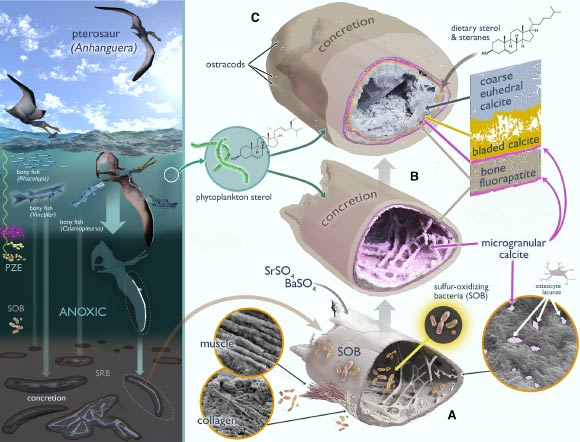
113-Million-Year-Old Pterosaur Fossil Reveals What Flying Reptiles Ate
Un fossile de ptérosaure vieux de 113 millions d'années révèle ce que mangeaient les reptiles volants
tissus alimentation Brésil fossile Anhangueridae Pterosauria poisson
Un fossile de ptérosaure vieux de 113 millions d'années provenant du nord-est du Brésil a fourni des preuves rares de tissus mous, de molécules organiques et de traces chimiques d'un régime alimentaire riche en poissons et en céphalopodes tels que les calmars ou les nautiles. L'article Un fossile de ptérosaure vieux de 113 millions d'années révèle ce que mangeaient les reptiles volants est apparu en premier sur Sci.News : Breaking Science News.
19/06/2026 sci-news ⚙ Traduction automatique
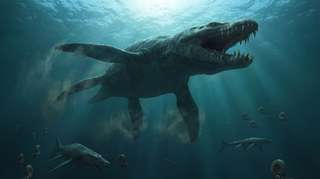
On le croyait roi des océans au Jurassique : une vertèbre percée raconte un combat d’une violence extrême
os dent vertèbre chasse musée Jurassique fossile Ichthyosauria Ichthyosaurus Pliosaurus comportement
Oublié pendant plus d’un siècle dans les tiroirs d’un musée, un fossile refait aujourd’hui surface et raconte une scène de violence extrême dans les océans du Jurassique. Une vertèbre d’ichtyosaure, marquée par l’impact d’une dent brisée, révèle peut-être l’attaque d’un des plus redoutables...
17/06/2026 futura-terre
1 2 3 4 5 6 7 8 9 10 11 12 13 14 15 16 17 18 19 20 21 22 23 24 25 26 27 28 29 30 31 32 33 34 35 36 37 38 39 40 41 42 43 44 45 46 47 48 49