fossil

Specimen nature

371 image(s) · 183 News

Image gallery

Fossil specimen of Ornithomimus sp. (TMP 1995.110.1), Royal Tyrrell Museum. This specimen was recovered from the middle Dinosaur Park Formation of Alberta, Canada.
Taxa Ornithomimidae

Fossil specimen of Ornithomimus sp. (TMP 1995.110.1), Royal Tyrrell Museum. This specimen was recovered from the middle Dinosaur Park Formation of Alberta, Canada.

museum Canada Germany Dinosaur Park +6
Taken at the Minnosota Science Museum: Dinosaurs and Fossils Gallery.

Creative Commons licensed photo by ideonexus.com. Please feel free to take and reuse for any purpose.
Taxa Mosasaurinae

Taken at the Minnosota Science Museum: Dinosaurs and Fossils Gallery. Creative Commons licensed photo by ideonexus.com. Please feel free to take and reuse for any purpose.

museum fossil Dinosauria Mosasaurinae
Montage of six dinosaur fossils: (clockwise from top left) Deinonychus antirrhopus, Buitreraptor gonzalezorum, Velociraptor mongoliensis, Microraptor gui, Halszkaraptor escuilliei, and Zhenyuanlong suni. This is a collection of six different works already found in Wikimedia Commons:
File:Deinonychus FMNH.jpg
File:Buitreraptor FMNH.jpg
File:Velociraptor Wyoming Dinosaur Center.jpg
File:MicroraptorGui-PaleozoologicalMuseumOfChina-May23-08.jpg
File:Halszkaraptor escuilliei.jpg
File:Zhenyuanlong.jpg
All of them are either under a free license already in Wikimedia Commons or in the public domain
Taxa Dromaeosauridae

Montage of six dinosaur fossils: (clockwise from top left) Deinonychus antirrhopus, Buitreraptor gonzalezorum, Velociraptor mongoliensis, Microraptor gui, Halszkaraptor escuilliei, and Zhenyuanlong suni. This is a collection of six different works already found in Wikimedia Commons: File:Deinonychus FMNH.jpg File:Buitreraptor FMNH.jpg File:Velociraptor Wyoming Dinosaur Center.jpg File:MicroraptorGui-PaleozoologicalMuseumOfChina-May23-08.jpg File:Halszkaraptor escuilliei.jpg File:Zhenyuanlong.jpg All of them are either under a free license already in Wikimedia Commons or in the public domain

fossil Buitreraptor Deinonychus Dinosauria +6
Uses https://commons.wikimedia.org/wiki/File:Dromaeosaurus_in_Canadian_Museum_of_Nature.jpg
File:Alaskan_troodont_Perot_Museum.jpg
File:Unenlagia_fossils.jpg
File:Talos_sampsoni.png
https://en.wikipedia.org/wiki/File:Velociraptor_Wyoming_Dinosaur_Center.jpg
https://en.wikipedia.org/wiki/Saurornitholestes
File:Buitreraptor-Deinonychus.jpg

File:Dakotaraptor_lateral_Wiki.jpg
Taxa Deinonychosauria

Uses https://commons.wikimedia.org/wiki/File:Dromaeosaurus_in_Canadian_Museum_of_Nature.jpg File:Alaskan_troodont_Perot_Museum.jpg File:Unenlagia_fossils.jpg File:Talos_sampsoni.png https://en.wikipedia.org/wiki/File:Velociraptor_Wyoming_Dinosaur_Center.jpg https://en.wikipedia.org/wiki/Saurornitholestes File:Buitreraptor-Deinonychus.jpg File:Dakotaraptor_lateral_Wiki.jpg

museum fossil Buitreraptor Dakotaraptor +8
fossil of placodus
Taxa Sauropterygia

fossil of placodus

fossil Placodontia Placodus Sauropterygia
fossil of placodus
Taxa Placodontia

fossil of placodus

fossil Placodontia Placodus Sauropterygia
fossil of placodus
Taxa Placodus

fossil of placodus

fossil Placodontia Placodus Sauropterygia
Apatosaurus louisae (CM 3018) mounted fossil skeleton on display at the Carnegie Museum of Natural History, Pittsburgh, PA
Taxa Sauropodomorpha

Apatosaurus louisae (CM 3018) mounted fossil skeleton on display at the Carnegie Museum of Natural History, Pittsburgh, PA

museum fossil Apatosaurus Diplodocidae +2
Apatosaurus louisae (CM 3018) mounted fossil skeleton on display at the Carnegie Museum of Natural History, Pittsburgh, PA
Taxa Diplodocidae

Apatosaurus louisae (CM 3018) mounted fossil skeleton on display at the Carnegie Museum of Natural History, Pittsburgh, PA

museum fossil Apatosaurus Diplodocidae +2
Apatosaurus louisae (CM 3018) mounted fossil skeleton on display at the Carnegie Museum of Natural History, Pittsburgh, PA
Taxa Apatosaurus

Apatosaurus louisae (CM 3018) mounted fossil skeleton on display at the Carnegie Museum of Natural History, Pittsburgh, PA

museum fossil Apatosaurus Diplodocidae +2
Palaeogeography of the Earth in Aptian, with location of Acrocanthosaurus fossils as green dots
Intervals Aptian

Palaeogeography of the Earth in Aptian, with location of Acrocanthosaurus fossils as green dots

Aptian fossil Acrocanthosaurus
Map of Cretaceous-aged dinosaur fossil localities of Mongolia.
Gobihadros mongoliensis was collected from Bayshin Tsav in Area C. Open squares indicate Late Cretaceous sites, solid squares represent Early Cretaceous localities. Abbreviations: A, Localities of Western Gobi Desert in Mongolia, mainly group of localities of Nemegtian age (early Maastrichtian), Late Cretaceous; B, Localities of Central Gobi Desert in Mongolia, mainly Djadokhtian age (Campanian), Late Cretaceous; C & D- Localities of Eastern Gobi Desert in Mongolia, mainly Baynshirenian age (Cenomanian-Santonian), Late Cretaceous. Figure has been modified from Tsogtbaatar et al. 2014, Figure 1 [24].
Formations Baynshire

Map of Cretaceous-aged dinosaur fossil localities of Mongolia. Gobihadros mongoliensis was collected from Bayshin Tsav in Area C. Open squares indicate Late Cretaceous sites, solid squares represent Early Cretaceous localities. Abbreviations: A, Localities of Western Gobi Desert in Mongolia, mainly group of localities of Nemegtian age (early Maastrichtian), Late Cretaceous; B, Localities of Central Gobi Desert in Mongolia, mainly Djadokhtian age (Campanian), Late Cretaceous; C & D- Localities of Eastern Gobi Desert in Mongolia, mainly Baynshirenian age (Cenomanian-Santonian), Late Cretaceous. Figure has been modified from Tsogtbaatar et al. 2014, Figure 1 [24].

Mongolia Campanian Cenomanian Cretaceous +8
Figure 2: Fossil vertebrate locality of Eric the Red West.
Shore platform looking west, showing undulating erosive boundary (solid white line) between the top of the Anchor Sandstone (AS) and the base of the ETRW Sandstone (ES). White dashed lines indicate selected bedding surfaces. White scale in mid-ground (indicated by arrow) equals 1 m.
Formations Eumeralla

Figure 2: Fossil vertebrate locality of Eric the Red West. Shore platform looking west, showing undulating erosive boundary (solid white line) between the top of the Anchor Sandstone (AS) and the base of the ETRW Sandstone (ES). White dashed lines indicate selected bedding surfaces. White scale in mid-ground (indicated by arrow) equals 1 m.

scale fossil
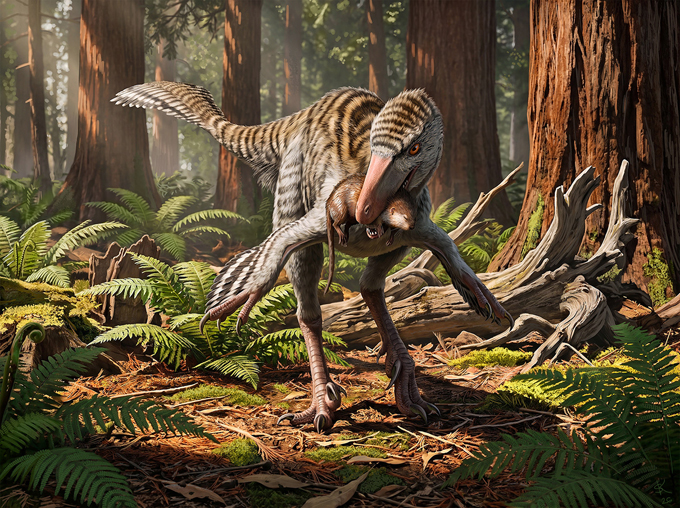
Rendering of newly discovered dinosaur Dinevenator robustus. This troodontid was identified in 2026 from a fossil collected from San Juan County.
Taxa Dinevenator

Rendering of newly discovered dinosaur Dinevenator robustus. This troodontid was identified in 2026 from a fossil collected from San Juan County.

fossil Dinevenator Troodontidae
A broken concretion with fossils inside; Late Cretaceous Pierre shale, near Ekalaka, Montana.
Formations Pierre Shale

A broken concretion with fossils inside; Late Cretaceous Pierre shale, near Ekalaka, Montana.

Pierre Shale Cretaceous Late Cretaceous fossil
The distictive banding of the Morrison Formation, a group of rock layers that occur throughout Dinosaur National Monument.  The formation originated as muds and sands laid down by ancient rivers, and some of its outcrops have been found to contain 150-million-year-old dinosaur fossils like those found at the monument's Dinosaur Quarry.
Formations Morrison

The distictive banding of the Morrison Formation, a group of rock layers that occur throughout Dinosaur National Monument. The formation originated as muds and sands laid down by ancient rivers, and some of its outcrops have been found to contain 150-million-year-old dinosaur fossils like those found at the monument's Dinosaur Quarry.

Morrison fossil Dinosauria formation
1 2 3 4 5 6 7 8 9 10 11 12 13 14 15 16 17 18 19 20 21 22 23 24

News

This ancient fossil could rewrite the story of human origins
fossil discovery human origin study
Scientists may have cracked the case of whether a seven-million-year-old fossil could walk upright. A new study found strong anatomical evidence that Sahelanthropus tchadensis was bipedal, including a ligament attachment seen only in human ancestors. Despite its ape-like appearance and small brain, its leg and hip structure suggest it moved confidently on two legs. The finding places bipedalism near the very root of the human family tree.
03/01/2026 sciencedaily-human-evo
Fossilized bones are revealing secrets from a lost world
bone fossil
Researchers have uncovered thousands of preserved metabolic molecules inside fossilized bones millions of years old, offering a surprising new window into prehistoric life. The findings reveal animals’ diets, diseases, and even their surrounding climate, including evidence of warmer, wetter environments. One fossil even showed signs of a parasite still known today. This approach could transform how scientists reconstruct ancient ecosystems.
03/01/2026 sciencedaily
This strange ancient snake was hiding in a museum for decades
bone museum fossil discovery
A strange little snake fossil found on England’s south coast has finally revealed its secrets—more than 40 years after it was discovered. The newly named Paradoxophidion richardoweni lived around 37 million years ago, during a time when Britain was warmer and teeming with reptiles. Though known only from tiny backbone bones, this “paradox snake” carries a surprising mix of traits seen in modern snakes, placing it near the very roots of today’s most diverse snake group.
31/12/2025 sciencedaily
Earth’s worst extinction was followed by a shockingly fast ocean comeback
predator fossil discovery extinction
A spectacular fossil trove on the Arctic island of Spitsbergen shows that marine life made a stunning comeback after Earth’s greatest extinction. Tens of thousands of fossils reveal fully aquatic reptiles and complex food chains thriving just three million years later. Some predators grew over five meters long, challenging the idea of a slow, step-by-step recovery. The find rewrites the early history of ocean ecosystems.
30/12/2025 sciencedaily
Dinosaur bones found almost on top of each other in Transylvania
bone pelvis Romania fossil Dinosauria Titanosauria skeleton
Scientists exploring Romania’s Hațeg Basin have discovered one of the densest dinosaur fossil sites ever found, with bones lying almost on top of each other. The K2 site preserves thousands of remains from a prehistoric flood-fed lake that acted like a natural bone trap 72 million years ago. Alongside common local dinosaurs, researchers uncovered the first well-preserved titanosaur skeletons ever found in the region. The site reveals how ancient European dinosaur ecosystems formed and evolved in
23/12/2025 sciencedaily
1 2 3 4 5 6 7 8 9 10 11 12 13 14 15 16 17 18 19 20 21 22 23 24 25 26 27 28 29 30 31 32 33 34 35 36 37