fossile

Nature du spécimen

183 image(s) · 103 Actualités

Galerie d'images

Fossil of Suevoleviathan, an extinct reptile- Took the picture at Museum of Paleontology at Tuebingen

Fossil of Suevoleviathan, an extinct reptile- Took the picture at Museum of Paleontology at Tuebingen

musée fossile Suevoleviathan
The Naturmuseum Senckenberg in Frankfurt is the second largest museum of natural history in Germany. It is particularly popular with children, who enjoy the extensive collection of dinosaur skeletons: Senckenberg boasts the largest exhibition of large dinosaurs in Europe. One particular treasure is a dinosaur fossil with unique, preserved scaled skin. The museum contains the world's largest and most diverse collection of stuffed birds with about 2000 specimens.

The Naturmuseum Senckenberg in Frankfurt is the second largest museum of natural history in Germany. It is particularly popular with children, who enjoy the extensive collection of dinosaur skeletons: Senckenberg boasts the largest exhibition of large dinosaurs in Europe. One particular treasure is a dinosaur fossil with unique, preserved scaled skin. The museum contains the world's largest and most diverse collection of stuffed birds with about 2000 specimens.

musée Allemagne fossile spécimen +4
Fossil in the Oxford University natural history museum

Fossil in the Oxford University natural history museum

musée Pérou fossile Peloneustes
Identifier: catalogueoffossi02bri (find matches)
Title: Catalogue of the fossil Reptilia and Amphibia in the British Museum (Natural history) ... By Richard Lydekker ..
Year: 1888 (1880s)
Authors:  British Museum (Natural History). Dept. of Geology Lydekker, Richard, 1849-1915
Subjects:  Reptiles, Fossil Amphibians, Fossil
Publisher:  London, Printed by order of the Trustees
Contributing Library:  Smithsonian Libraries
Digitizing Sponsor:  Biodiversity Heritage Library

View Book Page: Book Viewer
About This Book: Catalog Entry
View All Images: All Images From Book
Click here to view book online to see this illustration in context in a browseable online version of this book.

Text Appearing Before Image:
rface smooth; their terminal faces onlyslightly cupped, transversely ellipsoidal, and somewhat angulatod.Dorsals with longer centra, having nearly flat terminal faces, andforward overhang of upper part. Pectoral girdle of the general typeof Pliosaurus, with a small triangular omostornum between theventral plates of the scapula) (fig. 48), which have a strong ridge 1 Quart. Journ. Geol. Soc. vol. xlv. p. 49 (1889). 152 SATJKOPTERYGTA. dividing the ventral from the dorsal portion, and are thus more ofthe type of Thaumatosaurus. Pelvis (figs. 53, 54) like that ofPliosaurus, the pubis and ischium uniting to form an obturatorforamen. Relative lengths of humerus and femur unknown.Humerus articulating distally with only the radius and ulna, whichare relatively short, and separated only by a small interval (fig. 52) ;ulna and fibula subreniform, the former being considerably thelarger of the two. This genus may have been directly derived from the Longiros-trine group of Plesiosaurus. Fig. 49.
Text Appearing After Image:
Peloneustes philarchus.—Dorsal aspect of the coracoids; from the Oxford Clay of Bedford. Reduced, gl, glenoid cavity. (This and the preceding figure from the Quart. Joum. Geol. Soc.) Peloneustes sequalis (Phillips1). Syn. Pliosaurus cequalis, Phillips2.Pliosaurus sterrodirus, Seeley3. Imperfectly known. Cervical vertebrae with the neural canal•sunk into the centrum, and the pectorals with distinctly concaveterminal faces. Larger than typical examples of the next species. This species was founded upon a femur (fig. 50) from the Kime-ridge Clay of Oxfordshire, which so closely resembles the corre-sponding bone of P.jihilarchus as to indicate its generic identity; the 1 Geology of Oxford, p. 365 (1871).—Plesiosaurus. 2 Loc. cit. 3 Index to Ayes &c. in Cambridge Museum, p. 98 (1869).—No description. PLESI0SATJKIDJE, 153 length of this specimen is 0,572 (23 inches). The undermentionedvertebrae agree in relative size with this femur, and in genericcharacters with those of the ty

Note About Images

Please note that these images are extracted from scanned page images that may have been digitally enhanced for readability - coloration and appearance of these illustrations may not perfectly resemble the original work.

Identifier: catalogueoffossi02bri (find matches) Title: Catalogue of the fossil Reptilia and Amphibia in the British Museum (Natural history) ... By Richard Lydekker .. Year: 1888 (1880s) Authors: British Museum (Natural History). Dept. of Geology Lydekker, Richard, 1849-1915 Subjects: Reptiles, Fossil Amphibians, Fossil Publisher: London, Printed by order of the Trustees Contributing Library: Smithsonian Libraries Digitizing Sponsor: Biodiversity Heritage Library View Book Page: Book Viewer About This Book: Catalog Entry View All Images: All Images From Book Click here to view book online to see this illustration in context in a browseable online version of this book. Text Appearing Before Image: rface smooth; their terminal faces onlyslightly cupped, transversely ellipsoidal, and somewhat angulatod.Dorsals with longer centra, having nearly flat terminal faces, andforward overhang of upper part. Pectoral girdle of the general typeof Pliosaurus, with a small triangular omostornum between theventral plates of the scapula) (fig. 48), which have a strong ridge 1 Quart. Journ. Geol. Soc. vol. xlv. p. 49 (1889). 152 SATJKOPTERYGTA. dividing the ventral from the dorsal portion, and are thus more ofthe type of Thaumatosaurus. Pelvis (figs. 53, 54) like that ofPliosaurus, the pubis and ischium uniting to form an obturatorforamen. Relative lengths of humerus and femur unknown.Humerus articulating distally with only the radius and ulna, whichare relatively short, and separated only by a small interval (fig. 52) ;ulna and fibula subreniform, the former being considerably thelarger of the two. This genus may have been directly derived from the Longiros-trine group of Plesiosaurus. Fig. 49. Text Appearing After Image: Peloneustes philarchus.—Dorsal aspect of the coracoids; from the Oxford Clay of Bedford. Reduced, gl, glenoid cavity. (This and the preceding figure from the Quart. Joum. Geol. Soc.) Peloneustes sequalis (Phillips1). Syn. Pliosaurus cequalis, Phillips2.Pliosaurus sterrodirus, Seeley3. Imperfectly known. Cervical vertebrae with the neural canal•sunk into the centrum, and the pectorals with distinctly concaveterminal faces. Larger than typical examples of the next species. This species was founded upon a femur (fig. 50) from the Kime-ridge Clay of Oxfordshire, which so closely resembles the corre-sponding bone of P.jihilarchus as to indicate its generic identity; the 1 Geology of Oxford, p. 365 (1871).—Plesiosaurus. 2 Loc. cit. 3 Index to Ayes &c. in Cambridge Museum, p. 98 (1869).—No description. PLESI0SATJKIDJE, 153 length of this specimen is 0,572 (23 inches). The undermentionedvertebrae agree in relative size with this femur, and in genericcharacters with those of the ty Note About Images Please note that these images are extracted from scanned page images that may have been digitally enhanced for readability - coloration and appearance of these illustrations may not perfectly resemble the original work.

musée fossile Peloneustes Pliosaurus +1
Identifier: catalogueoffossi02bri (find matches)
Title: Catalogue of the fossil Reptilia and Amphibia in the British Museum (Natural history) ... By Richard Lydekker ..
Year: 1888 (1880s)
Authors:  British Museum (Natural History). Dept. of Geology Lydekker, Richard, 1849-1915
Subjects:  Reptiles, Fossil Amphibians, Fossil
Publisher:  London, Printed by order of the Trustees
Contributing Library:  Smithsonian Libraries
Digitizing Sponsor:  Biodiversity Heritage Library

View Book Page: Book Viewer
About This Book: Catalog Entry
View All Images: All Images From Book
Click here to view book online to see this illustration in context in a browseable online version of this book.

Text Appearing Before Image:
pterygian; from theKimeridge Clay of Ely. \. a, proximal, b, distal epiphysis ; c, shaft. 46792. Two still smaller specimens; from the Kimeridge Clay ofDevizes, Wiltshire. Cunnington Collection. R. 400. Two phalangeals; from the Oxford Clay of Weymouth,Dorsetshire. Presented by C. Westendarp, Esq., 1884. 150 SAUEOPTERIGIA. R. 1381. One longitudinal half of the humerus or femur of a me- (Ficj.) dium-sized form, with the inner surface cut and polished; from the Kimeridge Clay of Ely. This specimen is figured in the woodcut on the preceding page, and shows the two epiphyses almost meeting in the middle of the shaft. No history. R. 1381 a. The proximal half of a larger humerus or femur, longitu-dinally bisected; from the Kimeridge Clay of Ely. Thecontour of the proximal epiphysis is well displayed. No history. 46912. The proximal portion of a still larger humerus or femur,longitudinally bisected; from Shotover. The whole ofthe proximal epiphysis is displayed, of which the terminal Kg. 47.
Text Appearing After Image:
Sauropterygian mandibles.—A. Peloneustesphilarchus; from the Oxford Clay.\. B. Thaitmatosaurus indicus; from the Upper Jurassic of India. ).0. Pksiosaimcs dolichodirus; from the Lower Lias. f. (From the Kec.Geol. Surv. Ind.) PLESI0SAURID2E. 151 extremity appears to have been separated by a small va-cuity from that of the distal epiphysis. No history. 42097. One lateral half of a humerus or femur, with the inner sur- face cut; from the Neocomian bone-bed of Potton, Bed-fordshire. The extremity of one epiphysis is entire anddetached from the shaft, while a section is shown of thatat the opposite end. Purchased, 1870. 42098. A small imperfect femur, with the proximal epiphysis de- tached and lying loose in the cup of the shaft; fromPotton. Purchased, 1870. Genus PELONEUSTES, Lydekker \ Skull and teeth of the general type of Pliosaurus, but the mandible(fig. 47, A) with a longer symphysis, which includes more than adozen teeth. Neck short, with the anterior vertebras relativelyshort. Ve

Note About Images

Please note that these images are extracted from scanned page images that may have been digitally enhanced for readability - coloration and appearance of these illustrations may not perfectly resemble the original work.

Identifier: catalogueoffossi02bri (find matches) Title: Catalogue of the fossil Reptilia and Amphibia in the British Museum (Natural history) ... By Richard Lydekker .. Year: 1888 (1880s) Authors: British Museum (Natural History). Dept. of Geology Lydekker, Richard, 1849-1915 Subjects: Reptiles, Fossil Amphibians, Fossil Publisher: London, Printed by order of the Trustees Contributing Library: Smithsonian Libraries Digitizing Sponsor: Biodiversity Heritage Library View Book Page: Book Viewer About This Book: Catalog Entry View All Images: All Images From Book Click here to view book online to see this illustration in context in a browseable online version of this book. Text Appearing Before Image: pterygian; from theKimeridge Clay of Ely. \. a, proximal, b, distal epiphysis ; c, shaft. 46792. Two still smaller specimens; from the Kimeridge Clay ofDevizes, Wiltshire. Cunnington Collection. R. 400. Two phalangeals; from the Oxford Clay of Weymouth,Dorsetshire. Presented by C. Westendarp, Esq., 1884. 150 SAUEOPTERIGIA. R. 1381. One longitudinal half of the humerus or femur of a me- (Ficj.) dium-sized form, with the inner surface cut and polished; from the Kimeridge Clay of Ely. This specimen is figured in the woodcut on the preceding page, and shows the two epiphyses almost meeting in the middle of the shaft. No history. R. 1381 a. The proximal half of a larger humerus or femur, longitu-dinally bisected; from the Kimeridge Clay of Ely. Thecontour of the proximal epiphysis is well displayed. No history. 46912. The proximal portion of a still larger humerus or femur,longitudinally bisected; from Shotover. The whole ofthe proximal epiphysis is displayed, of which the terminal Kg. 47. Text Appearing After Image: Sauropterygian mandibles.—A. Peloneustesphilarchus; from the Oxford Clay.\. B. Thaitmatosaurus indicus; from the Upper Jurassic of India. ).0. Pksiosaimcs dolichodirus; from the Lower Lias. f. (From the Kec.Geol. Surv. Ind.) PLESI0SAURID2E. 151 extremity appears to have been separated by a small va-cuity from that of the distal epiphysis. No history. 42097. One lateral half of a humerus or femur, with the inner sur- face cut; from the Neocomian bone-bed of Potton, Bed-fordshire. The extremity of one epiphysis is entire anddetached from the shaft, while a section is shown of thatat the opposite end. Purchased, 1870. 42098. A small imperfect femur, with the proximal epiphysis de- tached and lying loose in the cup of the shaft; fromPotton. Purchased, 1870. Genus PELONEUSTES, Lydekker \ Skull and teeth of the general type of Pliosaurus, but the mandible(fig. 47, A) with a longer symphysis, which includes more than adozen teeth. Neck short, with the anterior vertebras relativelyshort. Ve Note About Images Please note that these images are extracted from scanned page images that may have been digitally enhanced for readability - coloration and appearance of these illustrations may not perfectly resemble the original work.

musée Oxford Clay fossile spécimen +2
Title: A descriptive catalogue of the marine reptiles of the Oxford clay. Based on the Leeds Collection in the British Museum (Natural History), London ..
Identifier: descriptivecatal02brit (find matches)
Year: 1910 (1910s)
Authors: British Museum (Natural History). Dept. of Geology; Andrews, Charles William, 1866-1924
Subjects: Reptiles, Fossil
Publisher: London, Printed by order of the Trustees
Contributing Library: Smithsonian Libraries
Digitizing Sponsor: Biodiversity Heritage Library

View Book Page: Book Viewer
About This Book: Catalog Entry
View All Images: All Images From Book
Click here to view book online to see this illustration in context in a browseable online version of this book.

Text Appearing Before Image: 
78 MAEINE EEPTILES OF THE OXEOED CLAT. Test-fig. 30.
Text Appearing After Image: 
aa. Coracoids of Peloneustes evansi: A, from front; B, from above. (E. 3897, 1 nat. size.)  glenoid facet; p.e.a., postero-esternal angle; sc.f., facet for scapula; sym., symphysial surface.

Note About Images

Please note that these images are extracted from scanned page images that may have been digitally enhanced for readability - coloration and appearance of these illustrations may not perfectly resemble the original work.

Title: A descriptive catalogue of the marine reptiles of the Oxford clay. Based on the Leeds Collection in the British Museum (Natural History), London .. Identifier: descriptivecatal02brit (find matches) Year: 1910 (1910s) Authors: British Museum (Natural History). Dept. of Geology; Andrews, Charles William, 1866-1924 Subjects: Reptiles, Fossil Publisher: London, Printed by order of the Trustees Contributing Library: Smithsonian Libraries Digitizing Sponsor: Biodiversity Heritage Library View Book Page: Book Viewer About This Book: Catalog Entry View All Images: All Images From Book Click here to view book online to see this illustration in context in a browseable online version of this book. Text Appearing Before Image: 78 MAEINE EEPTILES OF THE OXEOED CLAT. Test-fig. 30. Text Appearing After Image: aa. Coracoids of Peloneustes evansi: A, from front; B, from above. (E. 3897, 1 nat. size.) glenoid facet; p.e.a., postero-esternal angle; sc.f., facet for scapula; sym., symphysial surface. Note About Images Please note that these images are extracted from scanned page images that may have been digitally enhanced for readability - coloration and appearance of these illustrations may not perfectly resemble the original work.

musée Oxford Clay fossile Peloneustes +1
Title: A descriptive catalogue of the marine reptiles of the Oxford clay. Based on the Leeds Collection in the British Museum (Natural History), London ..
Identifier: descriptivecatal02brit (find matches)
Year: 1910 (1910s)
Authors: British Museum (Natural History). Dept. of Geology; Andrews, Charles William, 1866-1924
Subjects: Reptiles, Fossil
Publisher: London, Printed by order of the Trustees
Contributing Library: Smithsonian Libraries
Digitizing Sponsor: Biodiversity Heritage Library

View Book Page: Book Viewer
About This Book: Catalog Entry
View All Images: All Images From Book
Click here to view book online to see this illustration in context in a browseable online version of this book.

Text Appearing Before Image: 
CATAL,MARINE REPT. OXFORD CLAY. PART II. PLATE IV. col. — v.orb.
Text Appearing After Image: 
pas par. G.M.Woodward Aei.et litli. West.Newznsr. imp. PEEONEUSTES philarghus.

Note About Images

Please note that these images are extracted from scanned page images that may have been digitally enhanced for readability - coloration and appearance of these illustrations may not perfectly resemble the original work.
Taxons Peloneustes

Title: A descriptive catalogue of the marine reptiles of the Oxford clay. Based on the Leeds Collection in the British Museum (Natural History), London .. Identifier: descriptivecatal02brit (find matches) Year: 1910 (1910s) Authors: British Museum (Natural History). Dept. of Geology; Andrews, Charles William, 1866-1924 Subjects: Reptiles, Fossil Publisher: London, Printed by order of the Trustees Contributing Library: Smithsonian Libraries Digitizing Sponsor: Biodiversity Heritage Library View Book Page: Book Viewer About This Book: Catalog Entry View All Images: All Images From Book Click here to view book online to see this illustration in context in a browseable online version of this book. Text Appearing Before Image: CATAL,MARINE REPT. OXFORD CLAY. PART II. PLATE IV. col. — v.orb. Text Appearing After Image: pas par. G.M.Woodward Aei.et litli. West.Newznsr. imp. PEEONEUSTES philarghus. Note About Images Please note that these images are extracted from scanned page images that may have been digitally enhanced for readability - coloration and appearance of these illustrations may not perfectly resemble the original work.

musée Oxford Clay fossile Peloneustes +1
Title: A descriptive catalogue of the marine reptiles of the Oxford clay. Based on the Leeds Collection in the British Museum (Natural History), London ..
Identifier: descriptivecatal02brit (find matches)
Year: 1910 (1910s)
Authors: British Museum (Natural History). Dept. of Geology; Andrews, Charles William, 1866-1924
Subjects: Reptiles, Fossil
Publisher: London, Printed by order of the Trustees
Contributing Library: Smithsonian Libraries
Digitizing Sponsor: Biodiversity Heritage Library

View Book Page: Book Viewer
About This Book: Catalog Entry
View All Images: All Images From Book
Click here to view book online to see this illustration in context in a browseable online version of this book.

Text Appearing Before Image: 
CATAL.MARINE REPT. OXFORD CLAY. PART II. FLATE II.
Text Appearing After Image: 
G.M.Woodwa/p& del.etlitfL PLIOSAURUS PEROX. West, Newman imp.

Note About Images

Please note that these images are extracted from scanned page images that may have been digitally enhanced for readability - coloration and appearance of these illustrations may not perfectly resemble the original work.

Title: A descriptive catalogue of the marine reptiles of the Oxford clay. Based on the Leeds Collection in the British Museum (Natural History), London .. Identifier: descriptivecatal02brit (find matches) Year: 1910 (1910s) Authors: British Museum (Natural History). Dept. of Geology; Andrews, Charles William, 1866-1924 Subjects: Reptiles, Fossil Publisher: London, Printed by order of the Trustees Contributing Library: Smithsonian Libraries Digitizing Sponsor: Biodiversity Heritage Library View Book Page: Book Viewer About This Book: Catalog Entry View All Images: All Images From Book Click here to view book online to see this illustration in context in a browseable online version of this book. Text Appearing Before Image: CATAL.MARINE REPT. OXFORD CLAY. PART II. FLATE II. Text Appearing After Image: G.M.Woodwa/p& del.etlitfL PLIOSAURUS PEROX. West, Newman imp. Note About Images Please note that these images are extracted from scanned page images that may have been digitally enhanced for readability - coloration and appearance of these illustrations may not perfectly resemble the original work.

musée Oxford Clay fossile Liopleurodon +2
Title: A descriptive catalogue of the marine reptiles of the Oxford clay. Based on the Leeds Collection in the British Museum (Natural History), London ..
Identifier: descriptivecatal02brit (find matches)
Year: 1910 (1910s)
Authors: British Museum (Natural History). Dept. of Geology; Andrews, Charles William, 1866-1924
Subjects: Reptiles, Fossil
Publisher: London, Printed by order of the Trustees
Contributing Library: Smithsonian Libraries
Digitizing Sponsor: Biodiversity Heritage Library

View Book Page: Book Viewer
About This Book: Catalog Entry
View All Images: All Images From Book
Click here to view book online to see this illustration in context in a browseable online version of this book.

Text Appearing Before Image: 
CATAL.MARINE KEPT. OXFORD CLAY. PART II. PLATE I. pmcc.
Text Appearing After Image: 
>p77ia:. G.M.Woodward del. etlibh. West, Newman imp. PLIOSAURUS FEROX.

Note About Images

Please note that these images are extracted from scanned page images that may have been digitally enhanced for readability - coloration and appearance of these illustrations may not perfectly resemble the original work.
Taxons Liopleurodon

Title: A descriptive catalogue of the marine reptiles of the Oxford clay. Based on the Leeds Collection in the British Museum (Natural History), London .. Identifier: descriptivecatal02brit (find matches) Year: 1910 (1910s) Authors: British Museum (Natural History). Dept. of Geology; Andrews, Charles William, 1866-1924 Subjects: Reptiles, Fossil Publisher: London, Printed by order of the Trustees Contributing Library: Smithsonian Libraries Digitizing Sponsor: Biodiversity Heritage Library View Book Page: Book Viewer About This Book: Catalog Entry View All Images: All Images From Book Click here to view book online to see this illustration in context in a browseable online version of this book. Text Appearing Before Image: CATAL.MARINE KEPT. OXFORD CLAY. PART II. PLATE I. pmcc. Text Appearing After Image: >p77ia:. G.M.Woodward del. etlibh. West, Newman imp. PLIOSAURUS FEROX. Note About Images Please note that these images are extracted from scanned page images that may have been digitally enhanced for readability - coloration and appearance of these illustrations may not perfectly resemble the original work.

musée Oxford Clay fossile Liopleurodon +2
Fossil - Took The picture at Royal Belgian Institute of Natural Sciences, Brussels

Fossil - Took The picture at Royal Belgian Institute of Natural Sciences, Brussels

fossile Hainosaurus
Fossil - Took The picture at Royal Belgian Institute of Natural Sciences, Brussels

Fossil - Took The picture at Royal Belgian Institute of Natural Sciences, Brussels

fossile Hainosaurus
Fossil - Took The picture at Royal Belgian Institute of Natural Sciences, Brussels

Fossil - Took The picture at Royal Belgian Institute of Natural Sciences, Brussels

fossile Hainosaurus
Fossil of Hainosaurus, an extinct reptile  --  Took the photo at Natural History Museum of Bruxelles

Fossil of Hainosaurus, an extinct reptile -- Took the photo at Natural History Museum of Bruxelles

musée fossile Hainosaurus
Fossil of Anhanguera, an extinct reptile-- Took the photo at Natural History Museum, London

Fossil of Anhanguera, an extinct reptile-- Took the photo at Natural History Museum, London

musée fossile Anhanguera
Title: A dictionary of the fossils of Pennsylvania and neighboring states named in the reports and catalogues of the survey ..
Identifier: CUbiodiversity600397-9082 (find matches)
Year: 1889 (1880s)
Authors: Lesley, J. P. (J. Peter), 1819-1903; Pennsylvania. Board of Commissioners for the Second Geological Survey
Subjects: Paleontology
Publisher: Harrisburg, Board of Commissioners for the Geological Survey
Contributing Library: Cornell University Library
Digitizing Sponsor: Mann Library, Cornell

View Book Page: Book Viewer
About This Book: Catalog Entry
View All Images: All Images From Book
Click here to view book online to see this illustration in context in a browseable online version of this book.

Text Appearing Before Image: 
697 Plec. Plectropterna angusta, Hitchcock, Icht. Mass. page 110, lias. f-) itch cock ^ Idithuolo^ij McLSS.
Text Appearing After Image: 
I'lfrtroplerria,

Note About Images

Please note that these images are extracted from scanned page images that may have been digitally enhanced for readability - coloration and appearance of these illustrations may not perfectly resemble the original work.
Taxons Plectropterna

Title: A dictionary of the fossils of Pennsylvania and neighboring states named in the reports and catalogues of the survey .. Identifier: CUbiodiversity600397-9082 (find matches) Year: 1889 (1880s) Authors: Lesley, J. P. (J. Peter), 1819-1903; Pennsylvania. Board of Commissioners for the Second Geological Survey Subjects: Paleontology Publisher: Harrisburg, Board of Commissioners for the Geological Survey Contributing Library: Cornell University Library Digitizing Sponsor: Mann Library, Cornell View Book Page: Book Viewer About This Book: Catalog Entry View All Images: All Images From Book Click here to view book online to see this illustration in context in a browseable online version of this book. Text Appearing Before Image: 697 Plec. Plectropterna angusta, Hitchcock, Icht. Mass. page 110, lias. f-) itch cock ^ Idithuolo^ij McLSS. Text Appearing After Image: I'lfrtroplerria, Note About Images Please note that these images are extracted from scanned page images that may have been digitally enhanced for readability - coloration and appearance of these illustrations may not perfectly resemble the original work.

fossile Plectropterna
Crâne de mosasaure d'espèce Platecarpus tympaniticus (squamates, mosasaures).
Provenance : Smoky Hill Chalk, Kansas (aux Etats-Unis).
Date : Crétacé supérieur, période du Campanien, 88 millions d'années avant notre ère.
Collections du Muséum national d'histoire naturelle de Paris (France).
Exposé à l'occasion de l'exposition "Un T-Rex à Paris" au Muséum national d'histoire naturelle de Paris (France) du 6 juin au 2 septembre 2018.

Légende du fossile dans cette exposition : "Les mosasaures ne sont pas des dinosaures mais des reptiles marins, très répandus à la fin du Crétacé. Certains genres comme Globidens et Halisaurus sont connus aussi bien aux Etats-Unis qu'au Maroc. Ces animaux étaient d'excellents nageurs, capables de traverser l'Atlantique."

Crâne de mosasaure d'espèce Platecarpus tympaniticus (squamates, mosasaures). Provenance : Smoky Hill Chalk, Kansas (aux Etats-Unis). Date : Crétacé supérieur, période du Campanien, 88 millions d'années avant notre ère. Collections du Muséum national d'histoire naturelle de Paris (France). Exposé à l'occasion de l'exposition "Un T-Rex à Paris" au Muséum national d'histoire naturelle de Paris (France) du 6 juin au 2 septembre 2018. Légende du fossile dans cette exposition : "Les mosasaures ne sont pas des dinosaures mais des reptiles marins, très répandus à la fin du Crétacé. Certains genres comme Globidens et Halisaurus sont connus aussi bien aux Etats-Unis qu'au Maroc. Ces animaux étaient d'excellents nageurs, capables de traverser l'Atlantique."

France Maroc Campanien Crétacé +8
1 2 3 4 5 6 7 8 9 10 11 12

Actualités

De superbes traces de dinosaures vieilles de 132 millions d’années réécrivent l’histoire
fossile empreintes Dinosauria découverte
Un mystère de longue date dans les archives fossiles de l’Afrique australe commence à être résolu. Après que des coulées de lave massives, il y a 182 millions d'années, aient semblé effacer les traces de dinosaures dans la région, les scientifiques ont maintenant découvert de nouveaux indices surprenants le long de la côte du Cap occidental. Des dizaines de traces de dinosaures, vieilles d'environ 132 millions d'années, ont été découvertes dans une petite étendue rocheuse près de Knysna, ce qui en fait les plus jeunes jamais découvertes en Afrique australe.
23/04/2026 sciencedaily ⚙ Traduction automatique
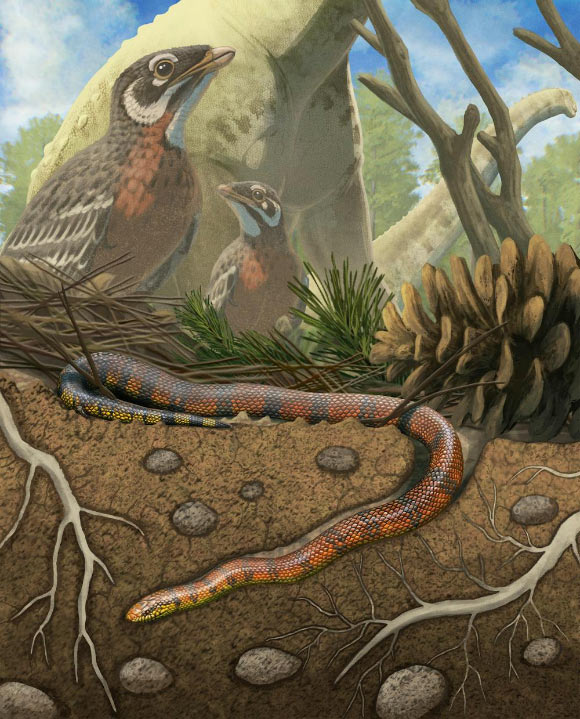
Des scientifiques découvrent des fossiles parfaits dans la rouille sous les terres agricoles australiennes
fossile
Sous les terres agricoles arides de la Nouvelle-Galles du Sud se trouve une fenêtre cachée sur une forêt tropicale perdue regorgeant de vie datant d'il y a 11 à 16 millions d'années. À McGraths Flat, les scientifiques ont découvert des fossiles préservés avec des détails étonnants, non pas dans des roches typiques comme le schiste ou le grès, mais dans des sédiments riches en fer que l'on croyait autrefois incapables d'une telle préservation. De minuscules particules de fer remplissaient et capturaient des cellules entières, préservant tout, des organes d'insectes aux pigments des yeux de poisson et aux délicats poils d'araignées.
23/04/2026 sciencedaily ⚙ Traduction automatique
Cet ancien parent du crocodile a grandi sur quatre pattes puis a marché sur deux
fossile Dinosauria
Un étrange parent d'un crocodile de l'époque des dinosaures réécrit ce que les scientifiques pensaient savoir sur les anciens reptiles. Cette créature de la taille d'un caniche, appelée Sonselasuchus cedrus, semble avoir commencé sa vie en marchant à quatre pattes avant de passer à une position sur deux pattes à mesure qu'elle grandissait - une transformation inhabituelle rarement observée dans les archives fossiles.
23/04/2026 sciencedaily ⚙ Traduction automatique
450-Million-Year-Old Fossils Reveal Strange, Tube-Dwelling Jellyfish Relative
Des fossiles vieux de 450 millions d’années révèlent un étrange parent de méduses tubicoles
Canada fossile spécimen nouvelle espèce
Les paléontologues ont identifié un nouveau genre et une nouvelle espèce de polype médusozoaire tubicole au corps mou à partir de spécimens bien conservés trouvés à environ 50 km au nord-est de la ville de Québec au Canada. L'article Des fossiles vieux de 450 millions d'années révèlent un étrange parent de méduses tubicoles apparaît en premier sur Sci.News : Breaking Science News.
21/04/2026 sci-news ⚙ Traduction automatique
Ces minuscules fossiles de dinosaures ont trompé les scientifiques pendant 20 ans
armure os croissance fossile Ankylosauria Dinosauria découverte
De minuscules fossiles de dinosaures qui ont intrigué les scientifiques pendant plus de 20 ans ont enfin révélé leur véritable identité. Plutôt que d’appartenir à une espèce miniature, ce sont en réalité des bébés ankylosaures, certains âgés de moins d’un an, y compris un possible nouveau-né. En étudiant les schémas de croissance osseuse, les chercheurs ont confirmé que ces jeunes dinosaures n’étaient pas encore devenus des adultes de grande taille. La découverte apporte un nouvel éclairage sur la façon dont les ankylosaures se sont développés, montrant qu'ils ont commencé à développer une armure étonnamment tôt.
21/04/2026 sciencedaily ⚙ Traduction automatique
1 2 3 4 5 6 7 8 9 10 11 12 13 14 15 16 17 18 19 20 21