Galerie d'images
Toutes les images de la base — taxons, formations et intervalles géologiques.
⚠ La fonctionnalité de récupération des images est en cours de test, des images non pertinentes peuvent apparaître.
4,186 image(s)


Musango is a basal sauropodomorph dinosaur that lived during the Late Triassic period in what is now Zimbabwe. Typical of early sauropodomorphs, or "prosauropods," it was an obligate biped with a long neck, and a long tail for counterbalance. Musango grew to approximately 5 m in total body length.


Uragasaurus is a sauropod dinosaur, and the first mamenchisaurid known from Thailand. Mamenchisaurids exhibit the basic sauropod body plan, processing their herbivorous diet in their large gut. Uniquely, mamenchisaurid necks, like that of Uragasaurus, are proportionately long, even by sauropod standards.

Life reconstruction of a herd of five individuals of Uragasaurus kalasinensis inhabiting a Late Jurassic forest in Thailand, accompanied by a pair of rhamphorhynchoid pterosaurs and a metriacanthosaurid theropod. Artwork by Pakorn Chotchaiyaporn (Jæsica ẞababi).

Quarry map showing the spatial distribution of the holotype of Uragasaurus kalasinensis and associated materials from the Phu Noi Locality (g). PRC 460 (Uragasaurus kalasinensis holotype) is indicated in red. Associated sauropod elements include KS 34-586, KS 34-587, KS 34-588, and KS 34-602a–b, highlighted in yellow, green, blue, purple, and pink, respectively. The inset shows a close-up of the excavation grid highlighting the relative positions of the holotype and nearby associated materials. Each grid square represents 0.75 × 0.75 m.

Locality map and section diagram of Phu Noi Locality. The map of Thailand (a); The location of Phu Noi Locality and the distribution of Phu Kradung Formation, the northeastern region with the outline of Kalasin Province (edit by Kantanat Trakulveerayut) (b); the diagrammatic section of Phu Noi (applied from Chowchuvech et al.31) (c).

The holotype anterior dorsal vertebra of Uragasaurus kalasinensis (PRC 460) in anterior (a) and posterior (b) views. Digital rendering of the specimen in anterior (c), posterior (d), right lateral (e), left lateral (f), dorsal (g), and ventral (h) views. Asterisk refers to an autapomorphic character. The blue highlight indicates the pneumatic fossa and pleurocoel.


Sant Pere Cercada (Santa Coloma de Farners-Catalunya). Original de 1063, fou un monestir agustinià al 1136. Actualment només resta l'església

Barri de Sant Pere Cercada (Santa Coloma de Farners-Catalunya), amb l'església del monestir agustinià de 1136.

Reconstruction of Agustinia ligabuei from the Early Cretaceous of Argentina as a rebbachisaurid following Bellardini et al. 2022
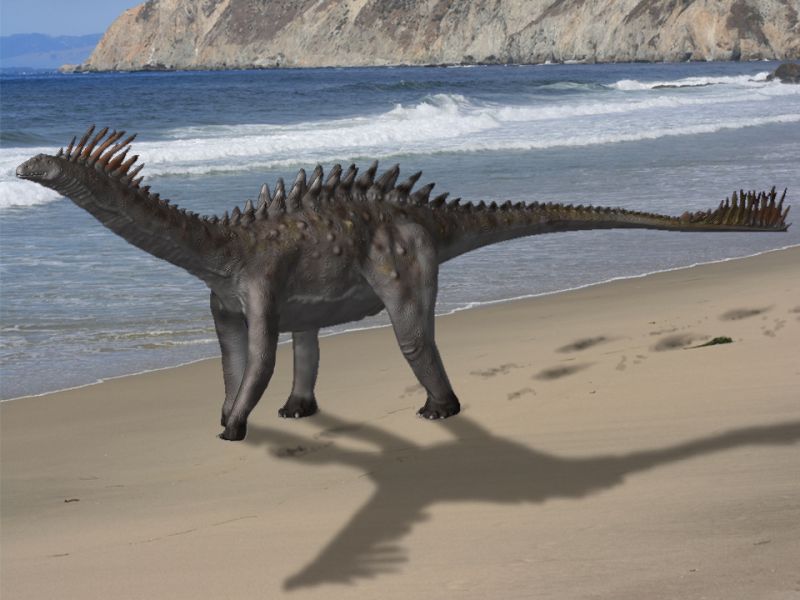
Agustinia ligabuei, a sauropod from the Early Cretaceous of Argentina. Digital.

Yangtzepus yipingensis holotype (IVPP V2473) at the Paleozoological Museum of China.

Brontotholus is a relatively large pachycephalosaurian dinosaur. Like all pachycephalosaurs, it was bipedal and sported the characteristic bony dome on top of its skull. Brontotholus grew to nearly 4 m in length, making it one of the largest known pachycephalosaurs, and the largest from the Campanian age.

Atrociraptor marshalli restoration. Follows elements depicted in original description:[1] Unknown parts restored after relatives with preserved feathers, such as described in:[2]

Fossil of Hainosaurus, an extinct reptile -- Took the photo at Natural History Museum of Bruxelles


Skeletal reconstruction of Gualicho shinyae showing recovered elements in white and missing elements in grey shading. Artwork by J. González.

Silesaurid left dentaries. (A) Kwanasaurus williamparkeri (based primarily on DMNH EPV.63136) in lateral view, (B) same in medial view, (C) Asilisaurus kongwe (NMT R89) in lateral view, (D) same in medial view, (E) Eucoelophysis baldwini (GR 224) in lateral view, (F) same in medial view, (G) Technosaurus smalli (TTU P-9021, reversed) in lateral view, (H) same in medial view (also reversed), (I) Sacisaurus agudoensis (composite based on MCN PV10042 and MCN PV10043) in lateral view, (J) same in medial view, (K) Silesaurus opolensis (ZPAL AbIII/361/26) in lateral view, (L) same in medial view, (M) Diodorus scytobrachion (MNHM-ARG 30) in lateral view (reversed), (N) same in medial view (also reversed), (O) Soumyasaurus aenigmaticus (TTU-P1125b) in lateral view, (P) same in medial view. Dashed lines indicate broken edges. Unshaded regions indicate the surface of the specimen is not exposed. All scale bars = 1 cm.

Hypothetical reconstruction of the skeleton of Amanasaurus nesbitti gen. et sp. nov. depicting (in orange) the preserved portions. (a) CAPPA/UFSM 0374 (holotype), a proximal portion of a right femur in anterior view. (b) CAPPA/UFSM 0375 (referred specimen), a distal portion of a left femur in anterior view. Figures were generated with GIMP 2.8 (https://www.gimp.org/). Cropped from original image and letters adjusted to match.

Pliosaurus (Luskhan itilensis) lived on the territory of the Volga region in the Hauterivian age of the Early Cretaceous period. Discovered in 2002 by G.N. Uspensky on the banks of the Volga near the village of Slantsevy Rudnik. This is the most complete pliosaurus skeleton found in Russia. This pliosaurus was not a predator and preferred to feed on fish and cephalopods.


Reconstruction of brachauchenin pliosaurid Luskhan itilensis. Early Cretaceous of Ulyanovsk region. 2017.


From the English Wikipedia. Original description: The pterodactyloid pterosaur Anhanguera piscator by John Conway, [1]


Skeletal reconstruction of Heyuannia yanshini (previously Ajancingenia yanshini). Specimens as: blue: MPC-D 100/30 (holotype); green: MPC-D 100/31; red: MPC-D 100/32; tan: MPC-D 100/20 (holotype skull of Conchoraptor gracilis).


Restored profile of the oviraptorid dinosaur Heyuannia yanshini by Matt Martyniuk.


Ajancingenia mounted cast (labeled as Ingenia), on display at the Museum of Ancient Life, Utah.

Ajancingenia mounted cast (labeled as Ingenia), detail of pelvis, on display at the Museum of Ancient Life, Utah.


B) The holotype of Lamprosauroides goepperti, a right maxilla (MGU Wr 3871s) from Krappitz in Upper Silesia, in lateral view. C) Close-up of the two posteriormost preserved teeth (6th and 7th counted from anterior) of MGU Wr 3871s. D) Close-up of the enlarged fang (3rd counted from anterior) of MGU Wr 3871s. E) A left maxilla (GPIT-PV-31630) in lateral view referable to Lamprosauroides goepperti from Gogolin in Upper Silesia. The image of GPIT-PV-31630 was kindly provided by Agnes Fatz (GPIT) and has been mirrored for direct comparison with the holotype.

The skull of Janusaurus lundi (PMO 222.654). A: Photo in right lateral view of the skull. B: Right lateral view with interpretation of the individual elements. Abbreviations: a, angular; art, articular; d, dentary; en, external naris; j, jugal; l, lacrimal; mx, maxilla; n, nasal; or, orbit; p, parietal; pmx, premaxilla; po, postorbital; pof, postfrontal; prf, prefrontal; q, quadrate; qj, quadratojugal; sa, surangular; st, supratemporal. Scale = 5 cm.

Silhouette of M.intrepidus showing recovered elements. Isolated indet. tyrannosauroid premaxillary tooth (NCSM 33393) recovered from nearby strata in (d) occlusal, (e) mesiodistal, and (f) lingual views. Holotype specimen of M.intrepidus (NCSM 33392) composed of (g) femur, (h) tibia, (i) fourth metatarsal, (j) second metatarsal, and (k) pedal phalanges of the fourth digit. Scale bar (c) 1 m, (g–k) 5 mm. (d–f) Enlarged to show detail, not to scale

Reconstruction of Bissektipelta archibaldi an ankylosaurid dinosaur from the Late Cretaceous of Uzbekistan

Reconstruction of the carnivorous abelisaurid theropod Niebla antiqua.


Huaxiazhoulong is a fairly large ankylosaurid dinosaur, at around 6 m in length. It was a robust quadruped with a beak and teeth adapted for processing its herbivorous diet. Huaxiazhoulong had an armor of osteoderms, and the characteristic ankylosaurid tail club which was likely used in defense against predators, as well as intraspecific combat.

Calvarius is a genus of styracosternan ornithopod from the Late Cretaceous of Spain. The name alludes to its chronostratigraphic proximity to the extinction event that wiped out the non-avian dinosaurs at the end of the Cretaceous. The highly modified metatarsal that is known from shows an example of convergent evolution, as it is more similar to non-iguanodontian ornithopods than to other styracosternans. It is thought that this is due to fulfilling a niche in its island habitat, resulting in Calvarius becoming a small-bodied animal, capable of rapid locomotion.

Size comparison of the genus within Carnotaurinae. Silhouette sources: Carnotaurus: File:Carnotaurus_Size_Chart.png Abelisaurus: File:Carnotaurus_reconstruction_Headden.jpg Pycnonemosaurus: File:Pycnonemosaurus_nevesi_skeletal_simple.jpg Aucasaurus: File:Aucasaurus_garridoi_by_Paleocolour.jpg Quilmesaurus: File:Quilmesaurus_curriei.jpg Ilokelesia: File:Rahiolisaurus_size.jpg Skorpiovenator: File:Skorpiovenator_bustingorryi.jpg Ekrixinatosaurus: File:Ekrixinatosaurus_novasi_by_Henrique_Paes.png Viavenator: File:Viavenator.jpg Thanos: File:Thanos_simonattoi.png


Life restoration of Amargatitanis based on the holotype specimen and the skeletal diagram of Amargasaurus by Scott Hartman.

Holotype of Argentinonectes calafatensis (MPM-PV 1002) housed in Museo Argentino de Ciencias Naturales

An illustration of the pterosaur Normannognathus wellnhoferi

Original description: The diagram is based on strict consensus of five minimum-length trees using 13 ingroup taxa and 102 unordered characters (CI = 0.76; RI = 0.78) (Text S5). Scaled icons represent a diplodocid (Apatosaurus) [11], dicraeosaurid (Dicraeosaurus) [51], and a rebbachisaurid (Nigersaurus). Geographic distributions include Laurasian diplodocoids (western North America—Apatasaurus, Diplodocus, Suuwassea; Europe—Histriasaurus, Spanish rebbachisaurid) and Gondwanan diplodocoids (South America—Cathartesaura, Limaysaurus, Zapalasaurus; Africa—Rebbachisaurus, Nigersaurus). Temporal boundaries based on a recent timescale [52]. Color scheme: Laurasia (orange); Gondwana (blue); North America (solid orange); Europe (striped orange); South America (blue); Africa (striped blue).

Astigmasaura is a medium-sized rebbachisaurid sauropod dinosaur from the Late Cretaceous period of what is now Argentina. Rebbachisaurids had highly pneumatized bones that helped them to hold their weight on their four pillar-like legs, and extremely long tails. Astigmasaura was likely a ground-level browsing herbivore.

Rebbachisaurids are the latest known sauropod dinosaurs outside the titanosaur lineage. Cienciargentina is a rebbachisaurid from the Late Cretaceous, making it among the most recent. It had many hollow bones, and likely had batteries of teeth used for chewing, a rebbachisaurid feature unique among sauropods.
