Dinosauria

Taxon

244 image(s) · 156 Actualités

Voir la fiche

Galerie d'images

Saltasaurus (which means "lizard from Salta") was a sauropod dinosaur of the Late Cretaceous Period. Relatively small among sauropods, though still massive by human standards, it was characterized by a diplodocid-like head
Taxons Saltasaurinae

Saltasaurus (which means "lizard from Salta") was a sauropod dinosaur of the Late Cretaceous Period. Relatively small among sauropods, though still massive by human standards, it was characterized by a diplodocid-like head

Crétacé Crétacé supérieur Balochisauridae Dinosauria +7
Saltasaurus (which means "lizard from Salta") was a sauropod dinosaur of the Late Cretaceous Period. Relatively small among sauropods, though still massive by human standards, it was characterized by a diplodocid-like head
Taxons Balochisauridae

Saltasaurus (which means "lizard from Salta") was a sauropod dinosaur of the Late Cretaceous Period. Relatively small among sauropods, though still massive by human standards, it was characterized by a diplodocid-like head

Crétacé Crétacé supérieur Balochisauridae Dinosauria +7
Saltasaurus (which means "lizard from Salta") was a sauropod dinosaur of the Late Cretaceous Period. Relatively small among sauropods, though still massive by human standards, it was characterized by a diplodocid-like head
Taxons Saltasaurini

Saltasaurus (which means "lizard from Salta") was a sauropod dinosaur of the Late Cretaceous Period. Relatively small among sauropods, though still massive by human standards, it was characterized by a diplodocid-like head

Crétacé Crétacé supérieur Balochisauridae Dinosauria +7
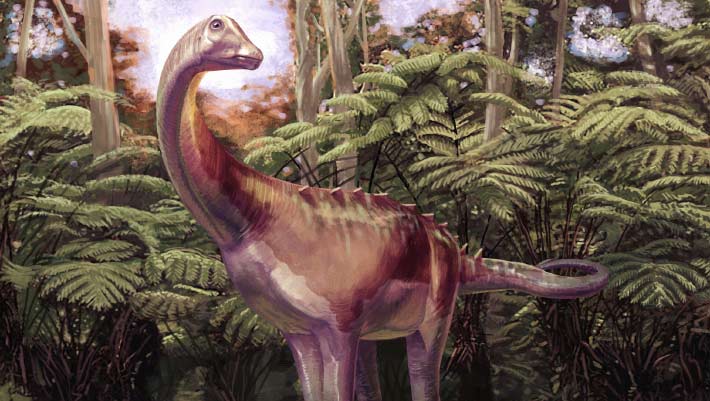
A visual representation of Yamanasaurus lojaensis, first dinosaur discovered in Ecuador
Taxons Yamanasaurus

A visual representation of Yamanasaurus lojaensis, first dinosaur discovered in Ecuador

Équateur Dinosauria Yamanasaurus
Reconstruction of the holotype skull (PIN 3906/2) of the Late Cretaceous sauropod Quaesitosaurus orientalis. Based on Kurzanov & Bannikov 1983,[1] missing elements restored after Nemegtosaurus.[2]
Color Key
  Preserved
  Missing
References

↑ (1983). "A new sauropod from the Upper Cretaceous of Mongolia". Paleontological Journal 2: 90−96.

↑ (2005). "Redescription of the mongolian sauropod Nemegtosaurus mongoliensis nowinski (dinosauria: Saurischia) and comments on late cretaceous sauropod diversity". Journal of Systematic Palaeontology 3 (3): 283−318. DOI:10.1017/S1477201905001628.
Taxons Quaesitosaurus

Reconstruction of the holotype skull (PIN 3906/2) of the Late Cretaceous sauropod Quaesitosaurus orientalis. Based on Kurzanov & Bannikov 1983,[1] missing elements restored after Nemegtosaurus.[2] Color Key   Preserved   Missing References ↑ (1983). "A new sauropod from the Upper Cretaceous of Mongolia". Paleontological Journal 2: 90−96. ↑ (2005). "Redescription of the mongolian sauropod Nemegtosaurus mongoliensis nowinski (dinosauria: Saurischia) and comments on late cretaceous sauropod diversity". Journal of Systematic Palaeontology 3 (3): 283−318. DOI:10.1017/S1477201905001628.

Mongolie Crétacé Crétacé supérieur holotype +5
Restoration of Borealosaurus a potentially titanosaur dinosaur from the Cretaceous of China
Taxons Borealosaurus

Restoration of Borealosaurus a potentially titanosaur dinosaur from the Cretaceous of China

Chine Crétacé Borealosaurus Dinosauria +1
Map of the localities in the Bauru Basin where the sauropod dinosaurs were collected.

Map of the localities in the Bauru Basin where the sauropod dinosaurs were collected.

Dinosauria Ibirania
(A) A phylogenetic principal-component analysis (PCA) represents the projection of the Dinosauria supertree (STAR Methods) into a PCA of climatic variables. PC1 axis shows strong positive correlation with maximum temperature ([temp max), low positive correlation with precipitation seasonality ( precip season), strong negative correlation with minimum temperature (Ytemp min), and strong negative correlation with minimum precipitation (Yprecip min). PC2 axis shows strong positive correlation with minimum temperature ([temp min) and negative correlation with precipitation seasonality (Yprecip season). Shadows around points highlight the relative density in the principal compo- nent space of non-dinosaurian Dinosauromorpha (gray), Ornithischia (blue), Sauropodomorpha (green), and Theropoda (red).
(B) Lower left plot shows 95% confidence interval convex hulls for each dinosauromorph subclade. Blue thermometer (top left corner) symbolizes the direction of the vector in the PC space region for cold temper- atures; yellow thermometer (top right corner) indicates the direction of the vector in PC space for warm tem- peratures; brown shrub (top right corner) depicts dry conditions, while the same with a gray, rainy cloud (mid, lower side of the graph) illustrates seasonal conditions.
Silhouettes represent the following taxa (clockwise from the higher left corner): Minmi, Edmontosaurus, Pachyrhinosaurus, Tyrannosaurus, Asilisaurus, Graci- liceratops, Harpymimus, Altirhinus, Gobititan, Suz- housaurus, Marasuchus, Pampadromaeus, Herrer- asaurus, Vulcanodon, Diplodocus, Giraffatitan,

Coelophysis, Dromomeron, Gondwanatitan, Tapuiasaurus, Anchisaurus, Siamotyrannus, Diodorus, Suchomimus, Phuwiangosaurus, Ouranosaurus, Irritator, Tangvayosaurus, Nanshiungosaurus, Aeolosaurus, Rebbachisaurus, Chuxiongosaurus, Tethyshadros, Koreanosaurus. Genyodectes, Mapusaurus, Vegavis, Goyocephale, and Rhoetosaurus.

(A) A phylogenetic principal-component analysis (PCA) represents the projection of the Dinosauria supertree (STAR Methods) into a PCA of climatic variables. PC1 axis shows strong positive correlation with maximum temperature ([temp max), low positive correlation with precipitation seasonality ( precip season), strong negative correlation with minimum temperature (Ytemp min), and strong negative correlation with minimum precipitation (Yprecip min). PC2 axis shows strong positive correlation with minimum temperature ([temp min) and negative correlation with precipitation seasonality (Yprecip season). Shadows around points highlight the relative density in the principal compo- nent space of non-dinosaurian Dinosauromorpha (gray), Ornithischia (blue), Sauropodomorpha (green), and Theropoda (red). (B) Lower left plot shows 95% confidence interval convex hulls for each dinosauromorph subclade. Blue thermometer (top left corner) symbolizes the direction of the vector in the PC space region for cold temper- atures; yellow thermometer (top right corner) indicates the direction of the vector in PC space for warm tem- peratures; brown shrub (top right corner) depicts dry conditions, while the same with a gray, rainy cloud (mid, lower side of the graph) illustrates seasonal conditions. Silhouettes represent the following taxa (clockwise from the higher left corner): Minmi, Edmontosaurus, Pachyrhinosaurus, Tyrannosaurus, Asilisaurus, Graci- liceratops, Harpymimus, Altirhinus, Gobititan, Suz- housaurus, Marasuchus, Pampadromaeus, Herrer- asaurus, Vulcanodon, Diplodocus, Giraffatitan, Coelophysis, Dromomeron, Gondwanatitan, Tapuiasaurus, Anchisaurus, Siamotyrannus, Diodorus, Suchomimus, Phuwiangosaurus, Ouranosaurus, Irritator, Tangvayosaurus, Nanshiungosaurus, Aeolosaurus, Rebbachisaurus, Chuxiongosaurus, Tethyshadros, Koreanosaurus. Genyodectes, Mapusaurus, Vegavis, Goyocephale, and Rhoetosaurus.

Dinosauria Ornithischia Pampadromaeus Sauropodomorpha +1
Simplified cladogram of Iguanodontia, drawn by me, based on Norman 2004 ("Basal Iguanodontia" in The Dinosauria 2nd Edition).

Simplified cladogram of Iguanodontia, drawn by me, based on Norman 2004 ("Basal Iguanodontia" in The Dinosauria 2nd Edition).

Dinosauria Iguanodontia Mochlodon
Herbivorous dinosaur found in the Al-khoudh area.  This dinosaur is similar to the Zalmoxes and Rhabdodon dinosaurs.  The skeleton in the Bait Al Baranda Museum was assembled from bones borrowed from several museums.

Herbivorous dinosaur found in the Al-khoudh area. This dinosaur is similar to the Zalmoxes and Rhabdodon dinosaurs. The skeleton in the Bait Al Baranda Museum was assembled from bones borrowed from several museums.

os musée Dinosauria Mochlodon +3
Locality map for Australian eurypodan thyreophoran fossils.

1, Stegosaurian? footprint (QM F5701), Walloon Coal Measures, Balgowan Colliery, Balgowan (Bajocian–Bathonian); 2, Minmi paravertebra holotype (QM F10329) (Molnar, 1980), Minmi Member, Bungil Formation (Valanginian–Barremian); 3, Thyreophoran trackways, Broome Sandstone, Dampier Peninsula, Western Australia (Valanginian–Barremian); 4, Ankylosauria indet. (see Barrett et al., 2010) ‘Flat Rocks’ Wonthaggi Formation (upper Hauterivian–Albian); 5, NMV P216739, ‘Lake Copco–Dinosaur Cove’ Eumeralla Formation (middle upper Aptian to lower middle Albian) (Barrett et al., 2010); 6, QM F33286; 7, AM F119849 and AM F35259; 8, Kunbarrasaurus ieversi gen. et sp. nov. (formerly Minmi sp.) (QM F18101); 9, QM F33565 and QM F33566; 10, QM F44324-28. Legend: Dark Green, Toolebuc Formation (late middle–early late Albian); Green, Allaru Formation (upper Albian–(?)lower Cenomanian); Light green, Mackunda Formation (upper Albian–lower Cenomanian); Lightest green, Winton Formation (late Albian–early Turonian).
Formations Toolebuc

Locality map for Australian eurypodan thyreophoran fossils. 1, Stegosaurian? footprint (QM F5701), Walloon Coal Measures, Balgowan Colliery, Balgowan (Bajocian–Bathonian); 2, Minmi paravertebra holotype (QM F10329) (Molnar, 1980), Minmi Member, Bungil Formation (Valanginian–Barremian); 3, Thyreophoran trackways, Broome Sandstone, Dampier Peninsula, Western Australia (Valanginian–Barremian); 4, Ankylosauria indet. (see Barrett et al., 2010) ‘Flat Rocks’ Wonthaggi Formation (upper Hauterivian–Albian); 5, NMV P216739, ‘Lake Copco–Dinosaur Cove’ Eumeralla Formation (middle upper Aptian to lower middle Albian) (Barrett et al., 2010); 6, QM F33286; 7, AM F119849 and AM F35259; 8, Kunbarrasaurus ieversi gen. et sp. nov. (formerly Minmi sp.) (QM F18101); 9, QM F33565 and QM F33566; 10, QM F44324-28. Legend: Dark Green, Toolebuc Formation (late middle–early late Albian); Green, Allaru Formation (upper Albian–(?)lower Cenomanian); Light green, Mackunda Formation (upper Albian–lower Cenomanian); Lightest green, Winton Formation (late Albian–early Turonian).

Australie Broome Sandstone Eumeralla Toolebuc +18
Original figure caption: .mw-parser-output .smallcaps{font-variant:small-caps}The Middletown Slab covered with the Footprints of Carnivorous Dinosaurs. The tracks are in high relief. Additional notes: Most if not all of these tridactylous (i.e. three-toed) footprints/tracks (but not the actual trackmaker!) are referred to as Grallator or as Grallator-type trace fossils. “High relief” means that these are actually casts of footprints forming a positive relief on the lower surface of the sandstone slab (so-called positive hyporelief). The material that originally formed the mud over which the dinosaurs walked was too friable to be recovered from the quarry in one piece. The slab consists of so called ‘brownstone’ which is the trading name of the sandstone quarried at Middletown, Connecticut. This sandstone belongs to the Lower Jurassic Portland Formation of the Hartford Basin (“Connecticut Valley”) and thus to the upper part of the Newark Supergroup. The trackmakers probably were relatively small ‘primitive’ theropod dinosaurs (coelophysoids) such as Podokesaurus the remains of which were recovered from Lower Jurassic deposits of the Hartford Basin.
Formations Portland

Original figure caption: .mw-parser-output .smallcaps{font-variant:small-caps}The Middletown Slab covered with the Footprints of Carnivorous Dinosaurs. The tracks are in high relief. Additional notes: Most if not all of these tridactylous (i.e. three-toed) footprints/tracks (but not the actual trackmaker!) are referred to as Grallator or as Grallator-type trace fossils. “High relief” means that these are actually casts of footprints forming a positive relief on the lower surface of the sandstone slab (so-called positive hyporelief). The material that originally formed the mud over which the dinosaurs walked was too friable to be recovered from the quarry in one piece. The slab consists of so called ‘brownstone’ which is the trading name of the sandstone quarried at Middletown, Connecticut. This sandstone belongs to the Lower Jurassic Portland Formation of the Hartford Basin (“Connecticut Valley”) and thus to the upper part of the Newark Supergroup. The trackmakers probably were relatively small ‘primitive’ theropod dinosaurs (coelophysoids) such as Podokesaurus the remains of which were recovered from Lower Jurassic deposits of the Hartford Basin.

Portland Jurassique moulage fossile +4
Title: Dinosaur hunting in western Canada
Identifier: dinosaurhuntingi00russ (find matches)
Year: 1966 (1960s)
Authors: Russell, Loris Shano, 1904-; Royal Ontario Museum
Subjects: Dinosaurs; Paleontology
Publisher: (Toronto : Printed at the University of Toronto Press)
Contributing Library: ROM - University of Toronto
Digitizing Sponsor: University of Toronto

View Book Page: Book Viewer
About This Book: Catalog Entry
View All Images: All Images From Book
Click here to view book online to see this illustration in context in a browseable online version of this book.

Text Appearing Before Image: 
This season of 1921 George Sternberg became the first dinosaur col- lector on the Red Deer River to have his work recorded in motion pictures. This happened by a curious error. The Dominion Motion Picture Bureau, predecessor of the National Film Board of Canada, had decided to make a short motion picture based on the work being done by the Geological Survey of Canada in the collecting and displaying of Canadian dinosaurs. The camera party sent to Alberta was naturally supposed to visit the Geological Survey party under Charles M. Sternberg, but local directions sent them to the camp of George Sternberg. So this excellent little film records field work by the University of Alberta party and preparation being done at the National Museum of Canada in Ottawa. That winter George Sternberg continued the preparation of the speci- mens obtained during the two preceding field seasons, but in the spring he resigned to accept a position with the Field Museum of Natural History of Chicago, under Elmer S. Riggs. The summer of 1922 was the last time that the eldest of the Sternberg sons worked on the Red Deer River, his collec- tion going to Chicago. However, he returned to Edmonton for several months in 1935, to complete the preparation of the collection that he brought together in 1920 and 1921. When George Sternberg left the Geological Survey of Canada in 1918, the only one of the four Sternbergs remaining at Ottawa was Charles Mortram Sternberg, the second son of C. H. Sternberg. Actually, Charles had his first independent expedition to the Red Deer badlands in 1917, C. M. Sternberg ami G. E. Lindblad working on the skull of a horned dinosaur (Centrasaurus sp.), Oldman formation, Red Deer River, 1917. N.M.C., No. 39994.
Text Appearing After Image: 
22

Note About Images

Please note that these images are extracted from scanned page images that may have been digitally enhanced for readability - coloration and appearance of these illustrations may not perfectly resemble the original work.

Title: Dinosaur hunting in western Canada Identifier: dinosaurhuntingi00russ (find matches) Year: 1966 (1960s) Authors: Russell, Loris Shano, 1904-; Royal Ontario Museum Subjects: Dinosaurs; Paleontology Publisher: (Toronto : Printed at the University of Toronto Press) Contributing Library: ROM - University of Toronto Digitizing Sponsor: University of Toronto View Book Page: Book Viewer About This Book: Catalog Entry View All Images: All Images From Book Click here to view book online to see this illustration in context in a browseable online version of this book. Text Appearing Before Image: This season of 1921 George Sternberg became the first dinosaur col- lector on the Red Deer River to have his work recorded in motion pictures. This happened by a curious error. The Dominion Motion Picture Bureau, predecessor of the National Film Board of Canada, had decided to make a short motion picture based on the work being done by the Geological Survey of Canada in the collecting and displaying of Canadian dinosaurs. The camera party sent to Alberta was naturally supposed to visit the Geological Survey party under Charles M. Sternberg, but local directions sent them to the camp of George Sternberg. So this excellent little film records field work by the University of Alberta party and preparation being done at the National Museum of Canada in Ottawa. That winter George Sternberg continued the preparation of the speci- mens obtained during the two preceding field seasons, but in the spring he resigned to accept a position with the Field Museum of Natural History of Chicago, under Elmer S. Riggs. The summer of 1922 was the last time that the eldest of the Sternberg sons worked on the Red Deer River, his collec- tion going to Chicago. However, he returned to Edmonton for several months in 1935, to complete the preparation of the collection that he brought together in 1920 and 1921. When George Sternberg left the Geological Survey of Canada in 1918, the only one of the four Sternbergs remaining at Ottawa was Charles Mortram Sternberg, the second son of C. H. Sternberg. Actually, Charles had his first independent expedition to the Red Deer badlands in 1917, C. M. Sternberg ami G. E. Lindblad working on the skull of a horned dinosaur (Centrasaurus sp.), Oldman formation, Red Deer River, 1917. N.M.C., No. 39994. Text Appearing After Image: 22 Note About Images Please note that these images are extracted from scanned page images that may have been digitally enhanced for readability - coloration and appearance of these illustrations may not perfectly resemble the original work.

chasse film musée Canada +1
Locality map: Grand Staircase-Escalante National Monument, southern Utah.
Map showing locality (indicated by star) of Nasutoceratops titusi holotype UMNH VP 16800, recovered from the Kaiparowits Formation of Grand Staircase-Escalante National Monument (GSENM). GSENM is bounded by the red rectangle and silhouetted in dark gray on the inset of Utah and surrounding states (modified from [1]).

The original map has been modified to show Nasutoceratops instead of Machairoceratops as in the original source. New location based on map in Ceratopsid Dinosaurs from the Grand Staircase of Southern Utah, page 489.

Locality map: Grand Staircase-Escalante National Monument, southern Utah. Map showing locality (indicated by star) of Nasutoceratops titusi holotype UMNH VP 16800, recovered from the Kaiparowits Formation of Grand Staircase-Escalante National Monument (GSENM). GSENM is bounded by the red rectangle and silhouetted in dark gray on the inset of Utah and surrounding states (modified from [1]). The original map has been modified to show Nasutoceratops instead of Machairoceratops as in the original source. New location based on map in Ceratopsid Dinosaurs from the Grand Staircase of Southern Utah, page 489.

Kaiparowits holotype Ceratopsidae Dinosauria +3
Locality map: Grand Staircase-Escalante National Monument, southern Utah.
Map showing locality (indicated by star) of Kosmoceratops richardsoni holotype UMNH VP 17000 and assigned subadult UMNH VP 16878, recovered from the Kaiparowits Formation of Grand Staircase-Escalante National Monument (GSENM). GSENM is bounded by the red rectangle and silhouetted in dark gray on the inset of Utah and surrounding states (modified from [1]).

The original map has been modified to show Kosmoceratops instead of Machairoceratops as in the original source. New location based on map in Ceratopsid Dinosaurs from the Grand Staircase of Southern Utah, page 489.

Locality map: Grand Staircase-Escalante National Monument, southern Utah. Map showing locality (indicated by star) of Kosmoceratops richardsoni holotype UMNH VP 17000 and assigned subadult UMNH VP 16878, recovered from the Kaiparowits Formation of Grand Staircase-Escalante National Monument (GSENM). GSENM is bounded by the red rectangle and silhouetted in dark gray on the inset of Utah and surrounding states (modified from [1]). The original map has been modified to show Kosmoceratops instead of Machairoceratops as in the original source. New location based on map in Ceratopsid Dinosaurs from the Grand Staircase of Southern Utah, page 489.

Kaiparowits holotype Ceratopsidae Dinosauria +3
Psittacosaurus skeletal mount (Early Cretaceous, Jiufotang Formation) and unidentified Late Cretaceous dinosaur egg from Xixia, Hennan, on display in the Li Siguang Memorial Museum in Huangzhou.
Formations Jiufotang

Psittacosaurus skeletal mount (Early Cretaceous, Jiufotang Formation) and unidentified Late Cretaceous dinosaur egg from Xixia, Hennan, on display in the Li Siguang Memorial Museum in Huangzhou.

musée Jiufotang Crétacé Crétacé inférieur +4
1 2 3 4 5 6 7 8 9 10 11 12 13 14 15 16

Actualités

Des monstres marins géants vivaient dans les rivières à la fin de l'ère des dinosaures
dent alimentation prédateur Dinosauria Mosasaurus isotope
Les mosasaures géants, autrefois considérés comme des prédateurs strictement océaniques, ont peut-être passé leur dernier chapitre à rôder dans les rivières d'eau douce aux côtés de dinosaures et de crocodiles. Une dent massive trouvée dans le Dakota du Nord, analysée à l'aide de techniques isotopiques chimiques, révèle que certains mosasaures se sont adaptés aux systèmes fluviaux à mesure que les mers se rafraîchissaient progressivement vers la fin de l'ère des dinosaures. Ces énormes reptiles, peut-être aussi longs qu'un bus, semblent avoir chassé près de la surface, se nourrissant peut-être même de dinosaures noyés.
15/12/2025 sciencedaily ⚙ Traduction automatique
Une momie de dinosaure retrouvée avec des sabots et une crête cachée
crête écaille film Dinosauria Edmontosaurus
Les scientifiques ont reconstitué le profil le plus complet et le plus réaliste d’Edmontosaurus annectens grâce à un processus de préservation extraordinaire appelé modèle d’argile, dans lequel un mince film d’argile a capturé la peau, les écailles, les pointes et même les sabots du dinosaure en trois dimensions. En combinant des «momies» récemment fouillées, une imagerie avancée et une reconstruction artistique, les chercheurs ont révélé une haute crête, une seule rangée de pointes de queue, de délicates écailles ressemblant à des cailloux et, ce qui est le plus remarquable, le plus ancien sabot connu.
30/11/2025 sciencedaily ⚙ Traduction automatique
Edmontosaurus: Beast of the Week
Edmontosaurus : la bête de la semaine
Crétacé Crétacé supérieur Canardia Dinosauria Edmontosaurus Hadrosauria
Aujourd’hui, nous examinons l’un des dinosaures à bec de canard les plus grands et les mieux étudiés.  Entrez Edmontosaure!  Edmontosaurus annectens dans les aquarelles de Christopher DiPiazza.Edmontosaurus était un dinosaure hadrosaure (« à bec de canard ») qui pouvait atteindre au moins 39 pieds (12 mètres) de long du bec à la queue et qui vivait à la fin du Crétacé dans ce qui est aujourd'hui l'ouest de l'Amérique du Nord.  Il existe actuellement deux espèces reconnues dans le genre, Edmontosaurus regalis et Edmontosaurus annect.
29/11/2025 prehistoricbeastoftheweek ⚙ Traduction automatique
Nanotyrannus: Beast of the Week
Nanotyrannus : Bête de la semaine
États-Unis Crétacé Dinosauria Nanotyrannus
 Cette semaine, nous allons découvrir un dinosaure dont l'identité a fait l'objet de nombreux débats pendant des décennies.  Découvrez Nanotyrannus ! Nanotyrannus était un dinosaure carnivore qui vivait dans ce qui est aujourd'hui le Montana aux États-Unis au cours de la dernière période du Crétacé, il y a entre 67 et 66 millions d'années.  Du museau à la queue, il mesurait entre 17 et 20 pieds (6,2 mètres) de long à l’état adulte. Le nom du genre se traduit par « petit tyran nain » car on pensait à l'origine qu'il s'agissait d'un proche parent.
19/11/2025 prehistoricbeastoftheweek ⚙ Traduction automatique
Zuul: Beast of the Week
Zuul : la bête de la semaine
film États-Unis Crétacé Crétacé supérieur Ankylosauria Dinosauria Zuul
 Cette semaine, nous allons découvrir un étonnant dinosaure blindé au nom délicieusement effrayant.  Découvrez le crurivastateur Zuul !  Zuul était un dinosaure ankylosaure qui vivait dans ce qui est aujourd'hui le Montana, aux États-Unis, à la fin du Crétacé, il y a environ 75 millions d'années.  Il mesurait environ 6 mètres du bec à la queue et aurait mangé des plantes de son vivant.  Le nom du genre fait directement référence au monstre du film Ghostbusters de 1984, qui, selon les paléontologues, ressemblait au dinosaure.
31/10/2025 prehistoricbeastoftheweek ⚙ Traduction automatique
1 2 3 4 5 6 7 8 9 10 11 12 13 14 15 16 17 18 19 20 21 22 23 24 25 26 27 28 29 30 31 32