Dinosauria

Taxon

211 image(s) · 103 Actualités

Voir la fiche

Galerie d'images

The theropod dinosaur Coelophysis bauri by John Conway [1]

The theropod dinosaur Coelophysis bauri by John Conway [1]

Conway Coelophysis Dinosauria Syntarsus
Badlands Dinosaur Museum, North Dakota 5-9-2022 (157)

Badlands Dinosaur Museum, North Dakota 5-9-2022 (157)

musée Dinosauria Thescelosaurus
Pectoral girdles and forelimbs of dinosaurs in left lateral view, depicting resting scapular and forelimb orientations in different dinosaurian groups as recommended according to the results of this study.

In each case, solid horizontal line is parallel to long axis of sacrum. A. theropods without semilunate carpals (Dilophosaurus wetherilli, UCMP 37302). B. theropods with semilunate carpals other than Caudipteryx (Velociraptor mongoliensis, after reference [60]). C. Caudipteryx (C. sp., after reference [8]). D. ceratopsids (Styracosaurus albertensis, NMC 344). E. basal sauropodomorphs (Plateosaurus engelhardti, AMNH 6810). F. non-hadrosaurian ornithopods (Thescelosaurus neglectus, reference [62]). G. hadrosaurids (Parasaurolophus walkeri, after reference [48]). Angle labels: B = scapular orientation relative to long axis of sacrum. E = elbow angle. S = shoulder angle. W = wrist angle. See Materials and Methods section for descriptions of angles.

Pectoral girdles and forelimbs of dinosaurs in left lateral view, depicting resting scapular and forelimb orientations in different dinosaurian groups as recommended according to the results of this study. In each case, solid horizontal line is parallel to long axis of sacrum. A. theropods without semilunate carpals (Dilophosaurus wetherilli, UCMP 37302). B. theropods with semilunate carpals other than Caudipteryx (Velociraptor mongoliensis, after reference [60]). C. Caudipteryx (C. sp., after reference [8]). D. ceratopsids (Styracosaurus albertensis, NMC 344). E. basal sauropodomorphs (Plateosaurus engelhardti, AMNH 6810). F. non-hadrosaurian ornithopods (Thescelosaurus neglectus, reference [62]). G. hadrosaurids (Parasaurolophus walkeri, after reference [48]). Angle labels: B = scapular orientation relative to long axis of sacrum. E = elbow angle. S = shoulder angle. W = wrist angle. See Materials and Methods section for descriptions of angles.

description Caudipteryx Ceratopsidae Dilophosaurus +9
Crâne de mosasaure d'espèce Platecarpus tympaniticus (squamates, mosasaures).
Provenance : Smoky Hill Chalk, Kansas (aux Etats-Unis).
Date : Crétacé supérieur, période du Campanien, 88 millions d'années avant notre ère.
Collections du Muséum national d'histoire naturelle de Paris (France).
Exposé à l'occasion de l'exposition "Un T-Rex à Paris" au Muséum national d'histoire naturelle de Paris (France) du 6 juin au 2 septembre 2018.

Légende du fossile dans cette exposition : "Les mosasaures ne sont pas des dinosaures mais des reptiles marins, très répandus à la fin du Crétacé. Certains genres comme Globidens et Halisaurus sont connus aussi bien aux Etats-Unis qu'au Maroc. Ces animaux étaient d'excellents nageurs, capables de traverser l'Atlantique."

Crâne de mosasaure d'espèce Platecarpus tympaniticus (squamates, mosasaures). Provenance : Smoky Hill Chalk, Kansas (aux Etats-Unis). Date : Crétacé supérieur, période du Campanien, 88 millions d'années avant notre ère. Collections du Muséum national d'histoire naturelle de Paris (France). Exposé à l'occasion de l'exposition "Un T-Rex à Paris" au Muséum national d'histoire naturelle de Paris (France) du 6 juin au 2 septembre 2018. Légende du fossile dans cette exposition : "Les mosasaures ne sont pas des dinosaures mais des reptiles marins, très répandus à la fin du Crétacé. Certains genres comme Globidens et Halisaurus sont connus aussi bien aux Etats-Unis qu'au Maroc. Ces animaux étaient d'excellents nageurs, capables de traverser l'Atlantique."

France Maroc Campanien Crétacé +8
Fig 2. Chrono-, bio- and lithostratigraphic context of the Reuchenette Formation in the Ajoie district, Canton Jura, NW Switzerland (modified from [20,23,28,31]. Four track-bearing intervals, named lower, intermediate, and upper (dinosaur track) levels, and track levels 600 have been identified within the Courtedoux Member (Nerinean Limestones, sensu [32]). All studied material comes from the intermediate (levels 1000–1100) and upper (levels 1500–1650) dinosaur track levels, details shown on inset on the upper right.

Fig 2. Chrono-, bio- and lithostratigraphic context of the Reuchenette Formation in the Ajoie district, Canton Jura, NW Switzerland (modified from [20,23,28,31]. Four track-bearing intervals, named lower, intermediate, and upper (dinosaur track) levels, and track levels 600 have been identified within the Courtedoux Member (Nerinean Limestones, sensu [32]). All studied material comes from the intermediate (levels 1000–1100) and upper (levels 1500–1650) dinosaur track levels, details shown on inset on the upper right.

Suisse Reuchenette Dinosauria Megalosauripus +1
Remake of the original picture of the Drzewica Formation. Terrestrial environment of the Pliensbachian-Toarcian boundary of Fennoscandinavia  Inland environment of the  Bornholm Coast, nearby the German realm of the Ciechocinek Formation. Includes
Ciechocinek Formation (Lower Toarcian, Bones) and Drzwica Formation (Latest Pliensbachian, Footprints) Fauna
Sorthat Formation environment, fluvial influenced mainland with Cheirolepidaceae and Bennetitales as dominant flora
Dinosaurs are based on material found on various locations of Northern Germany, and Footprints of the underliying Drzewica Formation at the Holy Cross Mountains, connected with Bornholm at the time.
Dinosaur Species appeared: 

Megalosauripus isp. Large Footprints (+65 cm) found on the Drzewica Formation. There is a dorsal vertebrae on the German Margin of the Ciechocinek Formation assigend to Megalosauria (Huene, 1966).
Gravisauria spp. representing the Grimmen Sauropod reported on 2014, as a taxon related with Tazoudasaurus. Barapasaurus-like footprints are know from the Drzewica Formation.
Coelophysoidea spp. based on coeval Anchisauripus tracks from the Holy Cross Mountains.
Basal Ornithischan, related to Eocursor, based on a crouching trace (Gerard Dariusz Gierlinski, Martin G. Lockley, Grzegorz Niedźwiedzki:2009).
Massospondylidae spp. based on Otozum-like tracks.
Taxons Megalosauripus

Remake of the original picture of the Drzewica Formation. Terrestrial environment of the Pliensbachian-Toarcian boundary of Fennoscandinavia Inland environment of the Bornholm Coast, nearby the German realm of the Ciechocinek Formation. Includes Ciechocinek Formation (Lower Toarcian, Bones) and Drzwica Formation (Latest Pliensbachian, Footprints) Fauna Sorthat Formation environment, fluvial influenced mainland with Cheirolepidaceae and Bennetitales as dominant flora Dinosaurs are based on material found on various locations of Northern Germany, and Footprints of the underliying Drzewica Formation at the Holy Cross Mountains, connected with Bornholm at the time. Dinosaur Species appeared: Megalosauripus isp. Large Footprints (+65 cm) found on the Drzewica Formation. There is a dorsal vertebrae on the German Margin of the Ciechocinek Formation assigend to Megalosauria (Huene, 1966). Gravisauria spp. representing the Grimmen Sauropod reported on 2014, as a taxon related with Tazoudasaurus. Barapasaurus-like footprints are know from the Drzewica Formation. Coelophysoidea spp. based on coeval Anchisauripus tracks from the Holy Cross Mountains. Basal Ornithischan, related to Eocursor, based on a crouching trace (Gerard Dariusz Gierlinski, Martin G. Lockley, Grzegorz Niedźwiedzki:2009). Massospondylidae spp. based on Otozum-like tracks.

os Allemagne Pliensbachien Toarcien +7
Heterodontosaurus tucki life restoration. Integument based on the related Tianyulong, proportions based on photos of specimen SAM-PK-K1332 and skeletal reconstruction by Gregory S. Paul (The Princeton Field Guide to Dinosaurs, 2010, p. 240).
Taxons Ferganocephale

Heterodontosaurus tucki life restoration. Integument based on the related Tianyulong, proportions based on photos of specimen SAM-PK-K1332 and skeletal reconstruction by Gregory S. Paul (The Princeton Field Guide to Dinosaurs, 2010, p. 240).

spécimen Dinosauria Ferganocephale Heterodontosauria +1
Depiction of dietary niche partitioning among megaherbivorous dinosaurs from the DPF (MAZ-2). Left to right: Chasmosaurus belli, Lambeosaurus lambei, Styracosaurus albertensis, Scolosaurus cutleri (formerly sunk in Euoplocephalus tutus), Prosaurolophus maximus, Panoplosaurus mirus. A herd of S. albertensis looms in the background.
Taxons Continuoolithus

Depiction of dietary niche partitioning among megaherbivorous dinosaurs from the DPF (MAZ-2). Left to right: Chasmosaurus belli, Lambeosaurus lambei, Styracosaurus albertensis, Scolosaurus cutleri (formerly sunk in Euoplocephalus tutus), Prosaurolophus maximus, Panoplosaurus mirus. A herd of S. albertensis looms in the background.

Chasmosaurus Continuoolithus Dinosauria Euoplocephalus +5
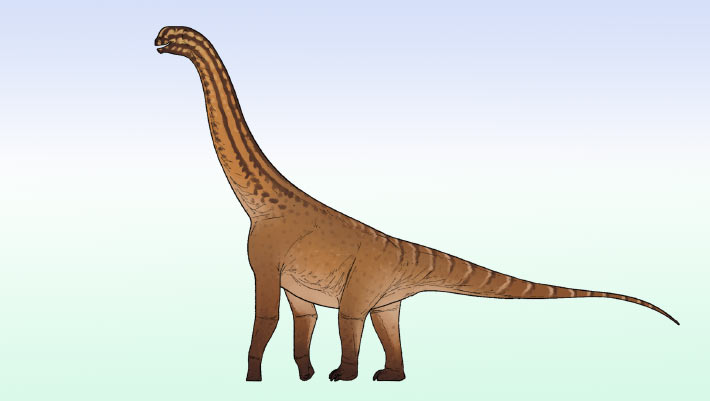
A hypothetical life restoration of Ampelosaurus atacis

• Ampelosaurus is known from hundreds of fossil specimens which show most of the dinosaur's osteological details, however, there are few articulated remains or reconstructions of the material so its overall proportions and life appearance are uncertain.
• Ampelosaurus is known to have supported osteoderms, only four are currently known. The number of these osteoderms that an individual Ampelosaurus would have supported in life and their and position on the body is not currently known. It's thought that due to the rarity of titanosaur osteoderms that they would be quite sparse on the body. The position and layout of the osteoderms has been loosely based on this interpretation, which is based on the work of Vidal et al 2015. [1]
Taxons Bagualosaurus

A hypothetical life restoration of Ampelosaurus atacis • Ampelosaurus is known from hundreds of fossil specimens which show most of the dinosaur's osteological details, however, there are few articulated remains or reconstructions of the material so its overall proportions and life appearance are uncertain. • Ampelosaurus is known to have supported osteoderms, only four are currently known. The number of these osteoderms that an individual Ampelosaurus would have supported in life and their and position on the body is not currently known. It's thought that due to the rarity of titanosaur osteoderms that they would be quite sparse on the body. The position and layout of the osteoderms has been loosely based on this interpretation, which is based on the work of Vidal et al 2015. [1]

fossile spécimen Ampelosaurus Bagualosauria +6
A hypothetical life restoration of Ampelosaurus atacis

• Ampelosaurus is known from hundreds of fossil specimens which show most of the dinosaur's osteological details, however, there are few articulated remains or reconstructions of the material so its overall proportions and life appearance are uncertain.
• Ampelosaurus is known to have supported osteoderms, only four are currently known. The number of these osteoderms that an individual Ampelosaurus would have supported in life and their and position on the body is not currently known. It's thought that due to the rarity of titanosaur osteoderms that they would be quite sparse on the body. The position and layout of the osteoderms has been loosely based on this interpretation, which is based on the work of Vidal et al 2015. [1]
Taxons Camelotia

A hypothetical life restoration of Ampelosaurus atacis • Ampelosaurus is known from hundreds of fossil specimens which show most of the dinosaur's osteological details, however, there are few articulated remains or reconstructions of the material so its overall proportions and life appearance are uncertain. • Ampelosaurus is known to have supported osteoderms, only four are currently known. The number of these osteoderms that an individual Ampelosaurus would have supported in life and their and position on the body is not currently known. It's thought that due to the rarity of titanosaur osteoderms that they would be quite sparse on the body. The position and layout of the osteoderms has been loosely based on this interpretation, which is based on the work of Vidal et al 2015. [1]

fossile spécimen Ampelosaurus Bagualosauria +6
A hypothetical life restoration of Ampelosaurus atacis

• Ampelosaurus is known from hundreds of fossil specimens which show most of the dinosaur's osteological details, however, there are few articulated remains or reconstructions of the material so its overall proportions and life appearance are uncertain.
• Ampelosaurus is known to have supported osteoderms, only four are currently known. The number of these osteoderms that an individual Ampelosaurus would have supported in life and their and position on the body is not currently known. It's thought that due to the rarity of titanosaur osteoderms that they would be quite sparse on the body. The position and layout of the osteoderms has been loosely based on this interpretation, which is based on the work of Vidal et al 2015. [1]
Taxons Chromogisaurus

A hypothetical life restoration of Ampelosaurus atacis • Ampelosaurus is known from hundreds of fossil specimens which show most of the dinosaur's osteological details, however, there are few articulated remains or reconstructions of the material so its overall proportions and life appearance are uncertain. • Ampelosaurus is known to have supported osteoderms, only four are currently known. The number of these osteoderms that an individual Ampelosaurus would have supported in life and their and position on the body is not currently known. It's thought that due to the rarity of titanosaur osteoderms that they would be quite sparse on the body. The position and layout of the osteoderms has been loosely based on this interpretation, which is based on the work of Vidal et al 2015. [1]

fossile spécimen Ampelosaurus Bagualosauria +6
A hypothetical life restoration of Ampelosaurus atacis

• Ampelosaurus is known from hundreds of fossil specimens which show most of the dinosaur's osteological details, however, there are few articulated remains or reconstructions of the material so its overall proportions and life appearance are uncertain.
• Ampelosaurus is known to have supported osteoderms, only four are currently known. The number of these osteoderms that an individual Ampelosaurus would have supported in life and their and position on the body is not currently known. It's thought that due to the rarity of titanosaur osteoderms that they would be quite sparse on the body. The position and layout of the osteoderms has been loosely based on this interpretation, which is based on the work of Vidal et al 2015. [1]
Taxons Dashanpusaurus

A hypothetical life restoration of Ampelosaurus atacis • Ampelosaurus is known from hundreds of fossil specimens which show most of the dinosaur's osteological details, however, there are few articulated remains or reconstructions of the material so its overall proportions and life appearance are uncertain. • Ampelosaurus is known to have supported osteoderms, only four are currently known. The number of these osteoderms that an individual Ampelosaurus would have supported in life and their and position on the body is not currently known. It's thought that due to the rarity of titanosaur osteoderms that they would be quite sparse on the body. The position and layout of the osteoderms has been loosely based on this interpretation, which is based on the work of Vidal et al 2015. [1]

fossile spécimen Ampelosaurus Bagualosauria +6
A hypothetical life restoration of Ampelosaurus atacis

• Ampelosaurus is known from hundreds of fossil specimens which show most of the dinosaur's osteological details, however, there are few articulated remains or reconstructions of the material so its overall proportions and life appearance are uncertain.
• Ampelosaurus is known to have supported osteoderms, only four are currently known. The number of these osteoderms that an individual Ampelosaurus would have supported in life and their and position on the body is not currently known. It's thought that due to the rarity of titanosaur osteoderms that they would be quite sparse on the body. The position and layout of the osteoderms has been loosely based on this interpretation, which is based on the work of Vidal et al 2015. [1]
Taxons Demandasaurus

A hypothetical life restoration of Ampelosaurus atacis • Ampelosaurus is known from hundreds of fossil specimens which show most of the dinosaur's osteological details, however, there are few articulated remains or reconstructions of the material so its overall proportions and life appearance are uncertain. • Ampelosaurus is known to have supported osteoderms, only four are currently known. The number of these osteoderms that an individual Ampelosaurus would have supported in life and their and position on the body is not currently known. It's thought that due to the rarity of titanosaur osteoderms that they would be quite sparse on the body. The position and layout of the osteoderms has been loosely based on this interpretation, which is based on the work of Vidal et al 2015. [1]

fossile spécimen Ampelosaurus Bagualosauria +6
fossil Europasaurus, Aathal Dinosaur Museum.
Taxons Europasaurus

fossil Europasaurus, Aathal Dinosaur Museum.

musée fossile Dinosauria Europasaurus
Right hind limb of the sauropodomorph dinosaur Musankwa sanyatiensis gen. et sp. nov. (NHMZ 2521) from the Pebbly Arkose Formation (Norian, Upper Triassic) of Spurwing Island, Zimbabwe. A. Right femur in posterior (A1), lateral (A2), anterior (A3), medial (A4), proximal (A5), and distal (A6) views. B. Right tibia with conjoined astragalus in anterior (B1), lateral (B2), posterior (B3), medial (B4), and proximal (B5) views.
Taxons Musankwa

Right hind limb of the sauropodomorph dinosaur Musankwa sanyatiensis gen. et sp. nov. (NHMZ 2521) from the Pebbly Arkose Formation (Norian, Upper Triassic) of Spurwing Island, Zimbabwe. A. Right femur in posterior (A1), lateral (A2), anterior (A3), medial (A4), proximal (A5), and distal (A6) views. B. Right tibia with conjoined astragalus in anterior (B1), lateral (B2), posterior (B3), medial (B4), and proximal (B5) views.

membre Zimbabwe Norien Trias +3
Reconstruction of Tuebingosaurus maierfritzorum gen. et sp. nov. as a quadruped dinosaur, using the outline of Riojasaurus as a base ‒ next to the silhouette of Friedrich von Huene. The drawing of the bones is based on and modified from the original illustrations of specimen “GPIT IV” in von Huene (1932, pl. 38) that have been replicated in the literature. The right fibula is marked in grey as it was found nearby with similar measurements to the left fibula and has been assumed to be part of the same individual.
Taxons Tuebingosaurus

Reconstruction of Tuebingosaurus maierfritzorum gen. et sp. nov. as a quadruped dinosaur, using the outline of Riojasaurus as a base ‒ next to the silhouette of Friedrich von Huene. The drawing of the bones is based on and modified from the original illustrations of specimen “GPIT IV” in von Huene (1932, pl. 38) that have been replicated in the literature. The right fibula is marked in grey as it was found nearby with similar measurements to the left fibula and has been assumed to be part of the same individual.

os dessin spécimen Dinosauria +2
1 2 3 4 5 6 7 8 9 10 11 12 13 14

Actualités

Omnivorous, Rodent-Like Mammal Lived in Dinosaurs’ Shadow on Pacific Coast
Un mammifère omnivore ressemblant à un rongeur vivait dans l’ombre des dinosaures sur la côte du Pacifique
Mexique fossile Dinosauria mammifères nouvelle espèce
Les paléontologues ont décrit une nouvelle espèce du genre de mammifères multituberculés Cimolodon sur la base d'un fossile trouvé en Basse-Californie, au Mexique. L'article Un mammifère omnivore ressemblant à un rongeur vivait dans l'ombre des dinosaures sur la côte du Pacifique est apparu en premier sur Sci.News : Breaking Science News.
29/04/2026 sci-news ⚙ Traduction automatique
Small Titanosaur Species from Morocco Reveals Surprising South American Ties
Une petite espèce de titanosaure du Maroc révèle des liens surprenants avec l'Amérique du Sud
Maroc Dinosauria Titanosauria nouvelle espèce
Un nouveau genre et une nouvelle espèce de dinosaure sauropode titanosaure apparentés aux formes sud-américaines ont été décrits par une équipe de paléontologues dirigée par le Dr Nick Longrich de l’Université de Bath. L'article Une petite espèce de titanosaure du Maroc révèle des liens surprenants avec l'Amérique du Sud apparaît en premier sur Sci.News : Breaking Science News.
28/04/2026 sci-news ⚙ Traduction automatique
Ce petit mammifère a survécu à l'apocalypse des dinosaures et a changé la vie sur Terre
fossile Dinosauria extinction mammifères
Un mammifère préhistorique récemment découvert pourrait détenir des indices sur la façon dont la vie a survécu à l’extinction des dinosaures. La minuscule espèce, Cimolodon desosai, vivait il y a 75 millions d'années et possédait des caractéristiques, comme un petit corps et un régime alimentaire varié, qui augmentaient probablement ses chances de survie. Trouvé en Basse-Californie, le fossile comprend de rares restes squelettiques qui révèlent comment il se déplaçait et vivait. Les chercheurs pensent que sa lignée a aidé les mammifères à endurer l’un des événements les plus meurtriers sur Terre.
27/04/2026 sciencedaily ⚙ Traduction automatique
Les vaisseaux sanguins découverts dans les os de T. rex réécrivent la science des dinosaures
os ADN fossile Dinosauria Tyrannosaurus
L’ADN des dinosaures est peut-être encore hors de portée, mais les scientifiques découvrent quelque chose de presque aussi passionnant : d’anciens vaisseaux sanguins cachés dans des os fossilisés. Dans un énorme Tyrannosaurus rex surnommé Scotty, les chercheurs ont découvert un réseau de vaisseaux préservés dans une côte qui s'était fracturée et avait commencé à guérir il y a 66 millions d'années. Grâce aux puissants rayons X synchrotron des accélérateurs de particules, ils ont pu observer l'intérieur du fossile dense sans l'endommager, révélant des structures complexes et riches en fer.
26/04/2026 sciencedaily ⚙ Traduction automatique
Les poulpes géants régnaient sur les océans il y a 100 millions d'années, selon une étude
mâchoire prédateur proie fossile Dinosauria étude
Des poulpes géants et redoutables auraient pu autrefois régner sur les mers anciennes, selon de nouvelles recherches qui renversent le scénario de leur passé évolutif. En découvrant des mâchoires fossiles superbement préservées cachées dans la roche, les scientifiques ont révélé que les premières pieuvres de l’âge des dinosaures n’étaient pas des vagabonds timides et au corps mou : c’étaient d’énormes prédateurs au sommet, pouvant s’étendre jusqu’à 20 mètres de long et écrasant leurs proies avec de puissantes morsures.
25/04/2026 sciencedaily-paleo ⚙ Traduction automatique
1 2 3 4 5 6 7 8 9 10 11 12 13 14 15 16 17 18 19 20 21