←

musée

Type de contenu

415 image(s) · 34 Actualités

Galerie d'images

Holotype of Fona herzogae NCSM 33548 at the w:North Carolina Museum of Natural Sciences
Taxons Fona

Holotype of Fona herzogae NCSM 33548 at the w:North Carolina Museum of Natural Sciences

musée holotype Fona
Yangtzepus yipingensis holotype (IVPP V2473) at the Paleozoological Museum of China.
Taxons Yangtzepus

Yangtzepus yipingensis holotype (IVPP V2473) at the Paleozoological Museum of China.

musée Chine holotype Yangtzepus
Muttaburrasaurus
The plants, animals and climate of the Australian continent have changed dramatically over long periods of time. Imagine this giant creature roaming the luxuriant wet forests that covered parts of the continent in the Cretaceous period, about 100-110 million years ago. The Muttaburrasaurus ambled along on all four legs or stood on its hind legs. Its large teeth were well adapted to eat tough vegetation such as the leathery foliage of the evergreen forests of Araucaria trees, ancient relatives of the bunya pine of south-eastern Queensland.
In 1963, grazier Doug Langdon discovered the fossilised bones of a dinosaur on his property near Muttaburra in central-west Queensland. It was one of the most complete dinosaur skeletons found in Australia. The bones belonged to a new species of ornithopod and palaeontologists named it Muttaburrasaurus langdoni.

Cast of Muttaburresaurus langdoni 1987 made by Queensland Museum, Brisbane National Museum of Australia
Taxons Muttaburrasaurus

Muttaburrasaurus The plants, animals and climate of the Australian continent have changed dramatically over long periods of time. Imagine this giant creature roaming the luxuriant wet forests that covered parts of the continent in the Cretaceous period, about 100-110 million years ago. The Muttaburrasaurus ambled along on all four legs or stood on its hind legs. Its large teeth were well adapted to eat tough vegetation such as the leathery foliage of the evergreen forests of Araucaria trees, ancient relatives of the bunya pine of south-eastern Queensland. In 1963, grazier Doug Langdon discovered the fossilised bones of a dinosaur on his property near Muttaburra in central-west Queensland. It was one of the most complete dinosaur skeletons found in Australia. The bones belonged to a new species of ornithopod and palaeontologists named it Muttaburrasaurus langdoni. Cast of Muttaburresaurus langdoni 1987 made by Queensland Museum, Brisbane National Museum of Australia

os musée Australie Crétacé +5
Montanoceratops cerorhynchus (Brown & Schlaikjer, 1942) - fossil ceratopsian dinosaur skeleton from the Cretaceous of Montana, USA. (MOR 542, Museum of the Rockies, Bozeman, Montana, USA)
The species name is sometimes incorrectly spelled "cerorhynchos".  The original publication spells it "cerorhynchus".  The genus name is sometimes incorrectly spelled "Montanaceratops".
Ceratopsians are the "horned dinosaurs".  They were large, quadrupedal, herbivorous dinosaurs having a beaked skull and a frill - an extension of bone behind the skull that partially covered the neck.  Ceratopsian dinosaurs are known from the Jurassic and Cretaceous.  The last members of the group died out at the Cretaceous-Tertiary boundary, 65 million years ago.
This is a partial skeleton of a juvenile Montanoceratops, a ceratopsian from the near-latest Cretaceous of western North America.  This type of ceratopsian lacked facial horns.


From exhibit signage:
Sixty-eight million years ago, when the horned dinosaurs Triceratops and Torosaurus inhabited the coastal plain near the inland ocean, primitive "horned" dinosaurs named Montanoceratops lived in uplands near the young Rocky Mountains.  These little protoceratopsians fed on plants with slicing teeth and narrow beaks similar to their giant three-horned relatives.


Classification: Animalia, Chordata, Vertebrata, Reptilia, Archosauria, Dinosauria, Ornithischia, Marginocephalia, Ceratopsia, Leptoceratopsidae
Stratigraphy: St. Mary River Formation, Maastrichtian Stage, Upper Cretaceous
Locality: Little Rocky Coulee, north of the town of Cut Bank, eastern Glacier County, northwestern Montana, USA


Info. at:

en.wikipedia.org/wiki/Montanoceratops
Taxons Montanoceratops

Montanoceratops cerorhynchus (Brown & Schlaikjer, 1942) - fossil ceratopsian dinosaur skeleton from the Cretaceous of Montana, USA. (MOR 542, Museum of the Rockies, Bozeman, Montana, USA) The species name is sometimes incorrectly spelled "cerorhynchos". The original publication spells it "cerorhynchus". The genus name is sometimes incorrectly spelled "Montanaceratops". Ceratopsians are the "horned dinosaurs". They were large, quadrupedal, herbivorous dinosaurs having a beaked skull and a frill - an extension of bone behind the skull that partially covered the neck. Ceratopsian dinosaurs are known from the Jurassic and Cretaceous. The last members of the group died out at the Cretaceous-Tertiary boundary, 65 million years ago. This is a partial skeleton of a juvenile Montanoceratops, a ceratopsian from the near-latest Cretaceous of western North America. This type of ceratopsian lacked facial horns. From exhibit signage: Sixty-eight million years ago, when the horned dinosaurs Triceratops and Torosaurus inhabited the coastal plain near the inland ocean, primitive "horned" dinosaurs named Montanoceratops lived in uplands near the young Rocky Mountains. These little protoceratopsians fed on plants with slicing teeth and narrow beaks similar to their giant three-horned relatives. Classification: Animalia, Chordata, Vertebrata, Reptilia, Archosauria, Dinosauria, Ornithischia, Marginocephalia, Ceratopsia, Leptoceratopsidae Stratigraphy: St. Mary River Formation, Maastrichtian Stage, Upper Cretaceous Locality: Little Rocky Coulee, north of the town of Cut Bank, eastern Glacier County, northwestern Montana, USA Info. at: en.wikipedia.org/wiki/Montanoceratops

os musée États-Unis Crétacé +17
Teratophoneus curriei, adult (left) and juvenile (right), on display at the Natural History Museum of Utah, Salt Lake City.
Taxons Teratophoneus

Teratophoneus curriei, adult (left) and juvenile (right), on display at the Natural History Museum of Utah, Salt Lake City.

musée juvénile Teratophoneus
Nigersaurus - 01 (possibly National Museum of Nature and Science, Tokyo)
Taxons Nigersaurus

Nigersaurus - 01 (possibly National Museum of Nature and Science, Tokyo)

musée Nigersaurus
Mounted specimen of Archaeornithomimus asiaticus on display at the Paleozoological Museum of China.
Taxons Archaeornithomimus

Mounted specimen of Archaeornithomimus asiaticus on display at the Paleozoological Museum of China.

musée Chine spécimen Archaeornithomimus
Holotype scapula of Tienshanosaurus chitaiensis on display at the Paleozoological Museum of China.
Taxons Tienshanosaurus

Holotype scapula of Tienshanosaurus chitaiensis on display at the Paleozoological Museum of China.

musée Chine holotype Tienshanosaurus
Skeleton identified as Nemegtomaia by Greg Funston.[1] Central Museum of Mongolian Dinosaurs, Ulaanbaatar. Complete indexed photo collection at WorldHistoryPics.com.
Taxons Nemegtomaia

Skeleton identified as Nemegtomaia by Greg Funston.[1] Central Museum of Mongolian Dinosaurs, Ulaanbaatar. Complete indexed photo collection at WorldHistoryPics.com.

musée Dinosauria Nemegtomaia squelette
Yangchuanosaurus shangyouensis skeleton displayed in Hong Kong Science Museum
Taxons Yangchuanosaurus

Yangchuanosaurus shangyouensis skeleton displayed in Hong Kong Science Museum

musée Yangchuanosaurus squelette
Leaellynasaura amicagraphica, dinosaur, skull. Holotype. [P 185991]
Taxons Leaellynasaura

Leaellynasaura amicagraphica, dinosaur, skull. Holotype. [P 185991]

musée holotype Dinosauria Leaellynasaura +1
Skeleton of Sinovenator on display at the Tianjin Natural History Museum.
Taxons Sinovenator

Skeleton of Sinovenator on display at the Tianjin Natural History Museum.

musée Sinovenator squelette
Lower jaw, arm bone, and leg bone (LACM 128258 and LACM 120478) of Fruitadens haagarorum on display at the Natural History Museum of Los Angeles County.
Taxons Fruitadens

Lower jaw, arm bone, and leg bone (LACM 128258 and LACM 120478) of Fruitadens haagarorum on display at the Natural History Museum of Los Angeles County.

os musée Fruitadens
Yunguisaurus liae, Zhejiang Museum of Natural History (Hangzhou)
Taxons Yunguisaurus

Yunguisaurus liae, Zhejiang Museum of Natural History (Hangzhou)

musée Yunguisaurus
Skeleton of Chungkingosaurus jiangbeiensis displayed in Hong Kong Science Museum
Taxons Chungkingosaurus

Skeleton of Chungkingosaurus jiangbeiensis displayed in Hong Kong Science Museum

musée Chungkingosaurus squelette
Scolosaurus thronus - Royal Tyrrell Museum
Taxons Scolosaurus

Scolosaurus thronus - Royal Tyrrell Museum

musée Scolosaurus
1 2 3 4 5 6 7 8 9 10 11 12 13 14 15 16 17 18 19 20 21 22 23 24 25 26

Actualités

Les os géants d'un camarasaure exposés pour la première fois à Angoulême
os musée Camarasaurus Diplodocia découverte
Le musée d’Angoulême expose, à partir de vendredi 22 mai, les ossements d’un camarasaure, un cousin du diplodocus de 20 mètres de long. Une première, deux ans après leur découverte spectaculaire à Angeac-Charente (Charente).
22/05/2026 sciencesetavenir
Bonne Journée internationale des musées (2026)
musée Dinosauria communication
Aujourd'hui, c'est la Journée internationale des musées et, ici à Everything Dinosaur, nous souhaitons célébrer le travail incroyable réalisé par les musées du monde entier. Les musées contribuent à inspirer la curiosité, à encourager l’apprentissage et à connecter les gens avec la nature. Ils jouent également un rôle crucial dans l’éducation, la communication scientifique et la sensibilisation. Nous avons toujours aimé visiter les musées, notamment
18/05/2026 everythingdinosaur ⚙ Traduction automatique
Il construisait un mur dans son jardin… quand une silhouette vieille de 240 millions d’années apparaît
musée fossile
Destiné à devenir un simple bloc de construction, un morceau de grès récupéré dans une carrière australienne cache en réalité un secret vieux de 240 millions d’années. Oublié pendant des décennies dans les réserves d’un musée, ce fossile exceptionnel vient seulement de révéler l’existence d’une...
18/05/2026 futura-terre
Giant Tyrannosaur Fossil Found in New Mexico
Un fossile de tyrannosaure géant découvert au Nouveau-Mexique
musée Mexique fossile Dinosauria Tyrannosauridae Tyrannosaurus
Un grand dinosaure tyrannosauridé aurait pu rôder dans les plaines inondables de ce qui est aujourd'hui le Nouveau-Mexique il y a près de 74 millions d'années, selon une équipe de paléontologues de l'Université de Bath, de l'Université d'État du Montana et du Musée d'histoire naturelle et des sciences du Nouveau-Mexique. L'article Un fossile de tyrannosaure géant découvert au Nouveau-Mexique est apparu en premier sur Sci.News : Breaking Science News.
15/05/2026 sci-news ⚙ Traduction automatique
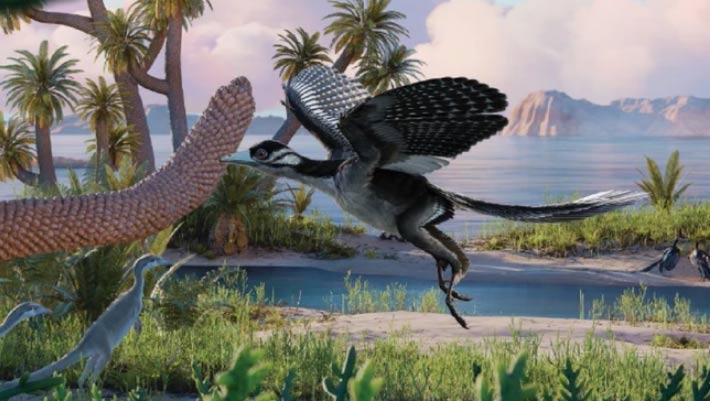
Paleontologists Reconstruct Ecology of Archaeopteryx
Des paléontologues reconstituent l'écologie de l'archéoptéryx
écologie musée fossile Archaeopteryx comportement étude
Une nouvelle étude complète réalisée par les paléontologues du Field Museum of Natural History rassemble les dernières preuves fossiles pour offrir le portrait le plus complet à ce jour de l’écologie, du comportement et de la vie quotidienne de l’Archaeopteryx. L'article Les paléontologues reconstruisent l'écologie de l'archéoptéryx apparaît en premier sur Sci.News : Breaking Science News.
08/05/2026 sci-news ⚙ Traduction automatique
1 2 3 4 5 6 7