étude

Thématique

4 image(s) · 32 Actualités

Galerie d'images

Figure 1. Evolution of macroecological traits in Dinosauria. Large scale event in dinosaur evolution (a); the origin of dinosaurs (star), hyperthermals (volcano), the earliest fossil Avialae (bird), the earliest fossil angiosperm (flower), the Cretaceous/Palaeogene mass extinction (asteroid). Phylogeny of dinosaurs (b) redrawn from Sereno and adapted to the current consensus and upon which an ancestral state reconstruction of temperature niche (mean annual temperature) after Chiarenza et al. is plotted; Mesozoic palaeogeographies (c) for Triassic (T), Jurassic (J) and Cretaceous (K). Silhouette colours symbolize body mass for each of the taxa represented; information on dietary habits are plotted after Barrett and Zanno & Makovicky; numbers represent clades discussed through this study: 1, Ornithischia; 2, Thyreophora; 3, Ornithopoda; 4, Hadrosauroidea; 5, Marginocephalia; 6, Ceratopsia; 7, Saurischia; 8, Sauropodomorpha; 9, Sauropoda; 10, Theropoda; 11, Ceratosauria; 12, Tetanurae; 13, Coelurosauria; 14, Maniraptoriformes; 15, Maniraptora; 16, Deinonychosauria; 17, Avialae; 18, Ornithothoraces. Palaeogeographies modified from original plots via R package ‘mapast’ using plate models by Scotese.

Figure 1. Evolution of macroecological traits in Dinosauria. Large scale event in dinosaur evolution (a); the origin of dinosaurs (star), hyperthermals (volcano), the earliest fossil Avialae (bird), the earliest fossil angiosperm (flower), the Cretaceous/Palaeogene mass extinction (asteroid). Phylogeny of dinosaurs (b) redrawn from Sereno and adapted to the current consensus and upon which an ancestral state reconstruction of temperature niche (mean annual temperature) after Chiarenza et al. is plotted; Mesozoic palaeogeographies (c) for Triassic (T), Jurassic (J) and Cretaceous (K). Silhouette colours symbolize body mass for each of the taxa represented; information on dietary habits are plotted after Barrett and Zanno & Makovicky; numbers represent clades discussed through this study: 1, Ornithischia; 2, Thyreophora; 3, Ornithopoda; 4, Hadrosauroidea; 5, Marginocephalia; 6, Ceratopsia; 7, Saurischia; 8, Sauropodomorpha; 9, Sauropoda; 10, Theropoda; 11, Ceratosauria; 12, Tetanurae; 13, Coelurosauria; 14, Maniraptoriformes; 15, Maniraptora; 16, Deinonychosauria; 17, Avialae; 18, Ornithothoraces. Palaeogeographies modified from original plots via R package ‘mapast’ using plate models by Scotese.

écaille Crétacé Jurassique Mésozoïque +23
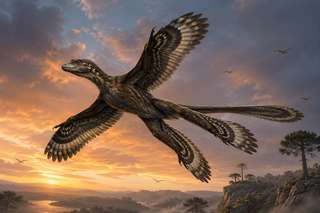
Restoration of Lucianovenator bonoi based on images of known remains and related genera. Proto-feathers for insulation in coelophysids and other early theropods have been supported by this study:[1]
Taxons Lucianovenator

Restoration of Lucianovenator bonoi based on images of known remains and related genera. Proto-feathers for insulation in coelophysids and other early theropods have been supported by this study:[1]

plume Coelophysidae Lucianovenator étude
(A) Present day map of Australia with the town of Lightning Ridge indicated by the star. (B) Regional map of the Lightning Ridge region showing localities (where known) for specimens described in this text. Sealed (solid black lines) and unsealed roads (dashed lines) are indicated. The ephemeral Coocoran Lake is marked with a dotted blue line. (C) Correlative stratigraphy of the major Cretaceous depositional basins and geological units discussed in this study. The ornithopod icon and arrow indicate the approximate level of the Griman Creek Formation from which the current material pertains. Informal units are in quotation marks. Maps in (A) and (B) redrawn and modified from Bell et al. (2016) and Opal Fields—Lightning Ridge Region map produced by the NSW Department of Mineral Resources, respectively. Stratigraphy based on Toslini, McLoughlin & Drinnan (1999) and Cook, Bryan & Draper (2013). Ornithopod silhouette created by Caleb M. Brown and used under the Creative Commons Attribution-ShareAlike 3.0 Unported license.

(A) Present day map of Australia with the town of Lightning Ridge indicated by the star. (B) Regional map of the Lightning Ridge region showing localities (where known) for specimens described in this text. Sealed (solid black lines) and unsealed roads (dashed lines) are indicated. The ephemeral Coocoran Lake is marked with a dotted blue line. (C) Correlative stratigraphy of the major Cretaceous depositional basins and geological units discussed in this study. The ornithopod icon and arrow indicate the approximate level of the Griman Creek Formation from which the current material pertains. Informal units are in quotation marks. Maps in (A) and (B) redrawn and modified from Bell et al. (2016) and Opal Fields—Lightning Ridge Region map produced by the NSW Department of Mineral Resources, respectively. Stratigraphy based on Toslini, McLoughlin & Drinnan (1999) and Cook, Bryan & Draper (2013). Ornithopod silhouette created by Caleb M. Brown and used under the Creative Commons Attribution-ShareAlike 3.0 Unported license.

Australie Griman Creek Crétacé spécimen +3
Pectoral girdles and forelimbs of dinosaurs in left lateral view, depicting resting scapular and forelimb orientations in different dinosaurian groups as recommended according to the results of this study.

In each case, solid horizontal line is parallel to long axis of sacrum. A. theropods without semilunate carpals (Dilophosaurus wetherilli, UCMP 37302). B. theropods with semilunate carpals other than Caudipteryx (Velociraptor mongoliensis, after reference [60]). C. Caudipteryx (C. sp., after reference [8]). D. ceratopsids (Styracosaurus albertensis, NMC 344). E. basal sauropodomorphs (Plateosaurus engelhardti, AMNH 6810). F. non-hadrosaurian ornithopods (Thescelosaurus neglectus, reference [62]). G. hadrosaurids (Parasaurolophus walkeri, after reference [48]). Angle labels: B = scapular orientation relative to long axis of sacrum. E = elbow angle. S = shoulder angle. W = wrist angle. See Materials and Methods section for descriptions of angles.

Pectoral girdles and forelimbs of dinosaurs in left lateral view, depicting resting scapular and forelimb orientations in different dinosaurian groups as recommended according to the results of this study. In each case, solid horizontal line is parallel to long axis of sacrum. A. theropods without semilunate carpals (Dilophosaurus wetherilli, UCMP 37302). B. theropods with semilunate carpals other than Caudipteryx (Velociraptor mongoliensis, after reference [60]). C. Caudipteryx (C. sp., after reference [8]). D. ceratopsids (Styracosaurus albertensis, NMC 344). E. basal sauropodomorphs (Plateosaurus engelhardti, AMNH 6810). F. non-hadrosaurian ornithopods (Thescelosaurus neglectus, reference [62]). G. hadrosaurids (Parasaurolophus walkeri, after reference [48]). Angle labels: B = scapular orientation relative to long axis of sacrum. E = elbow angle. S = shoulder angle. W = wrist angle. See Materials and Methods section for descriptions of angles.

description Caudipteryx Ceratopsidae Dilophosaurus +9

Actualités

Cet étrange petit dinosaure oblige à repenser l'évolution
os dent métabolisme Dinosauria Foskeia anatomie oiseau évolution mammifères étude crâne
Un petit dinosaure nouvellement identifié, Foskeia pelendonum, bouleverse les idées reçues de longue date sur l'évolution des dinosaures herbivores. Même si les adultes adultes étaient remarquablement petits et légers, leur anatomie était tout sauf simple : elles présentaient un crâne bizarre et hautement spécialisé et des traits évolutifs inattendus. Des études osseuses détaillées montrent que ces dinosaures ont mûri rapidement avec un métabolisme semblable à celui des oiseaux ou des mammifères, tandis que leurs dents et leur posture suggèrent une vie rapide et agile dans des forêts denses.
03/02/2026 sciencedaily ⚙ Traduction automatique
Cet ancien fossile pourrait réécrire l'histoire des origines humaines
fossile découverte origine humaine étude
Les scientifiques ont peut-être résolu la question de savoir si un fossile vieux de sept millions d’années pouvait marcher debout. Une nouvelle étude a trouvé des preuves anatomiques solides que Sahelanthropus tchadensis était bipède, y compris une attache ligamentaire observée uniquement chez les ancêtres humains. Malgré son apparence simiesque et son petit cerveau, la structure de ses pattes et de ses hanches suggère qu'il se déplaçait avec assurance sur deux pattes. Cette découverte place la bipédie à la racine même de l’arbre généalogique humain.
03/01/2026 sciencedaily-human-evo ⚙ Traduction automatique
La science résout enfin un meurtre royal vieux de 700 ans
génétique étude
Des preuves génétiques, isotopiques et médico-légales ont permis d'identifier de manière concluante les restes du duc Béla de Macsó et de découvrir des détails remarquables sur sa vie, ses ancêtres et sa mort violente. L'étude révèle un jeune noble d'origine scandinave-Rurik qui a été tué lors d'une attaque coordonnée et chargée d'émotion en 1272.
14/11/2025 sciencedaily-human-evo ⚙ Traduction automatique
Qui sont les Papouasie-Néo-Guinéens ? Une nouvelle étude ADN révèle des origines étonnantes
ADN migration Guinée Papouasie-Nouvelle-Guinée génétique étude
Sur les îles isolées de Papouasie-Nouvelle-Guinée, les gens portent une histoire qui nous relie tous à nos racines les plus profondes. Bien que leur apparence frappante ait autrefois intrigué les scientifiques, de nouvelles preuves génétiques montrent qu'ils partagent une ascendance commune avec d'autres Asiatiques, façonnée par l'isolement, l'adaptation et même le métissage avec de mystérieux Dénisoviens. Pourtant, leur histoire unique – marquée par des problèmes de survie et une séparation des booms agricoles – laisse ouvertes des questions sur les premières migrations hors d’Afrique et sur leur origine.
15/09/2025 sciencedaily-human-evo ⚙ Traduction automatique
Le gène caché de Denisovan qui a aidé les humains à conquérir un nouveau monde
génétique étude
Les anciens humains traversant le détroit de Béring vers les Amériques transportaient bien plus que des outils et de la détermination : ils portaient également un héritage génétique des Dénisoviens, un parent humain disparu. Une nouvelle étude révèle qu'un mystérieux gène appelé MUC19, hérité du croisement entre les Dénisoviens, les Néandertaliens et les humains, pourrait avoir joué un rôle essentiel en aidant les premiers Américains à survivre à de nouvelles maladies, aliments et environnements.
24/08/2025 sciencedaily-human-evo ⚙ Traduction automatique
1 2 3 4 5 6 7