Chine

Pays

87 image(s) · 28 Actualités

Galerie d'images

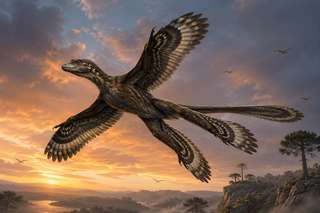
A reconstruction of Aorun, a small coelurosaurian theropod from the Middle Jurassic China.
Taxons Aorun

A reconstruction of Aorun, a small coelurosaurian theropod from the Middle Jurassic China.

Chine Jurassique Jurassique moyen Aorun +1
Holotype of Shenzhousaurus orientalis on display at the Geological Museum of China.
Taxons Shenzhousaurus

Holotype of Shenzhousaurus orientalis on display at the Geological Museum of China.

musée Chine holotype Shenzhousaurus
Holotype skull of Wannanosaurus yansiensis on display at the Paleozoological Museum of China.
Taxons Wannanosaurus

Holotype skull of Wannanosaurus yansiensis on display at the Paleozoological Museum of China.

musée Chine holotype Wannanosaurus +1
The hadrosaurid dinosaur Wulagasaurus dongi gen. et sp. nov. from the Upper Cretaceous Yuliangze Formation at the Wulaga quarry, China.

A. Holotype GMH W184, right dentary in lateral (A1) and medial (A2) views. B. GMH W217, right dentary in lateral (B1) and medial (B2) views.
Taxons Wulagasaurus

The hadrosaurid dinosaur Wulagasaurus dongi gen. et sp. nov. from the Upper Cretaceous Yuliangze Formation at the Wulaga quarry, China. A. Holotype GMH W184, right dentary in lateral (A1) and medial (A2) views. B. GMH W217, right dentary in lateral (B1) and medial (B2) views.

Chine Crétacé holotype Dinosauria +3
Changmiania liaoningensis, an ornithopod dinosaur from the Lower Cretaceous of Lujiatun (Liaoning Province, China).
(A) Holotype PMOL AD00114 in dorsal view; (B) anterior part of the holotype PMOL AD00114 in caudolateral view; (C) referred specimen PMOL LFV022 in dorsal view. Red arrows indicate the emplacement of the gastrolith clusters.
Taxons Changmiania

Changmiania liaoningensis, an ornithopod dinosaur from the Lower Cretaceous of Lujiatun (Liaoning Province, China). (A) Holotype PMOL AD00114 in dorsal view; (B) anterior part of the holotype PMOL AD00114 in caudolateral view; (C) referred specimen PMOL LFV022 in dorsal view. Red arrows indicate the emplacement of the gastrolith clusters.

Chine Crétacé holotype spécimen +2
Partial skeleton of the heterodontosaurid Tianyulong confuciusi from the Lower Cretaceous Jehol Group of China. Partial skeleton mainly in right lateral view (IVPP V17090). Enlargements of subsequent figures are shown in red. Scale bar equals 10 cm.
Taxons Tianyulong

Partial skeleton of the heterodontosaurid Tianyulong confuciusi from the Lower Cretaceous Jehol Group of China. Partial skeleton mainly in right lateral view (IVPP V17090). Enlargements of subsequent figures are shown in red. Scale bar equals 10 cm.

écaille Chine Crétacé Heterodontosauridae +3
Youngoolithus xiaguanensis nest on display at the Paleozoological Museum of China.
Taxons Youngoolithus

Youngoolithus xiaguanensis nest on display at the Paleozoological Museum of China.

nid musée Chine Youngoolithidae +1
Youngoolithus xiaguanensis nest on display at the Paleozoological Museum of China.
Taxons Youngoolithidae

Youngoolithus xiaguanensis nest on display at the Paleozoological Museum of China.

nid musée Chine Youngoolithidae +1
Figure 1: Reconstruction of the skull of Bellusaurus sui from the Middle-Late Jurassic Shishugou Formation of Xinjiang, China.
This reconstruction is a composite based on isolated holotypic and referred material. (A) Right lateral view. (B) Dorsal view. Holotypic elements are indicated in blue and referred elements are in green.
Taxons Bellusaurus

Figure 1: Reconstruction of the skull of Bellusaurus sui from the Middle-Late Jurassic Shishugou Formation of Xinjiang, China. This reconstruction is a composite based on isolated holotypic and referred material. (A) Right lateral view. (B) Dorsal view. Holotypic elements are indicated in blue and referred elements are in green.

Chine Jurassique Jurassique supérieur Bellusaurus +2
Chuanjiesaurus fossil in China Science and Technology Museum. The other two smaller suites of fossils are Lufengosaurus and Dilophosaurus.
Taxons Chuanjiesaurus

Chuanjiesaurus fossil in China Science and Technology Museum. The other two smaller suites of fossils are Lufengosaurus and Dilophosaurus.

musée Chine fossile Chuanjiesaurus +2
Jiangxititan a titanosaurian sauropod from the Late Cretaceous of China. Typical for a sauropod, it had a long neck and stood on four pillar-like legs to support its massive body. Jiangxititan is a member of the Lognkosauria, which include some of the largest dinosaurs known, and is one of the few from mainland Asia. The discovery of Jiangxititan demonstrates the presence of both early-diverging and late-diverging titanosauriform sauropods in that area during the Late Cretaceous.
Taxons Jiangxititan

Jiangxititan a titanosaurian sauropod from the Late Cretaceous of China. Typical for a sauropod, it had a long neck and stood on four pillar-like legs to support its massive body. Jiangxititan is a member of the Lognkosauria, which include some of the largest dinosaurs known, and is one of the few from mainland Asia. The discovery of Jiangxititan demonstrates the presence of both early-diverging and late-diverging titanosauriform sauropods in that area during the Late Cretaceous.

Chine Crétacé Crétacé supérieur Dinosauria +5
Restoration of Dongbeititan dongi from the Early Cretaceous of China
Taxons Dongbeititan

Restoration of Dongbeititan dongi from the Early Cretaceous of China

Chine Crétacé Crétacé inférieur Dongbeititan
Henan Geological Museum, Zhengzhou, China. Complete indexed photo collection at WorldHistoryPics.com.
Taxons Baotianmansaurus

Henan Geological Museum, Zhengzhou, China. Complete indexed photo collection at WorldHistoryPics.com.

musée Chine Baotianmansaurus
Gandititan is a basal titanosaurian sauropod dinosaur from the Late Cretaceous of what is now China. It was a long-necked herbivore, typical of sauropods, with a relatively short tail, a characteristic of titanosaurs compared to other sauropods. Titanosauria have a wide range of body sizes, and Gandititan falls around the middle, slightly on the smaller side. Discovered with a fairly well articluated spine from neck to tail, Gandititan is estimated at about 14 m in total body length.
Taxons Gandititan

Gandititan is a basal titanosaurian sauropod dinosaur from the Late Cretaceous of what is now China. It was a long-necked herbivore, typical of sauropods, with a relatively short tail, a characteristic of titanosaurs compared to other sauropods. Titanosauria have a wide range of body sizes, and Gandititan falls around the middle, slightly on the smaller side. Discovered with a fairly well articluated spine from neck to tail, Gandititan is estimated at about 14 m in total body length.

Chine Crétacé Crétacé supérieur Dinosauria +2
Restoration of Zhuchengtitan zangjiazhuangensis from the Late Cretaceous of China
Taxons Zhuchengtitan

Restoration of Zhuchengtitan zangjiazhuangensis from the Late Cretaceous of China

Chine Crétacé Crétacé supérieur Zhuchengtitan
Restoration of Borealosaurus a potentially titanosaur dinosaur from the Cretaceous of China
Taxons Borealosaurus

Restoration of Borealosaurus a potentially titanosaur dinosaur from the Cretaceous of China

Chine Crétacé Borealosaurus Dinosauria +1
1 2 3 4 5 6

Actualités

Haolong: Beast of the Week
Haolong : Bête de la semaine
Chine Crétacé Crétacé inférieur juvénile spécimen Dinosauria Haolong
 Cette semaine, nous allons découvrir un dinosaure nouvellement décrit qui est si unique qu'il change complètement ce que nous pensions savoir sur la peau des dinosaures !  Entrez Haolong Dongi ! Haolong était un dinosaure herbivore qui vivait dans ce qui est aujourd'hui le Liaoning, en Chine, au début du Crétacé, il y a environ 112,5 millions d'années.  Le seul spécimen enregistré mesure environ 8 pieds (2,45 m) du bec à la queue, mais il était juvénile lorsqu'il est mort, l'espèce a donc probablement grandi.  Le nom du genre se traduit du chinois par "S
08/03/2026 prehistoricbeastoftheweek ⚙ Traduction automatique
Un dinosaure vieux de 125 millions d'années avec des pointes creuses jamais vues auparavant découvert en Chine
Chine juvénile Dinosauria Iguanodontia
Un dinosaure vieux de 125 millions d’années vient de réécrire ce que nous pensions savoir sur la vie préhistorique. Des scientifiques chinois ont découvert un iguanodontien juvénile exceptionnellement préservé, avec une peau fossilisée si détaillée que les cellules individuelles sont encore visibles. Plus étonnant encore, le dinosaure herbivore était couvert de pointes creuses ressemblant à des porcs-épics, des structures jamais documentées auparavant chez aucun dinosaure.
18/02/2026 sciencedaily ⚙ Traduction automatique
Des outils anciens en Chine obligent les scientifiques à repenser les premiers humains
Chine datation découverte fouille
Les archéologues du centre de la Chine ont découvert des preuves que les premiers humains étaient bien plus inventifs qu’on ne le pensait depuis longtemps. Les fouilles sur le site de Xigou révèlent des outils en pierre avancés, y compris les premiers exemples connus d'outils équipés de manches en Asie de l'Est, remontant à 160 000 ans. Ces découvertes montrent que les anciennes populations de la région ont soigneusement planifié, fabriqué et adapté leurs outils pour s'adapter à des environnements changeants.
31/01/2026 sciencedaily-human-evo ⚙ Traduction automatique
1 2 3 4 5 6