dent

Partie anatomique

49 image(s) · 22 Actualités

Galerie d'images

Representative taxa from the Santonian Iharkút fauna from the Csehbánya Formation, Bakony Mountains, western Hungary. A Pannoniasaurus inexpectatus (Squamata, Mosasauroidea), dorsal vertebra (MTM uncatalogued) in dorsal view (photo by Réka Kalmár) B Foxemys trabanti (Pleurodira, Bothremydidae), skull (MTM V 2010.215.1.) in dorsal view (photo by Márton Rabi). C Bicuspidon aff. hatzegiensis (Squamata, Borioteiioidea), left dentary (MTM 2006.112.1.) in medial view (photo by László Makádi) D Basal tetanuran (Theropoda, Tetanurae), tooth (MTM V.01.54) in ?lingual view E Indeterminate abelisaurid (Theropoda, Abelisauridae), pedal ungual phalanx (MTM V 2008.43.1.) in lateral view F Pneumatoraptor fodori (Theropoda, Paraves), left scapulocoracoid (holotype, MTM V 2008.38.1.) in lateral view G Mochlodon vorosi (Ornithopoda, Rhabdodontidae), left dentary (holotype, MTM V 2010.105.1) in lateral view H Bakonydraco galaczi (Pterosauria, Azhdarchidae), mandible (holotype, MTM 2007.110.1) in dorsal view I Iharkutosuchus makadii (Eusuchia, Hylaeochampsidae), skull (holotype, MTM 2006.52.1) in dorsal view J Hungarosaurus tormai (Ankylosauria, Nodosauridae), right dentary (MTM 2007.25.2) in lateral view K Bauxitornis mindszentyae (Aves, Enantiornithes), left tarsometatarsus (holotype, MTM V 2009.38.1) in anterior view L Ajkaceratops kozmai (Ceratopsia), fused rostral and premaxillae (holotype, MTM V 2009.192.1) in lateral view. Scale bars: 2 cm in A, V, G, H, I, J; 1 cm in D, E, F, K, L; 1 mm in C.

Representative taxa from the Santonian Iharkút fauna from the Csehbánya Formation, Bakony Mountains, western Hungary. A Pannoniasaurus inexpectatus (Squamata, Mosasauroidea), dorsal vertebra (MTM uncatalogued) in dorsal view (photo by Réka Kalmár) B Foxemys trabanti (Pleurodira, Bothremydidae), skull (MTM V 2010.215.1.) in dorsal view (photo by Márton Rabi). C Bicuspidon aff. hatzegiensis (Squamata, Borioteiioidea), left dentary (MTM 2006.112.1.) in medial view (photo by László Makádi) D Basal tetanuran (Theropoda, Tetanurae), tooth (MTM V.01.54) in ?lingual view E Indeterminate abelisaurid (Theropoda, Abelisauridae), pedal ungual phalanx (MTM V 2008.43.1.) in lateral view F Pneumatoraptor fodori (Theropoda, Paraves), left scapulocoracoid (holotype, MTM V 2008.38.1.) in lateral view G Mochlodon vorosi (Ornithopoda, Rhabdodontidae), left dentary (holotype, MTM V 2010.105.1) in lateral view H Bakonydraco galaczi (Pterosauria, Azhdarchidae), mandible (holotype, MTM 2007.110.1) in dorsal view I Iharkutosuchus makadii (Eusuchia, Hylaeochampsidae), skull (holotype, MTM 2006.52.1) in dorsal view J Hungarosaurus tormai (Ankylosauria, Nodosauridae), right dentary (MTM 2007.25.2) in lateral view K Bauxitornis mindszentyae (Aves, Enantiornithes), left tarsometatarsus (holotype, MTM V 2009.38.1) in anterior view L Ajkaceratops kozmai (Ceratopsia), fused rostral and premaxillae (holotype, MTM V 2009.192.1) in lateral view. Scale bars: 2 cm in A, V, G, H, I, J; 1 cm in D, E, F, K, L; 1 mm in C.

dent vertèbre Hongrie Santonien +15
Comparisons of Victorian ornithopod maxillae in lateral view and schematics, showing dorsalmost extent of the maxillary ramus (indicated by large arrows): (1) Galleonosaurus dorisae n. gen. n sp., holotypic left maxilla (NMV P229196); (2) Atlascopcosaurus loadsi Rich and Rich, 1989, left maxilla (NMV P157390); (3) cast of original holotypic left maxilla of Atlascopcosaurus loadsi (NMV P166409). alv = alveolus; bur = buccal ridge; lpf = lateral palatine flange of maxilla; m#’ = maxillary tooth position (from posterior end) and replacement number; ml = medial lamina of maxilla; mra = maxillary ramus; nvt = neurovascular tract; plp = posterolateral process of maxilla; pmp = posteromedial process of maxilla; sal = supralveolar lamina of maxilla. Scale bars = 10 mm.

Comparisons of Victorian ornithopod maxillae in lateral view and schematics, showing dorsalmost extent of the maxillary ramus (indicated by large arrows): (1) Galleonosaurus dorisae n. gen. n sp., holotypic left maxilla (NMV P229196); (2) Atlascopcosaurus loadsi Rich and Rich, 1989, left maxilla (NMV P157390); (3) cast of original holotypic left maxilla of Atlascopcosaurus loadsi (NMV P166409). alv = alveolus; bur = buccal ridge; lpf = lateral palatine flange of maxilla; m#’ = maxillary tooth position (from posterior end) and replacement number; ml = medial lamina of maxilla; mra = maxillary ramus; nvt = neurovascular tract; plp = posterolateral process of maxilla; pmp = posteromedial process of maxilla; sal = supralveolar lamina of maxilla. Scale bars = 10 mm.

écaille dent moulage Atlascopcosaurus +1
A tooth tip from the theropod dinosaur Nuthetes destructor from the Lulworth Formation, England

A tooth tip from the theropod dinosaur Nuthetes destructor from the Lulworth Formation, England

dent Coeluridae Dinosauria Nuthetes +1
Piratosaurus holotype tooth USNM V 1000
Taxons Piratosaurus

Piratosaurus holotype tooth USNM V 1000

dent holotype Piratosaurus
Photographs of Melkamter pateko (MPEF-PV 11530), visible in medial views on the main block (1) with inset of the tooth (1B) and counterslab (2);. Rendered CT scan detail images (dashed areas represent visible bone that was too thin to be captured by CT scan) of the cranial fragment (1A), manual metacarpal (1C) and dorsal vertebrae (1D–F). Abbreviations: a = alveoli; if = infratemporal fenestra; j = jugal; l = lacrimal; m = maxilla; o = orbit; naof = Nnasoantorbital fenestra; np = nasal process; pm = premaxilla; po = postorbital; q = quadrate; qj = quadratojugal; s = squamosal; t = tooth; vas = vestigial ascending process.
Taxons Melkamter

Photographs of Melkamter pateko (MPEF-PV 11530), visible in medial views on the main block (1) with inset of the tooth (1B) and counterslab (2);. Rendered CT scan detail images (dashed areas represent visible bone that was too thin to be captured by CT scan) of the cranial fragment (1A), manual metacarpal (1C) and dorsal vertebrae (1D–F). Abbreviations: a = alveoli; if = infratemporal fenestra; j = jugal; l = lacrimal; m = maxilla; o = orbit; naof = Nnasoantorbital fenestra; np = nasal process; pm = premaxilla; po = postorbital; q = quadrate; qj = quadratojugal; s = squamosal; t = tooth; vas = vestigial ascending process.

os dent Melkamter tomographie
Photograph (A) and line drawings (B) of Gladocephaloideus jingangshanensis (JPM 2014–004). Abbreviations: ca, carpals; cr, coracoids; cv, cervical vertebrae; d, dentray; dg, deep groove along the mid-line of the mandibular symphysis; dv, dorsal vertebrae; dr, dorsal ribs; etp, extensor tendon process; f, frontal; fc, fifth carpal; fe, femur; fi, fibula; fin, fingers; h, humerus; il, ilium; m, maxilla; mmttsI-IV, metatrals I-IV; mttv, metatarsal V; nao, nasoantorbital opening; or, orbital; pcr, parietal crest; pm, premaxilla; pt, pteroid; ra, radius; rdl, radiale; sc, scapula; st, sternum; sl, sclerotic rings; t, teeth; tc, tooth sockets; ti, tibia; ul, ulna; wm, wing metacarpal; wph1-4, wing phalanges 1–4. Scale bar = 5 cm.
Taxons Gladocephaloideus

Photograph (A) and line drawings (B) of Gladocephaloideus jingangshanensis (JPM 2014–004). Abbreviations: ca, carpals; cr, coracoids; cv, cervical vertebrae; d, dentray; dg, deep groove along the mid-line of the mandibular symphysis; dv, dorsal vertebrae; dr, dorsal ribs; etp, extensor tendon process; f, frontal; fc, fifth carpal; fe, femur; fi, fibula; fin, fingers; h, humerus; il, ilium; m, maxilla; mmttsI-IV, metatrals I-IV; mttv, metatarsal V; nao, nasoantorbital opening; or, orbital; pcr, parietal crest; pm, premaxilla; pt, pteroid; ra, radius; rdl, radiale; sc, scapula; st, sternum; sl, sclerotic rings; t, teeth; tc, tooth sockets; ti, tibia; ul, ulna; wm, wing metacarpal; wph1-4, wing phalanges 1–4. Scale bar = 5 cm.

crête humérus écaille dent +2
Haliskia peterseni gen. et sp. nov., holotype specimen KK F1426. (A) dorsal vertebra, ribs, gastralium, left scapulocoracoid, left and right manual phalanx IV-2, right manual phalanx IV-3, left femur, left tibia, metatarsals and pedal phalanges, (B) mandible, teeth, ceratobranchials, cervical vertebra, rib, gastralium, right syncarpus, right lateral carpal, right pteroid, metacarpals, manual digits, right manual phalanx IV-1, left manual phalanx IV-4, (C) premaxilla with teeth, (D) isolated tooth, (E) isolated tooth, (F) left lateral carpal, (G) left metacarpal IV. Scale bar = 50 mm.
Taxons Haliskia

Haliskia peterseni gen. et sp. nov., holotype specimen KK F1426. (A) dorsal vertebra, ribs, gastralium, left scapulocoracoid, left and right manual phalanx IV-2, right manual phalanx IV-3, left femur, left tibia, metatarsals and pedal phalanges, (B) mandible, teeth, ceratobranchials, cervical vertebra, rib, gastralium, right syncarpus, right lateral carpal, right pteroid, metacarpals, manual digits, right manual phalanx IV-1, left manual phalanx IV-4, (C) premaxilla with teeth, (D) isolated tooth, (E) isolated tooth, (F) left lateral carpal, (G) left metacarpal IV. Scale bar = 50 mm.

écaille dent vertèbre holotype +2
Selected elements used in the diagnosis of Saltriovenator zanellai n. gen. n. sp.

Right humerus in medial (A), frontal (B) and distal (C) views; (D) left scapula, medial view; (E) right scapular glenoid and coracoid, lateral view; (F) furcula, ventral view; tooth, labial (G) and apical (H) views; (I) left humerus, medial view; right second metacarpal in dorsal (J), lateral (L) and distal (N) views; first phalanx of the right second digit in dorsal (K), lateral (M) and proximal (O) views; (P–T) right third digit in proximal, dorsal and lateral views; (U) right distal tarsal IV, proximal view; third right metatarsal in proximal (V) and frontal (X) views; second right metatarsal, proximal (W) and frontal (Y) views; (Z) reconstructed skeleton showing identified elements (red). Abbreviations as in text, asterisks mark autapomorphic traits. Scale bars: 10 cm in (A)–(E), (I), and (U)–(Y); two cm in (F), and (J)–(T); one cm in (G).
Taxons Saltriovenator

Selected elements used in the diagnosis of Saltriovenator zanellai n. gen. n. sp. Right humerus in medial (A), frontal (B) and distal (C) views; (D) left scapula, medial view; (E) right scapular glenoid and coracoid, lateral view; (F) furcula, ventral view; tooth, labial (G) and apical (H) views; (I) left humerus, medial view; right second metacarpal in dorsal (J), lateral (L) and distal (N) views; first phalanx of the right second digit in dorsal (K), lateral (M) and proximal (O) views; (P–T) right third digit in proximal, dorsal and lateral views; (U) right distal tarsal IV, proximal view; third right metatarsal in proximal (V) and frontal (X) views; second right metatarsal, proximal (W) and frontal (Y) views; (Z) reconstructed skeleton showing identified elements (red). Abbreviations as in text, asterisks mark autapomorphic traits. Scale bars: 10 cm in (A)–(E), (I), and (U)–(Y); two cm in (F), and (J)–(T); one cm in (G).

humérus écaille dent dessin +2
Specimen MN 6117-V, holotype of Oxalaia quilombensis.

A, Left lateral view. B, Right lateral view. C, Dorsal view. D, Slightly oblique ventral view, emphasizing the sculptured condition of the palatal portion of the left premaxilla. Abbreviations for teeth follow Hendrickx et al. [58]. Additional abbreviations: am.p, anteromedial process of maxilla; pm, premaxilla; r.t, replacement tooth; s.p, secondary palate.
Taxons Oxalaia

Specimen MN 6117-V, holotype of Oxalaia quilombensis. A, Left lateral view. B, Right lateral view. C, Dorsal view. D, Slightly oblique ventral view, emphasizing the sculptured condition of the palatal portion of the left premaxilla. Abbreviations for teeth follow Hendrickx et al. [58]. Additional abbreviations: am.p, anteromedial process of maxilla; pm, premaxilla; r.t, replacement tooth; s.p, secondary palate.

dent holotype spécimen Oxalaia
Left maxilla (A) and left dentary (B) of carcharodontosaurid theropod Kelmayisaurus petrolicus Dong, 1973 (IVPP V 4022, China, Lianmugin For−
mation, Lower Cretaceous). Photographs in lateral (A1, B1), medial (A2, B2), ventral (A3), and dorsal (B3) views. Scale bars 5 cm. Designation “d” refers to

dentary tooth, designation “m” refers to maxillary tooth position. Dorsal view of dentary shows tooth row only.
Taxons Kelmayisaurus

Left maxilla (A) and left dentary (B) of carcharodontosaurid theropod Kelmayisaurus petrolicus Dong, 1973 (IVPP V 4022, China, Lianmugin For− mation, Lower Cretaceous). Photographs in lateral (A1, B1), medial (A2, B2), ventral (A3), and dorsal (B3) views. Scale bars 5 cm. Designation “d” refers to dentary tooth, designation “m” refers to maxillary tooth position. Dorsal view of dentary shows tooth row only.

écaille dent Chine Crétacé +2
Cast of the holotype tooth (MGUH DK No. 315) of Dromaeosauroides bornholmensis at the Natural History Museum, London.
Taxons Dromaeosauroides

Cast of the holotype tooth (MGUH DK No. 315) of Dromaeosauroides bornholmensis at the Natural History Museum, London.

dent musée moulage holotype +1
Fig. 2. Selected cranial elements of Bicentenaria argentina nov. gen. et nov. sp. A, left lateral view of preserved caudal half of skull and jaws; B, right lateral view of preserved caudal half of skull and jaws; C, left quadrate and lower jaw in caudal view; D, fragmentary premaxillae with teeth in left lateral view; E, fragmentary left maxilla with tooth in lateral view. Abbreviations: an, angular; antf, antorbital fossa; art, articular; bs, basipterygoid process of basisphenoid; ch, notch for the chorda tympanica; gl, glenoid fossa; j, jugal; lc, lateral condyle of quadrate; lr, longitudinal ridge; ect, ectopterygoid; prar, right prearticular; pral, left prearticular; ptq, pterygoid ramus of quadrate; q, quadrate; qj, quadratojugal; sanl, left surangular; sanr, right surangular; rart, retroarticular process; t, tooth. Scale bars = 1 centimeter.
Taxons Bicentenaria

Fig. 2. Selected cranial elements of Bicentenaria argentina nov. gen. et nov. sp. A, left lateral view of preserved caudal half of skull and jaws; B, right lateral view of preserved caudal half of skull and jaws; C, left quadrate and lower jaw in caudal view; D, fragmentary premaxillae with teeth in left lateral view; E, fragmentary left maxilla with tooth in lateral view. Abbreviations: an, angular; antf, antorbital fossa; art, articular; bs, basipterygoid process of basisphenoid; ch, notch for the chorda tympanica; gl, glenoid fossa; j, jugal; lc, lateral condyle of quadrate; lr, longitudinal ridge; ect, ectopterygoid; prar, right prearticular; pral, left prearticular; ptq, pterygoid ramus of quadrate; q, quadrate; qj, quadratojugal; sanl, left surangular; sanr, right surangular; rart, retroarticular process; t, tooth. Scale bars = 1 centimeter.

écaille dent Argentine Bicentenaria +1
Photograph (A) and line drawing (B) of the skull of Asiatyrannus xui (ZMNH M30360) in right lateral view. The inset box in (A) indicates the position of the detailed jugal accessory horn in (C). acf accessory fossa of maxilla; ang angular; aof antorbital fenestra; cor cornual process; d dentary; d.t dentary tooth; emf external mandibular fenestra; en external naris; f frontal; gr groove; itf infratemporal fenestra; j jugal; jah jugal accessory horn; L left; la lacrimal; mf maxillary fenestra; mnvf maxillary neurovascular foramina; mx maxilla; nas nasal; nr nasal ridge; orb orbit; par parietal; pal palatine; pmx premaxilla; po postorbital; q quadrate; qj quadratojugal; R right; sa surangular; sf surangular foramen; snf subnarial foramen; sq squamosal; t1–6 maxillary tooth 1–6.
Taxons Asiatyrannus

Photograph (A) and line drawing (B) of the skull of Asiatyrannus xui (ZMNH M30360) in right lateral view. The inset box in (A) indicates the position of the detailed jugal accessory horn in (C). acf accessory fossa of maxilla; ang angular; aof antorbital fenestra; cor cornual process; d dentary; d.t dentary tooth; emf external mandibular fenestra; en external naris; f frontal; gr groove; itf infratemporal fenestra; j jugal; jah jugal accessory horn; L left; la lacrimal; mf maxillary fenestra; mnvf maxillary neurovascular foramina; mx maxilla; nas nasal; nr nasal ridge; orb orbit; par parietal; pal palatine; pmx premaxilla; po postorbital; q quadrate; qj quadratojugal; R right; sa surangular; sf surangular foramen; snf subnarial foramen; sq squamosal; t1–6 maxillary tooth 1–6.

dent dessin Asiatyrannus crâne
Reconstruction of the terrestrial paleoenvironmental setting of the Sao Khua Formation by Renata Cunha.
In the center, a generalized spinosaurid feeds on a sauropod. This trophic relationship is hypothesized based on isolated tooth crowns found in association with a sauropod skeleton [67]. In the background, a small pack of the ornithomimosaur theropod Kinnareemimus. Both sauropods and ornithomimosaurs (as part of the “herbivorous” theropods) were found to be positively associated with terrestrial paleoenvironments by Butler and Barrett [15].

(cropped from File:Spinosaurid and Kinnareemimus.PNG)
Taxons Kinnareemimus

Reconstruction of the terrestrial paleoenvironmental setting of the Sao Khua Formation by Renata Cunha. In the center, a generalized spinosaurid feeds on a sauropod. This trophic relationship is hypothesized based on isolated tooth crowns found in association with a sauropod skeleton [67]. In the background, a small pack of the ornithomimosaur theropod Kinnareemimus. Both sauropods and ornithomimosaurs (as part of the “herbivorous” theropods) were found to be positively associated with terrestrial paleoenvironments by Butler and Barrett [15]. (cropped from File:Spinosaurid and Kinnareemimus.PNG)

dent Sao Khua Kinnareemimus Ornithomimosauria +3
DMNH 2021-05-02, holotype left dentary of Ampelognathus coheni, photos and labeled outline drawings in A, lateral; B, medial; C, dorsal; D, ventral; E, anterior; and F, posterior views. Abbreviations: a#, alveolus and numerical position in tooth row; anf, angular facet; cof, coronoid facet; cop, coronoid process; d6, dentary tooth 6 base; ds, dentary symphysis; mc, Meckelian canal; mg, Meckelian groove; pdd, dorsal facet for predentary; pdv, ventral facet for predentary; saf, surangular facet. Gray fill indicates recessed surfaces. Stippling indicates visible sediment. Cross-hatching indicates broken bone surface. Scale bars equal 5 mm.
Taxons Ampelognathus

DMNH 2021-05-02, holotype left dentary of Ampelognathus coheni, photos and labeled outline drawings in A, lateral; B, medial; C, dorsal; D, ventral; E, anterior; and F, posterior views. Abbreviations: a#, alveolus and numerical position in tooth row; anf, angular facet; cof, coronoid facet; cop, coronoid process; d6, dentary tooth 6 base; ds, dentary symphysis; mc, Meckelian canal; mg, Meckelian groove; pdd, dorsal facet for predentary; pdv, ventral facet for predentary; saf, surangular facet. Gray fill indicates recessed surfaces. Stippling indicates visible sediment. Cross-hatching indicates broken bone surface. Scale bars equal 5 mm.

os écaille dent dessin +2
D. Dentary tooth crowns of Arenysaurus ardevoli (MPZ 2008/258) in lingual view. E. Caudal region of the skull roof of A. ardevoli (MPZ 2008/1) in dorsal view. F. Left dentary of A. ardevoli (MPZ 2008/258) in medial view.
Taxons Arenysaurus

D. Dentary tooth crowns of Arenysaurus ardevoli (MPZ 2008/258) in lingual view. E. Caudal region of the skull roof of A. ardevoli (MPZ 2008/1) in dorsal view. F. Left dentary of A. ardevoli (MPZ 2008/258) in medial view.

dent Arenysaurus crâne
1 2 3 4

Actualités

Un visage fossile vieux de 1,5 million d’années oblige à repenser les origines humaines
dent migration Éthiopie fossile découverte origine humaine
Des scientifiques ont reconstruit numériquement le visage d'un fossile d'Homo erectus vieux de 1,5 million d'années provenant d'Éthiopie, révélant ainsi une apparence étonnamment primitive. Bien que son boîtier crânien corresponde à celui de l'Homo erectus classique, le visage et les dents ressemblent à des ancêtres humains beaucoup plus anciens. Cette découverte remet en question les idées reçues de longue date sur le lieu et la manière dont Homo erectus a évolué. Cela fait également allusion à un réseau complexe de migrations et à un possible mélange entre les premières espèces humaines.
16/12/2025 sciencedaily ⚙ Traduction automatique
Des monstres marins géants vivaient dans les rivières à la fin de l'ère des dinosaures
dent alimentation prédateur Dinosauria Mosasaurus isotope
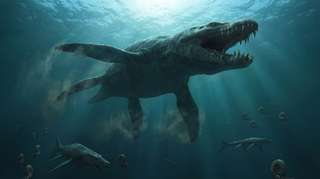
Les mosasaures géants, autrefois considérés comme des prédateurs strictement océaniques, ont peut-être passé leur dernier chapitre à rôder dans les rivières d'eau douce aux côtés de dinosaures et de crocodiles. Une dent massive trouvée dans le Dakota du Nord, analysée à l'aide de techniques isotopiques chimiques, révèle que certains mosasaures se sont adaptés aux systèmes fluviaux à mesure que les mers se rafraîchissaient progressivement vers la fin de l'ère des dinosaures. Ces énormes reptiles, peut-être aussi longs qu'un bus, semblent avoir chassé près de la surface, se nourrissant peut-être même de dinosaures noyés.
15/12/2025 sciencedaily ⚙ Traduction automatique
Un mini-prédateur vieux de 242 millions d'années change l'évolution du lézard
membre dent prédateur fossile évolution nouvelle espèce crâne
Un minuscule fossile du Devon vieux de 242 millions d’années bouleverse les hypothèses des scientifiques sur les premiers membres de la lignée des lézards. Au lieu des charnières du crâne et des dents du palais typiques des lézards et des serpents modernes, cette ancienne créature présente un mélange surprenant de traits primitifs et inhabituels, ainsi que des dents étonnamment grandes en forme de lame. Les scans synchrotron haute résolution ont révélé des détails invisibles à l'œil nu, aidant ainsi les chercheurs à nommer la nouvelle espèce Agriodontosaurus helsbypetrae
30/11/2025 sciencedaily ⚙ Traduction automatique
Les scientifiques découvrent un lien surprenant entre le plomb et l’évolution humaine
dent fossile évolution génétique
Les chercheurs ont découvert que les anciens hominidés, y compris les premiers humains, étaient exposés au plomb tout au long de leur enfance, laissant des traces chimiques dans les dents fossiles. Des expériences suggèrent que cette exposition pourrait avoir entraîné des changements génétiques renforçant les fonctions cérébrales liées au langage chez les humains modernes.
16/11/2025 sciencedaily-human-evo ⚙ Traduction automatique
Des dents vieilles de 2 millions d'années révèlent les secrets de l'aube de l'humanité
mâchoire dent protéine fossile génétique
Pendant des décennies, Paranthropus Robustus a intrigué les scientifiques en tant que cousin puissant et à grande mâchoire des premiers humains. Aujourd’hui, grâce à d’anciennes analyses de protéines, les chercheurs ont découvert de nouveaux secrets cachés dans l’émail dentaire vieux de 2 millions d’années. Ces protéines ont révélé à la fois le sexe et des différences génétiques subtiles entre les fossiles, suggérant que Paranthropus n'était peut-être pas une seule espèce mais un mélange évolutif plus complexe.
01/11/2025 sciencedaily-human-evo ⚙ Traduction automatique
1 2 3 4 5