dent

Partie anatomique

49 image(s) · 22 Actualités

Galerie d'images

Dentary of the hadrosauroid dinosaur Fylax thyrakolasus gen. et sp. nov. (IPS-36338, holotype) from the uppermost Maastrichtian Fontllonga-R locality; in posterior (A1), medial (A2), dorsal (A4), anterior (A5), lateral (A6), and ventral (A7) views. A detailed lingual view of the tooth crowns appears in A3.
Taxons Fylax

Dentary of the hadrosauroid dinosaur Fylax thyrakolasus gen. et sp. nov. (IPS-36338, holotype) from the uppermost Maastrichtian Fontllonga-R locality; in posterior (A1), medial (A2), dorsal (A4), anterior (A5), lateral (A6), and ventral (A7) views. A detailed lingual view of the tooth crowns appears in A3.

dent Maastrichtien holotype Dinosauria +1
Tooth of Siamodon nimngami in the rock
Taxons Siamodon

Tooth of Siamodon nimngami in the rock

dent Siamodon
Skeletal anatomy of Doolysaurus huhmini. All scale bars are 10 mm. Artwork by Janet Cañamar. Abbreviations: 4th tr: fourth trochanter; be: buccal emargination; boc: basioccipital condyle; bpro: boss for articulation with proatlas; bt: basal tubera; cc: cnemial condyle; cfo: carotid aorta foramen; cpc: coronoid process; dh: dorsal head; dtt: dentary tooth; ec: endocranial cavity; eoas: exoccipital articular surface; fm: foramen magnum; lc: lateral condyle; lw: lateral wing; mc: medial condyle; mkc: Meckelian canal; mt: metatarsal; mw: medial wing; mxt: maxillary tooth; ns: neural spine; oc: occipital condyle; pd: pedal digit; plp: posterolateral process; pop: paroccipital process; poz: postzygapophysis; prz: prezygapophyses; pscf: posterior semicircular canal foramen; ptf: posttemporal foramen.
Taxons Doolysaurus

Skeletal anatomy of Doolysaurus huhmini. All scale bars are 10 mm. Artwork by Janet Cañamar. Abbreviations: 4th tr: fourth trochanter; be: buccal emargination; boc: basioccipital condyle; bpro: boss for articulation with proatlas; bt: basal tubera; cc: cnemial condyle; cfo: carotid aorta foramen; cpc: coronoid process; dh: dorsal head; dtt: dentary tooth; ec: endocranial cavity; eoas: exoccipital articular surface; fm: foramen magnum; lc: lateral condyle; lw: lateral wing; mc: medial condyle; mkc: Meckelian canal; mt: metatarsal; mw: medial wing; mxt: maxillary tooth; ns: neural spine; oc: occipital condyle; pd: pedal digit; plp: posterolateral process; pop: paroccipital process; poz: postzygapophysis; prz: prezygapophyses; pscf: posterior semicircular canal foramen; ptf: posttemporal foramen.

écaille dent Doolysaurus anatomie
Ziapelta sanjuanensis, gen. et sp. nov., (holotype NMMNH P-64484), complete skull.

A, dorsal view; B, ventral view; C, anterior view; D, occipital view; and E, left lateral view. Abbreviations: asca, anterior supraorbital caputegulum; bas, basioccipital; ch, choana; fm, foramen magnum; j, jugal; laca, lacrimal caputegulum; loca, loreal caputegulum; ltf, laterotemporal fenestra; mnca, median nasal caputegulum; nar, external naris; oc, occipital condyle; orb, orbit; pal, palatine; par, parietal; parocc, paroccipital process; pmx, premaxilla; psca, posterior supraorbital caputegulum; pt, pterygoid; q, quadrate; qj, quadratojugal; qjh, quadratojugal horn; snca, supranarial caputegulum; socc, supraoccipital; sqh, squamosal horn; tr, tooth row; v, vomer.
Taxons Ziapelta

Ziapelta sanjuanensis, gen. et sp. nov., (holotype NMMNH P-64484), complete skull. A, dorsal view; B, ventral view; C, anterior view; D, occipital view; and E, left lateral view. Abbreviations: asca, anterior supraorbital caputegulum; bas, basioccipital; ch, choana; fm, foramen magnum; j, jugal; laca, lacrimal caputegulum; loca, loreal caputegulum; ltf, laterotemporal fenestra; mnca, median nasal caputegulum; nar, external naris; oc, occipital condyle; orb, orbit; pal, palatine; par, parietal; parocc, paroccipital process; pmx, premaxilla; psca, posterior supraorbital caputegulum; pt, pterygoid; q, quadrate; qj, quadratojugal; qjh, quadratojugal horn; snca, supranarial caputegulum; socc, supraoccipital; sqh, squamosal horn; tr, tooth row; v, vomer.

dent holotype Ziapelta crâne
Skull in dorsal (a and b, photograph and drawing respectively), and left lateral (c and d, photograph and drawing respectively) views. (e) Premaxillary tooth; (f,g) maxillary teeth (g inverted). amf, anterior maxillary fossa; aof, antorbital fossa; aso, anterior supraorbital; d, dentary; ef, elliptical fossa; f, foramina; fr, frontal; ift, infratemporal fenestra; j, jugal; mx, maxilla; n, nasals; o, orbit; pd, predentary; pdb, postdentary bones; pmx, premaxilla; po, postorbital; pso: posterior supraorbital; prf, prefrontal; qj, quadratojugal; sq, squamosal; stf, supratemporal fenestra. 1–7 denticles. The drawings were processed using Adobe Photoshop CS2 Serial Number: 1045-1412-5685-1654-6343-1431.
Taxons Isaberrysaura

Skull in dorsal (a and b, photograph and drawing respectively), and left lateral (c and d, photograph and drawing respectively) views. (e) Premaxillary tooth; (f,g) maxillary teeth (g inverted). amf, anterior maxillary fossa; aof, antorbital fossa; aso, anterior supraorbital; d, dentary; ef, elliptical fossa; f, foramina; fr, frontal; ift, infratemporal fenestra; j, jugal; mx, maxilla; n, nasals; o, orbit; pd, predentary; pdb, postdentary bones; pmx, premaxilla; po, postorbital; pso: posterior supraorbital; prf, prefrontal; qj, quadratojugal; sq, squamosal; stf, supratemporal fenestra. 1–7 denticles. The drawings were processed using Adobe Photoshop CS2 Serial Number: 1045-1412-5685-1654-6343-1431.

os dent dessin Isaberrysaura +1
Outline of Irisosaurus yimenensis displaying the preserved material. The most informative elements are figured. (a) Outline; (b) Tooth; (c) Left maxilla; (d) Middle cervical; (e) Posterior cervical; (f) Anterior dorsal; (g) Middle dorsal neural spine; (h) Right scapula; (i) Right humerus; (j) Right ulna; (k) Right manus. Scale bars = 1 m (a); 1 cm (b); 5 cm (c–g); 10 cm (h–k).
Taxons Irisosaurus

Outline of Irisosaurus yimenensis displaying the preserved material. The most informative elements are figured. (a) Outline; (b) Tooth; (c) Left maxilla; (d) Middle cervical; (e) Posterior cervical; (f) Anterior dorsal; (g) Middle dorsal neural spine; (h) Right scapula; (i) Right humerus; (j) Right ulna; (k) Right manus. Scale bars = 1 m (a); 1 cm (b); 5 cm (c–g); 10 cm (h–k).

humérus écaille dent Irisosaurus
Restoration of the Chinese theropod "Sinopliosaurus fusuiensis" as a generalized spinosaurid. Silhouette of the holotype tooth is visible.
Taxons Sinopliosaurus

Restoration of the Chinese theropod "Sinopliosaurus fusuiensis" as a generalized spinosaurid. Silhouette of the holotype tooth is visible.

dent holotype Sinopliosaurus Spinosauridae
dent de Globidens aegyptiacus. La couronne dentaire montre bien le mode "broyeur" de ce Mosasaure.

dent de Globidens aegyptiacus. La couronne dentaire montre bien le mode "broyeur" de ce Mosasaure.

dent Globidens Igdamanosaurus Mosasaurus
dent de Globidens aegyptiacus. La couronne dentaire montre bien le mode "broyeur" chez ce Mosasaure. A noter la cavité, vide, d'une dent de remplacement.

dent de Globidens aegyptiacus. La couronne dentaire montre bien le mode "broyeur" chez ce Mosasaure. A noter la cavité, vide, d'une dent de remplacement.

dent Globidens Igdamanosaurus Mosasaurus
dent de Globidens aegyptiacus. La couronne dentaire montre bien le mode "broyeur" chez ce Mosasaure.

dent de Globidens aegyptiacus. La couronne dentaire montre bien le mode "broyeur" chez ce Mosasaure.

dent Globidens Igdamanosaurus Mosasaurus
dent de Globidens aegyptiacus et dent de Mosasaurus beaugei montrant les cavités de la dent de remplacement

dent de Globidens aegyptiacus et dent de Mosasaurus beaugei montrant les cavités de la dent de remplacement

dent Globidens Igdamanosaurus Mosasaurus
dent de Globidens aegyptiacus et dent de Mosasaurus beaugei montrant les cavités de la dent de remplacement
Taxons Igdamanosaurus

dent de Globidens aegyptiacus et dent de Mosasaurus beaugei montrant les cavités de la dent de remplacement

dent Globidens Igdamanosaurus Mosasaurus
Representative taxa from the early Campanian Muthmannsdorf fauna from the Grünbach Formation, eastern Austria. A Doratodon carcharidens (Mesoeucrocodylia) mandible (PIUW 2349/57) in dorsal view (photo by Márton Rabi) B Indeterminate azhdarchid (Pterosauria, Azhdarchidae), left humerus (PIUW 2349/102) in anterior view C ‘Megalosaurus pannoniensis’ basal tetanuran (Theropoda, Tetanurae), tooth (PIUW uncatalogued) in lateral view D Mochlodon suessi (Ornithopoda, Rhabdodontidae), right dentary (holotype, PIUW 2349/2) in medial view. Scale bars equal 2 cm in A, B and D and 1 cm in C.

Representative taxa from the early Campanian Muthmannsdorf fauna from the Grünbach Formation, eastern Austria. A Doratodon carcharidens (Mesoeucrocodylia) mandible (PIUW 2349/57) in dorsal view (photo by Márton Rabi) B Indeterminate azhdarchid (Pterosauria, Azhdarchidae), left humerus (PIUW 2349/102) in anterior view C ‘Megalosaurus pannoniensis’ basal tetanuran (Theropoda, Tetanurae), tooth (PIUW uncatalogued) in lateral view D Mochlodon suessi (Ornithopoda, Rhabdodontidae), right dentary (holotype, PIUW 2349/2) in medial view. Scale bars equal 2 cm in A, B and D and 1 cm in C.

humérus écaille dent Autriche +11
Representative taxa from the Santonian Iharkút fauna from the Csehbánya Formation, Bakony Mountains, western Hungary. A Pannoniasaurus inexpectatus (Squamata, Mosasauroidea), dorsal vertebra (MTM uncatalogued) in dorsal view (photo by Réka Kalmár) B Foxemys trabanti (Pleurodira, Bothremydidae), skull (MTM V 2010.215.1.) in dorsal view (photo by Márton Rabi). C Bicuspidon aff. hatzegiensis (Squamata, Borioteiioidea), left dentary (MTM 2006.112.1.) in medial view (photo by László Makádi) D Basal tetanuran (Theropoda, Tetanurae), tooth (MTM V.01.54) in ?lingual view E Indeterminate abelisaurid (Theropoda, Abelisauridae), pedal ungual phalanx (MTM V 2008.43.1.) in lateral view F Pneumatoraptor fodori (Theropoda, Paraves), left scapulocoracoid (holotype, MTM V 2008.38.1.) in lateral view G Mochlodon vorosi (Ornithopoda, Rhabdodontidae), left dentary (holotype, MTM V 2010.105.1) in lateral view H Bakonydraco galaczi (Pterosauria, Azhdarchidae), mandible (holotype, MTM 2007.110.1) in dorsal view I Iharkutosuchus makadii (Eusuchia, Hylaeochampsidae), skull (holotype, MTM 2006.52.1) in dorsal view J Hungarosaurus tormai (Ankylosauria, Nodosauridae), right dentary (MTM 2007.25.2) in lateral view K Bauxitornis mindszentyae (Aves, Enantiornithes), left tarsometatarsus (holotype, MTM V 2009.38.1) in anterior view L Ajkaceratops kozmai (Ceratopsia), fused rostral and premaxillae (holotype, MTM V 2009.192.1) in lateral view. Scale bars: 2 cm in A, V, G, H, I, J; 1 cm in D, E, F, K, L; 1 mm in C.

Representative taxa from the Santonian Iharkút fauna from the Csehbánya Formation, Bakony Mountains, western Hungary. A Pannoniasaurus inexpectatus (Squamata, Mosasauroidea), dorsal vertebra (MTM uncatalogued) in dorsal view (photo by Réka Kalmár) B Foxemys trabanti (Pleurodira, Bothremydidae), skull (MTM V 2010.215.1.) in dorsal view (photo by Márton Rabi). C Bicuspidon aff. hatzegiensis (Squamata, Borioteiioidea), left dentary (MTM 2006.112.1.) in medial view (photo by László Makádi) D Basal tetanuran (Theropoda, Tetanurae), tooth (MTM V.01.54) in ?lingual view E Indeterminate abelisaurid (Theropoda, Abelisauridae), pedal ungual phalanx (MTM V 2008.43.1.) in lateral view F Pneumatoraptor fodori (Theropoda, Paraves), left scapulocoracoid (holotype, MTM V 2008.38.1.) in lateral view G Mochlodon vorosi (Ornithopoda, Rhabdodontidae), left dentary (holotype, MTM V 2010.105.1) in lateral view H Bakonydraco galaczi (Pterosauria, Azhdarchidae), mandible (holotype, MTM 2007.110.1) in dorsal view I Iharkutosuchus makadii (Eusuchia, Hylaeochampsidae), skull (holotype, MTM 2006.52.1) in dorsal view J Hungarosaurus tormai (Ankylosauria, Nodosauridae), right dentary (MTM 2007.25.2) in lateral view K Bauxitornis mindszentyae (Aves, Enantiornithes), left tarsometatarsus (holotype, MTM V 2009.38.1) in anterior view L Ajkaceratops kozmai (Ceratopsia), fused rostral and premaxillae (holotype, MTM V 2009.192.1) in lateral view. Scale bars: 2 cm in A, V, G, H, I, J; 1 cm in D, E, F, K, L; 1 mm in C.

dent vertèbre Hongrie Santonien +14
Restoration of the spinosaurid dinosaur Siamosaurus in the Sao Khua Formation palaeoenvironment, with Sunosuchus in the middle left and a herd of Phuwiangosaurus in the background.
References:
Siamosaurus based on tooth specimens [1] and the neural spine of a possibly referable skeleton[2], with other missing elements filled in with relatives (Suchomimus[3], Baryonyx[4], IchthyovenatorFile:Ichthyovenator_laosensis_skeletal_reconstruction_by_PaleoGeek.png).
Phuwiangosaurus based on skeletal by Suteethorn et al. (2009)[5] and missing elements of skull of EuhelopusFile:Euhelopus.png.

Sunosuchus based on Suteethorn and Ingavat (1983)[6] and missing elements based on Goniopholis[7].
Formations Sao Khua

Restoration of the spinosaurid dinosaur Siamosaurus in the Sao Khua Formation palaeoenvironment, with Sunosuchus in the middle left and a herd of Phuwiangosaurus in the background. References: Siamosaurus based on tooth specimens [1] and the neural spine of a possibly referable skeleton[2], with other missing elements filled in with relatives (Suchomimus[3], Baryonyx[4], IchthyovenatorFile:Ichthyovenator_laosensis_skeletal_reconstruction_by_PaleoGeek.png). Phuwiangosaurus based on skeletal by Suteethorn et al. (2009)[5] and missing elements of skull of EuhelopusFile:Euhelopus.png. Sunosuchus based on Suteethorn and Ingavat (1983)[6] and missing elements based on Goniopholis[7].

dent dessin Sao Khua spécimen +11
A 1.7cm tall tooth from Liodon anceps.  Cretaceous, Phosphate beds, Kouribga, Morocco.

A 1.7cm tall tooth from Liodon anceps. Cretaceous, Phosphate beds, Kouribga, Morocco.

dent Maroc Crétacé Leiodon +1
1 2 3 4

Actualités

Un visage fossile vieux de 1,5 million d’années oblige à repenser les origines humaines
dent migration Éthiopie fossile découverte origine humaine
Des scientifiques ont reconstruit numériquement le visage d'un fossile d'Homo erectus vieux de 1,5 million d'années provenant d'Éthiopie, révélant ainsi une apparence étonnamment primitive. Bien que son boîtier crânien corresponde à celui de l'Homo erectus classique, le visage et les dents ressemblent à des ancêtres humains beaucoup plus anciens. Cette découverte remet en question les idées reçues de longue date sur le lieu et la manière dont Homo erectus a évolué. Cela fait également allusion à un réseau complexe de migrations et à un possible mélange entre les premières espèces humaines.
16/12/2025 sciencedaily ⚙ Traduction automatique
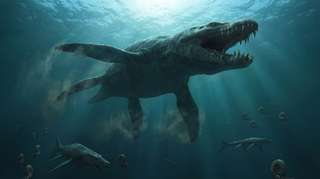
Des monstres marins géants vivaient dans les rivières à la fin de l'ère des dinosaures
dent alimentation prédateur Dinosauria Mosasaurus isotope
Les mosasaures géants, autrefois considérés comme des prédateurs strictement océaniques, ont peut-être passé leur dernier chapitre à rôder dans les rivières d'eau douce aux côtés de dinosaures et de crocodiles. Une dent massive trouvée dans le Dakota du Nord, analysée à l'aide de techniques isotopiques chimiques, révèle que certains mosasaures se sont adaptés aux systèmes fluviaux à mesure que les mers se rafraîchissaient progressivement vers la fin de l'ère des dinosaures. Ces énormes reptiles, peut-être aussi longs qu'un bus, semblent avoir chassé près de la surface, se nourrissant peut-être même de dinosaures noyés.
15/12/2025 sciencedaily ⚙ Traduction automatique
Un mini-prédateur vieux de 242 millions d'années change l'évolution du lézard
membre dent prédateur fossile évolution nouvelle espèce crâne
Un minuscule fossile du Devon vieux de 242 millions d’années bouleverse les hypothèses des scientifiques sur les premiers membres de la lignée des lézards. Au lieu des charnières du crâne et des dents du palais typiques des lézards et des serpents modernes, cette ancienne créature présente un mélange surprenant de traits primitifs et inhabituels, ainsi que des dents étonnamment grandes en forme de lame. Les scans synchrotron haute résolution ont révélé des détails invisibles à l'œil nu, aidant ainsi les chercheurs à nommer la nouvelle espèce Agriodontosaurus helsbypetrae
30/11/2025 sciencedaily ⚙ Traduction automatique
Les scientifiques découvrent un lien surprenant entre le plomb et l’évolution humaine
dent fossile évolution génétique
Les chercheurs ont découvert que les anciens hominidés, y compris les premiers humains, étaient exposés au plomb tout au long de leur enfance, laissant des traces chimiques dans les dents fossiles. Des expériences suggèrent que cette exposition pourrait avoir entraîné des changements génétiques renforçant les fonctions cérébrales liées au langage chez les humains modernes.
16/11/2025 sciencedaily-human-evo ⚙ Traduction automatique
Des dents vieilles de 2 millions d'années révèlent les secrets de l'aube de l'humanité
mâchoire dent protéine fossile génétique
Pendant des décennies, Paranthropus Robustus a intrigué les scientifiques en tant que cousin puissant et à grande mâchoire des premiers humains. Aujourd’hui, grâce à d’anciennes analyses de protéines, les chercheurs ont découvert de nouveaux secrets cachés dans l’émail dentaire vieux de 2 millions d’années. Ces protéines ont révélé à la fois le sexe et des différences génétiques subtiles entre les fossiles, suggérant que Paranthropus n'était peut-être pas une seule espèce mais un mélange évolutif plus complexe.
01/11/2025 sciencedaily-human-evo ⚙ Traduction automatique
1 2 3 4 5