Dinosauria

Taxon

211 image(s) · 103 News

View page

Image gallery

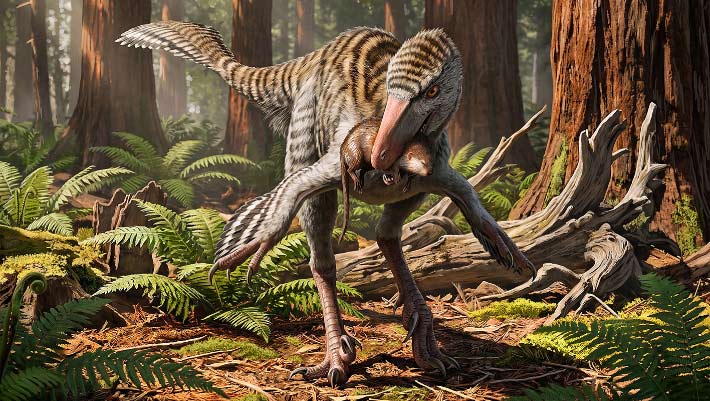
Diuqin is an unenlagiine dinosaur from the Late Cretaceous of what is now Argentina. Unenlagiines, known exclusively from South America, are usually classified as dromaeosaurs though this is sometimes debated. Like dromaeosaurs, they were covered in feathers, carnivorous, and had the large sickle-like claw on the inner toe of each foot. Unique to unenlagiines is their elongated snout, suggesting a piscivorous diet. Diuqin was a medium-sized unenlagiine, at about 4 m in length.

Diuqin is an unenlagiine dinosaur from the Late Cretaceous of what is now Argentina. Unenlagiines, known exclusively from South America, are usually classified as dromaeosaurs though this is sometimes debated. Like dromaeosaurs, they were covered in feathers, carnivorous, and had the large sickle-like claw on the inner toe of each foot. Unique to unenlagiines is their elongated snout, suggesting a piscivorous diet. Diuqin was a medium-sized unenlagiine, at about 4 m in length.

claw feather Argentina Cretaceous +5
Figure 1. Evolution of macroecological traits in Dinosauria. Large scale event in dinosaur evolution (a); the origin of dinosaurs (star), hyperthermals (volcano), the earliest fossil Avialae (bird), the earliest fossil angiosperm (flower), the Cretaceous/Palaeogene mass extinction (asteroid). Phylogeny of dinosaurs (b) redrawn from Sereno and adapted to the current consensus and upon which an ancestral state reconstruction of temperature niche (mean annual temperature) after Chiarenza et al. is plotted; Mesozoic palaeogeographies (c) for Triassic (T), Jurassic (J) and Cretaceous (K). Silhouette colours symbolize body mass for each of the taxa represented; information on dietary habits are plotted after Barrett and Zanno & Makovicky; numbers represent clades discussed through this study: 1, Ornithischia; 2, Thyreophora; 3, Ornithopoda; 4, Hadrosauroidea; 5, Marginocephalia; 6, Ceratopsia; 7, Saurischia; 8, Sauropodomorpha; 9, Sauropoda; 10, Theropoda; 11, Ceratosauria; 12, Tetanurae; 13, Coelurosauria; 14, Maniraptoriformes; 15, Maniraptora; 16, Deinonychosauria; 17, Avialae; 18, Ornithothoraces. Palaeogeographies modified from original plots via R package ‘mapast’ using plate models by Scotese.

Figure 1. Evolution of macroecological traits in Dinosauria. Large scale event in dinosaur evolution (a); the origin of dinosaurs (star), hyperthermals (volcano), the earliest fossil Avialae (bird), the earliest fossil angiosperm (flower), the Cretaceous/Palaeogene mass extinction (asteroid). Phylogeny of dinosaurs (b) redrawn from Sereno and adapted to the current consensus and upon which an ancestral state reconstruction of temperature niche (mean annual temperature) after Chiarenza et al. is plotted; Mesozoic palaeogeographies (c) for Triassic (T), Jurassic (J) and Cretaceous (K). Silhouette colours symbolize body mass for each of the taxa represented; information on dietary habits are plotted after Barrett and Zanno & Makovicky; numbers represent clades discussed through this study: 1, Ornithischia; 2, Thyreophora; 3, Ornithopoda; 4, Hadrosauroidea; 5, Marginocephalia; 6, Ceratopsia; 7, Saurischia; 8, Sauropodomorpha; 9, Sauropoda; 10, Theropoda; 11, Ceratosauria; 12, Tetanurae; 13, Coelurosauria; 14, Maniraptoriformes; 15, Maniraptora; 16, Deinonychosauria; 17, Avialae; 18, Ornithothoraces. Palaeogeographies modified from original plots via R package ‘mapast’ using plate models by Scotese.

scale Cretaceous Jurassic Mesozoic +23
Diagram illustrating the "Temporal paradox" in paleontology. First given it's nickname by Alan Feduccia, the paradox is made up by the fact that almost all feathered dinosaurs are dated to have lived millions of years after Archaeopteryx, the oldest bird (late Jurassic, believed to have existed about 150 million years ago). Only a few of the feathered dinosaurs/birdlike dinosaurs are given an older date than Archaeopteryx.

Diagram illustrating the "Temporal paradox" in paleontology. First given it's nickname by Alan Feduccia, the paradox is made up by the fact that almost all feathered dinosaurs are dated to have lived millions of years after Archaeopteryx, the oldest bird (late Jurassic, believed to have existed about 150 million years ago). Only a few of the feathered dinosaurs/birdlike dinosaurs are given an older date than Archaeopteryx.

Jurassic Late Jurassic Archaeopteryx Coelurosauria +2
Montage of eight different representatives of coelurosaurian dinosaurs: (Clockwise from upper left) GIN 100/42 which may represent Citipati or a different oviraptorosaur, Sinosauropteryx prima, Nothronychus mckinleyi, Tyrannosaurus rex, Bambiraptor feinbergi, Passer domesticus, Struthiomimus altus, Microraptor gui. This is a collection of eight different works already found in Wikimedia Commons (see source field below).

Montage of eight different representatives of coelurosaurian dinosaurs: (Clockwise from upper left) GIN 100/42 which may represent Citipati or a different oviraptorosaur, Sinosauropteryx prima, Nothronychus mckinleyi, Tyrannosaurus rex, Bambiraptor feinbergi, Passer domesticus, Struthiomimus altus, Microraptor gui. This is a collection of eight different works already found in Wikimedia Commons (see source field below).

Bambiraptor Citipati Coelurosauria Dinosauria +6
Simplified cladogram of Dinosauria with the distribution of feathers according to the fossil record. Despite its more ancient origin, it
was only in maniraptoriformes that modern-type feathers (pennaceous feathers) have arisen (Based in Xu & Guo, 2009; Clarke,

2013; Godefroit et al., 2013; Han et al., 2014; Koshchowitz et al., 2014).

Simplified cladogram of Dinosauria with the distribution of feathers according to the fossil record. Despite its more ancient origin, it was only in maniraptoriformes that modern-type feathers (pennaceous feathers) have arisen (Based in Xu & Guo, 2009; Clarke, 2013; Godefroit et al., 2013; Han et al., 2014; Koshchowitz et al., 2014).

feather fossil Dinosauria Maniraptoriformes +1
Ареал карнозавров

Ареал карнозавров

Dinosauria Tetanurae
Reconstruction of the theropod dinosaur Tachiraptor admirabilis. Artwork created with graphite and colored pencils. Author: Edwin Chávez "Disfrasaurio".

Reconstruction of the theropod dinosaur Tachiraptor admirabilis. Artwork created with graphite and colored pencils. Author: Edwin Chávez "Disfrasaurio".

Averostra Dinosauria Tachiraptor
Ceratosaurus nasicornis reconstruction. Matches proportions shown in Gregory S. Paul (The Princeton Field Guide to Dinosaurs, 2010, p. 84)

Ceratosaurus nasicornis reconstruction. Matches proportions shown in Gregory S. Paul (The Princeton Field Guide to Dinosaurs, 2010, p. 84)

Averostra Ceratosauria Dinosauria
Sketch-drawing of the vertebrate faunal assemblage of the Lisowice site (modified from Niedźwiedzki)10. (a) Large, theropod-like predatory archosaur (Smok wawelski); (b) large temnospondyl amphibian (Cyclotosaurus sp.); (c) small predatory dinosaurs (Neotheropoda indet.); (d) temnospondyl amphibian (Gerrothorax sp.); (e) small basal crocodylomorph (Crocodylomorpha indet.); (f) small diapsid (Choristodere-like animal); (g) hybodont sharks (Polyacrodus and Hybodus); (h) coelacanth fish; (i) dipnoan fish (Ptychoceratodus sp.); (j) actinopterygian fish; (k) gigantic dicynodont; (l) dinosauriforms or early dinosaurs (Dinosauriformes indet. or Dinosauria indet.); (m) small lepidosauromorphs (Sphenodontia indet.); (n) pterosaurs (Pterosauria indet.); (o) early mammaliaform (Hallautherium sp.).

Sketch-drawing of the vertebrate faunal assemblage of the Lisowice site (modified from Niedźwiedzki)10. (a) Large, theropod-like predatory archosaur (Smok wawelski); (b) large temnospondyl amphibian (Cyclotosaurus sp.); (c) small predatory dinosaurs (Neotheropoda indet.); (d) temnospondyl amphibian (Gerrothorax sp.); (e) small basal crocodylomorph (Crocodylomorpha indet.); (f) small diapsid (Choristodere-like animal); (g) hybodont sharks (Polyacrodus and Hybodus); (h) coelacanth fish; (i) dipnoan fish (Ptychoceratodus sp.); (j) actinopterygian fish; (k) gigantic dicynodont; (l) dinosauriforms or early dinosaurs (Dinosauriformes indet. or Dinosauria indet.); (m) small lepidosauromorphs (Sphenodontia indet.); (n) pterosaurs (Pterosauria indet.); (o) early mammaliaform (Hallautherium sp.).

drawing Dinosauria Neotheropoda Pterosauria
Diagram made to illustrate the debate over the hands of theropod dinosaurs and their alleged descendants, the birds ( Aves ). In the last years, the difference between the hands of theropods and birds have been an important thing when it comes question the theory that birds evolved from dinosaurs, even though some scientists may could refute it. In the diagram, a Neotheropoda ( 1 ), basal tetanurae ( 2 ), a coelurosaurian ( 3 ), the bird (?)Archaeopteryx ( 4 ) and modern bird ( 5 ).
In 1997, birdexpert Alan Feduccia at University of North Carolina discovered that birds develop hands with the digits II, III and IV ( see The Cincinnati Enquirer, 25 - 10 - 1997 ). This is in contrast with the hands of tetanurae, which seems to have the digits I, II and III. This make it almost impossible for dinosaurs and birds to be closely related, according to Feduccia.
Since the discovery by Feduccia, scientific research have came up with a possible explanation to the mystery of the dinosaur - bird hand difference, called The frame shift hypothesis ( see http://scienceblogs.com/tetrapodzoology/2009/06/limusaurus_is_awesome.php ). This hypothesis is based on a discovery which shows that although bird embryos develop the fingers II, III and IV, the genes which is coding for the external appearance of the digits seems to be from the fingers I, II and III. Based on this, scientists belive this: when neotheropods evolved into tetanurae, the losed digit I ( not digit IV, as earlier suggested ). During this process, the genes which coded for how the digits should looks like ( the number of phalanges, for example ) became refurnished ( see the color spots in th upper section in the diagram to understan ). The discovery of Limusaurus has been said to support this theory ( see https://www.livescience.com/animals/090617-dinosaur-hands.html ).
One thing is that may can be used to refute that Limusaurus should support the Frame shift hypothesis is that Limusaurus was a ceratosaurian, and is dated to be much younger than the oldest tetanurae's.
Also, some tetanure´s may had 4 digits' like the Archaeornithomimus ( see number 4 in the diagram ) ( see also http://dml.cmnh.org/1998Oct/msg00443.html and the Allosaurus hand in the image here: http://upload.wikimedia.org/wikipedia/commons/6/69/Allosaurus-mounted.jpg ). If this is the digits I, II, III and IV. If so, it shows that tetanurae had the digits I, II and III, and not II, II and IV, like birds.
For more in this debate, see text section to my picture Raptor-Archaeopteryx-bird hands differens.JPG at http://commons.wikimedia.org/wiki/File:Raptor-Archaeopteryx-bird_hands_differens.JPG.

Diagram made to illustrate the debate over the hands of theropod dinosaurs and their alleged descendants, the birds ( Aves ). In the last years, the difference between the hands of theropods and birds have been an important thing when it comes question the theory that birds evolved from dinosaurs, even though some scientists may could refute it. In the diagram, a Neotheropoda ( 1 ), basal tetanurae ( 2 ), a coelurosaurian ( 3 ), the bird (?)Archaeopteryx ( 4 ) and modern bird ( 5 ). In 1997, birdexpert Alan Feduccia at University of North Carolina discovered that birds develop hands with the digits II, III and IV ( see The Cincinnati Enquirer, 25 - 10 - 1997 ). This is in contrast with the hands of tetanurae, which seems to have the digits I, II and III. This make it almost impossible for dinosaurs and birds to be closely related, according to Feduccia. Since the discovery by Feduccia, scientific research have came up with a possible explanation to the mystery of the dinosaur - bird hand difference, called The frame shift hypothesis ( see http://scienceblogs.com/tetrapodzoology/2009/06/limusaurus_is_awesome.php ). This hypothesis is based on a discovery which shows that although bird embryos develop the fingers II, III and IV, the genes which is coding for the external appearance of the digits seems to be from the fingers I, II and III. Based on this, scientists belive this: when neotheropods evolved into tetanurae, the losed digit I ( not digit IV, as earlier suggested ). During this process, the genes which coded for how the digits should looks like ( the number of phalanges, for example ) became refurnished ( see the color spots in th upper section in the diagram to understan ). The discovery of Limusaurus has been said to support this theory ( see https://www.livescience.com/animals/090617-dinosaur-hands.html ). One thing is that may can be used to refute that Limusaurus should support the Frame shift hypothesis is that Limusaurus was a ceratosaurian, and is dated to be much younger than the oldest tetanurae's. Also, some tetanure´s may had 4 digits' like the Archaeornithomimus ( see number 4 in the diagram ) ( see also http://dml.cmnh.org/1998Oct/msg00443.html and the Allosaurus hand in the image here: http://upload.wikimedia.org/wikipedia/commons/6/69/Allosaurus-mounted.jpg ). If this is the digits I, II, III and IV. If so, it shows that tetanurae had the digits I, II and III, and not II, II and IV, like birds. For more in this debate, see text section to my picture Raptor-Archaeopteryx-bird hands differens.JPG at http://commons.wikimedia.org/wiki/File:Raptor-Archaeopteryx-bird_hands_differens.JPG.

Archaeopteryx Coelurosauria Dinosauria Neotheropoda +3
Cladogram of amniotes. Based on File:Cladogram Amniota A.jpg

Cladogram of amniotes. Based on File:Cladogram Amniota A.jpg

Coelurosauria Dinosauria Maniraptora Ornithischia +2
Cladogram of the former "Reptilia" (red)

Cladogram of the former "Reptilia" (red)

Coelurosauria Dinosauria Maniraptora Ornithischia +2
Dinosaur art by me!

Dinosaur art by me!

Dinosauria
The Chicago specimen of Archaeopteryx (PA 830), a well-preserved fossil highlighting the transitional features between non-avian dinosaurs and birds, housed at the Field Museum of Natural History.

The Chicago specimen of Archaeopteryx (PA 830), a well-preserved fossil highlighting the transitional features between non-avian dinosaurs and birds, housed at the Field Museum of Natural History.

museum fossil specimen Archaeopteryx +2
Life representation of Bicharracosaurus dionidei

Life representation of Bicharracosaurus dionidei

Bicharracosaurus Dinosauria
A badly drew sketch of Brontoholus (a placeholder for when an actual paleoart of Brontotholus is made.

A badly drew sketch of Brontoholus (a placeholder for when an actual paleoart of Brontotholus is made.

paleoart Brontotholus Dinosauria
1 2 3 4 5 6 7 8 9 10 11 12 13 14

News

Happy International Museum Day (2026)
museum Dinosauria communication
Today is International Museum Day and, here at Everything Dinosaur, we would like to celebrate the incredible work carried out by museums around the world. Museums help inspire curiosity, encourage learning and connect people with nature. They also play a crucial role in education, science communication and outreach. We have always enjoyed visiting museums, especially
18/05/2026 everythingdinosaur
Eocursor: Prehistoric Beast of the Week
South Africa Dinosauria Eocursor
This week we are going to check out a little dinosaur that gives us insight into the origins of some of the most iconic dinosaurs, Eocursor parvus!  Eocursor translates to "Dawn Runner" because it was a very early dinosaur and its extremely long legs show us that it was probably a fast runner.  From snout to tail it only measured about 3 feet (roughly 1m) and was a plant-eater.  It lived about 210 million years ago in what is now South Africa and was discovered in the 1990s but wasn't formally d
17/05/2026 prehistoricbeastoftheweek
Stunning 150-million-year-old stegosaur skull rewrites dinosaur evolution
fossil Dacentrurus Dinosauria Stegosauria discovery evolution skull
A spectacular dinosaur discovery in Spain is giving scientists a rare new look inside the world of stegosaurs. Paleontologists uncovered the best-preserved stegosaur skull ever found in Europe, belonging to the iconic plated dinosaur Dacentrurus armatus, which roamed Earth around 150 million years ago. Because stegosaur skulls are extremely fragile and almost never survive intact, the fossil is helping researchers uncover previously unknown details about how these armored giants evolved.
17/05/2026 sciencedaily
A New Dinosaur Discovery – The Last Titan from Thailand
Thailand fossil Dinosauria discovery new species
Researchers have announced the discovery of a new species of sauropod dinosaur.  It is the largest described to date from Southeast Asia. Furthermore, the newly described sauropod named Nagatitan chaiyaphumensis might be one of the geologically youngest of all the sauropods known from Southeast Asia. The fossil material was discovered in northeastern Thailand around ten
16/05/2026 everythingdinosaur
Giant Tyrannosaur Fossil Found in New Mexico
museum Mexico fossil Dinosauria Tyrannosauridae Tyrannosaurus
A large tyrannosaurid dinosaur may have stalked the floodplains of what is now New Mexico nearly 74 million years ago, according to a team of paleontologists from the University of Bath, Montana State University and the New Mexico Museum of Natural History and Science. The post Giant Tyrannosaur Fossil Found in New Mexico appeared first on Sci.News: Breaking Science News.
15/05/2026 sci-news
1 2 3 4 5 6 7 8 9 10 11 12 13 14 15 16 17 18 19 20 21