Pterosauria

Taxon

58 image(s) · 9 News

View page

Image gallery

Holotype of Alcione elainus.
Fig. 6 of:
Longrich, N. R., Martill, D. M., & Andres, B. (2018). Late Maastrichtian pterosaurs from North Africa and mass extinction of Pterosauria at the Cretaceous-Paleogene boundary. PLoS biology, 16(3), e2001663.
---
Original figure legend:
A. elainus FSAC-OB 2, holotype partial skeleton and FSAC-OB 217, metacarpal IV.

(A) Holotype right humerus in anterior view, (B) holotype right ulna and radius in anterior view, respectively, (C) holotype sternum in left lateral view, (D) referred metacarpal IV, (E) holotype, distal end of left metacarpal IV and left scapulocoracoid, and (F) holotype right femur in posterior view. Abbreviations: co, coracoid; cr, cristospine; dc, distal condyle; dpc, deltopectoral crest; ect, ectepicondyle; fh, femoral head; gl, glenoid; gt, greater trochanter; hh, humeral head; hum, humerus; mcIV, metacarpal IV, pc, proximal cotyle; pf, pneumatic foramen; rad, radius; scpr, supracondylar process; ste, sternum; uln, ulna.

Holotype of Alcione elainus. Fig. 6 of: Longrich, N. R., Martill, D. M., & Andres, B. (2018). Late Maastrichtian pterosaurs from North Africa and mass extinction of Pterosauria at the Cretaceous-Paleogene boundary. PLoS biology, 16(3), e2001663. --- Original figure legend: A. elainus FSAC-OB 2, holotype partial skeleton and FSAC-OB 217, metacarpal IV. (A) Holotype right humerus in anterior view, (B) holotype right ulna and radius in anterior view, respectively, (C) holotype sternum in left lateral view, (D) referred metacarpal IV, (E) holotype, distal end of left metacarpal IV and left scapulocoracoid, and (F) holotype right femur in posterior view. Abbreviations: co, coracoid; cr, cristospine; dc, distal condyle; dpc, deltopectoral crest; ect, ectepicondyle; fh, femoral head; gl, glenoid; gt, greater trochanter; hh, humeral head; hum, humerus; mcIV, metacarpal IV, pc, proximal cotyle; pf, pneumatic foramen; rad, radius; scpr, supracondylar process; ste, sternum; uln, ulna.

crest humerus Cretaceous Maastrichtian +7
This diagram illustrates how scientists believe the dinosaur group theropoda shall be classed in a  phylogenetic tree, besides Sauropoda and Pterosauria. The main reason of this diagram is to show groups or families which had respiratory system like birds. AS in the diagram is abbreviations for "Airsacs", and ASW means "AirSacs supported by immobile femur and a knee-driven Walk". BL means "Bellow lungs". 
Airsacs are known in many different theropods, as well as in birds, which most scientists believe are descendants of dinosaurus. Air sacs are found in the primitive Tawa hallae,[1] the abelisaurid Majungasaurus,[2] as well as Allosauroids like Aerosteon.[3] There is also evidence for respiratory systems like penguinss in Deinonychosaurians.[4] The primitive bird Archaeopteryx also had airsacs (Bonde and Christiansen, 2000).
It is very likely that Deinonychosaurians had airsacs. We don't know  whether Deinonychosauria had a walking/breathing system with immobile thighbones, ASW (like birds) or movable thighbones. However, some people suggsest coeluosaurs had the same type of leg movement as birds ("kneedriven walking").[5]
Bellow lungs are lungs like our own, which alternately is filled with air, and thereafter emptied, after which you take a new breath. This type of lungs exist in mammals, most reptiles, and most amphibians (although some frogs get their oxygen through the skin). There is no evidence for airsacs in Ornithischia, so the likely had bellow lungs.
References.=

↑ (see the video at http://www.nsf.gov/news/special_reports/tawa/)

↑ (Claessens & O'connor, 2006).

↑ Alcober O.A, Sereno P.C, Larsson H.C.E et.al (2008), "Evidence for Avian Intrathoracic Air Sacs in a New Predatory Dinosaur from Argentina", Public Library of Science Journals.

↑ http://www.stumbleupon.com/su/20q5Z4/news.bbc.co.uk/2/hi/science/nature/7081166.stm

↑ http://www.geol.umd.edu/~tholtz/G104/lectures/104coelur.html.

This diagram illustrates how scientists believe the dinosaur group theropoda shall be classed in a phylogenetic tree, besides Sauropoda and Pterosauria. The main reason of this diagram is to show groups or families which had respiratory system like birds. AS in the diagram is abbreviations for "Airsacs", and ASW means "AirSacs supported by immobile femur and a knee-driven Walk". BL means "Bellow lungs". Airsacs are known in many different theropods, as well as in birds, which most scientists believe are descendants of dinosaurus. Air sacs are found in the primitive Tawa hallae,[1] the abelisaurid Majungasaurus,[2] as well as Allosauroids like Aerosteon.[3] There is also evidence for respiratory systems like penguinss in Deinonychosaurians.[4] The primitive bird Archaeopteryx also had airsacs (Bonde and Christiansen, 2000). It is very likely that Deinonychosaurians had airsacs. We don't know whether Deinonychosauria had a walking/breathing system with immobile thighbones, ASW (like birds) or movable thighbones. However, some people suggsest coeluosaurs had the same type of leg movement as birds ("kneedriven walking").[5] Bellow lungs are lungs like our own, which alternately is filled with air, and thereafter emptied, after which you take a new breath. This type of lungs exist in mammals, most reptiles, and most amphibians (although some frogs get their oxygen through the skin). There is no evidence for airsacs in Ornithischia, so the likely had bellow lungs. References.= ↑ (see the video at http://www.nsf.gov/news/special_reports/tawa/) ↑ (Claessens & O'connor, 2006). ↑ Alcober O.A, Sereno P.C, Larsson H.C.E et.al (2008), "Evidence for Avian Intrathoracic Air Sacs in a New Predatory Dinosaur from Argentina", Public Library of Science Journals. ↑ http://www.stumbleupon.com/su/20q5Z4/news.bbc.co.uk/2/hi/science/nature/7081166.stm ↑ http://www.geol.umd.edu/~tholtz/G104/lectures/104coelur.html.

Abelisauridae Aerosteon Archaeopteryx Deinonychosauria +7
cast of Quetzalcoatlus northropi humerus 03 - Pterosaurs Flight in the Age of Dinosaurs

cast of Quetzalcoatlus northropi humerus 03 - Pterosaurs Flight in the Age of Dinosaurs

humerus flight United States cast +3
cast of Quetzalcoatlus northropi humerus 02 - Pterosaurs Flight in the Age of Dinosaurs

cast of Quetzalcoatlus northropi humerus 02 - Pterosaurs Flight in the Age of Dinosaurs

humerus flight United States cast +3
Cast of Quetzalcoatlus northropi humerus 01 - Pterosaurs Flight in the Age of Dinosaurs

Cast of Quetzalcoatlus northropi humerus 01 - Pterosaurs Flight in the Age of Dinosaurs

humerus flight cast Dinosauria +2
Figure 5: Measured and estimated azhdarchid pterosaur neck lengths against approximate wingspans.

Figure 5: Measured and estimated azhdarchid pterosaur neck lengths against approximate wingspans.

Azhdarchidae Pterosauria Quetzalcoatlus
Fossil of Quetzalcoatlus, an extinct pterosaur- Took the photo at Senckenberg Museum of Frankfurt
Taxa Quetzalcoatlus

Fossil of Quetzalcoatlus, an extinct pterosaur- Took the photo at Senckenberg Museum of Frankfurt

museum fossil Pterosauria Quetzalcoatlus
Several members of Pterodactyloidea (top to bottom):  Pteranodon, Pterodaustro, the skulls of several pterosaurs (Guidraco, Anhanguera, Tupandactylus, and an unnamed dsungaripterid), Quetzalcoatlus, Aerodactylus, and Coloborhynchus
Taxa Pterodactyloidea

Several members of Pterodactyloidea (top to bottom): Pteranodon, Pterodaustro, the skulls of several pterosaurs (Guidraco, Anhanguera, Tupandactylus, and an unnamed dsungaripterid), Quetzalcoatlus, Aerodactylus, and Coloborhynchus

Aerodactylus Anhanguera Coloborhynchus Dsungaripteridae +13
Several members of Pterodactyloidea (top to bottom):  Pteranodon, Pterodaustro, the skulls of several pterosaurs (Guidraco, Anhanguera, Tupandactylus, and an unnamed dsungaripterid), Quetzalcoatlus, Aerodactylus, and Coloborhynchus
Taxa Ornithocheiroidea

Several members of Pterodactyloidea (top to bottom): Pteranodon, Pterodaustro, the skulls of several pterosaurs (Guidraco, Anhanguera, Tupandactylus, and an unnamed dsungaripterid), Quetzalcoatlus, Aerodactylus, and Coloborhynchus

Aerodactylus Anhanguera Coloborhynchus Dsungaripteridae +13
Several members of Pterodactyloidea (top to bottom):  Pteranodon, Pterodaustro, the skulls of several pterosaurs (Guidraco, Anhanguera, Tupandactylus, and an unnamed dsungaripterid), Quetzalcoatlus, Aerodactylus, and Coloborhynchus
Taxa Lophocratia

Several members of Pterodactyloidea (top to bottom): Pteranodon, Pterodaustro, the skulls of several pterosaurs (Guidraco, Anhanguera, Tupandactylus, and an unnamed dsungaripterid), Quetzalcoatlus, Aerodactylus, and Coloborhynchus

Aerodactylus Anhanguera Coloborhynchus Dsungaripteridae +13
Several members of Pterodactyloidea (top to bottom):  Pteranodon, Pterodaustro, the skulls of several pterosaurs (Guidraco, Anhanguera, Tupandactylus, and an unnamed dsungaripterid), Quetzalcoatlus, Aerodactylus, and Coloborhynchus
Taxa Tapejaroidea

Several members of Pterodactyloidea (top to bottom): Pteranodon, Pterodaustro, the skulls of several pterosaurs (Guidraco, Anhanguera, Tupandactylus, and an unnamed dsungaripterid), Quetzalcoatlus, Aerodactylus, and Coloborhynchus

Aerodactylus Anhanguera Coloborhynchus Dsungaripteridae +13
Several members of Pterodactyloidea (top to bottom):  Pteranodon, Pterodaustro, the skulls of several pterosaurs (Guidraco, Anhanguera, Tupandactylus, and an unnamed dsungaripterid), Quetzalcoatlus, Aerodactylus, and Coloborhynchus
Taxa Dsungaripteroidea

Several members of Pterodactyloidea (top to bottom): Pteranodon, Pterodaustro, the skulls of several pterosaurs (Guidraco, Anhanguera, Tupandactylus, and an unnamed dsungaripterid), Quetzalcoatlus, Aerodactylus, and Coloborhynchus

Aerodactylus Anhanguera Coloborhynchus Dsungaripteridae +13
Several members of Pterodactyloidea (top to bottom):  Pteranodon, Pterodaustro, the skulls of several pterosaurs (Guidraco, Anhanguera, Tupandactylus, and an unnamed dsungaripterid), Quetzalcoatlus, Aerodactylus, and Coloborhynchus
Taxa Eupterodactyloidea

Several members of Pterodactyloidea (top to bottom): Pteranodon, Pterodaustro, the skulls of several pterosaurs (Guidraco, Anhanguera, Tupandactylus, and an unnamed dsungaripterid), Quetzalcoatlus, Aerodactylus, and Coloborhynchus

Aerodactylus Anhanguera Coloborhynchus Dsungaripteridae +13
Illustration of the holotype metacarpal of Dermodactylus montanus, a pterosaur from the Jurassic of Wyoming.  Reference 
Colbert EH (1969) A Jurassic Pterosaur from Cuba. American Museum Novitates 2370, 1-26
Taxa Dermodactylus

Illustration of the holotype metacarpal of Dermodactylus montanus, a pterosaur from the Jurassic of Wyoming. Reference Colbert EH (1969) A Jurassic Pterosaur from Cuba. American Museum Novitates 2370, 1-26

museum Cuba Jurassic holotype +2
Tropeognathine pterosaur Siroccopteryx moroccensis Mader andKellner, 1999, LINHM FR016, Kem Kem beds, Morocco, ?Albian–lowerCenomanian. A. Photograph in anterior (A1), left lateral (A2), and dorsal(A3) views. B. Interpretation of the palatal view following Mader andKellner (1999). Photographs courtesy of Megan L. Jacobs. Drawing byRVP based on Mader and Kellner (1999).
Taxa Siroccopteryx

Tropeognathine pterosaur Siroccopteryx moroccensis Mader andKellner, 1999, LINHM FR016, Kem Kem beds, Morocco, ?Albian–lowerCenomanian. A. Photograph in anterior (A1), left lateral (A2), and dorsal(A3) views. B. Interpretation of the palatal view following Mader andKellner (1999). Photographs courtesy of Megan L. Jacobs. Drawing byRVP based on Mader and Kellner (1999).

drawing Morocco Albian Pterosauria +1
Life restoration of Harpactognathus gentryii, a pterosaur from Jurassic USA
Taxa Harpactognathus

Life restoration of Harpactognathus gentryii, a pterosaur from Jurassic USA

United States Jurassic Harpactognathus Pterosauria
1 2 3 4

News

Pterosaurs May Have Sported Far More Varied Wings than Paleontologists Imagined
flight fossil Pterosauria biomechanics evolution
New research from the University of Bristol suggests that pterosaurs -- the first vertebrates to achieve powered flight -- probably displayed a much wider array of wing shapes and flying styles than fossil-based reconstructions have depicted. The post Pterosaurs May Have Sported Far More Varied Wings than Paleontologists Imagined appeared first on Sci.News: Breaking Science News.
30/06/2026 sci-news
113-Million-Year-Old Pterosaur Fossil Reveals What Flying Reptiles Ate
tissue feeding Brazil fossil Anhangueridae Pterosauria fish
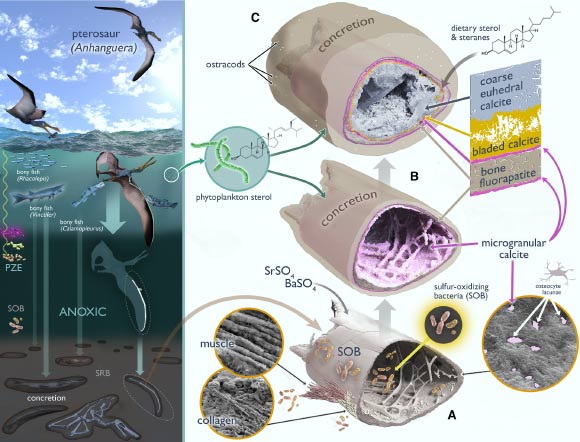
A 113-million-year-old pterosaur fossil from northeastern Brazil has yielded rare evidence of soft tissues, organic molecules and chemical traces of a diet heavy in fish and cephalopods such as squid or nautilus relatives. The post 113-Million-Year-Old Pterosaur Fossil Reveals What Flying Reptiles Ate appeared first on Sci.News: Breaking Science News.
19/06/2026 sci-news
Pterosaurs May Have Possessed Iridescent Pycnofibres
feather Pterosauria Tapejaridae behavior study
New research suggests that colourful tapejarid pterosaurs may have been even more spectacular than previously imagined. A recently published study proposes that some of these flying reptiles possessed iridescent pycnofibres that produced shimmering colours. As a result, these structures may have played an important role in visual signalling and display. The bodies of pterosaurs, the
19/06/2026 everythingdinosaur
Geosternbergia: Beast of the Week
fossil Geosternbergia Pteranodon Pterosauria taxonomy
 This week we are looing at a famous pterosaur.  Check out Geosternbergia sterngergi!  I'm going to start this post off with pointing out that Geosternbergia is considered simply a separate species within the genus, Pteranodon, by many experts, which would make its name Pteranodon sternbergi.  That being said, since I already did a post on Pteranodon longiceps, I'm choosing to refer to this pterosaur as Geosternbergia.  (taxonomy is complicated and also subject to change especially with fossils)
31/05/2026 prehistoricbeastoftheweek
What Is the Difference Between a Pterosaur and a Dinosaur?
Dinosauria Pterosauria
What is the difference between a pterosaur and a dinosaur? Many people think that pterosaurs were dinosaurs, but this is not correct. Pterosaurs were flying reptiles that lived at the same time as dinosaurs.  Although both pterosaurs and dinosaurs are reptiles, and they belong to a larger group called the Archosauria, pterosaurs evolved separately and
27/05/2026 everythingdinosaur
1 2