os

Partie anatomique

76 image(s) · 52 Actualités

Galerie d'images

Abelisaurid theropod Kryptops palaios gen. et sp. nov. MNN GAD1−1 from the Lower Cretaceous Elrhaz Formation of Niger. Left maxilla in lateral

view; stereopair (A) and line drawing (B). Cross−hatching indicates broken bone; dashed lines indicate estimated edges.
Taxons Kryptops

Abelisaurid theropod Kryptops palaios gen. et sp. nov. MNN GAD1−1 from the Lower Cretaceous Elrhaz Formation of Niger. Left maxilla in lateral view; stereopair (A) and line drawing (B). Cross−hatching indicates broken bone; dashed lines indicate estimated edges.

os dessin Niger Crétacé +3
Reconstruction of the Abelisaurus skull with original bones of the holotype. Museo Provincial Carlos Ameghino, Cipolletti, Argentina. Scale = 10 cm
Taxons Abelisaurus

Reconstruction of the Abelisaurus skull with original bones of the holotype. Museo Provincial Carlos Ameghino, Cipolletti, Argentina. Scale = 10 cm

os écaille Argentine holotype +3
Reconstructed skull of Duriavenator hesperis showing known material (white) of the holotype and only known specimen. Unknown bones based on related Eustreptospondylus oxoniensis. Scale bar is 10cm, image is 10px/cm. Cranial anatomy based on Benson (2008) "A redescription of "Megalosaurus" hesperis (Dinosauria, Theropoda) from the Inferior Oolite (Bajocian, Middle Jurassic) of Dorset, United Kingdom"
Taxons Duriavenator

Reconstructed skull of Duriavenator hesperis showing known material (white) of the holotype and only known specimen. Unknown bones based on related Eustreptospondylus oxoniensis. Scale bar is 10cm, image is 10px/cm. Cranial anatomy based on Benson (2008) "A redescription of "Megalosaurus" hesperis (Dinosauria, Theropoda) from the Inferior Oolite (Bajocian, Middle Jurassic) of Dorset, United Kingdom"

os écaille Royaume-Uni Bajocien +11
Reconstructed skull of the holotype and only specimen of Leshansaurus qianweiensis based on the possibly related megalosaurid Dubreuillosaurus valesdunensis. Scale bar is 10cm, image is 10px/cm. Cranial anatomy from figures in Fei et al. (2009) "A new carnosaur from the Late Jurassic of Qianwei, Sichuan, China". White bones are figured, light grey bones are unfigured and minimally described.
Taxons Leshansaurus

Reconstructed skull of the holotype and only specimen of Leshansaurus qianweiensis based on the possibly related megalosaurid Dubreuillosaurus valesdunensis. Scale bar is 10cm, image is 10px/cm. Cranial anatomy from figures in Fei et al. (2009) "A new carnosaur from the Late Jurassic of Qianwei, Sichuan, China". White bones are figured, light grey bones are unfigured and minimally described.

os écaille Chine Jurassique +9
Autapomorphies proposed for Diuqin lechiguanae gen. et sp. nov. (MUCPv 1401), with images generated from three-dimensional scans of selected bones. A–B, posteriormost (last) sacral neural arch (MUCPv 1401/1) in dorsal (A) and posterior (B) views. C, anterior caudal neural arch (MUCPv 1401/2) in dorsal view. D, left humerus (MUCPv 1401/4) in lateral view. Abbreviations: al, accessory lamina; dldpr, distolateral deltopectoral ridge; for, foramen. Scale bars equal 3 centimeters
Taxons Diuqin

Autapomorphies proposed for Diuqin lechiguanae gen. et sp. nov. (MUCPv 1401), with images generated from three-dimensional scans of selected bones. A–B, posteriormost (last) sacral neural arch (MUCPv 1401/1) in dorsal (A) and posterior (B) views. C, anterior caudal neural arch (MUCPv 1401/2) in dorsal view. D, left humerus (MUCPv 1401/4) in lateral view. Abbreviations: al, accessory lamina; dldpr, distolateral deltopectoral ridge; for, foramen. Scale bars equal 3 centimeters

os humérus écaille Diuqin +1
Skeletal reconstruction of Dineobellator notohesperus gen. et sp. nov., SMP VP-2430, with known elements colored in white. Figured bones are as follows: fused distal caudal vertebra (A); middle caudal vertebra (B); caudal vertebra 1 (C); right femur (D); rib (E); right basipterygoid (F); left lacrimal (reversed) (G); right jugal (H); right humerus (I); right ulna (J); right metacarpal III (K); right manual ungual II (L); right metatarsal II (M); right metatarsal III. (N) Individual scale bars, 2 cm. Skeletal drawing based off work of Scott Hartman.
Taxons Dineobellator

Skeletal reconstruction of Dineobellator notohesperus gen. et sp. nov., SMP VP-2430, with known elements colored in white. Figured bones are as follows: fused distal caudal vertebra (A); middle caudal vertebra (B); caudal vertebra 1 (C); right femur (D); rib (E); right basipterygoid (F); left lacrimal (reversed) (G); right jugal (H); right humerus (I); right ulna (J); right metacarpal III (K); right manual ungual II (L); right metatarsal II (M); right metatarsal III. (N) Individual scale bars, 2 cm. Skeletal drawing based off work of Scott Hartman.

os humérus écaille vertèbre +2
A diagram showing the bones and feathering preserved in IVPP V 12638, the holotype of Yixianosaurus longimanus, a feathered dinosaur.
Taxons Yixianosaurus

A diagram showing the bones and feathering preserved in IVPP V 12638, the holotype of Yixianosaurus longimanus, a feathered dinosaur.

os holotype Dinosauria Yixianosaurus
(A) Skeletal reconstruction in left lateral view (missing and damaged portions of the bones in gray). (B) Left ilium in lateral view. (C) Proximal caudal vertebrae in left lateral view with close-up of the infraprezygapophyses. (D) Chevron in cranial view. (E-F) Right scapula in dorsal (E) and lateral (F) views. (G) Last sacral and the two proximalmost caudals in left lateral view. (H) Right pubis in medial view. (I) Right ischium in lateral view. (J) Right femur in distal view. (K) Left metatarsus and distal tarsals in proximal view. (L) Right femur in cranial view. (M-N) Left metatarsus in lateral (M) and dorsal (N) views. Abbreviations: acr, acromion process; ant, antitrochanter; ch, chevron; cv, caudal vertebra(e); diprf, dorsal infraprezygapophyseal fossa; dt, distal tarsal(s); fct, cranial trochanter of femur; fh, femoral head; gl, glenoid fossa; idf, infradiapophyseal fossa; lc, lateral condyle; mc, medial condyle; mep, medial epicondyle; miprf, middle infraprezygapophyseal fossa; mt II, metatarsal II; mt IV, metatarsal IV; mt V, metatarsal V; ns, neural spine; obp, obturator process; pra, preacetabular process; pup, pubic peduncle; sprf, supraprezygapophyseal fossa; sv, sacral vertebra; tfc, tibiofibular crest; tp, transverse process; viprf, ventral infraprezygapophyseal fossa. Scale bars equal 10 cm in (A); 1 cm in (B-N).
https://doi.org/10.1371/journal.pone.0210867.g004
Taxons Gobiraptor

(A) Skeletal reconstruction in left lateral view (missing and damaged portions of the bones in gray). (B) Left ilium in lateral view. (C) Proximal caudal vertebrae in left lateral view with close-up of the infraprezygapophyses. (D) Chevron in cranial view. (E-F) Right scapula in dorsal (E) and lateral (F) views. (G) Last sacral and the two proximalmost caudals in left lateral view. (H) Right pubis in medial view. (I) Right ischium in lateral view. (J) Right femur in distal view. (K) Left metatarsus and distal tarsals in proximal view. (L) Right femur in cranial view. (M-N) Left metatarsus in lateral (M) and dorsal (N) views. Abbreviations: acr, acromion process; ant, antitrochanter; ch, chevron; cv, caudal vertebra(e); diprf, dorsal infraprezygapophyseal fossa; dt, distal tarsal(s); fct, cranial trochanter of femur; fh, femoral head; gl, glenoid fossa; idf, infradiapophyseal fossa; lc, lateral condyle; mc, medial condyle; mep, medial epicondyle; miprf, middle infraprezygapophyseal fossa; mt II, metatarsal II; mt IV, metatarsal IV; mt V, metatarsal V; ns, neural spine; obp, obturator process; pra, preacetabular process; pup, pubic peduncle; sprf, supraprezygapophyseal fossa; sv, sacral vertebra; tfc, tibiofibular crest; tp, transverse process; viprf, ventral infraprezygapophyseal fossa. Scale bars equal 10 cm in (A); 1 cm in (B-N). https://doi.org/10.1371/journal.pone.0210867.g004

os vertèbre Gobiraptor
Vertebrae, scapula, forelimb bones, and pelvic bones of Martharaptor greenriverensis (UMNH VP 21400). (A)–Partial cervical neural arch, dorsal view. (B–E)–Cranial dorsal centrum in cranial (B), caudal (C), right lateral (D), and left lateral (E) views. (F–G)–Distal caudal centrum in lateral (F) and ventral (G) views. (H)–Possible ulna. (I)–Possible radius. (J–K)–Left scapula in lateral (J) and medial (K) views. (L)–Proximal end of ischium. (M)–Possible distal end of pubis Scale bar = 50 mm. acr  =  acromium process, ar  =  acetabular rim, gl  =  glenoid, hyp  =  hypapophysis, poz  =  postzygapophysis, pnp  =  pneumatopore, prz  =  prezygapophysis.
Taxons Martharaptor

Vertebrae, scapula, forelimb bones, and pelvic bones of Martharaptor greenriverensis (UMNH VP 21400). (A)–Partial cervical neural arch, dorsal view. (B–E)–Cranial dorsal centrum in cranial (B), caudal (C), right lateral (D), and left lateral (E) views. (F–G)–Distal caudal centrum in lateral (F) and ventral (G) views. (H)–Possible ulna. (I)–Possible radius. (J–K)–Left scapula in lateral (J) and medial (K) views. (L)–Proximal end of ischium. (M)–Possible distal end of pubis Scale bar = 50 mm. acr  =  acromium process, ar  =  acetabular rim, gl  =  glenoid, hyp  =  hypapophysis, poz  =  postzygapophysis, pnp  =  pneumatopore, prz  =  prezygapophysis.

os écaille Martharaptor partiel
Skeletal diagram of Zuolong salleei, based on related basal coelurosaurs. Scale bar = 1 meter. Light colours indicate known material (white is known external bones, light grey is either palate, braincase, or sacrum). Dark colours indicate unknown material (partial bones or unknown braincase)
Taxons Zuolong

Skeletal diagram of Zuolong salleei, based on related basal coelurosaurs. Scale bar = 1 meter. Light colours indicate known material (white is known external bones, light grey is either palate, braincase, or sacrum). Dark colours indicate unknown material (partial bones or unknown braincase)

os écaille Coelurosauria Zuolong +1
(A), silhouette of Maip macrothorax showing the preserved bones in white. (B), reconstruction of the thoracic cavity of Maip at level of D6. (C), interpretative drawing of the excavation of Maip showing the original disposition of the bones. Abbreviations: a, axis; c, coracoid; ind, indeterminate bone; g, gastralia; r, rib; v, vertebrae.
Taxons Maip

(A), silhouette of Maip macrothorax showing the preserved bones in white. (B), reconstruction of the thoracic cavity of Maip at level of D6. (C), interpretative drawing of the excavation of Maip showing the original disposition of the bones. Abbreviations: a, axis; c, coracoid; ind, indeterminate bone; g, gastralia; r, rib; v, vertebrae.

os dessin Maip fouille
Tetanuran theropod Cruxicheiros newmanorum gen. et sp. nov. axial vertebrae (WARMS 15771) from the Chipping Norton Limestone Formation,
Bathonian of the United Kingdom. A. Posterior cervical or anterior dorsal vertebra in posterior view. B. Partial middle−posterior dorsal vertebra in right lat−
eral view showing a sagittal cross−section (B1) and in dorsal view (B2). C. Middle−distal caudal vertebra in left lateral (C1) and posterior (C2) views. D. Mid−
dle−posterior dorsal neural arch in anterior (D1), right lateral (D2, D3), and posterior (D4) views. Photographs (A, B1, B2, C1, C2, D1, D2, D4) and line drawing

(D3). Crossed−hatching indicates matrix and grey tone indicates broken bone.
Taxons Cruxicheiros

Tetanuran theropod Cruxicheiros newmanorum gen. et sp. nov. axial vertebrae (WARMS 15771) from the Chipping Norton Limestone Formation, Bathonian of the United Kingdom. A. Posterior cervical or anterior dorsal vertebra in posterior view. B. Partial middle−posterior dorsal vertebra in right lat− eral view showing a sagittal cross−section (B1) and in dorsal view (B2). C. Middle−distal caudal vertebra in left lateral (C1) and posterior (C2) views. D. Mid− dle−posterior dorsal neural arch in anterior (D1), right lateral (D2, D3), and posterior (D4) views. Photographs (A, B1, B2, C1, C2, D1, D2, D4) and line drawing (D3). Crossed−hatching indicates matrix and grey tone indicates broken bone.

os vertèbre dessin Royaume-Uni +4
Skeleton outline of Dracoraptor hanigani.

Bones highlighted green for present, orange for external moulds and blue for tentatively identified bones. Many unidentified or uncertain elements have been omitted.
Taxons Dracoraptor

Skeleton outline of Dracoraptor hanigani. Bones highlighted green for present, orange for external moulds and blue for tentatively identified bones. Many unidentified or uncertain elements have been omitted.

os Dracoraptor squelette
Reconstruction of the Bravoceratops skeleton with known bones marked in white. Specimen: TMM 46015-1 (holotype). Scale bar=2 m. Total length along centra=6.97 m.
Taxons Bravoceratops

Reconstruction of the Bravoceratops skeleton with known bones marked in white. Specimen: TMM 46015-1 (holotype). Scale bar=2 m. Total length along centra=6.97 m.

os écaille holotype spécimen +2
Ceratopsipes goldenensis Lockley & Hunt, 1995 - ceratopsian dinosaur trackway in the Cretaceous of Colorado, USA.
Ceratopsians are the "horned dinosaurs".  They were large, quadrupedal, herbivorous dinosaurs having a beaked skull and a frill - an extension of bone behind the skull that partially covered the neck.  Ceratopsian dinosaurs are known from the Jurassic and Cretaceous.  The last members of the group died out at the Cretaceous-Tertiary boundary, 65 million years ago.
Seen here is a ceratopsian dinosaur trackway.  Ceratopsian footprints are very rare.  The best examples are in Colorado's Laramie Formation, a nonmarine, coastal plain to deltaic succession of mostly mixed siliciclastic sedimentary rocks - sandstones, siltstones, claystones, and coals.  The footprints here consist of convex bulges on the basal surfaces of structurally-tilted sandstone beds.
The ichnospecies Ceratopsipes goldenensis was named based on footprints at this locality.  The trackmaker was very likely Triceratops, the # 1 most famous ceratopsian dinosaur.


From on-site signage:
Triceratops Tracks
Several tracks of Triceratops, or a closely related horned dinosaur were first discovered in this area and named Ceratopsipes goldenensis (meaning tracks of a horned dinosaur from Golden).  By happy coincidence, the first Triceratops known to science also comes from the greater Denver area near 13th Avenue and Federal Blvd.  Growing to a length of almost 25 feet, Triceratops and other members of the horned dinosaur family were herbivorous animals that roamed in herds.  Their trademark horns and frills that covered their necks probably served for defense.  A replica Triceratops skull is on display in the clubhouse at the Fossil Trace Golf Club.
These tracks (identified by small signs) help us understand that Triceratops walked with a narrow gait and erect front limbs  than with a wide, sprawling gait as previously depicted.  In 1887, the first Triceratops bones known to science were also discovered locally at a site near 13th Avenue and Federal Boulevard in Denver.
Nearby one may see many other traces of life such as burrows, probably made by invertebrates and impressions of plant debris.  Note that you are looking at all tracks and traces from the underside - in negative aspect - what one might call a worm’s eye view.  All of these trace fossils indicate that the Golden area once had a warm, temperate to subtropical climate.


Classification: Animalia, Chordata, Vertebrata, Reptilia, Archosauria, Dinosauria, Ornithischia, Marginocephalia, Ceratopsia, Ceratopsidae
Stratigraphy: Laramie Formation, Maastrichtian Stage, upper Upper Cretaceous
Locality: outcrop along Triceratops Trail, Parfet Prehistoric Preserve, southern side of the town of Golden, Colorado, USA (~vicinity of 39° 44' 35.24" North latitude, 105° 13’ 09.69" West longitude)


Some info. from:

Lockley & Hunt (1995) - Ceratopsid tracks and associated ichnofauna from the Laramie Formation (Upper Cretaceous: Maastrichtian) of Colorado.  Journal of Vertebrate Paleontology 15: 592-614.
Taxons Ceratopsipes

Ceratopsipes goldenensis Lockley & Hunt, 1995 - ceratopsian dinosaur trackway in the Cretaceous of Colorado, USA. Ceratopsians are the "horned dinosaurs". They were large, quadrupedal, herbivorous dinosaurs having a beaked skull and a frill - an extension of bone behind the skull that partially covered the neck. Ceratopsian dinosaurs are known from the Jurassic and Cretaceous. The last members of the group died out at the Cretaceous-Tertiary boundary, 65 million years ago. Seen here is a ceratopsian dinosaur trackway. Ceratopsian footprints are very rare. The best examples are in Colorado's Laramie Formation, a nonmarine, coastal plain to deltaic succession of mostly mixed siliciclastic sedimentary rocks - sandstones, siltstones, claystones, and coals. The footprints here consist of convex bulges on the basal surfaces of structurally-tilted sandstone beds. The ichnospecies Ceratopsipes goldenensis was named based on footprints at this locality. The trackmaker was very likely Triceratops, the # 1 most famous ceratopsian dinosaur. From on-site signage: Triceratops Tracks Several tracks of Triceratops, or a closely related horned dinosaur were first discovered in this area and named Ceratopsipes goldenensis (meaning tracks of a horned dinosaur from Golden). By happy coincidence, the first Triceratops known to science also comes from the greater Denver area near 13th Avenue and Federal Blvd. Growing to a length of almost 25 feet, Triceratops and other members of the horned dinosaur family were herbivorous animals that roamed in herds. Their trademark horns and frills that covered their necks probably served for defense. A replica Triceratops skull is on display in the clubhouse at the Fossil Trace Golf Club. These tracks (identified by small signs) help us understand that Triceratops walked with a narrow gait and erect front limbs than with a wide, sprawling gait as previously depicted. In 1887, the first Triceratops bones known to science were also discovered locally at a site near 13th Avenue and Federal Boulevard in Denver. Nearby one may see many other traces of life such as burrows, probably made by invertebrates and impressions of plant debris. Note that you are looking at all tracks and traces from the underside - in negative aspect - what one might call a worm’s eye view. All of these trace fossils indicate that the Golden area once had a warm, temperate to subtropical climate. Classification: Animalia, Chordata, Vertebrata, Reptilia, Archosauria, Dinosauria, Ornithischia, Marginocephalia, Ceratopsia, Ceratopsidae Stratigraphy: Laramie Formation, Maastrichtian Stage, upper Upper Cretaceous Locality: outcrop along Triceratops Trail, Parfet Prehistoric Preserve, southern side of the town of Golden, Colorado, USA (~vicinity of 39° 44' 35.24" North latitude, 105° 13’ 09.69" West longitude) Some info. from: Lockley & Hunt (1995) - Ceratopsid tracks and associated ichnofauna from the Laramie Formation (Upper Cretaceous: Maastrichtian) of Colorado. Journal of Vertebrate Paleontology 15: 592-614.

os États-Unis Crétacé Jurassique +6
DMNH 2021-05-02, holotype left dentary of Ampelognathus coheni, photos and labeled outline drawings in A, lateral; B, medial; C, dorsal; D, ventral; E, anterior; and F, posterior views. Abbreviations: a#, alveolus and numerical position in tooth row; anf, angular facet; cof, coronoid facet; cop, coronoid process; d6, dentary tooth 6 base; ds, dentary symphysis; mc, Meckelian canal; mg, Meckelian groove; pdd, dorsal facet for predentary; pdv, ventral facet for predentary; saf, surangular facet. Gray fill indicates recessed surfaces. Stippling indicates visible sediment. Cross-hatching indicates broken bone surface. Scale bars equal 5 mm.
Taxons Ampelognathus

DMNH 2021-05-02, holotype left dentary of Ampelognathus coheni, photos and labeled outline drawings in A, lateral; B, medial; C, dorsal; D, ventral; E, anterior; and F, posterior views. Abbreviations: a#, alveolus and numerical position in tooth row; anf, angular facet; cof, coronoid facet; cop, coronoid process; d6, dentary tooth 6 base; ds, dentary symphysis; mc, Meckelian canal; mg, Meckelian groove; pdd, dorsal facet for predentary; pdv, ventral facet for predentary; saf, surangular facet. Gray fill indicates recessed surfaces. Stippling indicates visible sediment. Cross-hatching indicates broken bone surface. Scale bars equal 5 mm.

os écaille dent dessin +2
1 2 3 4 5

Actualités

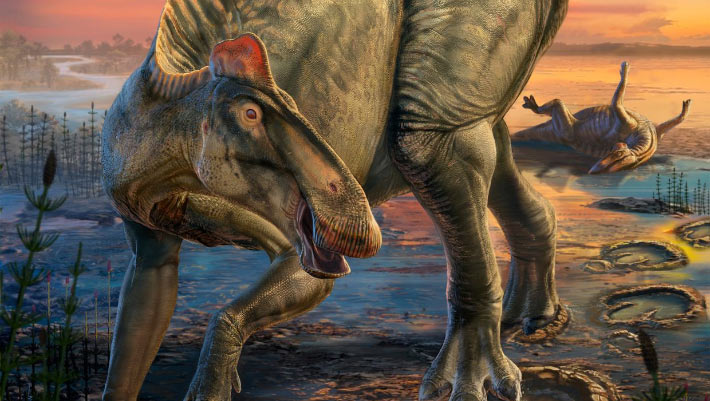
Tyrannosaurus rex Scavenged Duck-Billed Dinosaurs in Ancient Wyoming, Bite Marks Reveal
Des dinosaures à bec de canard récupérés par Tyrannosaurus rex dans l'ancien Wyoming et des marques de morsure révélées
os alimentation chasse États-Unis Crétacé Canardia Dinosauria Edmontosaurus Tyrannosaurus comportement
Des milliers d'os fossilisés provenant d'un gisement d'ossements du Crétacé dans le Wyoming, aux États-Unis, offrent des preuves physiques rares que le Tyrannosaurus rex s'est nourri des carcasses d'une espèce de dinosaure à bec de canard appelée Edmontosaurus annectens. L'article Tyrannosaurus rex a récupéré des dinosaures à bec de canard dans l'ancien Wyoming, les marques de morsure révèlent est apparu en premier sur Sci.News : Breaking Science News.
16/07/2026 sci-news ⚙ Traduction automatique
Uragasaurus – Un nouveau sauropode Mamenchisaurid de Thaïlande
os membre vertèbre Thaïlande fossile Dinosauria Mamenchisauridae Uragasaurus nouvelle espèce
Une équipe de chercheurs internationaux a nommé une nouvelle espèce remarquable de dinosaure à long cou originaire de Thaïlande. Uragasaurus kalasinensis est le premier membre formellement décrit des Mamenchisauridae de Thaïlande. Bien que les preuves fossiles consistent en une seule vertèbre, l'os préserve une combinaison unique de caractéristiques anatomiques qui ont permis aux scientifiques d'identifier un tout nouveau corps.
15/07/2026 everythingdinosaur ⚙ Traduction automatique
Les abeilles anciennes ont transformé les alvéoles dentaires en minuscules pépinières il y a 20 000 ans
os dent nid fossile oiseau découverte insecte mammifères
Une étonnante découverte de fossiles montre que d'anciennes abeilles utilisaient les alvéoles vides des os de mammifères comme de minuscules nids après que des hiboux aient dispersé les os sur le sol d'une grotte il y a 20 000 ans. Il s’agit de la première preuve connue de nidification d’abeilles dans des os d’animaux, révélant une stratégie de survie étonnamment créative.
05/07/2026 sciencedaily ⚙ Traduction automatique
Cet os oublié dans un tiroir depuis 40 ans vient de révéler le tout premier dinosaure découvert en Antarctique !
os vertèbre Antarctique Crétacé supérieur fossile Dinosauria Titanosauria découverte
Pendant près de quarante ans, il est resté oublié dans un tiroir du British Antarctic Survey. Ce fossile, découvert en Antarctique en 1985, vient pourtant d'être identifié comme le tout premier fossile de dinosaure jamais mis au jour sur le continent blanc. Une découverte qui éclaire aussi les...
01/07/2026 futura-terre
Les premiers humains apportaient du feu dans les grottes il y a 1,8 millions d'années
os Afrique du Sud comportement découverte Homo sapiens étude
Une nouvelle étude suggère que les premiers humains utilisaient le feu dans la grotte Wonderwerk en Afrique du Sud il y a 1,79 million d’années. Les chercheurs ont trouvé des ossements brûlés au plus profond de la grotte, là où les incendies naturels n'auraient pas pu atteindre, ce qui indique que le feu était probablement transporté et entretenu par les ancêtres humains. La découverte repousse la chronologie de l’utilisation du feu et révèle un comportement étonnamment sophistiqué bien avant que les humains ne puissent créer du feu à la demande.
24/06/2026 sciencedaily-paleo ⚙ Traduction automatique
1 2 3 4 5 6 7 8 9 10 11