crâne

Type de vue

211 image(s) · 22 Actualités

Galerie d'images

Skull reconstruction of Incisivosaurus gauthieri.
Taxons Incisivosaurus

Skull reconstruction of Incisivosaurus gauthieri.

Incisivosaurus crâne
Sarcosaurus diagram of known material: reconstruction based on basal Ceratosaurs (such as Berberosaurus and Saltriovenator). The Skull was made to look more generic and less like more derived Ceratosaurs such as Ceratosaurus. "Liassaurus", referred to "cf. Sarcosaurus woodi" and is smaller than the holotype: material in light grey is preserved, but to what extent is uncertain as it is not figured.
References:
Carrano and Sampson (2004). "A review of coelophysoids (Dinosauria: Theropoda) from the Early Jurassic of Europe, with comments on the late history of the Coelophysoidea." N. Jb. Geol. Palaont. Mh., 2004(9): 537-558. (for figures of the material)
theropoddatabase.com/Coelophysoidea.htm#Sarcosauruswoodi (for measurements of "Liassaurus")

Allain, Ronan & Tykoski, Ronald & Aquesbi, Najat & Jalil, Nour-Eddine & Monbaron, Michel & Russell, Dale & Taquet, Philippe. (2007). An abelisauroid (Dinosauria: Theropoda) from the Early Jurassic of the High Atlas Mountains, Morocco, and the radiation of Ceratosaurs. Journal of Vertebrate Paleontology. 27. 10.1671/0272-4634(2007)27[610:AADTFT]2.0.CO;2. (for measurements for Berberosaurus)
Taxons Sarcosaurus

Sarcosaurus diagram of known material: reconstruction based on basal Ceratosaurs (such as Berberosaurus and Saltriovenator). The Skull was made to look more generic and less like more derived Ceratosaurs such as Ceratosaurus. "Liassaurus", referred to "cf. Sarcosaurus woodi" and is smaller than the holotype: material in light grey is preserved, but to what extent is uncertain as it is not figured. References: Carrano and Sampson (2004). "A review of coelophysoids (Dinosauria: Theropoda) from the Early Jurassic of Europe, with comments on the late history of the Coelophysoidea." N. Jb. Geol. Palaont. Mh., 2004(9): 537-558. (for figures of the material) theropoddatabase.com/Coelophysoidea.htm#Sarcosauruswoodi (for measurements of "Liassaurus") Allain, Ronan & Tykoski, Ronald & Aquesbi, Najat & Jalil, Nour-Eddine & Monbaron, Michel & Russell, Dale & Taquet, Philippe. (2007). An abelisauroid (Dinosauria: Theropoda) from the Early Jurassic of the High Atlas Mountains, Morocco, and the radiation of Ceratosaurs. Journal of Vertebrate Paleontology. 27. 10.1671/0272-4634(2007)27[610:AADTFT]2.0.CO;2. (for measurements for Berberosaurus)

Maroc Jurassique inférieur Jurassique holotype +8
Leaellynasaura amicagraphica, dinosaur, skull. Holotype. [P 185991]
Taxons Leaellynasaura

Leaellynasaura amicagraphica, dinosaur, skull. Holotype. [P 185991]

musée holotype Dinosauria Leaellynasaura +1
Rhomboid distal nasal process of the crest of Tsintaosaurus spinorhinus.

A. Partial distal nasal process of IVPP V725 in right lateral view. B. Lateral view of composite skull (reversed). C. partial premaxillonasal complex of IVPP V829 in right lateral view. D. Line drawing of (C) showing nasal-premaxilla articulation, and the displacement (arrow) experienced by the distal nasal process relative to its articular position. E. Mounted holotype skull (IVPP V725) of T. spinorhinus in left lateral view (reversed). F. Partial right distal nasal process (although catalogued as IVPP V725, this element corresponds to a different specimen than the type; reversed).
Taxons Tsintaosaurus

Rhomboid distal nasal process of the crest of Tsintaosaurus spinorhinus. A. Partial distal nasal process of IVPP V725 in right lateral view. B. Lateral view of composite skull (reversed). C. partial premaxillonasal complex of IVPP V829 in right lateral view. D. Line drawing of (C) showing nasal-premaxilla articulation, and the displacement (arrow) experienced by the distal nasal process relative to its articular position. E. Mounted holotype skull (IVPP V725) of T. spinorhinus in left lateral view (reversed). F. Partial right distal nasal process (although catalogued as IVPP V725, this element corresponds to a different specimen than the type; reversed).

crête dessin holotype spécimen +3
Xenovenator espinosai, holotype braincase CPC 2973. In (A) left lateral; (B) right lateral; (C) dorsal; (D) ventral; (E) anterior; (F) posterior. Abbreviations: bo, basicoccipital; bul, parabasisphenoid bulla; ex, exoccipital; fr, frontal; lad, lateral depression; lac, lacrimal articulation; lat, laterosphenoid; osp, orbitosphenoid; par, parietal; pbs, parabasisphenoid; po, postorbital; ri, median ridge; sk, skull; stf, supratemporal fossa.
Taxons Xenovenator

Xenovenator espinosai, holotype braincase CPC 2973. In (A) left lateral; (B) right lateral; (C) dorsal; (D) ventral; (E) anterior; (F) posterior. Abbreviations: bo, basicoccipital; bul, parabasisphenoid bulla; ex, exoccipital; fr, frontal; lad, lateral depression; lac, lacrimal articulation; lat, laterosphenoid; osp, orbitosphenoid; par, parietal; pbs, parabasisphenoid; po, postorbital; ri, median ridge; sk, skull; stf, supratemporal fossa.

holotype Xenovenator crâne
Skull of Dromiceiomimus
Taxons Dromiceiomimus

Skull of Dromiceiomimus

Dromiceiomimus crâne
Skull of Saichania, Warsaw Museum of Evolution
Taxons Saichania

Skull of Saichania, Warsaw Museum of Evolution

musée Saichania évolution crâne
Skull of Oohkotokia horneri, gen. et sp. nov. (MOR 433, holotype)
Taxons Oohkotokia

Skull of Oohkotokia horneri, gen. et sp. nov. (MOR 433, holotype)

holotype Oohkotokia crâne
The incomplete skull and vertebrae of the holotype of Omphalosaurus nevadanus, seen in dorsal (left) and ventral view (right). This image was derived by combining plates 8 and 9 of Merriam (1906), done by an uncredited artist.
Legend:

A - angular
D - dentary
Pl - palatine
Pt - pterygoid
Sa - surangular
Sp - splenial
V - vertebrae
a, b, c - "doubtful elements"
Taxons Omphalosaurus

The incomplete skull and vertebrae of the holotype of Omphalosaurus nevadanus, seen in dorsal (left) and ventral view (right). This image was derived by combining plates 8 and 9 of Merriam (1906), done by an uncredited artist. Legend: A - angular D - dentary Pl - palatine Pt - pterygoid Sa - surangular Sp - splenial V - vertebrae a, b, c - "doubtful elements"

holotype Merriamia Omphalosaurus crâne
Restored Placochelys placodonta skull at the Museum für Naturkunde, Berlin.
Taxons Placochelys

Restored Placochelys placodonta skull at the Museum für Naturkunde, Berlin.

musée Placochelyidae Placochelys crâne
Restored Placochelys placodonta skull at the Museum für Naturkunde, Berlin.
Taxons Placochelyidae

Restored Placochelys placodonta skull at the Museum für Naturkunde, Berlin.

musée Placochelyidae Placochelys crâne
Comparison of cranial features between closely related southern Laramidian taxa; (A), Akainacephalus johnsoni (UMNH VP 20202) from the Late Cretaceous Kaiparowits Formation of Utah; and (B), Nodocephalosaurus kirtlandensis (SMP VP-900) from the Late Cretaceous Kirtland Formation of New Mexico, in left lateral views. Various synapomorphies are shared with N. kirtlandensis (highlighted in black and white arrows) and includes “flaring nostrils”; enlarged, laterally projecting, loreal osteoderms that are situated directly dorsal to the external nares. Other synapomorphies include pyramid-shaped nasal and frontal osteoderms positioned on the dorsal regions of the skull. A number of significant differences have been observed between both specimens; in A. johnsoni, the anterior, and posterior supraorbital bosses form an enlarged element that is somewhat backswept, whereas in N. kirtlandensis, the posterior and anterior supraorbital bosses are clearly defined as individual osteoderms, and are much smaller in size. Additionally, the squamosal horn in Akainacephalus is very small but is prominent and tetrahedrally shaped in Nodocephalosaurus. The quadratojugal horn in Akainacephalus is massive, has a subtriangular morphology in lateral view and projects almost entirely ventral, whereas in Nodocephalosaurus, the quadratojugal horn is smaller and has a typical fin-shaped morphology. Study sites: asob, anterior supraorbital boss; ext naris, external naris; laca, lacrimal caputegulum; loca, loreal caputegulum; naca, nasal caputegulae; orb, orbit; psob, posterior supraorbital boss; qjh, quadratojugal horn; sqh, squamosal horn.
Taxons Nodocephalosaurus

Comparison of cranial features between closely related southern Laramidian taxa; (A), Akainacephalus johnsoni (UMNH VP 20202) from the Late Cretaceous Kaiparowits Formation of Utah; and (B), Nodocephalosaurus kirtlandensis (SMP VP-900) from the Late Cretaceous Kirtland Formation of New Mexico, in left lateral views. Various synapomorphies are shared with N. kirtlandensis (highlighted in black and white arrows) and includes “flaring nostrils”; enlarged, laterally projecting, loreal osteoderms that are situated directly dorsal to the external nares. Other synapomorphies include pyramid-shaped nasal and frontal osteoderms positioned on the dorsal regions of the skull. A number of significant differences have been observed between both specimens; in A. johnsoni, the anterior, and posterior supraorbital bosses form an enlarged element that is somewhat backswept, whereas in N. kirtlandensis, the posterior and anterior supraorbital bosses are clearly defined as individual osteoderms, and are much smaller in size. Additionally, the squamosal horn in Akainacephalus is very small but is prominent and tetrahedrally shaped in Nodocephalosaurus. The quadratojugal horn in Akainacephalus is massive, has a subtriangular morphology in lateral view and projects almost entirely ventral, whereas in Nodocephalosaurus, the quadratojugal horn is smaller and has a typical fin-shaped morphology. Study sites: asob, anterior supraorbital boss; ext naris, external naris; laca, lacrimal caputegulum; loca, loreal caputegulum; naca, nasal caputegulae; orb, orbit; psob, posterior supraorbital boss; qjh, quadratojugal horn; sqh, squamosal horn.

Mexique Kaiparowits Kirtland Crétacé +6
Riojasaurus skull cast, Copenhagen.
Taxons Riojasaurus

Riojasaurus skull cast, Copenhagen.

moulage Riojasauridae Riojasaurus crâne
Riojasaurus skull cast, Copenhagen.
Taxons Riojasauridae

Riojasaurus skull cast, Copenhagen.

moulage Riojasauridae Riojasaurus crâne
Skull of Pistosaurus longaevus (cast - USNM 16107) in right, left and posterior views.
Taxons Pistosaurus

Skull of Pistosaurus longaevus (cast - USNM 16107) in right, left and posterior views.

moulage Pistosauria Pistosauridae crâne
Skull of Pistosaurus longaevus (cast - USNM 16107) in right, left and posterior views.
Taxons Pistosauridae

Skull of Pistosaurus longaevus (cast - USNM 16107) in right, left and posterior views.

moulage Pistosauria Pistosauridae crâne
1 2 3 4 5 6 7 8 9 10 11 12 13 14

Actualités

Cet animal ancien fut l'un des premiers à manger des plantes sur terre
dent fossile crâne
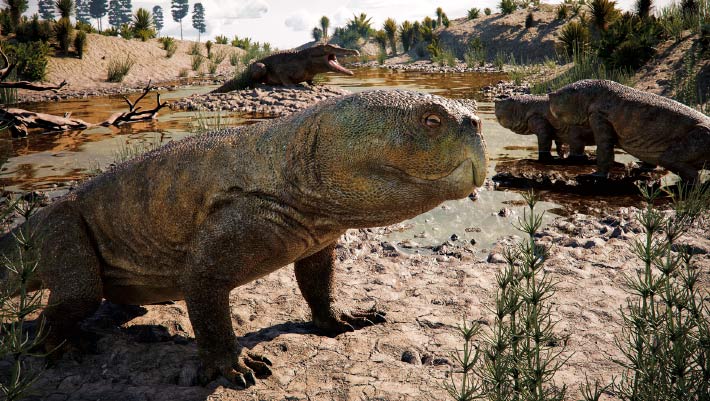
Il y a des centaines de millions d’années, les premiers animaux à ramper sur terre étaient de purs mangeurs de viande, alors même que les plantes avaient déjà envahi le paysage. Aujourd’hui, les scientifiques ont découvert un fossile vieux de 307 millions d’années qui réécrit cette histoire : l’un des premiers vertébrés terrestres connus à avoir commencé à manger des plantes. L'animal, nommé Tyrannoroter heberti, était une créature trapue de la taille d'un ballon de football avec un crâne rempli de dents spécialisées conçues pour écraser et broyer la végétation.
11/02/2026 sciencedaily ⚙ Traduction automatique
Cet étrange petit dinosaure oblige à repenser l'évolution
os dent métabolisme Dinosauria Foskeia anatomie oiseau évolution mammifères étude crâne
Un petit dinosaure nouvellement identifié, Foskeia pelendonum, bouleverse les idées reçues de longue date sur l'évolution des dinosaures herbivores. Même si les adultes adultes étaient remarquablement petits et légers, leur anatomie était tout sauf simple : elles présentaient un crâne bizarre et hautement spécialisé et des traits évolutifs inattendus. Des études osseuses détaillées montrent que ces dinosaures ont mûri rapidement avec un métabolisme semblable à celui des oiseaux ou des mammifères, tandis que leurs dents et leur posture suggèrent une vie rapide et agile dans des forêts denses.
03/02/2026 sciencedaily ⚙ Traduction automatique
Pachycephalosaurus: Beast of the Week
Pachycephalosaurus : Bête de la semaine
membre film Jurassique Dinosauria Pachycephalosauria crâne
Cette semaine, nous allons découvrir un dinosaure bien connu avec un crâne emblématique.  Ce dinosaure est l’un de mes favoris de tous les temps.  Je n'oublierai jamais d'avoir vu sa superbe représentation dans Le Monde Perdu : Jurassic Park au cinéma alors que j'avais seulement huit ans.  La façon dont il a détruit ce camion... ça m'a changé.  Dites bonjour à Pachycephalosaurus wyomingensis ! Pachycephalosaurus reconstitution de la vie à l'aquarelle par Christopher DiPiazza. Pachycephalosaurus était le plus grand membre connu o
25/01/2026 prehistoricbeastoftheweek ⚙ Traduction automatique
Un fossile vieux de 250 millions d'années révèle les origines de l'audition des mammifères
os mâchoire fossile mammifères crâne
L’audition sensible pourrait avoir évolué chez les ancêtres des mammifères bien plus tôt que ne le croyaient les scientifiques. En modélisant la façon dont le son se déplaçait dans le crâne de Thrinaxodon, un prédécesseur mammifère vieux de 250 millions d'années, les chercheurs ont découvert qu'il utilisait probablement un tympan précoce pour entendre les sons aériens. Cela remet en question l’idée répandue selon laquelle ces animaux « écoutaient » principalement à travers leurs mâchoires ou leurs os. Les résultats révèlent qu’une caractéristique clé de l’audition des mammifères modernes prenait déjà forme au plus profond de la préhistoire.
20/01/2026 sciencedaily ⚙ Traduction automatique
Anurognathus: Beast of the Week
Anurognathus : la bête de la semaine
Allemagne Jurassique Jurassique supérieur Anurognathus Pterosauria crâne
Cette semaine, nous allons découvrir un petit ptérosaure unique, Anurognathus ammoni !  Anurognathus vivait dans ce qui est aujourd'hui l'Allemagne à la fin du Jurassique, il y a environ 150 millions d'années.  Il était minuscule, avait une envergure de 35,5 cm (14 pouces) et aurait probablement mangé des insectes.  Son nom de genre se traduit par "Frog Jaw" puisque son crâne ressemblait à celui d'une grenouille, étant extrêmement émoussé avec une bouche large.  Reconstitution à l'aquarelle d'Anurognathus ammoni par Christopher DiPiazza.Sku d'Anurognathus
14/12/2025 prehistoricbeastoftheweek ⚙ Traduction automatique
1 2 3 4 5