crâne

Type de vue

386 image(s) · 29 Actualités

Galerie d'images

Reconstructed skull of the holotype and only specimen of Leshansaurus qianweiensis based on the possibly related megalosaurid Dubreuillosaurus valesdunensis. Scale bar is 10cm, image is 10px/cm. Cranial anatomy from figures in Fei et al. (2009) "A new carnosaur from the Late Jurassic of Qianwei, Sichuan, China". White bones are figured, light grey bones are unfigured and minimally described.
Taxons Leshansaurus

Reconstructed skull of the holotype and only specimen of Leshansaurus qianweiensis based on the possibly related megalosaurid Dubreuillosaurus valesdunensis. Scale bar is 10cm, image is 10px/cm. Cranial anatomy from figures in Fei et al. (2009) "A new carnosaur from the Late Jurassic of Qianwei, Sichuan, China". White bones are figured, light grey bones are unfigured and minimally described.

os écaille Chine Jurassique +9
Nemicolopterus crypticus holotype (IVPP V-14377).

(A) Skeleton overview, and (B) schematic drawing. (C) Skull (right lateral view), and (D) schematic drawing. Abbreviations: cdv, caudal vertebrae; co, coracoid; cv, cervical vertebra; d1–d4, digits 1–4; f, frontal; fe, femur; h, humerus; hy, hyoid; il, illium; is, ischium; j, jugal; l, left; la, lacrimal; mand, mandible; mc, metacarpal; mt, metatarsal; naof, nasoantorbital fenestra; or, orbit; pa, parietal; pm, premaxilla; ph, phalanx; ti, tibia; r, right; sca, scapula. Scale bars: A–B, 100 mm; C–D, 5 mm.
Taxons Nemicolopterus

Nemicolopterus crypticus holotype (IVPP V-14377). (A) Skeleton overview, and (B) schematic drawing. (C) Skull (right lateral view), and (D) schematic drawing. Abbreviations: cdv, caudal vertebrae; co, coracoid; cv, cervical vertebra; d1–d4, digits 1–4; f, frontal; fe, femur; h, humerus; hy, hyoid; il, illium; is, ischium; j, jugal; l, left; la, lacrimal; mand, mandible; mc, metacarpal; mt, metatarsal; naof, nasoantorbital fenestra; or, orbit; pa, parietal; pm, premaxilla; ph, phalanx; ti, tibia; r, right; sca, scapula. Scale bars: A–B, 100 mm; C–D, 5 mm.

humérus écaille vertèbre dessin +4
Udelartitan is a titanosaurian sauropod from the Late Cretaceous of what is now Uruguay. It had the typical sauropod body plan, standing on four thick pillar-like legs, and possessing a long neck. Titanosaurs are a very diverse group, Udelartitan was a small one, estimated at only 15 m in body length. Though a skull has yet to be discovered, it probably had peglike teeth, and a large gut for processing vegetation.
Taxons Udelartitan

Udelartitan is a titanosaurian sauropod from the Late Cretaceous of what is now Uruguay. It had the typical sauropod body plan, standing on four thick pillar-like legs, and possessing a long neck. Titanosaurs are a very diverse group, Udelartitan was a small one, estimated at only 15 m in body length. Though a skull has yet to be discovered, it probably had peglike teeth, and a large gut for processing vegetation.

Uruguay Crétacé Crétacé supérieur Titanosauria +2
Ludodactylus sibbicki. A, B, holotype (SMNK PAL 3828) skull and lower jaw in right lateral view.
Taxons Ludodactylus

Ludodactylus sibbicki. A, B, holotype (SMNK PAL 3828) skull and lower jaw in right lateral view.

holotype Ludodactylus crâne
Reconstruction of the skull of Spinops sternbergorum gen. et sp. nov. from the Campanian of Dinosaur Provincial Park, southern Alberta, in right lateral view. Preserved elements are stippled; missing portions are dotted and modeled after Centrosaurus apertus.
Taxons Spinops

Reconstruction of the skull of Spinops sternbergorum gen. et sp. nov. from the Campanian of Dinosaur Provincial Park, southern Alberta, in right lateral view. Preserved elements are stippled; missing portions are dotted and modeled after Centrosaurus apertus.

Campanien Centrosaurus Dinosauria Spinops +1
Skull of troodontid theropod Xixiasaurus henanensis gen. et sp. nov. (HGM 41HIII−0201; holotype), lower–middle Majiacun Formation (Upper Cretaceous: Coniacian–Campanian), Henan Province, China; in dorsal (A); lateral (B), and ventral (C) views.

Note that this version of the image does not include the interpretative lines of the version in the paper.
Taxons Xixiasaurus

Skull of troodontid theropod Xixiasaurus henanensis gen. et sp. nov. (HGM 41HIII−0201; holotype), lower–middle Majiacun Formation (Upper Cretaceous: Coniacian–Campanian), Henan Province, China; in dorsal (A); lateral (B), and ventral (C) views. Note that this version of the image does not include the interpretative lines of the version in the paper.

Chine Campanien Coniacien Crétacé +5
Skull diagram featuring the holotype skull (ROM 1790) of the ornithomimid Rativates evadens, from the Late Cretaceous period. Abbreviations: d, dentary; f, frontal; l, lacrimal; m, maxilla; n, nasal; pm, premaxila; ps, paraphenoid.
Taxons Rativates

Skull diagram featuring the holotype skull (ROM 1790) of the ornithomimid Rativates evadens, from the Late Cretaceous period. Abbreviations: d, dentary; f, frontal; l, lacrimal; m, maxilla; n, nasal; pm, premaxila; ps, paraphenoid.

Crétacé Crétacé supérieur holotype Ornithomimidae +2
Reconstructed skull of Archaeornithoides, known material in brown.
Taxons Archaeornithoides

Reconstructed skull of Archaeornithoides, known material in brown.

Archaeornithoides crâne
Holotype skull of Wannanosaurus yansiensis on display at the Paleozoological Museum of China.
Taxons Wannanosaurus

Holotype skull of Wannanosaurus yansiensis on display at the Paleozoological Museum of China.

musée Chine holotype Wannanosaurus +1
Holotype specimen (PIMUZ A/III 1274) of Prosantosaurus scheffoldi gen. et spec. nov. from the upper Prosanto Formation (Early Ladinian, Middle Triassic) of Ducanfurgga locality no. 4, southwest of Davos, Canton of Grisons, south-eastern Switzerland. A Nearly complete specimen as prepared in dorsal view. The posterior part of the tail was lost prior to burial. Both forearms are not visible but lie below the trunk region, pointing in an anteromedial direction (see Additional file 1: Fig. S3A). B Detail of skull and anterior neck region. C Outline sketch of skull sutures. D Detail of shoulder girdle (claviculae, scapulae) and anterior dorsal vertebrae and ribs. E Detail of right humerus. F Detail of posterior dorsal vertebrae and ribs, sacral vertebrae and ribs, and anterior caudal vertebrae and ribs. G Detail of left ilium and hindlimb. ar articular; as astragalus; bo basioccipital; cal calcaneus; cl clavicula; co coracoid; d dentary; en external naris; eo exoccipital; fe femur; fi fibula; fr frontal; hu humerus; il ilium; in internal naris; is ischium; j jugal; mx maxilla; na naris; o orbit; pa parietal; pl palatine; pmx premaxilla; pof postfrontal; po postorbital; prf prefrontal; pt pterygoid; pu pubis; q quadrate; qj quadratojugal; ti tibia; sacr sacral rib; sc scapula; so supraoccipital; sp splenial; sq squamosal; su surangular; utf upper temporal fenestra; v vomer
Taxons Prosantosaurus

Holotype specimen (PIMUZ A/III 1274) of Prosantosaurus scheffoldi gen. et spec. nov. from the upper Prosanto Formation (Early Ladinian, Middle Triassic) of Ducanfurgga locality no. 4, southwest of Davos, Canton of Grisons, south-eastern Switzerland. A Nearly complete specimen as prepared in dorsal view. The posterior part of the tail was lost prior to burial. Both forearms are not visible but lie below the trunk region, pointing in an anteromedial direction (see Additional file 1: Fig. S3A). B Detail of skull and anterior neck region. C Outline sketch of skull sutures. D Detail of shoulder girdle (claviculae, scapulae) and anterior dorsal vertebrae and ribs. E Detail of right humerus. F Detail of posterior dorsal vertebrae and ribs, sacral vertebrae and ribs, and anterior caudal vertebrae and ribs. G Detail of left ilium and hindlimb. ar articular; as astragalus; bo basioccipital; cal calcaneus; cl clavicula; co coracoid; d dentary; en external naris; eo exoccipital; fe femur; fi fibula; fr frontal; hu humerus; il ilium; in internal naris; is ischium; j jugal; mx maxilla; na naris; o orbit; pa parietal; pl palatine; pmx premaxilla; pof postfrontal; po postorbital; prf prefrontal; pt pterygoid; pu pubis; q quadrate; qj quadratojugal; ti tibia; sacr sacral rib; sc scapula; so supraoccipital; sp splenial; sq squamosal; su surangular; utf upper temporal fenestra; v vomer

humérus Suisse Ladinien Trias moyen +6
Reconstructed skull of the turiasaurian Mierasaurus, based on the holotype UMNH.VP.26004.
Taxons Mierasaurus

Reconstructed skull of the turiasaurian Mierasaurus, based on the holotype UMNH.VP.26004.

holotype Mierasaurus Turiasauria crâne
Riparovenator milnerae holotype skull
Taxons Riparovenator

Riparovenator milnerae holotype skull

holotype Riparovenator crâne
Caihong juji holotype specimen (PMoL-B00175). Photographs of the slab (a) and counter slab (b) and line drawing (c) of the specimen based on both slabs. Photograph (d) and line drawing (e) of a composite of the rostrum of the skull and mandible exposed on the counter slab and the post-rostrum cranium exposed on the slab. Arrows indicate lacrimal crests. Question mark indicates uncertain identification. Scale bars: 10 cm a–c, 1 cm d and e. aof antorbital fenestra, cav caudal vertebra, cev cervical vertebra, dr dorsal rib, dv dorsal vertebra, ect ectopterygoid, emf external mandibular fenestra, en external naris, f feather, fu furcula, ga gastralia, hy hyoid, il ilium, is ischium, la left angular, lar left articular, lc left coracoid, lcr lacrimal crest, ld left dentary, lf left, frontal, lfe left femur, lh left humerus, lj left jugal, ll left lacrimal, lma left maxilla, lm left manus, ln left nasal, lp left pes, lpa left palatine, lpo left postorbital, lq left quadrate, lqj left quadratojugal, lr left radius, ls left scapula, lsp left splenial, lsa left surangular, lsq left squamosal, lt left tibiotarsus, lu left ulna, ma mandible, mf maxillary fenestra, o orbit, p parietal, pm premaxilla, pt pterygoid, pu pubis, rar right articular, rc right coracoid, rd right dentary, rfe right femur, rh right humerus, rm right manus, rp right pes, rpra right prearticular, rq right quadrate, rr right radius, rs right scapula, rt right tibiotarsus, ru right ulna, scl sclerotic bones, sk skull, sy synsacrum
Taxons Caihong

Caihong juji holotype specimen (PMoL-B00175). Photographs of the slab (a) and counter slab (b) and line drawing (c) of the specimen based on both slabs. Photograph (d) and line drawing (e) of a composite of the rostrum of the skull and mandible exposed on the counter slab and the post-rostrum cranium exposed on the slab. Arrows indicate lacrimal crests. Question mark indicates uncertain identification. Scale bars: 10 cm a–c, 1 cm d and e. aof antorbital fenestra, cav caudal vertebra, cev cervical vertebra, dr dorsal rib, dv dorsal vertebra, ect ectopterygoid, emf external mandibular fenestra, en external naris, f feather, fu furcula, ga gastralia, hy hyoid, il ilium, is ischium, la left angular, lar left articular, lc left coracoid, lcr lacrimal crest, ld left dentary, lf left, frontal, lfe left femur, lh left humerus, lj left jugal, ll left lacrimal, lma left maxilla, lm left manus, ln left nasal, lp left pes, lpa left palatine, lpo left postorbital, lq left quadrate, lqj left quadratojugal, lr left radius, ls left scapula, lsp left splenial, lsa left surangular, lsq left squamosal, lt left tibiotarsus, lu left ulna, ma mandible, mf maxillary fenestra, o orbit, p parietal, pm premaxilla, pt pterygoid, pu pubis, rar right articular, rc right coracoid, rd right dentary, rfe right femur, rh right humerus, rm right manus, rp right pes, rpra right prearticular, rq right quadrate, rr right radius, rs right scapula, rt right tibiotarsus, ru right ulna, scl sclerotic bones, sk skull, sy synsacrum

os crête plume humérus +8
Figure 4: Anterior portion of the skull of Dakotadon lakotaensis (SDSM 8656).
(A) photograph in left lateral view; (B) photograph in right lateral view; (C) photograph in ventral view. Abbreviations: ant, anterior; post, posterior; vent, ventral. Scale bars equal 5.0 cm.
Taxons Dakotadon

Figure 4: Anterior portion of the skull of Dakotadon lakotaensis (SDSM 8656). (A) photograph in left lateral view; (B) photograph in right lateral view; (C) photograph in ventral view. Abbreviations: ant, anterior; post, posterior; vent, ventral. Scale bars equal 5.0 cm.

écaille Dakotadon crâne
Ceratosuchops inferodios Holotype skull fragments
Taxons Ceratosuchops

Ceratosuchops inferodios Holotype skull fragments

holotype Ceratosuchops crâne
Partial skull and anterior cervical vertebrae of unidentified pliosaurid plesiosaurian (MPPL 18797) from the uppermost Callovian–middle Oxfordian of Kaberlaba (Asiago, Italy), in left lateral view. Photograph (A) and explanatory drawing (B). White, preserved bone surfaces; dark grey, preserved margins of skull fenestrae; light grey, eroded bone surface; cross hatching, broken bone.
Taxons Anguanax

Partial skull and anterior cervical vertebrae of unidentified pliosaurid plesiosaurian (MPPL 18797) from the uppermost Callovian–middle Oxfordian of Kaberlaba (Asiago, Italy), in left lateral view. Photograph (A) and explanatory drawing (B). White, preserved bone surfaces; dark grey, preserved margins of skull fenestrae; light grey, eroded bone surface; cross hatching, broken bone.

os dessin Italie Callovien +6
1 2 3 4 5 6 7 8 9 10 11 12 13 14 15 16 17 18 19 20 21 22 23 24 25

Actualités

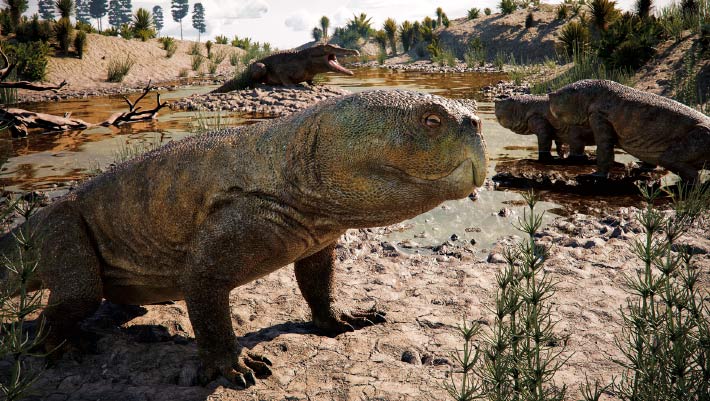
New Fossil from Brazil Reveals Unexpected Diversity among Pre-Dinosaur Herbivores
Un nouveau fossile du Brésil révèle une diversité inattendue parmi les herbivores pré-dinosaures
mâchoire Brésil Trias fossile Dinosauria nouvelle espèce partiel crâne
Des paléontologues du Brésil ont identifié un nouveau genre et une nouvelle espèce de rhynchosaure hyperodapédontique – une lignée éteinte de reptiles herbivores à bec – sur la base d'un crâne partiel et de mâchoires inférieures récupérés dans des roches du Trias. L'article Un nouveau fossile du Brésil révèle une diversité inattendue parmi les herbivores pré-dinosaures est apparu en premier sur Sci.News : Breaking Science News.
23/04/2026 sci-news ⚙ Traduction automatique
New Triassic Dinosaur Species Identified in New Mexico
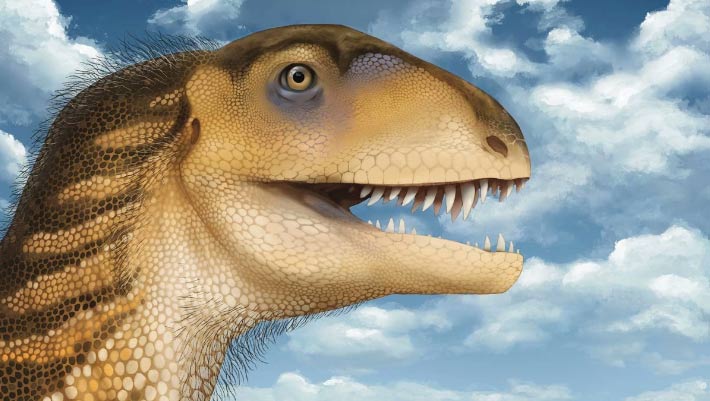
De nouvelles espèces de dinosaures du Trias identifiées au Nouveau-Mexique
Mexique États-Unis Trias Dinosauria nouvelle espèce crâne
Un nouveau genre et une nouvelle espèce de dinosaure herrerasaurien carnivore ont été décrits à partir d'un crâne incomplet mais bien conservé trouvé dans le nord du Nouveau-Mexique, aux États-Unis. L'article Nouvelles espèces de dinosaures du Trias identifiées au Nouveau-Mexique est apparu en premier sur Sci.News : Breaking Science News.
17/04/2026 sci-news ⚙ Traduction automatique
Un fossile écrasé révèle un dinosaure qui n’aurait pas dû exister
Trias fossile Dinosauria découverte extinction nouvelle espèce crâne
Un crâne de dinosaure gravement mutilé, oublié dans un tiroir, s'est avéré être une découverte rare et importante. Reconstruit par un étudiant de Virginia Tech, il a révélé une nouvelle espèce de dinosaure carnivore primitif présentant des caractéristiques inhabituelles jamais vues auparavant. Le fossile suggère que certains groupes de dinosaures ont été anéantis lors de l’extinction de la fin du Trias, et pas seulement leurs rivaux. Il s’agit peut-être de l’un des derniers survivants d’une ancienne lignée de dinosaures.
15/04/2026 sciencedaily ⚙ Traduction automatique
Daemonosaurus: Beast of the Week
Démonosaure : la bête de la semaine
Mexique États-Unis Trias supérieur Trias Daemonosaurus Dinosauria crâne
 Cette semaine, nous allons découvrir un premier dinosaure au look unique avec un nom très cool.  Rencontrez Daemonosaurus chaoliodus ! Daemonosaurus était un petit dinosaure carnivore qui vivait dans ce qui est aujourd'hui le Nouveau-Mexique, aux États-Unis, à la fin du Trias, il y a environ 205 à 200 millions d'années.  Du nez à la queue, on estime qu'il mesurait environ 5 à 7 pieds (1,5 à 2,2 m).  Il s’agit d’estimations basées sur le fait que seuls le crâne et le cou ont été retrouvés.  Le nom du genre se traduit par "Demo
05/04/2026 prehistoricbeastoftheweek ⚙ Traduction automatique
Les scientifiques ont trouvé un bébé dinosaure caché dans la roche et il est étonnamment mignon
os dessin Corée du Sud Dinosauria Doolysaurus tomographie découverte crâne
Des scientifiques ont découvert un bébé dinosaure rare en Corée du Sud et l'ont baptisé Doolysaurus, en hommage à un célèbre personnage de dessin animé. Grâce à des tomodensitogrammes de pointe, ils ont découvert des os cachés, notamment un crâne, dans la roche beaucoup plus rapidement que les méthodes traditionnelles. Le jeune dinosaure, peut-être duveteux et ressemblant à un agneau, avait même des calculs gastriques révélant qu'il mangeait un mélange de plantes et de petits animaux. Cette découverte suggère que de nombreux autres dinosaures pourraient encore être cachés dans les roches coréennes.
01/04/2026 sciencedaily ⚙ Traduction automatique
1 2 3 4 5 6