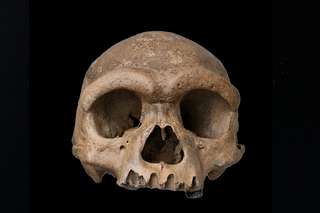
crâne

Type de vue

188 image(s) · 18 Actualités

Galerie d'images

Reconstruction of the skull of Lagenanectes richterae in right lateral view. Only the anterior part of the skull and lower jaw is preserved in the type and only known specimen. The posterior parts are reconstructed based on the related genus Libonectes.
Taxons Lagenanectes

Reconstruction of the skull of Lagenanectes richterae in right lateral view. Only the anterior part of the skull and lower jaw is preserved in the type and only known specimen. The posterior parts are reconstructed based on the related genus Libonectes.

spécimen Lagenanectes Libonectes crâne
A–B, skull in dorsal view; C–E, postcranial skeleton; in left dorsolateral (C) and left lateral (D–E) views. In line drawings (B, E) dark grey tone indicates damage and light grey tone indicates the palate. Abbreviations: ca, caudal vertebra [number following indicates order in preserved series]; ce, cervical vertebra; d, dorsal vertebra; depr, depression; ecto, ectopterygoid; epip, epipterygoid; exp, expanded neural spine apex; fr, frontal; jug, jugal; l., left [followed by name of element]; mx, maxilla; p, ‘pectoral’ vertebra; par, parietal; pmx, premaxilla; po, postorbital; pofr, postfrontal; prfr, prefrontal; qua, quadrate; r., right [followed by name of element]; s, sacral vertebra; sq, squamosal; unexp, unexpanded neural spine apex. Scale bars equal 50 mm (A–B), 20 mm (C), and 200 mm (D–E).
Taxons Avalonnectes

A–B, skull in dorsal view; C–E, postcranial skeleton; in left dorsolateral (C) and left lateral (D–E) views. In line drawings (B, E) dark grey tone indicates damage and light grey tone indicates the palate. Abbreviations: ca, caudal vertebra [number following indicates order in preserved series]; ce, cervical vertebra; d, dorsal vertebra; depr, depression; ecto, ectopterygoid; epip, epipterygoid; exp, expanded neural spine apex; fr, frontal; jug, jugal; l., left [followed by name of element]; mx, maxilla; p, ‘pectoral’ vertebra; par, parietal; pmx, premaxilla; po, postorbital; pofr, postfrontal; prfr, prefrontal; qua, quadrate; r., right [followed by name of element]; s, sacral vertebra; sq, squamosal; unexp, unexpanded neural spine apex. Scale bars equal 50 mm (A–B), 20 mm (C), and 200 mm (D–E).

écaille vertèbre dessin Avalonnectes +2
Skull of Augustasaurus hagdorni in the Field Museum of Natural History.
Taxons Augustasaurus

Skull of Augustasaurus hagdorni in the Field Museum of Natural History.

musée Augustasaurus crâne
A color-coded skull diagram of Palatodonta bleekeri, mostly based on a diagram published by Neenan et al. (2013). Some interpretations (such as the presence of a quadratojugal) are based on Maisch (2020). Depicted in left lateral view, mirrored from the original specimen as preserved in right lateral view. Dotted lines indicate missing bone.
Taxons Palatodonta

A color-coded skull diagram of Palatodonta bleekeri, mostly based on a diagram published by Neenan et al. (2013). Some interpretations (such as the presence of a quadratojugal) are based on Maisch (2020). Depicted in left lateral view, mirrored from the original specimen as preserved in right lateral view. Dotted lines indicate missing bone.

os spécimen Palatodonta crâne
skull restoration of Russellosaurus
Taxons Russellosaurus

skull restoration of Russellosaurus

Russellosaurus crâne
Cuspicephalus scarfi MJMG K1918. A, Original skull on slab of mudstone, Lacking the mandible and dentition; B, outline diagram of preserved bone. Light grey is bone, dark grey is fibrous bone of sagittal crest, black is dental alveoli where unambiguous; C restoration of skull outline, with hypothetical lower jaw. Scale bar = 50 mm. Abbreviation: j, jugal; naof, nasoantorbital fenestra; m, maxilla; o, orbit; pm, premaxilla; q, quadrate; sc,

sagittal crest; sq, squamosal; tr np, trace of nasal process.
Taxons Cuspicephalus

Cuspicephalus scarfi MJMG K1918. A, Original skull on slab of mudstone, Lacking the mandible and dentition; B, outline diagram of preserved bone. Light grey is bone, dark grey is fibrous bone of sagittal crest, black is dental alveoli where unambiguous; C restoration of skull outline, with hypothetical lower jaw. Scale bar = 50 mm. Abbreviation: j, jugal; naof, nasoantorbital fenestra; m, maxilla; o, orbit; pm, premaxilla; q, quadrate; sc, sagittal crest; sq, squamosal; tr np, trace of nasal process.

os crête écaille Cuspicephalus +1
3D printed skull of Caelestiventus hanseni.
Taxons Caelestiventus

3D printed skull of Caelestiventus hanseni.

Caelestiventus crâne
Figure 2.
Holotype of Liaodactylus primus gen. et sp. nov. (PMOL-AP00031): photographs and line drawings of the nearly complete skull with mandibles in left lateral (a,b), and palatal (c,d) views. aa, atlas-axis complex; an, angular; arf, articular facet; bo, basioccipital; bs, basisphenoid; co, coronoid; d, dentary; ec, ectopterygoid; f, frontal; j, jugal; m, maxilla; naof, nasoantorbital fenestra; p, parietal; pal, palatine; pat, proatlas; pecf, pterygo-ectopterygoid fenestra; pm, premaxilla; pof, postfrontal; pra, prearticular; pt, pterygoid; q, quadrate; qj, quadratojugal; sa, surangular; sof, suborbital fenestra; spl, splenial; sq, squamosal; stf, subtemporal fenestra.
Taxons Liaodactylus

Figure 2. Holotype of Liaodactylus primus gen. et sp. nov. (PMOL-AP00031): photographs and line drawings of the nearly complete skull with mandibles in left lateral (a,b), and palatal (c,d) views. aa, atlas-axis complex; an, angular; arf, articular facet; bo, basioccipital; bs, basisphenoid; co, coronoid; d, dentary; ec, ectopterygoid; f, frontal; j, jugal; m, maxilla; naof, nasoantorbital fenestra; p, parietal; pal, palatine; pat, proatlas; pecf, pterygo-ectopterygoid fenestra; pm, premaxilla; pof, postfrontal; pra, prearticular; pt, pterygoid; q, quadrate; qj, quadratojugal; sa, surangular; sof, suborbital fenestra; spl, splenial; sq, squamosal; stf, subtemporal fenestra.

dessin holotype Liaodactylus crâne
Holotype skull (IVPP V17083) of Guidraco venator on display at the Paleozoological Museum of China.
Taxons Guidraco

Holotype skull (IVPP V17083) of Guidraco venator on display at the Paleozoological Museum of China.

musée Chine holotype Guidraco +1
Holotype skull and mandible of the anhanguerid Ferrodraco (A), holotype skull and mandible of the anhanguerid Mythunga (B), and holotype mandible of the targaryendraconian Aussiedraco (C).
Taxons Mythunga

Holotype skull and mandible of the anhanguerid Ferrodraco (A), holotype skull and mandible of the anhanguerid Mythunga (B), and holotype mandible of the targaryendraconian Aussiedraco (C).

holotype Anhangueridae Aussiedraco Ferrodraco +3
Zhejiangopterus linhaiensis, skull (cast), Zhejiang Geological Museum
Taxons Zhejiangopterus

Zhejiangopterus linhaiensis, skull (cast), Zhejiang Geological Museum

musée moulage Zhejiangopterus crâne
Skull of Caiuajara dobruskii gen. et sp. nov. (holotype, CP.V 1449) with the shape of an adult individual.

Scale bar equals 50: d, dentary; dcr, dentary crest; dep, depression; exp, ventral expansion of the premaxilla; f, frontal; fcr, frontal crest; fo, foraminae; m, maxilla; oc, occipital condyle; op, opisthotic; p, parietal; pm, premaxilla; pmcr, premaxillary crest; q, quadrate; soc, supraoccipital. The quadrate is inverted.
Taxons Caiuajara

Skull of Caiuajara dobruskii gen. et sp. nov. (holotype, CP.V 1449) with the shape of an adult individual. Scale bar equals 50: d, dentary; dcr, dentary crest; dep, depression; exp, ventral expansion of the premaxilla; f, frontal; fcr, frontal crest; fo, foraminae; m, maxilla; oc, occipital condyle; op, opisthotic; p, parietal; pm, premaxilla; pmcr, premaxillary crest; q, quadrate; soc, supraoccipital. The quadrate is inverted.

crête écaille holotype Caiuajara +1
Reconstructed skull of Caupedactylus.
Taxons Caupedactylus

Reconstructed skull of Caupedactylus.

Brésil Caupedactylus crâne
Azhdarchoid pterosaur Kariridraco dianae gen. et sp. nov. holotype (MPSC R 1056) from Lower Cretaceous of Northeastern Brazil. Skull in right lateral view. Photograph (A1), interpretative drawing (A2). Dark grey areas indicate remains of the carbonate matrix still attachaed to the skull.
Taxons Kariridraco

Azhdarchoid pterosaur Kariridraco dianae gen. et sp. nov. holotype (MPSC R 1056) from Lower Cretaceous of Northeastern Brazil. Skull in right lateral view. Photograph (A1), interpretative drawing (A2). Dark grey areas indicate remains of the carbonate matrix still attachaed to the skull.

dessin Brésil Crétacé holotype +3
Nemicolopterus crypticus holotype (IVPP V-14377).

(A) Skeleton overview, and (B) schematic drawing. (C) Skull (right lateral view), and (D) schematic drawing. Abbreviations: cdv, caudal vertebrae; co, coracoid; cv, cervical vertebra; d1–d4, digits 1–4; f, frontal; fe, femur; h, humerus; hy, hyoid; il, illium; is, ischium; j, jugal; l, left; la, lacrimal; mand, mandible; mc, metacarpal; mt, metatarsal; naof, nasoantorbital fenestra; or, orbit; pa, parietal; pm, premaxilla; ph, phalanx; ti, tibia; r, right; sca, scapula. Scale bars: A–B, 100 mm; C–D, 5 mm.
Taxons Nemicolopterus

Nemicolopterus crypticus holotype (IVPP V-14377). (A) Skeleton overview, and (B) schematic drawing. (C) Skull (right lateral view), and (D) schematic drawing. Abbreviations: cdv, caudal vertebrae; co, coracoid; cv, cervical vertebra; d1–d4, digits 1–4; f, frontal; fe, femur; h, humerus; hy, hyoid; il, illium; is, ischium; j, jugal; l, left; la, lacrimal; mand, mandible; mc, metacarpal; mt, metatarsal; naof, nasoantorbital fenestra; or, orbit; pa, parietal; pm, premaxilla; ph, phalanx; ti, tibia; r, right; sca, scapula. Scale bars: A–B, 100 mm; C–D, 5 mm.

humérus écaille vertèbre dessin +4
Australian Mesozoic pterosaurs. A, Aussiedraco molnari (QM F10613; holotype) mandible in dorsal view. Scale = 1 cm. B, Mythunga camara (QM F18896; holotype) partial skull and mandible in left lateral view. Scale = 5 cm. C, Thapunngaka shawi (KK F494; holotype) mandible in left lateral view. Scale = 5 cm. D, Ferrodraco lentoni (AODF 0876; holotype [part]) partial skull and mandible in left lateral view. Scale = 5 cm.
Taxons Aussiedraco

Australian Mesozoic pterosaurs. A, Aussiedraco molnari (QM F10613; holotype) mandible in dorsal view. Scale = 1 cm. B, Mythunga camara (QM F18896; holotype) partial skull and mandible in left lateral view. Scale = 5 cm. C, Thapunngaka shawi (KK F494; holotype) mandible in left lateral view. Scale = 5 cm. D, Ferrodraco lentoni (AODF 0876; holotype [part]) partial skull and mandible in left lateral view. Scale = 5 cm.

écaille Mésozoïque holotype Aussiedraco +6
1 2 3 4 5 6 7 8 9 10 11 12

Actualités

Le tricératops avait un nez géant qui aurait pu refroidir sa tête massive
fossile Triceratops tomographie crâne
La tête massive du tricératops faisait peut-être plus que simplement montrer ces fameuses cornes. À l’aide de tomodensitogrammes et de reconstructions 3D de crânes fossiles, les chercheurs ont découvert un système nasal étonnamment complexe caché à l’intérieur de son énorme museau. Au lieu d’être simplement un nez surdimensionné pour sentir, il abritait probablement des réseaux complexes de nerfs et de vaisseaux sanguins, et même des structures spéciales qui aidaient à réguler la chaleur et l’humidité.
22/02/2026 sciencedaily ⚙ Traduction automatique
Cet animal ancien fut l'un des premiers à manger des plantes sur terre
dent fossile crâne
Il y a des centaines de millions d’années, les premiers animaux à ramper sur terre étaient de purs mangeurs de viande, alors même que les plantes avaient déjà envahi le paysage. Aujourd’hui, les scientifiques ont découvert un fossile vieux de 307 millions d’années qui réécrit cette histoire : l’un des premiers vertébrés terrestres connus à avoir commencé à manger des plantes. L'animal, nommé Tyrannoroter heberti, était une créature trapue de la taille d'un ballon de football avec un crâne rempli de dents spécialisées conçues pour écraser et broyer la végétation.
11/02/2026 sciencedaily ⚙ Traduction automatique
Cet étrange petit dinosaure oblige à repenser l'évolution
os dent métabolisme Dinosauria Foskeia anatomie oiseau évolution mammifères étude crâne
Un petit dinosaure nouvellement identifié, Foskeia pelendonum, bouleverse les idées reçues de longue date sur l'évolution des dinosaures herbivores. Même si les adultes adultes étaient remarquablement petits et légers, leur anatomie était tout sauf simple : elles présentaient un crâne bizarre et hautement spécialisé et des traits évolutifs inattendus. Des études osseuses détaillées montrent que ces dinosaures ont mûri rapidement avec un métabolisme semblable à celui des oiseaux ou des mammifères, tandis que leurs dents et leur posture suggèrent une vie rapide et agile dans des forêts denses.
03/02/2026 sciencedaily ⚙ Traduction automatique
Pachycephalosaurus: Beast of the Week
Pachycephalosaurus : Bête de la semaine
membre film Jurassique Dinosauria Pachycephalosauria crâne
Cette semaine, nous allons découvrir un dinosaure bien connu avec un crâne emblématique.  Ce dinosaure est l’un de mes favoris de tous les temps.  Je n'oublierai jamais d'avoir vu sa superbe représentation dans Le Monde Perdu : Jurassic Park au cinéma alors que j'avais seulement huit ans.  La façon dont il a détruit ce camion... ça m'a changé.  Dites bonjour à Pachycephalosaurus wyomingensis ! Pachycephalosaurus reconstitution de la vie à l'aquarelle par Christopher DiPiazza. Pachycephalosaurus était le plus grand membre connu o
25/01/2026 prehistoricbeastoftheweek ⚙ Traduction automatique
Un fossile vieux de 250 millions d'années révèle les origines de l'audition des mammifères
os mâchoire fossile mammifères crâne
L’audition sensible pourrait avoir évolué chez les ancêtres des mammifères bien plus tôt que ne le croyaient les scientifiques. En modélisant la façon dont le son se déplaçait dans le crâne de Thrinaxodon, un prédécesseur mammifère vieux de 250 millions d'années, les chercheurs ont découvert qu'il utilisait probablement un tympan précoce pour entendre les sons aériens. Cela remet en question l’idée répandue selon laquelle ces animaux « écoutaient » principalement à travers leurs mâchoires ou leurs os. Les résultats révèlent qu’une caractéristique clé de l’audition des mammifères modernes prenait déjà forme au plus profond de la préhistoire.
20/01/2026 sciencedaily ⚙ Traduction automatique
1 2 3 4