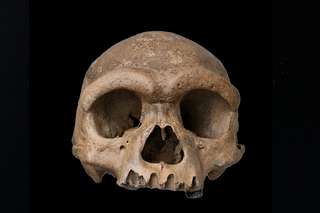
crâne

Type de vue

188 image(s) · 18 Actualités

Galerie d'images

Several members of Pterodactyloidea (top to bottom):  Pteranodon, Pterodaustro, the skulls of several pterosaurs (Guidraco, Anhanguera, Tupandactylus, and an unnamed dsungaripterid), Quetzalcoatlus, Aerodactylus, and Coloborhynchus
Taxons Ornithocheiroidea

Several members of Pterodactyloidea (top to bottom): Pteranodon, Pterodaustro, the skulls of several pterosaurs (Guidraco, Anhanguera, Tupandactylus, and an unnamed dsungaripterid), Quetzalcoatlus, Aerodactylus, and Coloborhynchus

Aerodactylus Anhanguera Coloborhynchus Dsungaripteridae +13
Several members of Pterodactyloidea (top to bottom):  Pteranodon, Pterodaustro, the skulls of several pterosaurs (Guidraco, Anhanguera, Tupandactylus, and an unnamed dsungaripterid), Quetzalcoatlus, Aerodactylus, and Coloborhynchus
Taxons Lophocratia

Several members of Pterodactyloidea (top to bottom): Pteranodon, Pterodaustro, the skulls of several pterosaurs (Guidraco, Anhanguera, Tupandactylus, and an unnamed dsungaripterid), Quetzalcoatlus, Aerodactylus, and Coloborhynchus

Aerodactylus Anhanguera Coloborhynchus Dsungaripteridae +13
Several members of Pterodactyloidea (top to bottom):  Pteranodon, Pterodaustro, the skulls of several pterosaurs (Guidraco, Anhanguera, Tupandactylus, and an unnamed dsungaripterid), Quetzalcoatlus, Aerodactylus, and Coloborhynchus
Taxons Tapejaroidea

Several members of Pterodactyloidea (top to bottom): Pteranodon, Pterodaustro, the skulls of several pterosaurs (Guidraco, Anhanguera, Tupandactylus, and an unnamed dsungaripterid), Quetzalcoatlus, Aerodactylus, and Coloborhynchus

Aerodactylus Anhanguera Coloborhynchus Dsungaripteridae +13
Several members of Pterodactyloidea (top to bottom):  Pteranodon, Pterodaustro, the skulls of several pterosaurs (Guidraco, Anhanguera, Tupandactylus, and an unnamed dsungaripterid), Quetzalcoatlus, Aerodactylus, and Coloborhynchus
Taxons Dsungaripteroidea

Several members of Pterodactyloidea (top to bottom): Pteranodon, Pterodaustro, the skulls of several pterosaurs (Guidraco, Anhanguera, Tupandactylus, and an unnamed dsungaripterid), Quetzalcoatlus, Aerodactylus, and Coloborhynchus

Aerodactylus Anhanguera Coloborhynchus Dsungaripteridae +13
Several members of Pterodactyloidea (top to bottom):  Pteranodon, Pterodaustro, the skulls of several pterosaurs (Guidraco, Anhanguera, Tupandactylus, and an unnamed dsungaripterid), Quetzalcoatlus, Aerodactylus, and Coloborhynchus
Taxons Eupterodactyloidea

Several members of Pterodactyloidea (top to bottom): Pteranodon, Pterodaustro, the skulls of several pterosaurs (Guidraco, Anhanguera, Tupandactylus, and an unnamed dsungaripterid), Quetzalcoatlus, Aerodactylus, and Coloborhynchus

Aerodactylus Anhanguera Coloborhynchus Dsungaripteridae +13
Main skull block of Bentiabasaurus jacobsi holotype (MGUAN P183D) on temporary display at the Smithsonian National Museum of Natural History
Taxons Bentiabasaurus

Main skull block of Bentiabasaurus jacobsi holotype (MGUAN P183D) on temporary display at the Smithsonian National Museum of Natural History

musée holotype Bentiabasaurus crâne
Composite of the holotype (GM F10004) skull of Qianzhousaurus sinensis, lower jaw mirrowed. With authorization and permission by Dr. Stephen L. Brusatte.
Taxons Qianzhousaurus

Composite of the holotype (GM F10004) skull of Qianzhousaurus sinensis, lower jaw mirrowed. With authorization and permission by Dr. Stephen L. Brusatte.

holotype Qianzhousaurus crâne
Skull of Minotaurasaurus
Taxons Minotaurasaurus

Skull of Minotaurasaurus

Minotaurasaurus crâne
Holotype skull of Thalattoarchon saurophagis at the Field Museum of Natural History.
Taxons Thalattoarchon

Holotype skull of Thalattoarchon saurophagis at the Field Museum of Natural History.

musée holotype Thalattoarchon crâne
Figure description from paper: "Fig. 3 Wimanius odontopalatus Maisch & Matzke, 1998, holotype, GPIT-PV-76272. Photos courtesy of G. Bindellini (Milano). a The complete holotype. b Detail showing a part of the dentition. c Disarticulated bones from the posterior part of the skull
Taxons Wimanius

Figure description from paper: "Fig. 3 Wimanius odontopalatus Maisch & Matzke, 1998, holotype, GPIT-PV-76272. Photos courtesy of G. Bindellini (Milano). a The complete holotype. b Detail showing a part of the dentition. c Disarticulated bones from the posterior part of the skull

os description holotype Wimaniidae +2
Figure description from paper: "Fig. 3 Wimanius odontopalatus Maisch & Matzke, 1998, holotype, GPIT-PV-76272. Photos courtesy of G. Bindellini (Milano). a The complete holotype. b Detail showing a part of the dentition. c Disarticulated bones from the posterior part of the skull
Taxons Wimaniidae

Figure description from paper: "Fig. 3 Wimanius odontopalatus Maisch & Matzke, 1998, holotype, GPIT-PV-76272. Photos courtesy of G. Bindellini (Milano). a The complete holotype. b Detail showing a part of the dentition. c Disarticulated bones from the posterior part of the skull

os description holotype Wimaniidae +2
Holotype specimen (PIMUZ A/III 1274) of Prosantosaurus scheffoldi gen. et spec. nov. from the upper Prosanto Formation (Early Ladinian, Middle Triassic) of Ducanfurgga locality no. 4, southwest of Davos, Canton of Grisons, south-eastern Switzerland. A Nearly complete specimen as prepared in dorsal view. The posterior part of the tail was lost prior to burial. Both forearms are not visible but lie below the trunk region, pointing in an anteromedial direction (see Additional file 1: Fig. S3A). B Detail of skull and anterior neck region. C Outline sketch of skull sutures. D Detail of shoulder girdle (claviculae, scapulae) and anterior dorsal vertebrae and ribs. E Detail of right humerus. F Detail of posterior dorsal vertebrae and ribs, sacral vertebrae and ribs, and anterior caudal vertebrae and ribs. G Detail of left ilium and hindlimb. ar articular; as astragalus; bo basioccipital; cal calcaneus; cl clavicula; co coracoid; d dentary; en external naris; eo exoccipital; fe femur; fi fibula; fr frontal; hu humerus; il ilium; in internal naris; is ischium; j jugal; mx maxilla; na naris; o orbit; pa parietal; pl palatine; pmx premaxilla; pof postfrontal; po postorbital; prf prefrontal; pt pterygoid; pu pubis; q quadrate; qj quadratojugal; ti tibia; sacr sacral rib; sc scapula; so supraoccipital; sp splenial; sq squamosal; su surangular; utf upper temporal fenestra; v vomer
Taxons Prosantosaurus

Holotype specimen (PIMUZ A/III 1274) of Prosantosaurus scheffoldi gen. et spec. nov. from the upper Prosanto Formation (Early Ladinian, Middle Triassic) of Ducanfurgga locality no. 4, southwest of Davos, Canton of Grisons, south-eastern Switzerland. A Nearly complete specimen as prepared in dorsal view. The posterior part of the tail was lost prior to burial. Both forearms are not visible but lie below the trunk region, pointing in an anteromedial direction (see Additional file 1: Fig. S3A). B Detail of skull and anterior neck region. C Outline sketch of skull sutures. D Detail of shoulder girdle (claviculae, scapulae) and anterior dorsal vertebrae and ribs. E Detail of right humerus. F Detail of posterior dorsal vertebrae and ribs, sacral vertebrae and ribs, and anterior caudal vertebrae and ribs. G Detail of left ilium and hindlimb. ar articular; as astragalus; bo basioccipital; cal calcaneus; cl clavicula; co coracoid; d dentary; en external naris; eo exoccipital; fe femur; fi fibula; fr frontal; hu humerus; il ilium; in internal naris; is ischium; j jugal; mx maxilla; na naris; o orbit; pa parietal; pl palatine; pmx premaxilla; pof postfrontal; po postorbital; prf prefrontal; pt pterygoid; pu pubis; q quadrate; qj quadratojugal; ti tibia; sacr sacral rib; sc scapula; so supraoccipital; sp splenial; sq squamosal; su surangular; utf upper temporal fenestra; v vomer

humérus Suisse Ladinien Trias moyen +6
Partial skull and anterior cervical vertebrae of unidentified pliosaurid plesiosaurian (MPPL 18797) from the uppermost Callovian–middle Oxfordian of Kaberlaba (Asiago, Italy), in left lateral view. Photograph (A) and explanatory drawing (B). White, preserved bone surfaces; dark grey, preserved margins of skull fenestrae; light grey, eroded bone surface; cross hatching, broken bone.
Taxons Anguanax

Partial skull and anterior cervical vertebrae of unidentified pliosaurid plesiosaurian (MPPL 18797) from the uppermost Callovian–middle Oxfordian of Kaberlaba (Asiago, Italy), in left lateral view. Photograph (A) and explanatory drawing (B). White, preserved bone surfaces; dark grey, preserved margins of skull fenestrae; light grey, eroded bone surface; cross hatching, broken bone.

os dessin Italie Callovien +6
Holotype of the polycotylid[1] plesiosaur Edgarosaurus muddi DRUCKENMILLER, 2002, (MOR 751) comprising the skull, the neck, and the left front flipper, on display in the Museum of the Rockies in Bozeman, Montana. The specimen was collected in Edgar, Carbon County, Montana, from the Shell Creek member of the Thermopolis Shale Formation, Upper Albian, uppermost Lower Cretaceous.[2]
Taxons Edgarosaurus

Holotype of the polycotylid[1] plesiosaur Edgarosaurus muddi DRUCKENMILLER, 2002, (MOR 751) comprising the skull, the neck, and the left front flipper, on display in the Museum of the Rockies in Bozeman, Montana. The specimen was collected in Edgar, Carbon County, Montana, from the Shell Creek member of the Thermopolis Shale Formation, Upper Albian, uppermost Lower Cretaceous.[2]

musée États-Unis Albien Crétacé +7
Holotype skull of Plesiopleurodon wellesi CM2815 In left and right lateral, dorsal, and oblique left lateral views.
Taxons Plesiopleurodon

Holotype skull of Plesiopleurodon wellesi CM2815 In left and right lateral, dorsal, and oblique left lateral views.

holotype Plesiopleurodon crâne
Skull of the plesiosauroid Lusonectes sauvagei gen et sp. nov. (MG33) from the Toarcian of Portugal, in right lateral (A), left lateral (B), dorsal (C), and ventral (D) views. Photographs (A1–D1), explanatory drawings (A2–D2).
Taxons Lusonectes

Skull of the plesiosauroid Lusonectes sauvagei gen et sp. nov. (MG33) from the Toarcian of Portugal, in right lateral (A), left lateral (B), dorsal (C), and ventral (D) views. Photographs (A1–D1), explanatory drawings (A2–D2).

dessin Portugal Toarcien Lusonectes +1
1 2 3 4 5 6 7 8 9 10 11 12

Actualités

Le tricératops avait un nez géant qui aurait pu refroidir sa tête massive
fossile Triceratops tomographie crâne
La tête massive du tricératops faisait peut-être plus que simplement montrer ces fameuses cornes. À l’aide de tomodensitogrammes et de reconstructions 3D de crânes fossiles, les chercheurs ont découvert un système nasal étonnamment complexe caché à l’intérieur de son énorme museau. Au lieu d’être simplement un nez surdimensionné pour sentir, il abritait probablement des réseaux complexes de nerfs et de vaisseaux sanguins, et même des structures spéciales qui aidaient à réguler la chaleur et l’humidité.
22/02/2026 sciencedaily ⚙ Traduction automatique
Cet animal ancien fut l'un des premiers à manger des plantes sur terre
dent fossile crâne
Il y a des centaines de millions d’années, les premiers animaux à ramper sur terre étaient de purs mangeurs de viande, alors même que les plantes avaient déjà envahi le paysage. Aujourd’hui, les scientifiques ont découvert un fossile vieux de 307 millions d’années qui réécrit cette histoire : l’un des premiers vertébrés terrestres connus à avoir commencé à manger des plantes. L'animal, nommé Tyrannoroter heberti, était une créature trapue de la taille d'un ballon de football avec un crâne rempli de dents spécialisées conçues pour écraser et broyer la végétation.
11/02/2026 sciencedaily ⚙ Traduction automatique
Cet étrange petit dinosaure oblige à repenser l'évolution
os dent métabolisme Dinosauria Foskeia anatomie oiseau évolution mammifères étude crâne
Un petit dinosaure nouvellement identifié, Foskeia pelendonum, bouleverse les idées reçues de longue date sur l'évolution des dinosaures herbivores. Même si les adultes adultes étaient remarquablement petits et légers, leur anatomie était tout sauf simple : elles présentaient un crâne bizarre et hautement spécialisé et des traits évolutifs inattendus. Des études osseuses détaillées montrent que ces dinosaures ont mûri rapidement avec un métabolisme semblable à celui des oiseaux ou des mammifères, tandis que leurs dents et leur posture suggèrent une vie rapide et agile dans des forêts denses.
03/02/2026 sciencedaily ⚙ Traduction automatique
Pachycephalosaurus: Beast of the Week
Pachycephalosaurus : Bête de la semaine
membre film Jurassique Dinosauria Pachycephalosauria crâne
Cette semaine, nous allons découvrir un dinosaure bien connu avec un crâne emblématique.  Ce dinosaure est l’un de mes favoris de tous les temps.  Je n'oublierai jamais d'avoir vu sa superbe représentation dans Le Monde Perdu : Jurassic Park au cinéma alors que j'avais seulement huit ans.  La façon dont il a détruit ce camion... ça m'a changé.  Dites bonjour à Pachycephalosaurus wyomingensis ! Pachycephalosaurus reconstitution de la vie à l'aquarelle par Christopher DiPiazza. Pachycephalosaurus était le plus grand membre connu o
25/01/2026 prehistoricbeastoftheweek ⚙ Traduction automatique
Un fossile vieux de 250 millions d'années révèle les origines de l'audition des mammifères
os mâchoire fossile mammifères crâne
L’audition sensible pourrait avoir évolué chez les ancêtres des mammifères bien plus tôt que ne le croyaient les scientifiques. En modélisant la façon dont le son se déplaçait dans le crâne de Thrinaxodon, un prédécesseur mammifère vieux de 250 millions d'années, les chercheurs ont découvert qu'il utilisait probablement un tympan précoce pour entendre les sons aériens. Cela remet en question l’idée répandue selon laquelle ces animaux « écoutaient » principalement à travers leurs mâchoires ou leurs os. Les résultats révèlent qu’une caractéristique clé de l’audition des mammifères modernes prenait déjà forme au plus profond de la préhistoire.
20/01/2026 sciencedaily ⚙ Traduction automatique
1 2 3 4