crâne

Type de vue

386 image(s) · 29 Actualités

Galerie d'images

Reconstructed skull of Jaxartosaurus aralensis Riabinin, 1937. Only a posterior portion of the skull, as well as a surangular is known, with the rest of the skull being based mostly upon File:Aralosaurus skull.png. Jaxartosaurus is currently classified as a basal lambeosaurine, more derived than Aralosaurini, but more primitive than Parasaurolophini and Lambeosaurini. It might be more derived than Tsintaosaurini (Godefroit et al., 2004). References: 
Riabinin, A.M. (1937). "A New Finding of Dinosaurs in the Trans-Baikal Region". Ezhegodn. Vserossijskogo Palaeont. Obstcg. 11: 142–144
Godefroit, P.; Bolotsky, Y.L.; Van Itterbeeck, J. (2004). "The lambeosaurine dinosaur Amurosaurus riabinini, from the
Maastrichtian of Far Eastern Russia". Acta Palaeontologica Polonica 49(4): 585–618
Taxons Jaxartosaurus

Reconstructed skull of Jaxartosaurus aralensis Riabinin, 1937. Only a posterior portion of the skull, as well as a surangular is known, with the rest of the skull being based mostly upon File:Aralosaurus skull.png. Jaxartosaurus is currently classified as a basal lambeosaurine, more derived than Aralosaurini, but more primitive than Parasaurolophini and Lambeosaurini. It might be more derived than Tsintaosaurini (Godefroit et al., 2004). References: Riabinin, A.M. (1937). "A New Finding of Dinosaurs in the Trans-Baikal Region". Ezhegodn. Vserossijskogo Palaeont. Obstcg. 11: 142–144 Godefroit, P.; Bolotsky, Y.L.; Van Itterbeeck, J. (2004). "The lambeosaurine dinosaur Amurosaurus riabinini, from the Maastrichtian of Far Eastern Russia". Acta Palaeontologica Polonica 49(4): 585–618

Russie Maastrichtien Amurosaurus Aralosaurini +7
Megacephalosaurus eulerti reconstructed skull in the Rocky Mountain Dinosaur Resource Center, Woodland Park, Colorado.
Taxons Megacephalosaurus

Megacephalosaurus eulerti reconstructed skull in the Rocky Mountain Dinosaur Resource Center, Woodland Park, Colorado.

Dinosauria Megacephalosaurus crâne
Skeletal elements of Lophorhothon atopus. (A, B and C) Partial skull roof and braincase (holotype FMNH 27383) in dorsal, ventral, and left lateral views. (D) Partial left nasal of FMNH 27383 in lateral view. (E) Left prefrontal of FMNH 27383 in lateral view. (F) Partial left jugal of FMNH 27383 in medial view. (G) Detail of marginal denticles of the dentary tooth in (H). (H) Apical half of a dentary tooth crown AUMP 2295 in lingual view. (I) Maxillary tooth crown of FMNH 27383 in labial view. (J) Left pubis of AUMP 2295 in lateral view. (K) Iliac process of the left ilium of FMNH 27383 in lateral view.
Taxons Lophorhothon

Skeletal elements of Lophorhothon atopus. (A, B and C) Partial skull roof and braincase (holotype FMNH 27383) in dorsal, ventral, and left lateral views. (D) Partial left nasal of FMNH 27383 in lateral view. (E) Left prefrontal of FMNH 27383 in lateral view. (F) Partial left jugal of FMNH 27383 in medial view. (G) Detail of marginal denticles of the dentary tooth in (H). (H) Apical half of a dentary tooth crown AUMP 2295 in lingual view. (I) Maxillary tooth crown of FMNH 27383 in labial view. (J) Left pubis of AUMP 2295 in lateral view. (K) Iliac process of the left ilium of FMNH 27383 in lateral view.

dent holotype Lophorhothon partiel +1
The skull of the holotype of Acristavus, MOR 1155
Taxons Acristavus

The skull of the holotype of Acristavus, MOR 1155

holotype Acristavus Montanoceratops crâne
Holotype skull of Augustynolophus morrisi (LACM 2852) on display at the Natural History Museum of Los Angeles County.
Taxons Augustynolophus

Holotype skull of Augustynolophus morrisi (LACM 2852) on display at the Natural History Museum of Los Angeles County.

musée holotype Augustynolophus crâne
Partial skull of Shastasaurus pacificus (UCMP 9017) from the Late Triassic of California, USA, in (A) lateral, (B) dorsal, and (C) anterolateral view.

Based on this skull, Shastasaurus has repeatedly been reconstructed with a long, tooth-bearing rostrum. However, note the slenderness of the lower jaw (B, C) and the strong anterior taper of the snout (B), both of which are more consistent with the abbreviated and toothless snout of Shastasaurus liangae comb. nov. than with the traditional long-snouted reconstruction of this skull (as, e.g., in references [22] and [23]).
Taxons Merriamosauria

Partial skull of Shastasaurus pacificus (UCMP 9017) from the Late Triassic of California, USA, in (A) lateral, (B) dorsal, and (C) anterolateral view. Based on this skull, Shastasaurus has repeatedly been reconstructed with a long, tooth-bearing rostrum. However, note the slenderness of the lower jaw (B, C) and the strong anterior taper of the snout (B), both of which are more consistent with the abbreviated and toothless snout of Shastasaurus liangae comb. nov. than with the traditional long-snouted reconstruction of this skull (as, e.g., in references [22] and [23]).

dent États-Unis Trias supérieur Trias +4
Partial skull of Shastasaurus pacificus (UCMP 9017) from the Late Triassic of California, USA, in (A) lateral, (B) dorsal, and (C) anterolateral view.

Based on this skull, Shastasaurus has repeatedly been reconstructed with a long, tooth-bearing rostrum. However, note the slenderness of the lower jaw (B, C) and the strong anterior taper of the snout (B), both of which are more consistent with the abbreviated and toothless snout of Shastasaurus liangae comb. nov. than with the traditional long-snouted reconstruction of this skull (as, e.g., in references [22] and [23]).
Taxons Shastasaurus

Partial skull of Shastasaurus pacificus (UCMP 9017) from the Late Triassic of California, USA, in (A) lateral, (B) dorsal, and (C) anterolateral view. Based on this skull, Shastasaurus has repeatedly been reconstructed with a long, tooth-bearing rostrum. However, note the slenderness of the lower jaw (B, C) and the strong anterior taper of the snout (B), both of which are more consistent with the abbreviated and toothless snout of Shastasaurus liangae comb. nov. than with the traditional long-snouted reconstruction of this skull (as, e.g., in references [22] and [23]).

dent États-Unis Trias supérieur Trias +4
Albertosaurus skull cast (specimen TMP 1981.010.0001) at the Geological Museum in Copenhagen.
Taxons Albertosaurinae

Albertosaurus skull cast (specimen TMP 1981.010.0001) at the Geological Museum in Copenhagen.

musée moulage spécimen Albertosaurinae +2
Restored skull and neck vertebra of Anzu wyliei (previously labelled as a specimen of Chirostenotes)
Taxons Caenagnathidae

Restored skull and neck vertebra of Anzu wyliei (previously labelled as a specimen of Chirostenotes)

vertèbre spécimen Anzu Caenagnathidae +2
Skull of the Middle Triassic North-American ichthyosaur Cymbospondylus petrinus, preserved in three dimensions. This specimen is cataloged under the number UCMP 9913. More information is available from the source link.
Taxons Hueneosauria

Skull of the Middle Triassic North-American ichthyosaur Cymbospondylus petrinus, preserved in three dimensions. This specimen is cataloged under the number UCMP 9913. More information is available from the source link.

musée Trias moyen Trias spécimen +4
Skull of Globidens dakotensis in the Field Museum of Natural History.
Taxons Globidensini

Skull of Globidens dakotensis in the Field Museum of Natural History.

musée Globidens Globidensini crâne
Montage of four pachycephalosaurs. Clockwise from top left: Stegoceras, Prenocephale, Pachycephalosaurus and Homalocephale. These files are already on Commons with their respective licenses. This montage was made for the article Pachycephalosauria on Wikipedia.
File:Stegoceras mount.jpg
File:Dinosauria - Prenocephale.jpg
File:Fossil Pachycephalosaurus.jpg
File:Homalocephale skull.jpg
Taxons Pachycephalosauria

Montage of four pachycephalosaurs. Clockwise from top left: Stegoceras, Prenocephale, Pachycephalosaurus and Homalocephale. These files are already on Commons with their respective licenses. This montage was made for the article Pachycephalosauria on Wikipedia. File:Stegoceras mount.jpg File:Dinosauria - Prenocephale.jpg File:Fossil Pachycephalosaurus.jpg File:Homalocephale skull.jpg

fossile Dinosauria Homalocephale Pachycephalosauria +3
Skull of Pteranodon sp. (specimen AMNH 7515) in the American Museum of Natural History.
Taxons Pteranodontia

Skull of Pteranodon sp. (specimen AMNH 7515) in the American Museum of Natural History.

musée spécimen Pteranodon Pteranodontia +1
Several members of Pterodactyloidea (top to bottom):  Pteranodon, Pterodaustro, the skulls of several pterosaurs (Guidraco, Anhanguera, Tupandactylus, and an unnamed dsungaripterid), Quetzalcoatlus, Aerodactylus, and Coloborhynchus
Taxons Pterodactyloidea

Several members of Pterodactyloidea (top to bottom): Pteranodon, Pterodaustro, the skulls of several pterosaurs (Guidraco, Anhanguera, Tupandactylus, and an unnamed dsungaripterid), Quetzalcoatlus, Aerodactylus, and Coloborhynchus

Aerodactylus Anhanguera Coloborhynchus Dsungaripteridae +8
Duck-billed dinosaurs at the Royal Ontario Museum. A Maiasaura skeleton is visible on the foreground, with two Maiasaura juveniles at the foot of the skeletal mount. On the background, flushing with the wall, there's the two-dimensional mount of a Gryposaurus specimen. The unidentified skull of another duck-billed dinosaur is visible on the low right corner of the photograph.
Taxons Hadrosauridae

Duck-billed dinosaurs at the Royal Ontario Museum. A Maiasaura skeleton is visible on the foreground, with two Maiasaura juveniles at the foot of the skeletal mount. On the background, flushing with the wall, there's the two-dimensional mount of a Gryposaurus specimen. The unidentified skull of another duck-billed dinosaur is visible on the low right corner of the photograph.

musée juvénile spécimen Dinosauria +5
Duck-billed dinosaurs at the Royal Ontario Museum. A Maiasaura skeleton is visible on the foreground, with two Maiasaura juveniles at the foot of the skeletal mount. On the background, flushing with the wall, there's the two-dimensional mount of a Gryposaurus specimen. The unidentified skull of another duck-billed dinosaur is visible on the low right corner of the photograph.
Taxons Hadrosauridae

Duck-billed dinosaurs at the Royal Ontario Museum. A Maiasaura skeleton is visible on the foreground, with two Maiasaura juveniles at the foot of the skeletal mount. On the background, flushing with the wall, there's the two-dimensional mount of a Gryposaurus specimen. The unidentified skull of another duck-billed dinosaur is visible on the low right corner of the photograph.

musée juvénile spécimen Dinosauria +5
1 2 3 4 5 6 7 8 9 10 11 12 13 14 15 16 17 18 19 20 21 22 23 24 25

Actualités

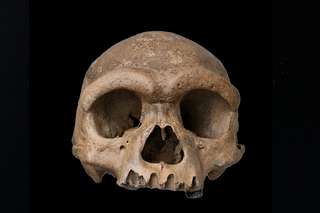
Les scientifiques pensaient les Denisoviens introuvables : cette découverte spectaculaire change désormais tout
os ADN Chine découverte Homo sapiens origine humaine crâne
Pendant quinze ans, les Denisoviens n'ont eu ni visage ni contour. Juste de l'ADN extrait d'un fragment d'os sibérien grand comme un ongle. En 2025, un crâne exceptionnel découvert en Chine a tout changé. Homo longi, surnommé l'Homme dragon, donne enfin un visage à ce groupe humain fantôme. 
06/06/2026 futura-terre
Ce poisson préhistorique pourrait expliquer comment les animaux ont marché pour la première fois sur Terre
Antarctique crâne
Les scientifiques ont examiné l'intérieur du crâne d'un poisson de l'Antarctique vieux de 380 millions d'années, étroitement apparenté aux premiers animaux à avoir marché sur terre, révélant des indices surprenants sur la façon dont la vie a commencé à sortir de l'eau. Grâce à l’imagerie neutronique avancée, les chercheurs ont découvert que Koharalepis jarviki possédait des caractéristiques adaptées pour vivre près de la surface de l’eau, notamment des ouvertures dans son crâne qui auraient pu l’aider à avaler de l’air et un organe sensible à la lumière lié aux rythmes jour-nuit.
25/05/2026 sciencedaily-paleo ⚙ Traduction automatique
Les petits bras du T. rex pourraient avoir évolué pour une raison étonnamment brutale
mâchoire membre chasse prédateur proie Dinosauria crâne
Pourquoi le T. rex avait-il des bras si petits ? Les scientifiques pensent désormais que c’est parce que sa tête géante est devenue l’outil de chasse ultime. Dans plusieurs groupes de dinosaures, des crânes plus forts et des mâchoires écrasantes ont évolué parallèlement à des membres antérieurs rétrécis, en particulier chez les prédateurs chassant d'énormes proies. En d’autres termes, une fois que la morsure est devenue suffisamment mortelle, les bras ont peut-être cessé d’avoir de l’importance.
20/05/2026 sciencedaily ⚙ Traduction automatique
Un superbe crâne de stégosaure vieux de 150 millions d'années réécrit l'évolution des dinosaures
fossile Dacentrurus Dinosauria Stegosauria découverte évolution crâne
Une découverte spectaculaire de dinosaures en Espagne donne aux scientifiques un nouveau regard rare sur le monde des stégosaures. Les paléontologues ont découvert le crâne de stégosaure le mieux conservé jamais découvert en Europe, appartenant à l'emblématique dinosaure plaqué Dacentrurus armatus, qui parcourait la Terre il y a environ 150 millions d'années. Parce que les crânes de stégosaures sont extrêmement fragiles et ne survivent presque jamais intacts, le fossile aide les chercheurs à découvrir des détails jusqu'alors inconnus sur l'évolution de ces géants blindés.
17/05/2026 sciencedaily ⚙ Traduction automatique
Un nouveau dinosaure carnivore du Trias identifié à Ghost Ranch
États-Unis Trias supérieur Trias fossile spécimen Coelophysis Dinosauria Ptychotherates nouvelle espèce crâne
Des chercheurs de Virginia Tech (Virginie, États-Unis) ont identifié une nouvelle espèce de dinosaure du Trias supérieur.  Le dinosaure a été nommé Ptychotherates bucculentus.  Ce nouveau taxon de dinosaure carnivore a été érigé sur la base de l'examen détaillé d'un fossile de crâne incomplet, bien conservé mais mélangé (numéro de spécimen CM 31368).  Le crâne provient de la Coelophysis de renommée mondiale
11/05/2026 everythingdinosaur ⚙ Traduction automatique
1 2 3 4 5 6