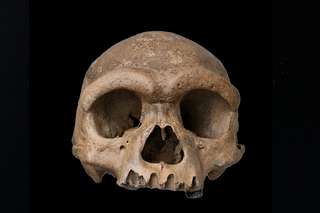
crâne

Type de vue

188 image(s) · 20 Actualités

Galerie d'images

Sarahsaurus aurifontanalis, referred skull (MCZ 8893), in (a) lateral, (b) occipital, (c) dorsal and (d) ventral views. an, angular; ar, articular; bo, basioccipital; bs, basisphenoid; ec, ectopterygoid; f, frontal; h, hyoid; j, jugal; l, lacrimal; ls, laterosphenoid; m, maxilla; n, nasal; op, opisthotic-exoccipital; p, parietal; po, postorbital; prf, prefrontal; pm, premaxilla; pt, pterygoid; q, quadrate; qj, quadratojugal; so, supraoccipital; sq, squamosal. Scale bar, 5 cm.
Taxons Sarahsaurus

Sarahsaurus aurifontanalis, referred skull (MCZ 8893), in (a) lateral, (b) occipital, (c) dorsal and (d) ventral views. an, angular; ar, articular; bo, basioccipital; bs, basisphenoid; ec, ectopterygoid; f, frontal; h, hyoid; j, jugal; l, lacrimal; ls, laterosphenoid; m, maxilla; n, nasal; op, opisthotic-exoccipital; p, parietal; po, postorbital; prf, prefrontal; pm, premaxilla; pt, pterygoid; q, quadrate; qj, quadratojugal; so, supraoccipital; sq, squamosal. Scale bar, 5 cm.

écaille Sarahsaurus crâne
Skull of the mosasaurid squamate Thalassotitan atrox from the late Maastrichtian of Sidi Daoui, Ouled Abdoun Basin, Khouribga Province, Morocco, North Africa.
Taxons Thalassotitan

Skull of the mosasaurid squamate Thalassotitan atrox from the late Maastrichtian of Sidi Daoui, Ouled Abdoun Basin, Khouribga Province, Morocco, North Africa.

Maroc Maastrichtien Mosasauridae Thalassotitan +1
Holotype of Ulughbegsaurus as well as the holotype placed on a reconstruction of Ulughbegsaurus's skull
Taxons Ulughbegsaurus

Holotype of Ulughbegsaurus as well as the holotype placed on a reconstruction of Ulughbegsaurus's skull

holotype Ulughbegsaurus crâne
Reconstructed skull of Einiosaurus procurvicornis on display at the Natural History Museum of Los Angeles County.
Taxons Einiosaurus

Reconstructed skull of Einiosaurus procurvicornis on display at the Natural History Museum of Los Angeles County.

musée Einiosaurus crâne
Montanoceratops cerorhynchus (Brown & Schlaikjer, 1942) - fossil ceratopsian dinosaur skeleton from the Cretaceous of Montana, USA. (MOR 542, Museum of the Rockies, Bozeman, Montana, USA)
The species name is sometimes incorrectly spelled "cerorhynchos".  The original publication spells it "cerorhynchus".  The genus name is sometimes incorrectly spelled "Montanaceratops".
Ceratopsians are the "horned dinosaurs".  They were large, quadrupedal, herbivorous dinosaurs having a beaked skull and a frill - an extension of bone behind the skull that partially covered the neck.  Ceratopsian dinosaurs are known from the Jurassic and Cretaceous.  The last members of the group died out at the Cretaceous-Tertiary boundary, 65 million years ago.
This is a partial skeleton of a juvenile Montanoceratops, a ceratopsian from the near-latest Cretaceous of western North America.  This type of ceratopsian lacked facial horns.


From exhibit signage:
Sixty-eight million years ago, when the horned dinosaurs Triceratops and Torosaurus inhabited the coastal plain near the inland ocean, primitive "horned" dinosaurs named Montanoceratops lived in uplands near the young Rocky Mountains.  These little protoceratopsians fed on plants with slicing teeth and narrow beaks similar to their giant three-horned relatives.


Classification: Animalia, Chordata, Vertebrata, Reptilia, Archosauria, Dinosauria, Ornithischia, Marginocephalia, Ceratopsia, Leptoceratopsidae
Stratigraphy: St. Mary River Formation, Maastrichtian Stage, Upper Cretaceous
Locality: Little Rocky Coulee, north of the town of Cut Bank, eastern Glacier County, northwestern Montana, USA


Info. at:

en.wikipedia.org/wiki/Montanoceratops
Taxons Montanoceratops

Montanoceratops cerorhynchus (Brown & Schlaikjer, 1942) - fossil ceratopsian dinosaur skeleton from the Cretaceous of Montana, USA. (MOR 542, Museum of the Rockies, Bozeman, Montana, USA) The species name is sometimes incorrectly spelled "cerorhynchos". The original publication spells it "cerorhynchus". The genus name is sometimes incorrectly spelled "Montanaceratops". Ceratopsians are the "horned dinosaurs". They were large, quadrupedal, herbivorous dinosaurs having a beaked skull and a frill - an extension of bone behind the skull that partially covered the neck. Ceratopsian dinosaurs are known from the Jurassic and Cretaceous. The last members of the group died out at the Cretaceous-Tertiary boundary, 65 million years ago. This is a partial skeleton of a juvenile Montanoceratops, a ceratopsian from the near-latest Cretaceous of western North America. This type of ceratopsian lacked facial horns. From exhibit signage: Sixty-eight million years ago, when the horned dinosaurs Triceratops and Torosaurus inhabited the coastal plain near the inland ocean, primitive "horned" dinosaurs named Montanoceratops lived in uplands near the young Rocky Mountains. These little protoceratopsians fed on plants with slicing teeth and narrow beaks similar to their giant three-horned relatives. Classification: Animalia, Chordata, Vertebrata, Reptilia, Archosauria, Dinosauria, Ornithischia, Marginocephalia, Ceratopsia, Leptoceratopsidae Stratigraphy: St. Mary River Formation, Maastrichtian Stage, Upper Cretaceous Locality: Little Rocky Coulee, north of the town of Cut Bank, eastern Glacier County, northwestern Montana, USA Info. at: en.wikipedia.org/wiki/Montanoceratops

os musée États-Unis Crétacé +10
Skull of a Parksosaurus
Taxons Parksosaurus

Skull of a Parksosaurus

Parksosaurus crâne
Kronosaurus queenslandicus (QM F18827; proposed neotype [part]) skull in dorsal view (modified from McHenry Citation2009). Scale = 30 cm.
Taxons Kronosaurus

Kronosaurus queenslandicus (QM F18827; proposed neotype [part]) skull in dorsal view (modified from McHenry Citation2009). Scale = 30 cm.

écaille Kronosaurus crâne
Paratype skull of Hamipterus tianshanensis on display at the Paleozoological Museum of China.
Taxons Hamipterus

Paratype skull of Hamipterus tianshanensis on display at the Paleozoological Museum of China.

musée Chine Hamipteridae Hamipterus +1
Paratype skull of Hamipterus tianshanensis on display at the Paleozoological Museum of China.
Taxons Hamipteridae

Paratype skull of Hamipterus tianshanensis on display at the Paleozoological Museum of China.

musée Chine Hamipteridae Hamipterus +1
Skull reconstruction of Incisivosaurus gauthieri.
Taxons Incisivosaurus

Skull reconstruction of Incisivosaurus gauthieri.

Incisivosaurus crâne
Sarcosaurus diagram of known material: reconstruction based on basal Ceratosaurs (such as Berberosaurus and Saltriovenator). The Skull was made to look more generic and less like more derived Ceratosaurs such as Ceratosaurus. "Liassaurus", referred to "cf. Sarcosaurus woodi" and is smaller than the holotype: material in light grey is preserved, but to what extent is uncertain as it is not figured.
References:
Carrano and Sampson (2004). "A review of coelophysoids (Dinosauria: Theropoda) from the Early Jurassic of Europe, with comments on the late history of the Coelophysoidea." N. Jb. Geol. Palaont. Mh., 2004(9): 537-558. (for figures of the material)
theropoddatabase.com/Coelophysoidea.htm#Sarcosauruswoodi (for measurements of "Liassaurus")

Allain, Ronan & Tykoski, Ronald & Aquesbi, Najat & Jalil, Nour-Eddine & Monbaron, Michel & Russell, Dale & Taquet, Philippe. (2007). An abelisauroid (Dinosauria: Theropoda) from the Early Jurassic of the High Atlas Mountains, Morocco, and the radiation of Ceratosaurs. Journal of Vertebrate Paleontology. 27. 10.1671/0272-4634(2007)27[610:AADTFT]2.0.CO;2. (for measurements for Berberosaurus)
Taxons Sarcosaurus

Sarcosaurus diagram of known material: reconstruction based on basal Ceratosaurs (such as Berberosaurus and Saltriovenator). The Skull was made to look more generic and less like more derived Ceratosaurs such as Ceratosaurus. "Liassaurus", referred to "cf. Sarcosaurus woodi" and is smaller than the holotype: material in light grey is preserved, but to what extent is uncertain as it is not figured. References: Carrano and Sampson (2004). "A review of coelophysoids (Dinosauria: Theropoda) from the Early Jurassic of Europe, with comments on the late history of the Coelophysoidea." N. Jb. Geol. Palaont. Mh., 2004(9): 537-558. (for figures of the material) theropoddatabase.com/Coelophysoidea.htm#Sarcosauruswoodi (for measurements of "Liassaurus") Allain, Ronan & Tykoski, Ronald & Aquesbi, Najat & Jalil, Nour-Eddine & Monbaron, Michel & Russell, Dale & Taquet, Philippe. (2007). An abelisauroid (Dinosauria: Theropoda) from the Early Jurassic of the High Atlas Mountains, Morocco, and the radiation of Ceratosaurs. Journal of Vertebrate Paleontology. 27. 10.1671/0272-4634(2007)27[610:AADTFT]2.0.CO;2. (for measurements for Berberosaurus)

Maroc Jurassique inférieur Jurassique holotype +8
Leaellynasaura amicagraphica, dinosaur, skull. Holotype. [P 185991]
Taxons Leaellynasaura

Leaellynasaura amicagraphica, dinosaur, skull. Holotype. [P 185991]

musée holotype Dinosauria Leaellynasaura +1
Rhomboid distal nasal process of the crest of Tsintaosaurus spinorhinus.

A. Partial distal nasal process of IVPP V725 in right lateral view. B. Lateral view of composite skull (reversed). C. partial premaxillonasal complex of IVPP V829 in right lateral view. D. Line drawing of (C) showing nasal-premaxilla articulation, and the displacement (arrow) experienced by the distal nasal process relative to its articular position. E. Mounted holotype skull (IVPP V725) of T. spinorhinus in left lateral view (reversed). F. Partial right distal nasal process (although catalogued as IVPP V725, this element corresponds to a different specimen than the type; reversed).
Taxons Tsintaosaurus

Rhomboid distal nasal process of the crest of Tsintaosaurus spinorhinus. A. Partial distal nasal process of IVPP V725 in right lateral view. B. Lateral view of composite skull (reversed). C. partial premaxillonasal complex of IVPP V829 in right lateral view. D. Line drawing of (C) showing nasal-premaxilla articulation, and the displacement (arrow) experienced by the distal nasal process relative to its articular position. E. Mounted holotype skull (IVPP V725) of T. spinorhinus in left lateral view (reversed). F. Partial right distal nasal process (although catalogued as IVPP V725, this element corresponds to a different specimen than the type; reversed).

crête dessin holotype spécimen +3
Xenovenator espinosai, holotype braincase CPC 2973. In (A) left lateral; (B) right lateral; (C) dorsal; (D) ventral; (E) anterior; (F) posterior. Abbreviations: bo, basicoccipital; bul, parabasisphenoid bulla; ex, exoccipital; fr, frontal; lad, lateral depression; lac, lacrimal articulation; lat, laterosphenoid; osp, orbitosphenoid; par, parietal; pbs, parabasisphenoid; po, postorbital; ri, median ridge; sk, skull; stf, supratemporal fossa.
Taxons Xenovenator

Xenovenator espinosai, holotype braincase CPC 2973. In (A) left lateral; (B) right lateral; (C) dorsal; (D) ventral; (E) anterior; (F) posterior. Abbreviations: bo, basicoccipital; bul, parabasisphenoid bulla; ex, exoccipital; fr, frontal; lad, lateral depression; lac, lacrimal articulation; lat, laterosphenoid; osp, orbitosphenoid; par, parietal; pbs, parabasisphenoid; po, postorbital; ri, median ridge; sk, skull; stf, supratemporal fossa.

holotype Xenovenator crâne
Skull of Dromiceiomimus
Taxons Dromiceiomimus

Skull of Dromiceiomimus

Dromiceiomimus crâne
Skull of Saichania, Warsaw Museum of Evolution
Taxons Saichania

Skull of Saichania, Warsaw Museum of Evolution

musée Saichania évolution crâne
1 2 3 4 5 6 7 8 9 10 11 12

Actualités

Les scientifiques ont trouvé un bébé dinosaure caché dans la roche et il est étonnamment mignon
os dessin Corée du Sud Dinosauria Doolysaurus tomographie découverte crâne
Des scientifiques ont découvert un bébé dinosaure rare en Corée du Sud et l'ont baptisé Doolysaurus, en hommage à un célèbre personnage de dessin animé. Grâce à des tomodensitogrammes de pointe, ils ont découvert des os cachés, notamment un crâne, dans la roche beaucoup plus rapidement que les méthodes traditionnelles. Le jeune dinosaure, peut-être duveteux et ressemblant à un agneau, avait même des calculs gastriques révélant qu'il mangeait un mélange de plantes et de petits animaux. Cette découverte suggère que de nombreux autres dinosaures pourraient encore être cachés dans les roches coréennes.
01/04/2026 sciencedaily ⚙ Traduction automatique
Des fossiles de poissons vieux de 400 millions d'années révèlent comment la vie a commencé à s'installer sur terre
Australie Chine fossile formation crâne
Les scientifiques ont découvert de nouveaux indices sur certains des premiers poissons de la Terre, mettant ainsi en lumière les origines anciennes des vertébrés qui ont fini par s’installer sur terre. En réanalysant de mystérieux fossiles de la célèbre formation australienne Gogo et en étudiant un crâne de poisson-poumon récemment reconstruit, vieux de 410 millions d'années et provenant de Chine, les chercheurs révèlent comment ces créatures primitives ont évolué.
12/03/2026 sciencedaily ⚙ Traduction automatique
Le tricératops avait un nez géant qui aurait pu refroidir sa tête massive
fossile Triceratops tomographie crâne
La tête massive du tricératops faisait peut-être plus que simplement montrer ces fameuses cornes. À l’aide de tomodensitogrammes et de reconstructions 3D de crânes fossiles, les chercheurs ont découvert un système nasal étonnamment complexe caché à l’intérieur de son énorme museau. Au lieu d’être simplement un nez surdimensionné pour sentir, il abritait probablement des réseaux complexes de nerfs et de vaisseaux sanguins, et même des structures spéciales qui aidaient à réguler la chaleur et l’humidité.
22/02/2026 sciencedaily ⚙ Traduction automatique
Cet animal ancien fut l'un des premiers à manger des plantes sur terre
dent fossile crâne
Il y a des centaines de millions d’années, les premiers animaux à ramper sur terre étaient de purs mangeurs de viande, alors même que les plantes avaient déjà envahi le paysage. Aujourd’hui, les scientifiques ont découvert un fossile vieux de 307 millions d’années qui réécrit cette histoire : l’un des premiers vertébrés terrestres connus à avoir commencé à manger des plantes. L'animal, nommé Tyrannoroter heberti, était une créature trapue de la taille d'un ballon de football avec un crâne rempli de dents spécialisées conçues pour écraser et broyer la végétation.
11/02/2026 sciencedaily ⚙ Traduction automatique
Cet étrange petit dinosaure oblige à repenser l'évolution
os dent métabolisme Dinosauria Foskeia anatomie oiseau évolution mammifères étude crâne
Un petit dinosaure nouvellement identifié, Foskeia pelendonum, bouleverse les idées reçues de longue date sur l'évolution des dinosaures herbivores. Même si les adultes adultes étaient remarquablement petits et légers, leur anatomie était tout sauf simple : elles présentaient un crâne bizarre et hautement spécialisé et des traits évolutifs inattendus. Des études osseuses détaillées montrent que ces dinosaures ont mûri rapidement avec un métabolisme semblable à celui des oiseaux ou des mammifères, tandis que leurs dents et leur posture suggèrent une vie rapide et agile dans des forêts denses.
03/02/2026 sciencedaily ⚙ Traduction automatique
1 2 3 4