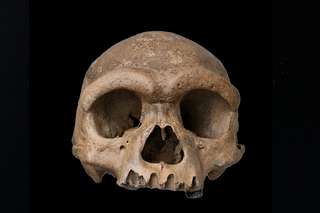
crâne

Type de vue

386 image(s) · 29 Actualités

Galerie d'images

Photos of caudodorsal part of the skull of Yunganglong datongensis (SXMG V 00001).
(A)-Right lateral view. (B)-Dorsal view. (C)-Caudal view.

Scale bar = 10 cm.
Taxons Yunganglong

Photos of caudodorsal part of the skull of Yunganglong datongensis (SXMG V 00001). (A)-Right lateral view. (B)-Dorsal view. (C)-Caudal view. Scale bar = 10 cm.

écaille Jian Yunganglong crâne
Illustration of the skull of Abrosaurus with known remains in grey
Taxons Abrosaurus

Illustration of the skull of Abrosaurus with known remains in grey

Abrosaurus crâne
Yizhousaurus sunae skull and jaw
Taxons Yizhousaurus

Yizhousaurus sunae skull and jaw

Yizhousaurus crâne
Holotype skull and mandible of the anhanguerid Ferrodraco (A), holotype skull and mandible of the anhanguerid Mythunga (B), and holotype mandible of the targaryendraconian Aussiedraco (C).
Taxons Mythunga

Holotype skull and mandible of the anhanguerid Ferrodraco (A), holotype skull and mandible of the anhanguerid Mythunga (B), and holotype mandible of the targaryendraconian Aussiedraco (C).

holotype Anhangueridae Aussiedraco Ferrodraco +3
Skull diagram showing the known material of Aardonyx. Based on photographs and measurements in original description and supplementary material. Scale bar = 10 cm
Taxons Aardonyx

Skull diagram showing the known material of Aardonyx. Based on photographs and measurements in original description and supplementary material. Scale bar = 10 cm

écaille description Aardonyx crâne
Cuspicephalus scarfi MJMG K1918. A, Original skull on slab of mudstone, Lacking the mandible and dentition; B, outline diagram of preserved bone. Light grey is bone, dark grey is fibrous bone of sagittal crest, black is dental alveoli where unambiguous; C restoration of skull outline, with hypothetical lower jaw. Scale bar = 50 mm. Abbreviation: j, jugal; naof, nasoantorbital fenestra; m, maxilla; o, orbit; pm, premaxilla; q, quadrate; sc,

sagittal crest; sq, squamosal; tr np, trace of nasal process.
Taxons Cuspicephalus

Cuspicephalus scarfi MJMG K1918. A, Original skull on slab of mudstone, Lacking the mandible and dentition; B, outline diagram of preserved bone. Light grey is bone, dark grey is fibrous bone of sagittal crest, black is dental alveoli where unambiguous; C restoration of skull outline, with hypothetical lower jaw. Scale bar = 50 mm. Abbreviation: j, jugal; naof, nasoantorbital fenestra; m, maxilla; o, orbit; pm, premaxilla; q, quadrate; sc, sagittal crest; sq, squamosal; tr np, trace of nasal process.

os crête écaille Cuspicephalus +1
Skull reconstruction of Shanag ashile based on holotype IGM 100/1119, missing elements based on Sinornithosaurus.
Taxons Shanag

Skull reconstruction of Shanag ashile based on holotype IGM 100/1119, missing elements based on Sinornithosaurus.

holotype Shanag Sinornithosaurus crâne
Holotype of Transylvanosaurus platycephalus, LPB (FGGUB) R.2070, a partial skull comprising the articulated basicranium and both frontals. Scale bar: 1 cm.
Taxons Transylvanosaurus

Holotype of Transylvanosaurus platycephalus, LPB (FGGUB) R.2070, a partial skull comprising the articulated basicranium and both frontals. Scale bar: 1 cm.

écaille holotype Transylvanosaurus partiel +1
Skull in dorsal (a and b, photograph and drawing respectively), and left lateral (c and d, photograph and drawing respectively) views. (e) Premaxillary tooth; (f,g) maxillary teeth (g inverted). amf, anterior maxillary fossa; aof, antorbital fossa; aso, anterior supraorbital; d, dentary; ef, elliptical fossa; f, foramina; fr, frontal; ift, infratemporal fenestra; j, jugal; mx, maxilla; n, nasals; o, orbit; pd, predentary; pdb, postdentary bones; pmx, premaxilla; po, postorbital; pso: posterior supraorbital; prf, prefrontal; qj, quadratojugal; sq, squamosal; stf, supratemporal fenestra. 1–7 denticles. The drawings were processed using Adobe Photoshop CS2 Serial Number: 1045-1412-5685-1654-6343-1431.
Taxons Isaberrysaura

Skull in dorsal (a and b, photograph and drawing respectively), and left lateral (c and d, photograph and drawing respectively) views. (e) Premaxillary tooth; (f,g) maxillary teeth (g inverted). amf, anterior maxillary fossa; aof, antorbital fossa; aso, anterior supraorbital; d, dentary; ef, elliptical fossa; f, foramina; fr, frontal; ift, infratemporal fenestra; j, jugal; mx, maxilla; n, nasals; o, orbit; pd, predentary; pdb, postdentary bones; pmx, premaxilla; po, postorbital; pso: posterior supraorbital; prf, prefrontal; qj, quadratojugal; sq, squamosal; stf, supratemporal fenestra. 1–7 denticles. The drawings were processed using Adobe Photoshop CS2 Serial Number: 1045-1412-5685-1654-6343-1431.

os dent dessin Isaberrysaura +1
Ziapelta sanjuanensis, gen. et sp. nov., (holotype NMMNH P-64484), complete skull.

A, dorsal view; B, ventral view; C, anterior view; D, occipital view; and E, left lateral view. Abbreviations: asca, anterior supraorbital caputegulum; bas, basioccipital; ch, choana; fm, foramen magnum; j, jugal; laca, lacrimal caputegulum; loca, loreal caputegulum; ltf, laterotemporal fenestra; mnca, median nasal caputegulum; nar, external naris; oc, occipital condyle; orb, orbit; pal, palatine; par, parietal; parocc, paroccipital process; pmx, premaxilla; psca, posterior supraorbital caputegulum; pt, pterygoid; q, quadrate; qj, quadratojugal; qjh, quadratojugal horn; snca, supranarial caputegulum; socc, supraoccipital; sqh, squamosal horn; tr, tooth row; v, vomer.
Taxons Ziapelta

Ziapelta sanjuanensis, gen. et sp. nov., (holotype NMMNH P-64484), complete skull. A, dorsal view; B, ventral view; C, anterior view; D, occipital view; and E, left lateral view. Abbreviations: asca, anterior supraorbital caputegulum; bas, basioccipital; ch, choana; fm, foramen magnum; j, jugal; laca, lacrimal caputegulum; loca, loreal caputegulum; ltf, laterotemporal fenestra; mnca, median nasal caputegulum; nar, external naris; oc, occipital condyle; orb, orbit; pal, palatine; par, parietal; parocc, paroccipital process; pmx, premaxilla; psca, posterior supraorbital caputegulum; pt, pterygoid; q, quadrate; qj, quadratojugal; qjh, quadratojugal horn; snca, supranarial caputegulum; socc, supraoccipital; sqh, squamosal horn; tr, tooth row; v, vomer.

dent holotype Ziapelta crâne
Skull of Augustasaurus hagdorni in the Field Museum of Natural History.
Taxons Augustasaurus

Skull of Augustasaurus hagdorni in the Field Museum of Natural History.

musée Augustasaurus crâne
Holotype of the polycotylid[1] plesiosaur Edgarosaurus muddi DRUCKENMILLER, 2002, (MOR 751) comprising the skull, the neck, and the left front flipper, on display in the Museum of the Rockies in Bozeman, Montana. The specimen was collected in Edgar, Carbon County, Montana, from the Shell Creek member of the Thermopolis Shale Formation, Upper Albian, uppermost Lower Cretaceous.[2]
Taxons Edgarosaurus

Holotype of the polycotylid[1] plesiosaur Edgarosaurus muddi DRUCKENMILLER, 2002, (MOR 751) comprising the skull, the neck, and the left front flipper, on display in the Museum of the Rockies in Bozeman, Montana. The specimen was collected in Edgar, Carbon County, Montana, from the Shell Creek member of the Thermopolis Shale Formation, Upper Albian, uppermost Lower Cretaceous.[2]

musée États-Unis Albien Crétacé +7
Holotype skull of Plesiopleurodon wellesi CM2815 In left and right lateral, dorsal, and oblique left lateral views.
Taxons Plesiopleurodon

Holotype skull of Plesiopleurodon wellesi CM2815 In left and right lateral, dorsal, and oblique left lateral views.

holotype Plesiopleurodon crâne
Reconstructed skull of the dromaeosaurid Adasaurus mongoliensis. The holotype IGM 100/20 preserves a partial right side of the skull and other postcrania including the hindlimbs, it has an estimated length of 2 m (6.6 ft) with a weight of 15 kg (33 lb).[1] Skull mainly based on Turner et al. 2012 and Mickey Mortimer.[2][3]
Color Key
  Known
  Unknown
Taxons Adasaurus

Reconstructed skull of the dromaeosaurid Adasaurus mongoliensis. The holotype IGM 100/20 preserves a partial right side of the skull and other postcrania including the hindlimbs, it has an estimated length of 2 m (6.6 ft) with a weight of 15 kg (33 lb).[1] Skull mainly based on Turner et al. 2012 and Mickey Mortimer.[2][3] Color Key   Known   Unknown

holotype Adasaurus Dromaeosauridae Turneria +2
Skull of MPC-D 100/32-a (Rinchenia mongoliensis).
Taxons Rinchenia

Skull of MPC-D 100/32-a (Rinchenia mongoliensis).

Rinchenia crâne
A color-coded skull diagram of Palatodonta bleekeri, mostly based on a diagram published by Neenan et al. (2013). Some interpretations (such as the presence of a quadratojugal) are based on Maisch (2020). Depicted in left lateral view, mirrored from the original specimen as preserved in right lateral view. Dotted lines indicate missing bone.
Taxons Palatodonta

A color-coded skull diagram of Palatodonta bleekeri, mostly based on a diagram published by Neenan et al. (2013). Some interpretations (such as the presence of a quadratojugal) are based on Maisch (2020). Depicted in left lateral view, mirrored from the original specimen as preserved in right lateral view. Dotted lines indicate missing bone.

os spécimen Palatodonta crâne
1 2 3 4 5 6 7 8 9 10 11 12 13 14 15 16 17 18 19 20 21 22 23 24 25

Actualités

Les scientifiques pensaient les Denisoviens introuvables : cette découverte spectaculaire change désormais tout
os ADN Chine découverte Homo sapiens origine humaine crâne
Pendant quinze ans, les Denisoviens n'ont eu ni visage ni contour. Juste de l'ADN extrait d'un fragment d'os sibérien grand comme un ongle. En 2025, un crâne exceptionnel découvert en Chine a tout changé. Homo longi, surnommé l'Homme dragon, donne enfin un visage à ce groupe humain fantôme. 
06/06/2026 futura-terre
Ce poisson préhistorique pourrait expliquer comment les animaux ont marché pour la première fois sur Terre
Antarctique crâne
Les scientifiques ont examiné l'intérieur du crâne d'un poisson de l'Antarctique vieux de 380 millions d'années, étroitement apparenté aux premiers animaux à avoir marché sur terre, révélant des indices surprenants sur la façon dont la vie a commencé à sortir de l'eau. Grâce à l’imagerie neutronique avancée, les chercheurs ont découvert que Koharalepis jarviki possédait des caractéristiques adaptées pour vivre près de la surface de l’eau, notamment des ouvertures dans son crâne qui auraient pu l’aider à avaler de l’air et un organe sensible à la lumière lié aux rythmes jour-nuit.
25/05/2026 sciencedaily-paleo ⚙ Traduction automatique
Les petits bras du T. rex pourraient avoir évolué pour une raison étonnamment brutale
mâchoire membre chasse prédateur proie Dinosauria crâne
Pourquoi le T. rex avait-il des bras si petits ? Les scientifiques pensent désormais que c’est parce que sa tête géante est devenue l’outil de chasse ultime. Dans plusieurs groupes de dinosaures, des crânes plus forts et des mâchoires écrasantes ont évolué parallèlement à des membres antérieurs rétrécis, en particulier chez les prédateurs chassant d'énormes proies. En d’autres termes, une fois que la morsure est devenue suffisamment mortelle, les bras ont peut-être cessé d’avoir de l’importance.
20/05/2026 sciencedaily ⚙ Traduction automatique
Un superbe crâne de stégosaure vieux de 150 millions d'années réécrit l'évolution des dinosaures
fossile Dacentrurus Dinosauria Stegosauria découverte évolution crâne
Une découverte spectaculaire de dinosaures en Espagne donne aux scientifiques un nouveau regard rare sur le monde des stégosaures. Les paléontologues ont découvert le crâne de stégosaure le mieux conservé jamais découvert en Europe, appartenant à l'emblématique dinosaure plaqué Dacentrurus armatus, qui parcourait la Terre il y a environ 150 millions d'années. Parce que les crânes de stégosaures sont extrêmement fragiles et ne survivent presque jamais intacts, le fossile aide les chercheurs à découvrir des détails jusqu'alors inconnus sur l'évolution de ces géants blindés.
17/05/2026 sciencedaily ⚙ Traduction automatique
Un nouveau dinosaure carnivore du Trias identifié à Ghost Ranch
États-Unis Trias supérieur Trias fossile spécimen Coelophysis Dinosauria Ptychotherates nouvelle espèce crâne
Des chercheurs de Virginia Tech (Virginie, États-Unis) ont identifié une nouvelle espèce de dinosaure du Trias supérieur.  Le dinosaure a été nommé Ptychotherates bucculentus.  Ce nouveau taxon de dinosaure carnivore a été érigé sur la base de l'examen détaillé d'un fossile de crâne incomplet, bien conservé mais mélangé (numéro de spécimen CM 31368).  Le crâne provient de la Coelophysis de renommée mondiale
11/05/2026 everythingdinosaur ⚙ Traduction automatique
1 2 3 4 5 6