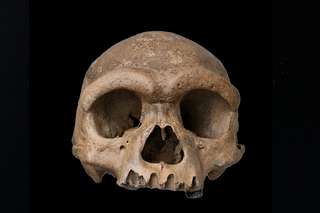
skull

View type

386 image(s) · 29 News

Image gallery

Yizhousaurus sunae skull and jaw

Yizhousaurus sunae skull and jaw

Yizhousaurus skull
Skull diagram showing the known material of Aardonyx. Based on photographs and measurements in original description and supplementary material. Scale bar = 10 cm

Skull diagram showing the known material of Aardonyx. Based on photographs and measurements in original description and supplementary material. Scale bar = 10 cm

scale description Aardonyx skull
Photographs of the skull of BP/1/4779.
(A) Right lateral view. (B) Dorsal view. (C) Left lateral view. Scale bar represents 10 mm. Photographs by Kimberley E.J. Chapelle.

Photographs of the skull of BP/1/4779. (A) Right lateral view. (B) Dorsal view. (C) Left lateral view. Scale bar represents 10 mm. Photographs by Kimberley E.J. Chapelle.

scale Ngwevu skull
Skull of the new basal sauropodomorph Leyesaurus marayensis (PVSJ 706). 
Photograph of the skull (A) and
interpretative drawing (B) in lateral view.
Dark grey color represents matrix and light grey color represents foraminae.

Abbreviations: a, angular; aoF, antorbital fenestra; aoFo; antorbital fossa; Apmx, ascending process of the maxilla; d, dentary; f, frontal; itF, infratemporal fenestra; j, jugal; l, lacrimal; laoFo; lacrimal antorbital fossa; mF, mandibular fenestra; mx, maxilla; n, nasal; O, orbit; p, parietal; pf, prefrontal; pm, premaxilla; po, postorbital; rug, platform-like rugosities; q, quadrate; qj, quadratejugal; Rmx, ridge of the ascending process of the maxilla; sa, surangular; snf, subnarial foramen.
Scale bar equals 1cm.

Skull of the new basal sauropodomorph Leyesaurus marayensis (PVSJ 706). Photograph of the skull (A) and interpretative drawing (B) in lateral view. Dark grey color represents matrix and light grey color represents foraminae. Abbreviations: a, angular; aoF, antorbital fenestra; aoFo; antorbital fossa; Apmx, ascending process of the maxilla; d, dentary; f, frontal; itF, infratemporal fenestra; j, jugal; l, lacrimal; laoFo; lacrimal antorbital fossa; mF, mandibular fenestra; mx, maxilla; n, nasal; O, orbit; p, parietal; pf, prefrontal; pm, premaxilla; po, postorbital; rug, platform-like rugosities; q, quadrate; qj, quadratejugal; Rmx, ridge of the ascending process of the maxilla; sa, surangular; snf, subnarial foramen. Scale bar equals 1cm.

scale drawing Leyesaurus skull
Photograph of the skulls NHMD 164741 and NHMD 164758. (A) NHMD 164741 in left lateral view. (B) NHMD 164758 in left lateral view.

Photograph of the skulls NHMD 164741 and NHMD 164758. (A) NHMD 164741 in left lateral view. (B) NHMD 164758 in left lateral view.

Issi skull
Three-dimensional skull of BMT 1955.G35.1, Protoichthyosaurus prostaxalis. (B) Skull in left lateral view, as reconstructed in 2015. (C) Skull in right lateral view, as reconstructed in 2015. Note the distinctive asymmetric maxilla with long, narrow anterior process. Teeth are not in their original positions. Scale bar represents 20 cm.

Three-dimensional skull of BMT 1955.G35.1, Protoichthyosaurus prostaxalis. (B) Skull in left lateral view, as reconstructed in 2015. (C) Skull in right lateral view, as reconstructed in 2015. Note the distinctive asymmetric maxilla with long, narrow anterior process. Teeth are not in their original positions. Scale bar represents 20 cm.

scale Protoichthyosaurus skull
Skull of Megacephalosaurus eulerti FHSM VP-321 in dorsal and palatal view. Right mandible in medial and lateral views.

Skull of Megacephalosaurus eulerti FHSM VP-321 in dorsal and palatal view. Right mandible in medial and lateral views.

Megacephalosaurus skull
Holotype skull of Plesiotylosaurus crassidens (LACM 2759) on display at the Natural History Museum of Los Angeles County.

Holotype skull of Plesiotylosaurus crassidens (LACM 2759) on display at the Natural History Museum of Los Angeles County.

museum holotype Plesiotylosaurus skull
Selmasaurus johnsoni mounted skull in the Rocky Mountain Dinosaur Resource Center in Woodland Park, Colorado

Selmasaurus johnsoni mounted skull in the Rocky Mountain Dinosaur Resource Center in Woodland Park, Colorado

Dinosauria Selmasaurus skull
Cast of the skull of Parapsicephalus purdoni (specimen AMNH 1694) in the American Museum of Natural History.

Cast of the skull of Parapsicephalus purdoni (specimen AMNH 1694) in the American Museum of Natural History.

museum cast specimen Parapsicephalus +1
Achelousaurus horneri skull, collected in Glacier County, Montana, at the Museum of the Rockies in Bozeman, Montana.
The Ceratopsidae are those dinosaurs with head frills.  There are three large subgroups of Ceratopsidae: Centrosaurinae, Ceratopsinae, and Chasmosaurinae. The Triceratopsini are a "tribe" of the Chasmosaurinae -- a genus so vast that it gets the special name "tribe".  The Pachyrhinosaurini are a "tribe" within the Centrosaurinae.

Achelousaurus is a genus within the Pachyrhinosaurini.  So far, only three skulls and some limited skeletal remains have been collected anywhere in the world -- and all of them in Montana.  Their bony frills are quite similar to the Styracosaurus albertensis, although their other skull features (such as big bony bosses on the nose and behind the eyes) are not.

Achelousaurus horneri skull, collected in Glacier County, Montana, at the Museum of the Rockies in Bozeman, Montana. The Ceratopsidae are those dinosaurs with head frills. There are three large subgroups of Ceratopsidae: Centrosaurinae, Ceratopsinae, and Chasmosaurinae. The Triceratopsini are a "tribe" of the Chasmosaurinae -- a genus so vast that it gets the special name "tribe". The Pachyrhinosaurini are a "tribe" within the Centrosaurinae. Achelousaurus is a genus within the Pachyrhinosaurini. So far, only three skulls and some limited skeletal remains have been collected anywhere in the world -- and all of them in Montana. Their bony frills are quite similar to the Styracosaurus albertensis, although their other skull features (such as big bony bosses on the nose and behind the eyes) are not.

museum United States Achelousaurus Centrosaurinae +8
Skull cast of Liaoceratops yanzigouensis on display at the Baoding Natural History Museum.

Skull cast of Liaoceratops yanzigouensis on display at the Baoding Natural History Museum.

museum cast Liaoceratops skull
Skeleton of Yamaceratops dorngobiensis (MPC-D 100/553) in right dorsolateral view. (A) Photograph; (B) Interpretive drawing. Bones are bounded by solid lines and colored beige; the matrix is gray. Shaded areas represent the broken surface of bones. Abbreviations: cd, caudal vertebrae; dr, dorsal ribs; dv, dorsal vertebrae; f, femur; fi, fibula; h, humerus; L, bone on the left side; p, isolated parietal; pp, pedal phalanges; R, bone on the right side; ra, radius; sk, skull; sv, sacral vertebrae; ti, tibia; u, ulna; il, ilium; is, ischium.

Skeleton of Yamaceratops dorngobiensis (MPC-D 100/553) in right dorsolateral view. (A) Photograph; (B) Interpretive drawing. Bones are bounded by solid lines and colored beige; the matrix is gray. Shaded areas represent the broken surface of bones. Abbreviations: cd, caudal vertebrae; dr, dorsal ribs; dv, dorsal vertebrae; f, femur; fi, fibula; h, humerus; L, bone on the left side; p, isolated parietal; pp, pedal phalanges; R, bone on the right side; ra, radius; sk, skull; sv, sacral vertebrae; ti, tibia; u, ulna; il, ilium; is, ischium.

bone humerus drawing Yamaceratops +2
Skeletal elements of Lophorhothon atopus. (A, B and C) Partial skull roof and braincase (holotype FMNH 27383) in dorsal, ventral, and left lateral views. (D) Partial left nasal of FMNH 27383 in lateral view. (E) Left prefrontal of FMNH 27383 in lateral view. (F) Partial left jugal of FMNH 27383 in medial view. (G) Detail of marginal denticles of the dentary tooth in (H). (H) Apical half of a dentary tooth crown AUMP 2295 in lingual view. (I) Maxillary tooth crown of FMNH 27383 in labial view. (J) Left pubis of AUMP 2295 in lateral view. (K) Iliac process of the left ilium of FMNH 27383 in lateral view.

Skeletal elements of Lophorhothon atopus. (A, B and C) Partial skull roof and braincase (holotype FMNH 27383) in dorsal, ventral, and left lateral views. (D) Partial left nasal of FMNH 27383 in lateral view. (E) Left prefrontal of FMNH 27383 in lateral view. (F) Partial left jugal of FMNH 27383 in medial view. (G) Detail of marginal denticles of the dentary tooth in (H). (H) Apical half of a dentary tooth crown AUMP 2295 in lingual view. (I) Maxillary tooth crown of FMNH 27383 in labial view. (J) Left pubis of AUMP 2295 in lateral view. (K) Iliac process of the left ilium of FMNH 27383 in lateral view.

tooth holotype Lophorhothon partial +1
The skull of the holotype of Acristavus, MOR 1155

The skull of the holotype of Acristavus, MOR 1155

holotype Acristavus Montanoceratops skull
Holotype skull of Augustynolophus morrisi (LACM 2852) on display at the Natural History Museum of Los Angeles County.

Holotype skull of Augustynolophus morrisi (LACM 2852) on display at the Natural History Museum of Los Angeles County.

museum holotype Augustynolophus skull
1 2 3 4 5 6 7 8 9 10 11 12 13 14 15 16 17 18 19 20 21 22 23 24 25

News

Les scientifiques pensaient les Denisoviens introuvables : cette découverte spectaculaire change désormais tout
Scientists thought the Denisovans were impossible to find: this spectacular discovery now changes everything
bone DNA China discovery Homo sapiens human origin skull
For fifteen years, the Denisovans had neither face nor outline. Just DNA extracted from a piece of Siberian bone the size of a fingernail. In 2025, an exceptional skull discovered in China changed everything. Homo longi, nicknamed the Dragon Man, finally gives a face to this phantom human group. 
06/06/2026 futura-terre ⚙ Auto-translated
This prehistoric fish may explain how animals first walked on Earth
Antarctica skull
Scientists have peered inside the skull of a 380-million-year-old Antarctic fish that was closely related to the first animals to walk on land, revealing surprising clues about how life began its move out of the water. Using advanced neutron imaging, researchers discovered that Koharalepis jarviki had features suited for living near the water’s surface, including openings in its skull that may have helped it gulp air and a light-sensitive organ linked to day-night rhythms.
25/05/2026 sciencedaily-paleo
T. rex’s tiny arms may have evolved for a surprisingly brutal reason
jaw limb hunting predator prey Dinosauria skull
Why did T. rex have such tiny arms? Scientists now think it’s because its giant head became the ultimate hunting tool. Across multiple dinosaur groups, stronger skulls and crushing jaws evolved alongside shrinking forelimbs, especially in predators hunting enormous prey. In other words, once the bite became deadly enough, the arms may have stopped mattering.
20/05/2026 sciencedaily
Stunning 150-million-year-old stegosaur skull rewrites dinosaur evolution
fossil Dacentrurus Dinosauria Stegosauria discovery evolution skull
A spectacular dinosaur discovery in Spain is giving scientists a rare new look inside the world of stegosaurs. Paleontologists uncovered the best-preserved stegosaur skull ever found in Europe, belonging to the iconic plated dinosaur Dacentrurus armatus, which roamed Earth around 150 million years ago. Because stegosaur skulls are extremely fragile and almost never survive intact, the fossil is helping researchers uncover previously unknown details about how these armored giants evolved.
17/05/2026 sciencedaily
New Triassic Carnivorous Dinosaur Identified from Ghost Ranch
United States Late Triassic Triassic fossil specimen Coelophysis Dinosauria Ptychotherates new species skull
Researchers from Virginia Tech (Virginia, USA) have identified a new species of Late Triassic dinosaur.  The dinosaur has been named Ptychotherates bucculentus.  This new carnivorous dinosaur taxon has been erected based on the detailed examination of an incomplete, well-preserved but jumbled up skull fossil (specimen number CM 31368).  The skull comes from the world-famous Coelophysis
11/05/2026 everythingdinosaur
1 2 3 4 5 6