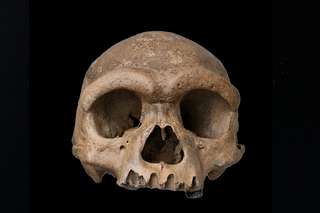
crâne

Type de vue

188 image(s) · 20 Actualités

Galerie d'images

Reconstruction of the skull of Spinops sternbergorum gen. et sp. nov. from the Campanian of Dinosaur Provincial Park, southern Alberta, in right lateral view. Preserved elements are stippled; missing portions are dotted and modeled after Centrosaurus apertus.
Taxons Spinops

Reconstruction of the skull of Spinops sternbergorum gen. et sp. nov. from the Campanian of Dinosaur Provincial Park, southern Alberta, in right lateral view. Preserved elements are stippled; missing portions are dotted and modeled after Centrosaurus apertus.

Campanien Centrosaurus Dinosauria Spinops +1
Photograph of the holotype skull of Titanoceratops ouranos, from the late Campanian aged Kirtland/Fruitland beds of New Mexico, USA. Photograph by Nick Longrich
Taxons Titanoceratops

Photograph of the holotype skull of Titanoceratops ouranos, from the late Campanian aged Kirtland/Fruitland beds of New Mexico, USA. Photograph by Nick Longrich

Mexique États-Unis Fruitland Kirtland +4
Ceratopsipes goldenensis Lockley & Hunt, 1995 - ceratopsian dinosaur trackway in the Cretaceous of Colorado, USA.
Ceratopsians are the "horned dinosaurs".  They were large, quadrupedal, herbivorous dinosaurs having a beaked skull and a frill - an extension of bone behind the skull that partially covered the neck.  Ceratopsian dinosaurs are known from the Jurassic and Cretaceous.  The last members of the group died out at the Cretaceous-Tertiary boundary, 65 million years ago.
Seen here is a ceratopsian dinosaur trackway.  Ceratopsian footprints are very rare.  The best examples are in Colorado's Laramie Formation, a nonmarine, coastal plain to deltaic succession of mostly mixed siliciclastic sedimentary rocks - sandstones, siltstones, claystones, and coals.  The footprints here consist of convex bulges on the basal surfaces of structurally-tilted sandstone beds.
The ichnospecies Ceratopsipes goldenensis was named based on footprints at this locality.  The trackmaker was very likely Triceratops, the # 1 most famous ceratopsian dinosaur.


From on-site signage:
Triceratops Tracks
Several tracks of Triceratops, or a closely related horned dinosaur were first discovered in this area and named Ceratopsipes goldenensis (meaning tracks of a horned dinosaur from Golden).  By happy coincidence, the first Triceratops known to science also comes from the greater Denver area near 13th Avenue and Federal Blvd.  Growing to a length of almost 25 feet, Triceratops and other members of the horned dinosaur family were herbivorous animals that roamed in herds.  Their trademark horns and frills that covered their necks probably served for defense.  A replica Triceratops skull is on display in the clubhouse at the Fossil Trace Golf Club.
These tracks (identified by small signs) help us understand that Triceratops walked with a narrow gait and erect front limbs  than with a wide, sprawling gait as previously depicted.  In 1887, the first Triceratops bones known to science were also discovered locally at a site near 13th Avenue and Federal Boulevard in Denver.
Nearby one may see many other traces of life such as burrows, probably made by invertebrates and impressions of plant debris.  Note that you are looking at all tracks and traces from the underside - in negative aspect - what one might call a worm’s eye view.  All of these trace fossils indicate that the Golden area once had a warm, temperate to subtropical climate.


Classification: Animalia, Chordata, Vertebrata, Reptilia, Archosauria, Dinosauria, Ornithischia, Marginocephalia, Ceratopsia, Ceratopsidae
Stratigraphy: Laramie Formation, Maastrichtian Stage, upper Upper Cretaceous
Locality: outcrop along Triceratops Trail, Parfet Prehistoric Preserve, southern side of the town of Golden, Colorado, USA (~vicinity of 39° 44' 35.24" North latitude, 105° 13’ 09.69" West longitude)


Some info. from:

Lockley & Hunt (1995) - Ceratopsid tracks and associated ichnofauna from the Laramie Formation (Upper Cretaceous: Maastrichtian) of Colorado.  Journal of Vertebrate Paleontology 15: 592-614.
Taxons Ceratopsipes

Ceratopsipes goldenensis Lockley & Hunt, 1995 - ceratopsian dinosaur trackway in the Cretaceous of Colorado, USA. Ceratopsians are the "horned dinosaurs". They were large, quadrupedal, herbivorous dinosaurs having a beaked skull and a frill - an extension of bone behind the skull that partially covered the neck. Ceratopsian dinosaurs are known from the Jurassic and Cretaceous. The last members of the group died out at the Cretaceous-Tertiary boundary, 65 million years ago. Seen here is a ceratopsian dinosaur trackway. Ceratopsian footprints are very rare. The best examples are in Colorado's Laramie Formation, a nonmarine, coastal plain to deltaic succession of mostly mixed siliciclastic sedimentary rocks - sandstones, siltstones, claystones, and coals. The footprints here consist of convex bulges on the basal surfaces of structurally-tilted sandstone beds. The ichnospecies Ceratopsipes goldenensis was named based on footprints at this locality. The trackmaker was very likely Triceratops, the # 1 most famous ceratopsian dinosaur. From on-site signage: Triceratops Tracks Several tracks of Triceratops, or a closely related horned dinosaur were first discovered in this area and named Ceratopsipes goldenensis (meaning tracks of a horned dinosaur from Golden). By happy coincidence, the first Triceratops known to science also comes from the greater Denver area near 13th Avenue and Federal Blvd. Growing to a length of almost 25 feet, Triceratops and other members of the horned dinosaur family were herbivorous animals that roamed in herds. Their trademark horns and frills that covered their necks probably served for defense. A replica Triceratops skull is on display in the clubhouse at the Fossil Trace Golf Club. These tracks (identified by small signs) help us understand that Triceratops walked with a narrow gait and erect front limbs than with a wide, sprawling gait as previously depicted. In 1887, the first Triceratops bones known to science were also discovered locally at a site near 13th Avenue and Federal Boulevard in Denver. Nearby one may see many other traces of life such as burrows, probably made by invertebrates and impressions of plant debris. Note that you are looking at all tracks and traces from the underside - in negative aspect - what one might call a worm’s eye view. All of these trace fossils indicate that the Golden area once had a warm, temperate to subtropical climate. Classification: Animalia, Chordata, Vertebrata, Reptilia, Archosauria, Dinosauria, Ornithischia, Marginocephalia, Ceratopsia, Ceratopsidae Stratigraphy: Laramie Formation, Maastrichtian Stage, upper Upper Cretaceous Locality: outcrop along Triceratops Trail, Parfet Prehistoric Preserve, southern side of the town of Golden, Colorado, USA (~vicinity of 39° 44' 35.24" North latitude, 105° 13’ 09.69" West longitude) Some info. from: Lockley & Hunt (1995) - Ceratopsid tracks and associated ichnofauna from the Laramie Formation (Upper Cretaceous: Maastrichtian) of Colorado. Journal of Vertebrate Paleontology 15: 592-614.

os États-Unis Crétacé Jurassique +6
Hualianceratops holotype IVVP V18641, Skull reconstruction
Taxons Hualianceratops

Hualianceratops holotype IVVP V18641, Skull reconstruction

holotype Hualianceratops crâne
Figure 1: Holotype and skeletal reconstruction of Mosaiceratops azumai, gen. et sp. nov (ZMNH M8856). (a) photograph and line drawing of ZMNH M8856; (b) skeletal reconstruction showing preserved elements in white. Scale bar 10 cm. Abbreviations: a, astragalus; boc, basioccipital; c, calcaneum; cav, caudal vertebra; ch, chevron; cv, cervical vertebra; dr, dorsal rib; dv, dorsal vertebra; f, frontal; fem, femur; fl, fibula; h, humerus; il, ilium; is, ischium; L, left; mt, metatarsal; ph, phalanx/phalanges; po, postorbital; R, right; sk, skull; sq, squamosal; t, tibia; td, tendon; ?, undiagnostic remains.
Taxons Mosaiceratops

Figure 1: Holotype and skeletal reconstruction of Mosaiceratops azumai, gen. et sp. nov (ZMNH M8856). (a) photograph and line drawing of ZMNH M8856; (b) skeletal reconstruction showing preserved elements in white. Scale bar 10 cm. Abbreviations: a, astragalus; boc, basioccipital; c, calcaneum; cav, caudal vertebra; ch, chevron; cv, cervical vertebra; dr, dorsal rib; dv, dorsal vertebra; f, frontal; fem, femur; fl, fibula; h, humerus; il, ilium; is, ischium; L, left; mt, metatarsal; ph, phalanx/phalanges; po, postorbital; R, right; sk, skull; sq, squamosal; t, tibia; td, tendon; ?, undiagnostic remains.

humérus écaille vertèbre dessin +3
Skeletal diagram featuring the optimal remains of the holotype of Graciliceratops mongoliensis: ZPAL MgD-I/156.[1] Found in the Bayan Shireh Formation, in the original description the remains were referred to the genus Microceratops (now obsolete).[2] However, Sereno in 2000 noted that there was no base for this referral, then, he created a new genus and species for this specimen.[1] The holotype is very fragmented (specially the skull), consisting of:[2]
Fragmented skull; 4 cervical, 12 dorsal and 7 sacral vertebrae; right scapula; proximal end of left scapula; left coracoid; right humerus, radius and fragmentary ulna; proximal and distal end of left humerus; proximal fragments of both pubis; fragments of both illium and fragment of right ischium; right femur, tibia and nearly complete pes; distal part of left tibia, fragmentary left pes; tarsals and isolated ribs.[2]

The sacral vertebrae are not fused, an indicator of the immaturity of this specimen; the estimated adult size is about 2 meters long or similar to Protoceratops.[2][1] Right quadratojugal, quadrate and fragmentary jugal were reversed in order to get an optimal view.
Taxons Graciliceratops

Skeletal diagram featuring the optimal remains of the holotype of Graciliceratops mongoliensis: ZPAL MgD-I/156.[1] Found in the Bayan Shireh Formation, in the original description the remains were referred to the genus Microceratops (now obsolete).[2] However, Sereno in 2000 noted that there was no base for this referral, then, he created a new genus and species for this specimen.[1] The holotype is very fragmented (specially the skull), consisting of:[2] Fragmented skull; 4 cervical, 12 dorsal and 7 sacral vertebrae; right scapula; proximal end of left scapula; left coracoid; right humerus, radius and fragmentary ulna; proximal and distal end of left humerus; proximal fragments of both pubis; fragments of both illium and fragment of right ischium; right femur, tibia and nearly complete pes; distal part of left tibia, fragmentary left pes; tarsals and isolated ribs.[2] The sacral vertebrae are not fused, an indicator of the immaturity of this specimen; the estimated adult size is about 2 meters long or similar to Protoceratops.[2][1] Right quadratojugal, quadrate and fragmentary jugal were reversed in order to get an optimal view.

humérus description holotype spécimen +4
Holotype skull of Wannanosaurus yansiensis on display at the Paleozoological Museum of China.
Taxons Wannanosaurus

Holotype skull of Wannanosaurus yansiensis on display at the Paleozoological Museum of China.

musée Chine holotype Wannanosaurus +1
Diagram featuring the holotype skull (ZPAL MgD-I/105) of Tylocephale gilmorei in left lateral view. Scale bar equals 5 cm (50 mm). Based on Maryańska & Osmólska, 1974,[1] and Sullivan, 2006.[2]
References

↑ (1974). "Pachycephalosauria, a new suborder of ornithischian dinosaurs". Palaeontologica Polonica (30): 45−102.

↑ (2006). "A taxonomic review of the Pachycephalosauridae (Dinosauria: Ornithischia)". New Mexico Museum of Natural History and Science Bulletin (35): 347–365.
Taxons Tylocephale

Diagram featuring the holotype skull (ZPAL MgD-I/105) of Tylocephale gilmorei in left lateral view. Scale bar equals 5 cm (50 mm). Based on Maryańska & Osmólska, 1974,[1] and Sullivan, 2006.[2] References ↑ (1974). "Pachycephalosauria, a new suborder of ornithischian dinosaurs". Palaeontologica Polonica (30): 45−102. ↑ (2006). "A taxonomic review of the Pachycephalosauridae (Dinosauria: Ornithischia)". New Mexico Museum of Natural History and Science Bulletin (35): 347–365.

écaille musée Mexique holotype +6
Lateral diagram of the skull of Sinocephale bexelli (Bohlin, 1953) with unknown regions (grey) restored after Stegoceras
Taxons Sinocephale

Lateral diagram of the skull of Sinocephale bexelli (Bohlin, 1953) with unknown regions (grey) restored after Stegoceras

Sinocephale Stegoceras crâne
Holotype of Transylvanosaurus platycephalus, LPB (FGGUB) R.2070, a partial skull comprising the articulated basicranium and both frontals. Scale bar: 1 cm.
Taxons Transylvanosaurus

Holotype of Transylvanosaurus platycephalus, LPB (FGGUB) R.2070, a partial skull comprising the articulated basicranium and both frontals. Scale bar: 1 cm.

écaille holotype Transylvanosaurus partiel +1
skull of iguanodontian Altirhinus kurzanovi
Taxons Altirhinus

skull of iguanodontian Altirhinus kurzanovi

Altirhinus Iguanodontia crâne
Figure 4: Anterior portion of the skull of Dakotadon lakotaensis (SDSM 8656).
(A) photograph in left lateral view; (B) photograph in right lateral view; (C) photograph in ventral view. Abbreviations: ant, anterior; post, posterior; vent, ventral. Scale bars equal 5.0 cm.
Taxons Dakotadon

Figure 4: Anterior portion of the skull of Dakotadon lakotaensis (SDSM 8656). (A) photograph in left lateral view; (B) photograph in right lateral view; (C) photograph in ventral view. Abbreviations: ant, anterior; post, posterior; vent, ventral. Scale bars equal 5.0 cm.

écaille Dakotadon crâne
Angulomastacator skull reconstruction with known elements in white. 
Scale bar 20 cm.
Taxons Angulomastacator

Angulomastacator skull reconstruction with known elements in white. Scale bar 20 cm.

écaille Angulomastacator crâne
Reconstruction of the skull of Tlatolophus galorum by sculptor Samuel Nieves Tlapaya (El Alebrije Prehistórico). Displayed in the lobby of the hosting hotel of the 12th Latin American Congress of Paleontology, held in Puebla, Mexico, during the first week of March 2025.
Taxons Tlatolophus

Reconstruction of the skull of Tlatolophus galorum by sculptor Samuel Nieves Tlapaya (El Alebrije Prehistórico). Displayed in the lobby of the hosting hotel of the 12th Latin American Congress of Paleontology, held in Puebla, Mexico, during the first week of March 2025.

Mexique Tlatolophus crâne
Minqaria bata skull reconstruction with known elements shown in white.
Taxons Minqaria

Minqaria bata skull reconstruction with known elements shown in white.

Minqaria crâne
D. Dentary tooth crowns of Arenysaurus ardevoli (MPZ 2008/258) in lingual view. E. Caudal region of the skull roof of A. ardevoli (MPZ 2008/1) in dorsal view. F. Left dentary of A. ardevoli (MPZ 2008/258) in medial view.
Taxons Arenysaurus

D. Dentary tooth crowns of Arenysaurus ardevoli (MPZ 2008/258) in lingual view. E. Caudal region of the skull roof of A. ardevoli (MPZ 2008/1) in dorsal view. F. Left dentary of A. ardevoli (MPZ 2008/258) in medial view.

dent Arenysaurus crâne
1 2 3 4 5 6 7 8 9 10 11 12

Actualités

Les scientifiques ont trouvé un bébé dinosaure caché dans la roche et il est étonnamment mignon
os dessin Corée du Sud Dinosauria Doolysaurus tomographie découverte crâne
Des scientifiques ont découvert un bébé dinosaure rare en Corée du Sud et l'ont baptisé Doolysaurus, en hommage à un célèbre personnage de dessin animé. Grâce à des tomodensitogrammes de pointe, ils ont découvert des os cachés, notamment un crâne, dans la roche beaucoup plus rapidement que les méthodes traditionnelles. Le jeune dinosaure, peut-être duveteux et ressemblant à un agneau, avait même des calculs gastriques révélant qu'il mangeait un mélange de plantes et de petits animaux. Cette découverte suggère que de nombreux autres dinosaures pourraient encore être cachés dans les roches coréennes.
01/04/2026 sciencedaily ⚙ Traduction automatique
Des fossiles de poissons vieux de 400 millions d'années révèlent comment la vie a commencé à s'installer sur terre
Australie Chine fossile formation crâne
Les scientifiques ont découvert de nouveaux indices sur certains des premiers poissons de la Terre, mettant ainsi en lumière les origines anciennes des vertébrés qui ont fini par s’installer sur terre. En réanalysant de mystérieux fossiles de la célèbre formation australienne Gogo et en étudiant un crâne de poisson-poumon récemment reconstruit, vieux de 410 millions d'années et provenant de Chine, les chercheurs révèlent comment ces créatures primitives ont évolué.
12/03/2026 sciencedaily ⚙ Traduction automatique
Le tricératops avait un nez géant qui aurait pu refroidir sa tête massive
fossile Triceratops tomographie crâne
La tête massive du tricératops faisait peut-être plus que simplement montrer ces fameuses cornes. À l’aide de tomodensitogrammes et de reconstructions 3D de crânes fossiles, les chercheurs ont découvert un système nasal étonnamment complexe caché à l’intérieur de son énorme museau. Au lieu d’être simplement un nez surdimensionné pour sentir, il abritait probablement des réseaux complexes de nerfs et de vaisseaux sanguins, et même des structures spéciales qui aidaient à réguler la chaleur et l’humidité.
22/02/2026 sciencedaily ⚙ Traduction automatique
Cet animal ancien fut l'un des premiers à manger des plantes sur terre
dent fossile crâne
Il y a des centaines de millions d’années, les premiers animaux à ramper sur terre étaient de purs mangeurs de viande, alors même que les plantes avaient déjà envahi le paysage. Aujourd’hui, les scientifiques ont découvert un fossile vieux de 307 millions d’années qui réécrit cette histoire : l’un des premiers vertébrés terrestres connus à avoir commencé à manger des plantes. L'animal, nommé Tyrannoroter heberti, était une créature trapue de la taille d'un ballon de football avec un crâne rempli de dents spécialisées conçues pour écraser et broyer la végétation.
11/02/2026 sciencedaily ⚙ Traduction automatique
Cet étrange petit dinosaure oblige à repenser l'évolution
os dent métabolisme Dinosauria Foskeia anatomie oiseau évolution mammifères étude crâne
Un petit dinosaure nouvellement identifié, Foskeia pelendonum, bouleverse les idées reçues de longue date sur l'évolution des dinosaures herbivores. Même si les adultes adultes étaient remarquablement petits et légers, leur anatomie était tout sauf simple : elles présentaient un crâne bizarre et hautement spécialisé et des traits évolutifs inattendus. Des études osseuses détaillées montrent que ces dinosaures ont mûri rapidement avec un métabolisme semblable à celui des oiseaux ou des mammifères, tandis que leurs dents et leur posture suggèrent une vie rapide et agile dans des forêts denses.
03/02/2026 sciencedaily ⚙ Traduction automatique
1 2 3 4