crâne

Type de vue

386 image(s) · 29 Actualités

Galerie d'images

The nodosaurid dinosaur, Glyptodontopelta is mostly known from isolated osteoderms ("armor plates"). The specimen SMP VP-1580 (State Museum of Pennysylvania) is however, the most complete known specimen, comprising parts of the skull, hundreds of osteoderms and fragments. This specimen was discovered in 2003 by Warwick Fowler, in the Naashoibito Member of the Ojo Alamo Formation (Maatrichtian, Late Cretaceous) of the San Juan Basin, New Mexico, during an expedition led by Dr. Robert Sullivan.
Taxons Glyptodontopelta

The nodosaurid dinosaur, Glyptodontopelta is mostly known from isolated osteoderms ("armor plates"). The specimen SMP VP-1580 (State Museum of Pennysylvania) is however, the most complete known specimen, comprising parts of the skull, hundreds of osteoderms and fragments. This specimen was discovered in 2003 by Warwick Fowler, in the Naashoibito Member of the Ojo Alamo Formation (Maatrichtian, Late Cretaceous) of the San Juan Basin, New Mexico, during an expedition led by Dr. Robert Sullivan.

armure musée Mexique Denver +9
Reconstruction and restoration of the skull of Eolambia.

(A) Skull reconstruction of Eolambia in left lateral view by the lead author. Bones in white are unknown, bones in dark grey are based primarily upon the adult holotype (CEUM 9758) or paratype (CEUM 5212), and bones in light grey are based primarily upon juvenile elements from the Eo2 and WS8 bonebeds. Sutures and points of contact between bones are marked in black. Scale bar equals 10 cm; scale is calibrated with the dentary of CEUM 9758. (B) Life restoration of the head of Eolambia by Lukas Panzarin. Abbreviations: an, angular; d, dentary; f, frontal; j, jugal; l, lacrimal; mx, maxilla; na, nasal; pd, predentary; pmx, premaxilla; po, postorbital; prf, prefrontal; q, quadrate; qj, quadratojugal; sa, surangular; sq, squamosal.
Taxons Eolambia

Reconstruction and restoration of the skull of Eolambia. (A) Skull reconstruction of Eolambia in left lateral view by the lead author. Bones in white are unknown, bones in dark grey are based primarily upon the adult holotype (CEUM 9758) or paratype (CEUM 5212), and bones in light grey are based primarily upon juvenile elements from the Eo2 and WS8 bonebeds. Sutures and points of contact between bones are marked in black. Scale bar equals 10 cm; scale is calibrated with the dentary of CEUM 9758. (B) Life restoration of the head of Eolambia by Lukas Panzarin. Abbreviations: an, angular; d, dentary; f, frontal; j, jugal; l, lacrimal; mx, maxilla; na, nasal; pd, predentary; pmx, premaxilla; po, postorbital; prf, prefrontal; q, quadrate; qj, quadratojugal; sa, surangular; sq, squamosal.

os écaille holotype juvénile +2
Figure description from the paper: "The segmented model of right lateral side of the skull of mixosaurid ichthyosaur Phalarodon fraasi (Merriam, 1910) PMO 235.393, from the Botneheia Formation, Middle Triassic of the Isfjorden area in Spitsbergen, Svalbard."
References:

Roberts, A.J.; Engelschiøn, V.S.; Hurum, J.H. (2022). "First three-dimensional skull of the Middle Triassic mixosaurid ichthyosaur Phalarodon fraasi from Svalbard, Norway". Acta Palaeontologica Polonica 67 (1): 51–62. DOI:https://doi.org/10.4202/app.00915.2021.
Taxons Phalarodon

Figure description from the paper: "The segmented model of right lateral side of the skull of mixosaurid ichthyosaur Phalarodon fraasi (Merriam, 1910) PMO 235.393, from the Botneheia Formation, Middle Triassic of the Isfjorden area in Spitsbergen, Svalbard." References: Roberts, A.J.; Engelschiøn, V.S.; Hurum, J.H. (2022). "First three-dimensional skull of the Middle Triassic mixosaurid ichthyosaur Phalarodon fraasi from Svalbard, Norway". Acta Palaeontologica Polonica 67 (1): 51–62. DOI:https://doi.org/10.4202/app.00915.2021.

description Norvège Trias moyen Trias +6
Skeletal reconstruction of Stenonychosaurus, based on all known material, with missing parts of the skull and vertebral column based on Saurornithoides.[1]

This version is modified from a version which was itself modified with red colour to show the known parts of the new genus Talos.
Taxons Stenonychosaurus

Skeletal reconstruction of Stenonychosaurus, based on all known material, with missing parts of the skull and vertebral column based on Saurornithoides.[1] This version is modified from a version which was itself modified with red colour to show the known parts of the new genus Talos.

Saurornithoides Stenonychosaurus Talos crâne
Panoplosaurus mirus skull.
Taxons Panoplosaurus

Panoplosaurus mirus skull.

Panoplosaurus crâne
The skull of a Chasmosaurus mariscalensis, on display at the Texas Memorial Museum. Chasmosaurus was a Cretaceous ceratopsian of North America. This specimen was discovered in Brewster County, Texas.
Taxons Agujaceratops

The skull of a Chasmosaurus mariscalensis, on display at the Texas Memorial Museum. Chasmosaurus was a Cretaceous ceratopsian of North America. This specimen was discovered in Brewster County, Texas.

musée Crétacé spécimen Agujaceratops +3
Drawing of lectoholotype skull BMNH R.3386 (desigated by Weishampel et al., 1993)[1][2] of Limnosaurus transsylvanicus NOPCSA 1900 (later renamed Telmatosaurus transsylvanicus), a basal hadrosaurid dinosaur from the Late Maastrichtian (latest Upper Cretaceous) Sanpetru Formation of West Central Romania.
Taxons Telmatosaurus

Drawing of lectoholotype skull BMNH R.3386 (desigated by Weishampel et al., 1993)[1][2] of Limnosaurus transsylvanicus NOPCSA 1900 (later renamed Telmatosaurus transsylvanicus), a basal hadrosaurid dinosaur from the Late Maastrichtian (latest Upper Cretaceous) Sanpetru Formation of West Central Romania.

dessin Roumanie Crétacé Maastrichtien +6
Kritosaurus navajovius skull
Taxons Kritosaurus

Kritosaurus navajovius skull

Kritosaurus crâne
Plioplatecarpus primaevus skull, Oxford University Museum of Natural History .
Taxons Plioplatecarpus

Plioplatecarpus primaevus skull, Oxford University Museum of Natural History .

musée Plioplatecarpus crâne
Globidens phosphaticus skull cast on display at the Smithsonian's National Museum of Natural History.
Taxons Globidens

Globidens phosphaticus skull cast on display at the Smithsonian's National Museum of Natural History.

musée moulage Globidens crâne
Main skull block of Bentiabasaurus jacobsi holotype (MGUAN P183D) on temporary display at the Smithsonian National Museum of Natural History
Taxons Bentiabasaurus

Main skull block of Bentiabasaurus jacobsi holotype (MGUAN P183D) on temporary display at the Smithsonian National Museum of Natural History

musée holotype Bentiabasaurus crâne
Composite of the holotype (GM F10004) skull of Qianzhousaurus sinensis, lower jaw mirrowed. With authorization and permission by Dr. Stephen L. Brusatte.
Taxons Qianzhousaurus

Composite of the holotype (GM F10004) skull of Qianzhousaurus sinensis, lower jaw mirrowed. With authorization and permission by Dr. Stephen L. Brusatte.

holotype Qianzhousaurus crâne
Complete specimen of the Laueropterus vitriolus holotype (LF 6268). The holotype specimen seen under natural light. Major elements are labeled. Abbreviations as follows here and in subsequent figures: ca, caudal vertebra; cp, carpal; cv, cervical vertebrae; dv, dorsal vertebra; fe, femur; hu, humerus; mn, mandible; mt, metatarsal; ph, phalanges; pmm, premaxilla-maxilla; pp, prepubis; pt, pteroid; pv, pelvic plate; r, rib; sa, sacrum; sc, scapulocoracoid; sk, skull part; st, sternum; ta, tarsals; ti, tibia; ul, ulna; un, ungual; wpx, wing phalanges; wmc, wing metacarpal. Scale bar = 100 mm.
Taxons Laueropterus

Complete specimen of the Laueropterus vitriolus holotype (LF 6268). The holotype specimen seen under natural light. Major elements are labeled. Abbreviations as follows here and in subsequent figures: ca, caudal vertebra; cp, carpal; cv, cervical vertebrae; dv, dorsal vertebra; fe, femur; hu, humerus; mn, mandible; mt, metatarsal; ph, phalanges; pmm, premaxilla-maxilla; pp, prepubis; pt, pteroid; pv, pelvic plate; r, rib; sa, sacrum; sc, scapulocoracoid; sk, skull part; st, sternum; ta, tarsals; ti, tibia; ul, ulna; un, ungual; wpx, wing phalanges; wmc, wing metacarpal. Scale bar = 100 mm.

humérus écaille vertèbre holotype +3
Cryptarcus ("Chasmosaurus") russelli holotype cranium (CMNFV 8800). (A) Skull in left lateral view (with restored jugal and lower jaw); (B) detail of snout in left lateral view; (C) detail of parietosquamosal frill in dorsal view; (D) detail of supraorbital review in dorsal view; (E) detail of es6 episquamosal; (F) detail of es7 episquamosal. Arrowheads in E and F point to margins of episquamosals.
Taxons Cryptarcus

Cryptarcus ("Chasmosaurus") russelli holotype cranium (CMNFV 8800). (A) Skull in left lateral view (with restored jugal and lower jaw); (B) detail of snout in left lateral view; (C) detail of parietosquamosal frill in dorsal view; (D) detail of supraorbital review in dorsal view; (E) detail of es6 episquamosal; (F) detail of es7 episquamosal. Arrowheads in E and F point to margins of episquamosals.

holotype Chasmosaurus Cryptarcus crâne
Skull of Minotaurasaurus
Taxons Minotaurasaurus

Skull of Minotaurasaurus

Minotaurasaurus crâne
Theiophytalia kerri Brill & Carpenter, 2006 - ornithopod dinosaur skull from the Cretaceous of Colorado, USA. (YPM 1887, public display, Garden of the Gods visitor center, Colorado Springs, Colorado, USA)
This skull is the holotype and only known specimen of an entire genus of ornithopod dinosaurs, Theiophytalia.  Ornithopods were herbivorous dinosaurs.


From exhibit signage:
A Brand New Dinosaur Species Theiophytalia kerri
What we know about the dinosaur fossil - so far:
It is the only Theiophytalia kerri fossil known to exist in the world.
It is a brand new genus and species of dinosaur.
Theiophytalia kerri means "belonging to the Garden of the Gods".  "Theios" is a Greek word that means "belonging to the gods" and "phytalia" means "garden".  "kerri" honors James Hutchinson Kerr (pronounced "Care"), who discovered the dinosaur fossil.
Theiophytalia was a medium-sized dinosaur, measuring about 30 feet from head to tail.
It was found in 1878 in the Garden of the Gods in the lower Lytle Member of the Purgatoire Rock Formation of the Dakota Group.
The dinosaur fossil skull is from the Aptian-Albian Age of the Cretaceous Ear, 125 - 100 million years old.
Look closely at the fossil skull.  Where are the teeth located?  You can see the teeth in the back of the jaw.  There are no teeth in the front of the dinosaur's beak-like mouth.  This is evidence that the Theiophytalia was a plant eater.  It could nip and tear plants, then grind them between its tightly-packed back teeth, similar to plant-eaters of today.
Timeline:
Dinosaur Fossil Discovered, then Forgotten
1878 - James Kerr, geology professor at Colorado College, finds a fossil skull "in one of the ridges east of the red rocks of the Garden of the Gods."
1886 - O.C. Marsh, famous 1800s dinosaur collector from Yale University, obtains the fossil skull from James Kerr, identifies it as a Camptosaurus dinosaur, and sends the fossil to the Yale Peabody Museum in New Haven, Connecticut.
1886 - 1995 - While the dinosaur fossil skull safely rests in the Yale Museum for many decades, knowledge of its existence is forgotten in Colorado Springs.
Rediscovery - 117 years later
1994 - Colorado Springs City park staff research new exhibits for the Garden of the Gods Visitor and Nature Center, set to open in 1995.  They meet with Doctor Kirk Johnson, curator of paleontology at the Denver Museum of Nature & Science.
1995 - Kirk Johnson refers the park staff to his museum colleague Doctor Ken Carpenter, expert dinosaur scientist.  Doctor Carpenter remembers seeing in his files "something about a dinosaur fossil found in Garden of the Gods" and mails the following article to park staff.
Camptosaurus amplus No. 1887, Yale Museum, consisting of portions of the skull and lower jaw.  It was collected from deposits in the Garden of the Gods, Colorado Springs, Colorado.  With this specimen was found the following note in Professor O.C. Marsh's handwriting, "Part of this animal and various Sauropoda bones were taken out by Professor Kerr in 1878."
A Case of Mistaken Identity Reveals a Brand New Dinosaur!
1996 - Kirk Johnson (a Yale alumnus) secures permission to hand-carry the Camptosaurus fossil from the Yale Peabody Museum to Denver so that Ken Carpenter can make a cast (a precise replica) of the fossil.
Doctor Carpenter notices irregularities in the Camptosaurus fossil and decides to re-examine the fossil when his schedule permits.
1997 - The Camptosaurus fossil replica is given to the City of Colorado Springs and is exhibited at the Garden of the Gods Visitor and Nature Center.
2006 - Doctor Carpenter and his associate Kathleen Brill reassess the fossil skull and note that it differs from other Camptosaurus skulls in several significant ways, such as the narrower mouth and snout, and the position of the nasal openings, and the bony structures over the eyes.
Also, microscopic identification of the rock matrix clinging to the fossil, and research of archival maps, reveal that the fossil skull was actually found in the lower Dakota Rock Formation, not the Morrison Formation as originally reported in the 1800s.  The skull is from a dinosaur that lived in the Cretaceous Ear and can't be a Jurassic Era Camptosaurus.
Doctor Carpenter's exacting research reveals that the dinosaur skull is a brand new genus and species of dinosaur!  He names it Theiophytalia kerri.
2008 - The Theiophytalia kerri is proudly re-exhibited at the Garden of the Gods Visitor and Nature Center.


Classification: Animalia, Chordata, Vertebrata, Dinosauria, Ornithischia, Ornithopoda
Stratigraphy: lower Lytle Member, Purgatoire Formation, Dakota Group, Aptian to Albian Stages, upper Lower Cretaceous
Locality: Garden of the Gods, Colorado Springs, Colorado, USA


See info. at:
en.wikipedia.org/wiki/Theiophytalia
and

en.wikipedia.org/wiki/Ornithopoda
Taxons Theiophytalia

Theiophytalia kerri Brill & Carpenter, 2006 - ornithopod dinosaur skull from the Cretaceous of Colorado, USA. (YPM 1887, public display, Garden of the Gods visitor center, Colorado Springs, Colorado, USA) This skull is the holotype and only known specimen of an entire genus of ornithopod dinosaurs, Theiophytalia. Ornithopods were herbivorous dinosaurs. From exhibit signage: A Brand New Dinosaur Species Theiophytalia kerri What we know about the dinosaur fossil - so far: It is the only Theiophytalia kerri fossil known to exist in the world. It is a brand new genus and species of dinosaur. Theiophytalia kerri means "belonging to the Garden of the Gods". "Theios" is a Greek word that means "belonging to the gods" and "phytalia" means "garden". "kerri" honors James Hutchinson Kerr (pronounced "Care"), who discovered the dinosaur fossil. Theiophytalia was a medium-sized dinosaur, measuring about 30 feet from head to tail. It was found in 1878 in the Garden of the Gods in the lower Lytle Member of the Purgatoire Rock Formation of the Dakota Group. The dinosaur fossil skull is from the Aptian-Albian Age of the Cretaceous Ear, 125 - 100 million years old. Look closely at the fossil skull. Where are the teeth located? You can see the teeth in the back of the jaw. There are no teeth in the front of the dinosaur's beak-like mouth. This is evidence that the Theiophytalia was a plant eater. It could nip and tear plants, then grind them between its tightly-packed back teeth, similar to plant-eaters of today. Timeline: Dinosaur Fossil Discovered, then Forgotten 1878 - James Kerr, geology professor at Colorado College, finds a fossil skull "in one of the ridges east of the red rocks of the Garden of the Gods." 1886 - O.C. Marsh, famous 1800s dinosaur collector from Yale University, obtains the fossil skull from James Kerr, identifies it as a Camptosaurus dinosaur, and sends the fossil to the Yale Peabody Museum in New Haven, Connecticut. 1886 - 1995 - While the dinosaur fossil skull safely rests in the Yale Museum for many decades, knowledge of its existence is forgotten in Colorado Springs. Rediscovery - 117 years later 1994 - Colorado Springs City park staff research new exhibits for the Garden of the Gods Visitor and Nature Center, set to open in 1995. They meet with Doctor Kirk Johnson, curator of paleontology at the Denver Museum of Nature & Science. 1995 - Kirk Johnson refers the park staff to his museum colleague Doctor Ken Carpenter, expert dinosaur scientist. Doctor Carpenter remembers seeing in his files "something about a dinosaur fossil found in Garden of the Gods" and mails the following article to park staff. Camptosaurus amplus No. 1887, Yale Museum, consisting of portions of the skull and lower jaw. It was collected from deposits in the Garden of the Gods, Colorado Springs, Colorado. With this specimen was found the following note in Professor O.C. Marsh's handwriting, "Part of this animal and various Sauropoda bones were taken out by Professor Kerr in 1878." A Case of Mistaken Identity Reveals a Brand New Dinosaur! 1996 - Kirk Johnson (a Yale alumnus) secures permission to hand-carry the Camptosaurus fossil from the Yale Peabody Museum to Denver so that Ken Carpenter can make a cast (a precise replica) of the fossil. Doctor Carpenter notices irregularities in the Camptosaurus fossil and decides to re-examine the fossil when his schedule permits. 1997 - The Camptosaurus fossil replica is given to the City of Colorado Springs and is exhibited at the Garden of the Gods Visitor and Nature Center. 2006 - Doctor Carpenter and his associate Kathleen Brill reassess the fossil skull and note that it differs from other Camptosaurus skulls in several significant ways, such as the narrower mouth and snout, and the position of the nasal openings, and the bony structures over the eyes. Also, microscopic identification of the rock matrix clinging to the fossil, and research of archival maps, reveal that the fossil skull was actually found in the lower Dakota Rock Formation, not the Morrison Formation as originally reported in the 1800s. The skull is from a dinosaur that lived in the Cretaceous Ear and can't be a Jurassic Era Camptosaurus. Doctor Carpenter's exacting research reveals that the dinosaur skull is a brand new genus and species of dinosaur! He names it Theiophytalia kerri. 2008 - The Theiophytalia kerri is proudly re-exhibited at the Garden of the Gods Visitor and Nature Center. Classification: Animalia, Chordata, Vertebrata, Dinosauria, Ornithischia, Ornithopoda Stratigraphy: lower Lytle Member, Purgatoire Formation, Dakota Group, Aptian to Albian Stages, upper Lower Cretaceous Locality: Garden of the Gods, Colorado Springs, Colorado, USA See info. at: en.wikipedia.org/wiki/Theiophytalia and en.wikipedia.org/wiki/Ornithopoda

os musée États-Unis Denver +19
1 2 3 4 5 6 7 8 9 10 11 12 13 14 15 16 17 18 19 20 21 22 23 24 25

Actualités

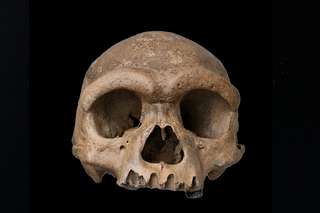
Les scientifiques pensaient les Denisoviens introuvables : cette découverte spectaculaire change désormais tout
os ADN Chine découverte Homo sapiens origine humaine crâne
Pendant quinze ans, les Denisoviens n'ont eu ni visage ni contour. Juste de l'ADN extrait d'un fragment d'os sibérien grand comme un ongle. En 2025, un crâne exceptionnel découvert en Chine a tout changé. Homo longi, surnommé l'Homme dragon, donne enfin un visage à ce groupe humain fantôme. 
06/06/2026 futura-terre
Ce poisson préhistorique pourrait expliquer comment les animaux ont marché pour la première fois sur Terre
Antarctique crâne
Les scientifiques ont examiné l'intérieur du crâne d'un poisson de l'Antarctique vieux de 380 millions d'années, étroitement apparenté aux premiers animaux à avoir marché sur terre, révélant des indices surprenants sur la façon dont la vie a commencé à sortir de l'eau. Grâce à l’imagerie neutronique avancée, les chercheurs ont découvert que Koharalepis jarviki possédait des caractéristiques adaptées pour vivre près de la surface de l’eau, notamment des ouvertures dans son crâne qui auraient pu l’aider à avaler de l’air et un organe sensible à la lumière lié aux rythmes jour-nuit.
25/05/2026 sciencedaily-paleo ⚙ Traduction automatique
Les petits bras du T. rex pourraient avoir évolué pour une raison étonnamment brutale
mâchoire membre chasse prédateur proie Dinosauria crâne
Pourquoi le T. rex avait-il des bras si petits ? Les scientifiques pensent désormais que c’est parce que sa tête géante est devenue l’outil de chasse ultime. Dans plusieurs groupes de dinosaures, des crânes plus forts et des mâchoires écrasantes ont évolué parallèlement à des membres antérieurs rétrécis, en particulier chez les prédateurs chassant d'énormes proies. En d’autres termes, une fois que la morsure est devenue suffisamment mortelle, les bras ont peut-être cessé d’avoir de l’importance.
20/05/2026 sciencedaily ⚙ Traduction automatique
Un superbe crâne de stégosaure vieux de 150 millions d'années réécrit l'évolution des dinosaures
fossile Dacentrurus Dinosauria Stegosauria découverte évolution crâne
Une découverte spectaculaire de dinosaures en Espagne donne aux scientifiques un nouveau regard rare sur le monde des stégosaures. Les paléontologues ont découvert le crâne de stégosaure le mieux conservé jamais découvert en Europe, appartenant à l'emblématique dinosaure plaqué Dacentrurus armatus, qui parcourait la Terre il y a environ 150 millions d'années. Parce que les crânes de stégosaures sont extrêmement fragiles et ne survivent presque jamais intacts, le fossile aide les chercheurs à découvrir des détails jusqu'alors inconnus sur l'évolution de ces géants blindés.
17/05/2026 sciencedaily ⚙ Traduction automatique
Un nouveau dinosaure carnivore du Trias identifié à Ghost Ranch
États-Unis Trias supérieur Trias fossile spécimen Coelophysis Dinosauria Ptychotherates nouvelle espèce crâne
Des chercheurs de Virginia Tech (Virginie, États-Unis) ont identifié une nouvelle espèce de dinosaure du Trias supérieur.  Le dinosaure a été nommé Ptychotherates bucculentus.  Ce nouveau taxon de dinosaure carnivore a été érigé sur la base de l'examen détaillé d'un fossile de crâne incomplet, bien conservé mais mélangé (numéro de spécimen CM 31368).  Le crâne provient de la Coelophysis de renommée mondiale
11/05/2026 everythingdinosaur ⚙ Traduction automatique
1 2 3 4 5 6