crâne

Type de vue

386 image(s) · 29 Actualités

Galerie d'images

A–B, skull in dorsal view; C–E, postcranial skeleton; in left dorsolateral (C) and left lateral (D–E) views. In line drawings (B, E) dark grey tone indicates damage and light grey tone indicates the palate. Abbreviations: ca, caudal vertebra [number following indicates order in preserved series]; ce, cervical vertebra; d, dorsal vertebra; depr, depression; ecto, ectopterygoid; epip, epipterygoid; exp, expanded neural spine apex; fr, frontal; jug, jugal; l., left [followed by name of element]; mx, maxilla; p, ‘pectoral’ vertebra; par, parietal; pmx, premaxilla; po, postorbital; pofr, postfrontal; prfr, prefrontal; qua, quadrate; r., right [followed by name of element]; s, sacral vertebra; sq, squamosal; unexp, unexpanded neural spine apex. Scale bars equal 50 mm (A–B), 20 mm (C), and 200 mm (D–E).
Taxons Avalonnectes

A–B, skull in dorsal view; C–E, postcranial skeleton; in left dorsolateral (C) and left lateral (D–E) views. In line drawings (B, E) dark grey tone indicates damage and light grey tone indicates the palate. Abbreviations: ca, caudal vertebra [number following indicates order in preserved series]; ce, cervical vertebra; d, dorsal vertebra; depr, depression; ecto, ectopterygoid; epip, epipterygoid; exp, expanded neural spine apex; fr, frontal; jug, jugal; l., left [followed by name of element]; mx, maxilla; p, ‘pectoral’ vertebra; par, parietal; pmx, premaxilla; po, postorbital; pofr, postfrontal; prfr, prefrontal; qua, quadrate; r., right [followed by name of element]; s, sacral vertebra; sq, squamosal; unexp, unexpanded neural spine apex. Scale bars equal 50 mm (A–B), 20 mm (C), and 200 mm (D–E).

écaille vertèbre dessin Avalonnectes +2
Reconstructed skull of Duriavenator hesperis showing known material (white) of the holotype and only known specimen. Unknown bones based on related Eustreptospondylus oxoniensis. Scale bar is 10cm, image is 10px/cm. Cranial anatomy based on Benson (2008) "A redescription of "Megalosaurus" hesperis (Dinosauria, Theropoda) from the Inferior Oolite (Bajocian, Middle Jurassic) of Dorset, United Kingdom"
Taxons Duriavenator

Reconstructed skull of Duriavenator hesperis showing known material (white) of the holotype and only known specimen. Unknown bones based on related Eustreptospondylus oxoniensis. Scale bar is 10cm, image is 10px/cm. Cranial anatomy based on Benson (2008) "A redescription of "Megalosaurus" hesperis (Dinosauria, Theropoda) from the Inferior Oolite (Bajocian, Middle Jurassic) of Dorset, United Kingdom"

os écaille Royaume-Uni Bajocien +11
Beg tse - skull and drawing. a Skull in lateral view. b Schematic drawing of skull in left lateral view. Abbreviations: af, antorbital fossa; an, angular; de, dentary; fr, frontal; j, jugal; la, lacrimal; mx, maxilla; na, nasal; or, orbit; pd, predentary; pf, prefrontal; pm, premaxilla; po, postorbital; qu, quadrate; sa, surangular.
Taxons Beg

Beg tse - skull and drawing. a Skull in lateral view. b Schematic drawing of skull in left lateral view. Abbreviations: af, antorbital fossa; an, angular; de, dentary; fr, frontal; j, jugal; la, lacrimal; mx, maxilla; na, nasal; or, orbit; pd, predentary; pf, prefrontal; pm, premaxilla; po, postorbital; qu, quadrate; sa, surangular.

dessin crâne
Azhdarchoid pterosaur Kariridraco dianae gen. et sp. nov. holotype (MPSC R 1056) from Lower Cretaceous of Northeastern Brazil. Skull in right lateral view. Photograph (A1), interpretative drawing (A2). Dark grey areas indicate remains of the carbonate matrix still attachaed to the skull.
Taxons Kariridraco

Azhdarchoid pterosaur Kariridraco dianae gen. et sp. nov. holotype (MPSC R 1056) from Lower Cretaceous of Northeastern Brazil. Skull in right lateral view. Photograph (A1), interpretative drawing (A2). Dark grey areas indicate remains of the carbonate matrix still attachaed to the skull.

dessin Brésil Crétacé holotype +3
Reconstructed skull of Wiehenvenator albati based on holotype specimen (white). Scale bar is 10cm, image if 10px/cm. Unknown material based on related Torvosaurus tanneri. Cranial anatomy based on Rauhut et al (2016) "A new megalosaurid theropod dinosaur from the late Middle Jurassic (Callovian) of north-western Germany: implications for theropod evolution and faunal turnover in the Jurassic"
Taxons Wiehenvenator

Reconstructed skull of Wiehenvenator albati based on holotype specimen (white). Scale bar is 10cm, image if 10px/cm. Unknown material based on related Torvosaurus tanneri. Cranial anatomy based on Rauhut et al (2016) "A new megalosaurid theropod dinosaur from the late Middle Jurassic (Callovian) of north-western Germany: implications for theropod evolution and faunal turnover in the Jurassic"

écaille Allemagne Callovien Jurassique +10
Photograph (A) and line drawing (B) of the skull of Asiatyrannus xui (ZMNH M30360) in right lateral view. The inset box in (A) indicates the position of the detailed jugal accessory horn in (C). acf accessory fossa of maxilla; ang angular; aof antorbital fenestra; cor cornual process; d dentary; d.t dentary tooth; emf external mandibular fenestra; en external naris; f frontal; gr groove; itf infratemporal fenestra; j jugal; jah jugal accessory horn; L left; la lacrimal; mf maxillary fenestra; mnvf maxillary neurovascular foramina; mx maxilla; nas nasal; nr nasal ridge; orb orbit; par parietal; pal palatine; pmx premaxilla; po postorbital; q quadrate; qj quadratojugal; R right; sa surangular; sf surangular foramen; snf subnarial foramen; sq squamosal; t1–6 maxillary tooth 1–6.
Taxons Asiatyrannus

Photograph (A) and line drawing (B) of the skull of Asiatyrannus xui (ZMNH M30360) in right lateral view. The inset box in (A) indicates the position of the detailed jugal accessory horn in (C). acf accessory fossa of maxilla; ang angular; aof antorbital fenestra; cor cornual process; d dentary; d.t dentary tooth; emf external mandibular fenestra; en external naris; f frontal; gr groove; itf infratemporal fenestra; j jugal; jah jugal accessory horn; L left; la lacrimal; mf maxillary fenestra; mnvf maxillary neurovascular foramina; mx maxilla; nas nasal; nr nasal ridge; orb orbit; par parietal; pal palatine; pmx premaxilla; po postorbital; q quadrate; qj quadratojugal; R right; sa surangular; sf surangular foramen; snf subnarial foramen; sq squamosal; t1–6 maxillary tooth 1–6.

dent dessin Asiatyrannus crâne
D. Dentary tooth crowns of Arenysaurus ardevoli (MPZ 2008/258) in lingual view. E. Caudal region of the skull roof of A. ardevoli (MPZ 2008/1) in dorsal view. F. Left dentary of A. ardevoli (MPZ 2008/258) in medial view.
Taxons Arenysaurus

D. Dentary tooth crowns of Arenysaurus ardevoli (MPZ 2008/258) in lingual view. E. Caudal region of the skull roof of A. ardevoli (MPZ 2008/1) in dorsal view. F. Left dentary of A. ardevoli (MPZ 2008/258) in medial view.

dent Arenysaurus crâne
Figure 1: Jianianhualong tengi holotype DLXH 1218.
Scale bar, 50 cm. cav, caudal vertebrae; cv, cervical vertebrae; dv, dorsal vertebrae; fu, furcula; lfe, left femur; lh, left humerus; li, left ilium; lis, left ischium; lm, left manus; lp left pes; lpu, left pubis; lr, left radius; lu, left ulna; md, mandible; rc, right coracoid; rfe, right femur; rfi, right fibula; rh, right humerus; ri, right ilium; rm, right manus; rr, right radius; rs, right scapula; rt, right tibiotarsus; ru, right ulna; sk, skull; ss, synsacrum.
Taxons Jianianhualong

Figure 1: Jianianhualong tengi holotype DLXH 1218. Scale bar, 50 cm. cav, caudal vertebrae; cv, cervical vertebrae; dv, dorsal vertebrae; fu, furcula; lfe, left femur; lh, left humerus; li, left ilium; lis, left ischium; lm, left manus; lp left pes; lpu, left pubis; lr, left radius; lu, left ulna; md, mandible; rc, right coracoid; rfe, right femur; rfi, right fibula; rh, right humerus; ri, right ilium; rm, right manus; rr, right radius; rs, right scapula; rt, right tibiotarsus; ru, right ulna; sk, skull; ss, synsacrum.

humérus écaille holotype Jianianhualong +1
Diagram featuring the holotype (BNMNH-PV030) skull of the troodontid Papiliovenator neimengguensis, from the Bayan Mandahu Formation. Abbreviations: a, angular; d, dentary; f, frontal; j, jugal; l, lacrimal; m, maxilla; n, nasal; p, parietal; q, quadrate;  s, surangular;  sp, splenial.[1]
References

↑  (2022). "A new troodontid from the Upper Cretaceous Gobi Basin of inner Mongolia, China". Cretaceous Research 130: Article 105052. DOI:10.1016/j.cretres.2021.105052.
Taxons Papiliovenator

Diagram featuring the holotype (BNMNH-PV030) skull of the troodontid Papiliovenator neimengguensis, from the Bayan Mandahu Formation. Abbreviations: a, angular; d, dentary; f, frontal; j, jugal; l, lacrimal; m, maxilla; n, nasal; p, parietal; q, quadrate; s, surangular; sp, splenial.[1] References ↑ (2022). "A new troodontid from the Upper Cretaceous Gobi Basin of inner Mongolia, China". Cretaceous Research 130: Article 105052. DOI:10.1016/j.cretres.2021.105052.

Chine Mongolie Crétacé holotype +4
Partial skull of Abrictosaurus consors in left lateral view (NHMUK RU B54)
Taxons Abrictosaurus

Partial skull of Abrictosaurus consors in left lateral view (NHMUK RU B54)

Abrictosaurus partiel crâne
Holotype skull of Thalattoarchon saurophagis at the Field Museum of Natural History.
Taxons Thalattoarchon

Holotype skull of Thalattoarchon saurophagis at the Field Museum of Natural History.

musée holotype Thalattoarchon crâne
Balaenognathus maeuseri gen. et sp. nov.: comparative interpretive drawings of the skulls of suspension feeding ctenochasmatoid pterosaurs in dorsal aspect. Balaenognathus this paper; Pterodaustro based on Bonaparte (1978); Plateleorhynchus based on Howse and Milner (1995); Gnathosaurus based on specimen JME-SOS 4580; Ctenochasma based on (2007 Fig. 2F)
Taxons Plataleorhynchus

Balaenognathus maeuseri gen. et sp. nov.: comparative interpretive drawings of the skulls of suspension feeding ctenochasmatoid pterosaurs in dorsal aspect. Balaenognathus this paper; Pterodaustro based on Bonaparte (1978); Plateleorhynchus based on Howse and Milner (1995); Gnathosaurus based on specimen JME-SOS 4580; Ctenochasma based on (2007 Fig. 2F)

alimentation dessin spécimen Balaenognathus +6
Photograph of the holotype of Linhevenator tani (LH V0021). Abbreviations: ds, dorsal series; lf, left femur; li, left ischium; lpe, left pes; rh, right humerus; rs, right scapula; sk, skull. Scale bar equals 20 mm.
Taxons Linhevenator

Photograph of the holotype of Linhevenator tani (LH V0021). Abbreviations: ds, dorsal series; lf, left femur; li, left ischium; lpe, left pes; rh, right humerus; rs, right scapula; sk, skull. Scale bar equals 20 mm.

humérus écaille holotype Linhevenator +1
Mounted skull of EMK 0012 (Lokiceratops rangiformis holotype). (A) Mounted skull in posterior view. (B) Mounted skull in right lateral view. (C) Mounted skull in dorsal view. (D) Mounted skull in left lateral view. Areas in gray are reconstructed. Minor changes from side to side and in the orbits are the result of post-depositional deformation. Photos contain parallax. Scale bar equals 1 m.
Taxons Lokiceratops

Mounted skull of EMK 0012 (Lokiceratops rangiformis holotype). (A) Mounted skull in posterior view. (B) Mounted skull in right lateral view. (C) Mounted skull in dorsal view. (D) Mounted skull in left lateral view. Areas in gray are reconstructed. Minor changes from side to side and in the orbits are the result of post-depositional deformation. Photos contain parallax. Scale bar equals 1 m.

écaille holotype Lokiceratops crâne
Reconstruceted skull of Dubreuillosaurus illustrating known (white) and unknown (grey) material. Scale bar is 10cm. Based of figures and description of Allain (2002) "Discovery of megalosaur (Dinosauria, Theropoda) in the middle Bathonian of Normandy (France) and its implications for the phylogeny of basal Tetanurae"
Taxons Dubreuillosaurus

Reconstruceted skull of Dubreuillosaurus illustrating known (white) and unknown (grey) material. Scale bar is 10cm. Based of figures and description of Allain (2002) "Discovery of megalosaur (Dinosauria, Theropoda) in the middle Bathonian of Normandy (France) and its implications for the phylogeny of basal Tetanurae"

écaille description France Bathonien +8
skull of iguanodontian Altirhinus kurzanovi
Taxons Altirhinus

skull of iguanodontian Altirhinus kurzanovi

Altirhinus Iguanodontia crâne
1 2 3 4 5 6 7 8 9 10 11 12 13 14 15 16 17 18 19 20 21 22 23 24 25

Actualités

L’oiseau dodo possédait un monde sensoriel secret que les scientifiques découvrent seulement maintenant
oiseau tomographie découverte crâne
Les tomodensitogrammes des crânes de dodo les plus rares au monde suggèrent que l'oiseau disparu aurait pu avoir un odorat plus fort, un bec très sensible et un mode de vie qui s'étendait jusqu'à l'aube et au crépuscule. Ces découvertes contribuent à renverser des mythes vieux de plusieurs siècles et à révéler un animal bien plus complexe que le fameux dodo « stupide » de l’imagination populaire.
09/08/2026 sciencedaily-paleo ⚙ Traduction automatique
Un fossile oublié vient de révéler un nouveau prédateur du Trias datant d'il y a 210 millions d'années
mâchoire prédateur proie Mexique Trias fossile crâne
Un fossile négligé depuis près de 80 ans a révélé un parent de crocodile jusqu'alors inconnu qui vivait il y a 210 millions d'années dans ce qui est aujourd'hui le Nouveau-Mexique. Nommé Eosphorosuchus lacrimosa, ce prédateur de la taille d'un chacal avait un crâne renforcé, des muscles de mâchoire puissants et un museau court conçu pour s'attaquer à des proies plus grosses.
30/07/2026 sciencedaily ⚙ Traduction automatique
Ce fossile de dinosaure capture les derniers instants d'une attaque de T. rex
dent prédateur proie fossile Dinosauria Edmontosaurus Tyrannosaurus découverte crâne
Un crâne fossilisé d'Edmontosaure avec une dent de tyrannosaure encore incrustée dans son visage a fourni aux scientifiques de rares preuves d'une rencontre dramatique entre prédateur et proie. La découverte suggère que le carnivore géant a prononcé une morsure face-à-face incroyablement puissante, offrant de nouveaux indices sur la façon dont le tyrannosaure chassait.
14/07/2026 sciencedaily ⚙ Traduction automatique
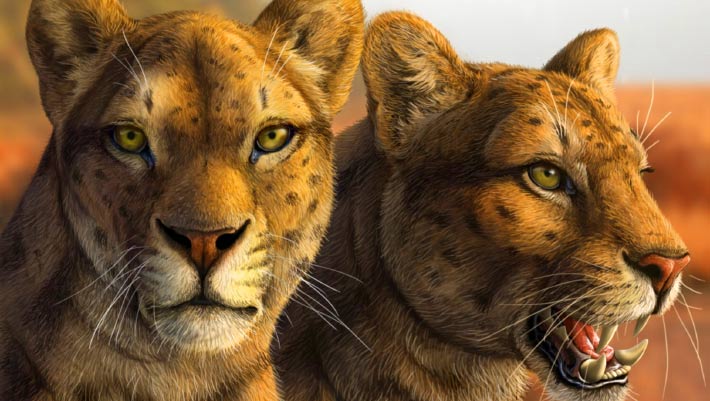
Early Saber-Toothed Cat Gets New Face after Decades of Mystery
Le premier chat à dents de sabre obtient un nouveau visage après des décennies de mystère
dent paléoart reconstitution États-Unis Pliocène mammifères crâne
Un crâne presque complet découvert il y a plusieurs décennies en Arizona a donné aux paléontologues leur aperçu le plus clair à ce jour d'Adelphailurus kansensis, une espèce énigmatique de félidés qui habitait l'Amérique du Nord il y a plus de 5 millions d'années et occupait une des premières branches de l'arbre généalogique des chats à dents de sabre. L'article Le premier chat à dents de sabre obtient un nouveau visage après des décennies de mystère est apparu en premier sur Sci.News : Breaking Science News.
29/06/2026 sci-news ⚙ Traduction automatique
Un superbe crâne de théropode exposé
musée fossile Tyrannosaurus crâne
Lors d'une visite au Museum für Naturkunde (Berlin) nous en avons profité pour photographier le magnifique crâne de Tristan le Tyrannosaurus rex.  Le crâne est l’un des crânes de tyrannosaure les plus complets et les mieux conservés connus de la science.  Les fossiles de T. rex, exposés à côté du crâne, ont été nommés Tristan Otto.  À
12/06/2026 everythingdinosaur ⚙ Traduction automatique
1 2 3 4 5 6