skull

View type

386 image(s) · 29 News

Image gallery

Skull of Saichania, Warsaw Museum of Evolution

Skull of Saichania, Warsaw Museum of Evolution

museum Saichania evolution skull
Skull of Oohkotokia horneri, gen. et sp. nov. (MOR 433, holotype)

Skull of Oohkotokia horneri, gen. et sp. nov. (MOR 433, holotype)

holotype Oohkotokia skull
The incomplete skull and vertebrae of the holotype of Omphalosaurus nevadanus, seen in dorsal (left) and ventral view (right). This image was derived by combining plates 8 and 9 of Merriam (1906), done by an uncredited artist.
Legend:

A - angular
D - dentary
Pl - palatine
Pt - pterygoid
Sa - surangular
Sp - splenial
V - vertebrae
a, b, c - "doubtful elements"

The incomplete skull and vertebrae of the holotype of Omphalosaurus nevadanus, seen in dorsal (left) and ventral view (right). This image was derived by combining plates 8 and 9 of Merriam (1906), done by an uncredited artist. Legend: A - angular D - dentary Pl - palatine Pt - pterygoid Sa - surangular Sp - splenial V - vertebrae a, b, c - "doubtful elements"

holotype Merriamia skull
Restored Placochelys placodonta skull at the Museum für Naturkunde, Berlin.

Restored Placochelys placodonta skull at the Museum für Naturkunde, Berlin.

museum Placochelyidae Placochelys skull
Comparison of cranial features between closely related southern Laramidian taxa; (A), Akainacephalus johnsoni (UMNH VP 20202) from the Late Cretaceous Kaiparowits Formation of Utah; and (B), Nodocephalosaurus kirtlandensis (SMP VP-900) from the Late Cretaceous Kirtland Formation of New Mexico, in left lateral views. Various synapomorphies are shared with N. kirtlandensis (highlighted in black and white arrows) and includes “flaring nostrils”; enlarged, laterally projecting, loreal osteoderms that are situated directly dorsal to the external nares. Other synapomorphies include pyramid-shaped nasal and frontal osteoderms positioned on the dorsal regions of the skull. A number of significant differences have been observed between both specimens; in A. johnsoni, the anterior, and posterior supraorbital bosses form an enlarged element that is somewhat backswept, whereas in N. kirtlandensis, the posterior and anterior supraorbital bosses are clearly defined as individual osteoderms, and are much smaller in size. Additionally, the squamosal horn in Akainacephalus is very small but is prominent and tetrahedrally shaped in Nodocephalosaurus. The quadratojugal horn in Akainacephalus is massive, has a subtriangular morphology in lateral view and projects almost entirely ventral, whereas in Nodocephalosaurus, the quadratojugal horn is smaller and has a typical fin-shaped morphology. Study sites: asob, anterior supraorbital boss; ext naris, external naris; laca, lacrimal caputegulum; loca, loreal caputegulum; naca, nasal caputegulae; orb, orbit; psob, posterior supraorbital boss; qjh, quadratojugal horn; sqh, squamosal horn.

Comparison of cranial features between closely related southern Laramidian taxa; (A), Akainacephalus johnsoni (UMNH VP 20202) from the Late Cretaceous Kaiparowits Formation of Utah; and (B), Nodocephalosaurus kirtlandensis (SMP VP-900) from the Late Cretaceous Kirtland Formation of New Mexico, in left lateral views. Various synapomorphies are shared with N. kirtlandensis (highlighted in black and white arrows) and includes “flaring nostrils”; enlarged, laterally projecting, loreal osteoderms that are situated directly dorsal to the external nares. Other synapomorphies include pyramid-shaped nasal and frontal osteoderms positioned on the dorsal regions of the skull. A number of significant differences have been observed between both specimens; in A. johnsoni, the anterior, and posterior supraorbital bosses form an enlarged element that is somewhat backswept, whereas in N. kirtlandensis, the posterior and anterior supraorbital bosses are clearly defined as individual osteoderms, and are much smaller in size. Additionally, the squamosal horn in Akainacephalus is very small but is prominent and tetrahedrally shaped in Nodocephalosaurus. The quadratojugal horn in Akainacephalus is massive, has a subtriangular morphology in lateral view and projects almost entirely ventral, whereas in Nodocephalosaurus, the quadratojugal horn is smaller and has a typical fin-shaped morphology. Study sites: asob, anterior supraorbital boss; ext naris, external naris; laca, lacrimal caputegulum; loca, loreal caputegulum; naca, nasal caputegulae; orb, orbit; psob, posterior supraorbital boss; qjh, quadratojugal horn; sqh, squamosal horn.

Mexico Kaiparowits Kirtland Cretaceous +6
Riojasaurus skull cast, Copenhagen.

Riojasaurus skull cast, Copenhagen.

cast Riojasauridae Riojasaurus skull
Skull of Pistosaurus longaevus (cast - USNM 16107) in right, left and posterior views.
Taxa Pistosaurus

Skull of Pistosaurus longaevus (cast - USNM 16107) in right, left and posterior views.

cast Pistosauria Pistosauridae skull
Skull of Pistosaurus longaevus (cast - USNM 16107) in right, left and posterior views.
Taxa Pistosauridae

Skull of Pistosaurus longaevus (cast - USNM 16107) in right, left and posterior views.

cast Pistosauria Pistosauridae skull
Skull replica of Vagaceratops at Canadian Museum of Nature

Skull replica of Vagaceratops at Canadian Museum of Nature

museum Vagaceratops skull
Skull cast of Anchiceratops ornatus (original specimen: TMP 1983.001.0001) on display at the University of Michigan Museum of Natural History.

Skull cast of Anchiceratops ornatus (original specimen: TMP 1983.001.0001) on display at the University of Michigan Museum of Natural History.

museum cast specimen Anchiceratops +1
Cranial remains of Arthropterygius chrisorum CCMGE 17–44/13328 (A–J) and PMO 222.669 (L, M).

(A, B) Right postfrontal in ventral (A) and dorsal (B) views. (C) Left lateral view on articulated postfrontal, prefrontal and nasal. (D) Left prefrontal in ventral view. (E, F) Right prefrontal in ventral (E) and dorsal (F) views. (G, H) left nasal in dorsal (G) and ventral (H) views. (I, J) Left jugal in medial (I) and lateral (J) views. (K) Cranial reconstruction, showing the depicted elements (colored). (L, M) oblique dorsal view and interpretation of sutures of the skull roof of PMO 222.669. Abbreviations: ffr, facet for the frontal; fnas, facet of the nasal; fpo, facet for the postorbital; fpref, facet for the prefrontal; fqj, facet for the quadratojugal; fsut, facet for the supratemporal; lw, lateral wing of the nasal lamella; nas, nasal; par, parietal; pf, parietal foramen; pref, prefrontal; sut, supratemporal. Both scale bars represent 10 cm.

Cranial remains of Arthropterygius chrisorum CCMGE 17–44/13328 (A–J) and PMO 222.669 (L, M). (A, B) Right postfrontal in ventral (A) and dorsal (B) views. (C) Left lateral view on articulated postfrontal, prefrontal and nasal. (D) Left prefrontal in ventral view. (E, F) Right prefrontal in ventral (E) and dorsal (F) views. (G, H) left nasal in dorsal (G) and ventral (H) views. (I, J) Left jugal in medial (I) and lateral (J) views. (K) Cranial reconstruction, showing the depicted elements (colored). (L, M) oblique dorsal view and interpretation of sutures of the skull roof of PMO 222.669. Abbreviations: ffr, facet for the frontal; fnas, facet of the nasal; fpo, facet for the postorbital; fpref, facet for the prefrontal; fqj, facet for the quadratojugal; fsut, facet for the supratemporal; lw, lateral wing of the nasal lamella; nas, nasal; par, parietal; pf, parietal foramen; pref, prefrontal; sut, supratemporal. Both scale bars represent 10 cm.

scale Arthropterygius skull
Skull of Lesothosaurus - ornithischian dinosaur
Taxa Stormbergia

Skull of Lesothosaurus - ornithischian dinosaur

Dinosauria Lesothosauria Ornithischia Stormbergia +1
The nodosaurid dinosaur, Glyptodontopelta is mostly known from isolated osteoderms ("armor plates"). The specimen SMP VP-1580 (State Museum of Pennysylvania) is however, the most complete known specimen, comprising parts of the skull, hundreds of osteoderms and fragments. This specimen was discovered in 2003 by Warwick Fowler, in the Naashoibito Member of the Ojo Alamo Formation (Maatrichtian, Late Cretaceous) of the San Juan Basin, New Mexico, during an expedition led by Dr. Robert Sullivan.

The nodosaurid dinosaur, Glyptodontopelta is mostly known from isolated osteoderms ("armor plates"). The specimen SMP VP-1580 (State Museum of Pennysylvania) is however, the most complete known specimen, comprising parts of the skull, hundreds of osteoderms and fragments. This specimen was discovered in 2003 by Warwick Fowler, in the Naashoibito Member of the Ojo Alamo Formation (Maatrichtian, Late Cretaceous) of the San Juan Basin, New Mexico, during an expedition led by Dr. Robert Sullivan.

armor museum Mexico Denver +9
Reconstruction and restoration of the skull of Eolambia.

(A) Skull reconstruction of Eolambia in left lateral view by the lead author. Bones in white are unknown, bones in dark grey are based primarily upon the adult holotype (CEUM 9758) or paratype (CEUM 5212), and bones in light grey are based primarily upon juvenile elements from the Eo2 and WS8 bonebeds. Sutures and points of contact between bones are marked in black. Scale bar equals 10 cm; scale is calibrated with the dentary of CEUM 9758. (B) Life restoration of the head of Eolambia by Lukas Panzarin. Abbreviations: an, angular; d, dentary; f, frontal; j, jugal; l, lacrimal; mx, maxilla; na, nasal; pd, predentary; pmx, premaxilla; po, postorbital; prf, prefrontal; q, quadrate; qj, quadratojugal; sa, surangular; sq, squamosal.

Reconstruction and restoration of the skull of Eolambia. (A) Skull reconstruction of Eolambia in left lateral view by the lead author. Bones in white are unknown, bones in dark grey are based primarily upon the adult holotype (CEUM 9758) or paratype (CEUM 5212), and bones in light grey are based primarily upon juvenile elements from the Eo2 and WS8 bonebeds. Sutures and points of contact between bones are marked in black. Scale bar equals 10 cm; scale is calibrated with the dentary of CEUM 9758. (B) Life restoration of the head of Eolambia by Lukas Panzarin. Abbreviations: an, angular; d, dentary; f, frontal; j, jugal; l, lacrimal; mx, maxilla; na, nasal; pd, predentary; pmx, premaxilla; po, postorbital; prf, prefrontal; q, quadrate; qj, quadratojugal; sa, surangular; sq, squamosal.

bone scale holotype juvenile +2
Type skull of Pentaceratops sternbergii, American Museum of Natural History # AMNH6325

Type skull of Pentaceratops sternbergii, American Museum of Natural History # AMNH6325

museum Pentaceratops skull
Figure description from the paper: "The segmented model of right lateral side of the skull of mixosaurid ichthyosaur Phalarodon fraasi (Merriam, 1910) PMO 235.393, from the Botneheia Formation, Middle Triassic of the Isfjorden area in Spitsbergen, Svalbard."
References:

Roberts, A.J.; Engelschiøn, V.S.; Hurum, J.H. (2022). "First three-dimensional skull of the Middle Triassic mixosaurid ichthyosaur Phalarodon fraasi from Svalbard, Norway". Acta Palaeontologica Polonica 67 (1): 51–62. DOI:https://doi.org/10.4202/app.00915.2021.
Taxa Contectopalatus

Figure description from the paper: "The segmented model of right lateral side of the skull of mixosaurid ichthyosaur Phalarodon fraasi (Merriam, 1910) PMO 235.393, from the Botneheia Formation, Middle Triassic of the Isfjorden area in Spitsbergen, Svalbard." References: Roberts, A.J.; Engelschiøn, V.S.; Hurum, J.H. (2022). "First three-dimensional skull of the Middle Triassic mixosaurid ichthyosaur Phalarodon fraasi from Svalbard, Norway". Acta Palaeontologica Polonica 67 (1): 51–62. DOI:https://doi.org/10.4202/app.00915.2021.

description Norway Middle Triassic Triassic +7
1 2 3 4 5 6 7 8 9 10 11 12 13 14 15 16 17 18 19 20 21 22 23 24 25

News

The dodo bird had a secret sensory world scientists are only now discovering
bird CT-scan discovery skull
CT scans of the world’s rarest dodo skulls suggest the extinct bird may have had a stronger sense of smell, a highly sensitive beak, and a lifestyle that extended into dawn and dusk. The discoveries are helping overturn centuries-old myths and reveal a far more complex animal than the famously “dumb” dodo of popular imagination.
09/08/2026 sciencedaily-paleo
A forgotten fossil just revealed a new Triassic predator from 210 million years ago
jaw predator prey Mexico Triassic fossil skull
A fossil overlooked for nearly 80 years has revealed a previously unknown crocodile relative that lived 210 million years ago in what is now New Mexico. Named Eosphorosuchus lacrimosa, the jackal-sized predator had a reinforced skull, powerful jaw muscles, and a short snout built for tackling larger prey.
30/07/2026 sciencedaily
This dinosaur fossil captures the final moments of a T. rex attack
tooth predator prey fossil Dinosauria Edmontosaurus Tyrannosaurus discovery skull
A fossilized Edmontosaurus skull with a Tyrannosaurus tooth still embedded in its face has given scientists rare evidence of a dramatic predator-prey encounter. The discovery suggests the giant carnivore delivered an incredibly powerful face-to-face bite, offering new clues about how Tyrannosaurus hunted.
14/07/2026 sciencedaily
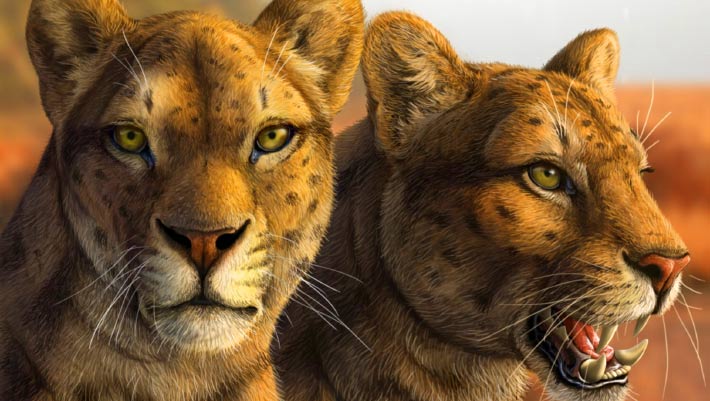
Early Saber-Toothed Cat Gets New Face after Decades of Mystery
tooth paleoart reconstitution United States Pliocene mammals skull
A nearly complete skull unearthed decades ago in Arizona has given paleontologists their clearest look yet at Adelphailurus kansensis, an enigmatic felid species that inhabited North America more than 5 million years ago and occupied an early branch of the saber-toothed cat family tree. The post Early Saber-Toothed Cat Gets New Face after Decades of Mystery appeared first on Sci.News: Breaking Science News.
29/06/2026 sci-news
A Stunning Theropod Skull on Display
museum fossil Tyrannosaurus skull
During a visit to the Museum für Naturkunde (Berlin) we took the opportunity to photograph the beautiful skull of Tristan the Tyrannosaurus rex.  The skull is one of the most complete and best-preserved tyrannosaur skulls known to science.  The T. rex fossils, on display next to the skull material have been named Tristan Otto.  To
12/06/2026 everythingdinosaur
1 2 3 4 5 6