skull

View type

386 image(s) · 29 News

Image gallery

Hypothetical Plesiolophus skull reconstruction with known elements in white. Missing elements in grey. Scale bar 20 cm.
Taxa Plesiolophus

Hypothetical Plesiolophus skull reconstruction with known elements in white. Missing elements in grey. Scale bar 20 cm.

scale Plesiolophus skull
Montanoceratops cerorhynchus (Brown & Schlaikjer, 1942) - fossil ceratopsian dinosaur skeleton from the Cretaceous of Montana, USA. (MOR 542, Museum of the Rockies, Bozeman, Montana, USA)
The species name is sometimes incorrectly spelled "cerorhynchos".  The original publication spells it "cerorhynchus".  The genus name is sometimes incorrectly spelled "Montanaceratops".
Ceratopsians are the "horned dinosaurs".  They were large, quadrupedal, herbivorous dinosaurs having a beaked skull and a frill - an extension of bone behind the skull that partially covered the neck.  Ceratopsian dinosaurs are known from the Jurassic and Cretaceous.  The last members of the group died out at the Cretaceous-Tertiary boundary, 65 million years ago.
This is a partial skeleton of a juvenile Montanoceratops, a ceratopsian from the near-latest Cretaceous of western North America.  This type of ceratopsian lacked facial horns.


From exhibit signage:
Sixty-eight million years ago, when the horned dinosaurs Triceratops and Torosaurus inhabited the coastal plain near the inland ocean, primitive "horned" dinosaurs named Montanoceratops lived in uplands near the young Rocky Mountains.  These little protoceratopsians fed on plants with slicing teeth and narrow beaks similar to their giant three-horned relatives.


Classification: Animalia, Chordata, Vertebrata, Reptilia, Archosauria, Dinosauria, Ornithischia, Marginocephalia, Ceratopsia, Leptoceratopsidae
Stratigraphy: St. Mary River Formation, Maastrichtian Stage, Upper Cretaceous
Locality: Little Rocky Coulee, north of the town of Cut Bank, eastern Glacier County, northwestern Montana, USA


Info. at:

en.wikipedia.org/wiki/Montanoceratops
Taxa Montanoceratops

Montanoceratops cerorhynchus (Brown & Schlaikjer, 1942) - fossil ceratopsian dinosaur skeleton from the Cretaceous of Montana, USA. (MOR 542, Museum of the Rockies, Bozeman, Montana, USA) The species name is sometimes incorrectly spelled "cerorhynchos". The original publication spells it "cerorhynchus". The genus name is sometimes incorrectly spelled "Montanaceratops". Ceratopsians are the "horned dinosaurs". They were large, quadrupedal, herbivorous dinosaurs having a beaked skull and a frill - an extension of bone behind the skull that partially covered the neck. Ceratopsian dinosaurs are known from the Jurassic and Cretaceous. The last members of the group died out at the Cretaceous-Tertiary boundary, 65 million years ago. This is a partial skeleton of a juvenile Montanoceratops, a ceratopsian from the near-latest Cretaceous of western North America. This type of ceratopsian lacked facial horns. From exhibit signage: Sixty-eight million years ago, when the horned dinosaurs Triceratops and Torosaurus inhabited the coastal plain near the inland ocean, primitive "horned" dinosaurs named Montanoceratops lived in uplands near the young Rocky Mountains. These little protoceratopsians fed on plants with slicing teeth and narrow beaks similar to their giant three-horned relatives. Classification: Animalia, Chordata, Vertebrata, Reptilia, Archosauria, Dinosauria, Ornithischia, Marginocephalia, Ceratopsia, Leptoceratopsidae Stratigraphy: St. Mary River Formation, Maastrichtian Stage, Upper Cretaceous Locality: Little Rocky Coulee, north of the town of Cut Bank, eastern Glacier County, northwestern Montana, USA Info. at: en.wikipedia.org/wiki/Montanoceratops

bone museum United States Cretaceous +17
Skull of a Parksosaurus
Taxa Parksosaurus

Skull of a Parksosaurus

Parksosaurus skull
Leaellynasaura amicagraphica, dinosaur, skull. Holotype. [P 185991]
Taxa Leaellynasaura

Leaellynasaura amicagraphica, dinosaur, skull. Holotype. [P 185991]

museum holotype Dinosauria Leaellynasaura +1
Skull reconstruction of Incisivosaurus gauthieri.
Taxa Incisivosaurus

Skull reconstruction of Incisivosaurus gauthieri.

Incisivosaurus skull
Sarcosaurus diagram of known material: reconstruction based on basal Ceratosaurs (such as Berberosaurus and Saltriovenator). The Skull was made to look more generic and less like more derived Ceratosaurs such as Ceratosaurus. "Liassaurus", referred to "cf. Sarcosaurus woodi" and is smaller than the holotype: material in light grey is preserved, but to what extent is uncertain as it is not figured.
References:
Carrano and Sampson (2004). "A review of coelophysoids (Dinosauria: Theropoda) from the Early Jurassic of Europe, with comments on the late history of the Coelophysoidea." N. Jb. Geol. Palaont. Mh., 2004(9): 537-558. (for figures of the material)
theropoddatabase.com/Coelophysoidea.htm#Sarcosauruswoodi (for measurements of "Liassaurus")

Allain, Ronan & Tykoski, Ronald & Aquesbi, Najat & Jalil, Nour-Eddine & Monbaron, Michel & Russell, Dale & Taquet, Philippe. (2007). An abelisauroid (Dinosauria: Theropoda) from the Early Jurassic of the High Atlas Mountains, Morocco, and the radiation of Ceratosaurs. Journal of Vertebrate Paleontology. 27. 10.1671/0272-4634(2007)27[610:AADTFT]2.0.CO;2. (for measurements for Berberosaurus)
Taxa Sarcosaurus

Sarcosaurus diagram of known material: reconstruction based on basal Ceratosaurs (such as Berberosaurus and Saltriovenator). The Skull was made to look more generic and less like more derived Ceratosaurs such as Ceratosaurus. "Liassaurus", referred to "cf. Sarcosaurus woodi" and is smaller than the holotype: material in light grey is preserved, but to what extent is uncertain as it is not figured. References: Carrano and Sampson (2004). "A review of coelophysoids (Dinosauria: Theropoda) from the Early Jurassic of Europe, with comments on the late history of the Coelophysoidea." N. Jb. Geol. Palaont. Mh., 2004(9): 537-558. (for figures of the material) theropoddatabase.com/Coelophysoidea.htm#Sarcosauruswoodi (for measurements of "Liassaurus") Allain, Ronan & Tykoski, Ronald & Aquesbi, Najat & Jalil, Nour-Eddine & Monbaron, Michel & Russell, Dale & Taquet, Philippe. (2007). An abelisauroid (Dinosauria: Theropoda) from the Early Jurassic of the High Atlas Mountains, Morocco, and the radiation of Ceratosaurs. Journal of Vertebrate Paleontology. 27. 10.1671/0272-4634(2007)27[610:AADTFT]2.0.CO;2. (for measurements for Berberosaurus)

Morocco Early Jurassic Jurassic holotype +8
Rhomboid distal nasal process of the crest of Tsintaosaurus spinorhinus.

A. Partial distal nasal process of IVPP V725 in right lateral view. B. Lateral view of composite skull (reversed). C. partial premaxillonasal complex of IVPP V829 in right lateral view. D. Line drawing of (C) showing nasal-premaxilla articulation, and the displacement (arrow) experienced by the distal nasal process relative to its articular position. E. Mounted holotype skull (IVPP V725) of T. spinorhinus in left lateral view (reversed). F. Partial right distal nasal process (although catalogued as IVPP V725, this element corresponds to a different specimen than the type; reversed).
Taxa Tsintaosaurus

Rhomboid distal nasal process of the crest of Tsintaosaurus spinorhinus. A. Partial distal nasal process of IVPP V725 in right lateral view. B. Lateral view of composite skull (reversed). C. partial premaxillonasal complex of IVPP V829 in right lateral view. D. Line drawing of (C) showing nasal-premaxilla articulation, and the displacement (arrow) experienced by the distal nasal process relative to its articular position. E. Mounted holotype skull (IVPP V725) of T. spinorhinus in left lateral view (reversed). F. Partial right distal nasal process (although catalogued as IVPP V725, this element corresponds to a different specimen than the type; reversed).

crest drawing holotype specimen +3
Xenovenator espinosai, holotype braincase CPC 2973. In (A) left lateral; (B) right lateral; (C) dorsal; (D) ventral; (E) anterior; (F) posterior. Abbreviations: bo, basicoccipital; bul, parabasisphenoid bulla; ex, exoccipital; fr, frontal; lad, lateral depression; lac, lacrimal articulation; lat, laterosphenoid; osp, orbitosphenoid; par, parietal; pbs, parabasisphenoid; po, postorbital; ri, median ridge; sk, skull; stf, supratemporal fossa.
Taxa Xenovenator

Xenovenator espinosai, holotype braincase CPC 2973. In (A) left lateral; (B) right lateral; (C) dorsal; (D) ventral; (E) anterior; (F) posterior. Abbreviations: bo, basicoccipital; bul, parabasisphenoid bulla; ex, exoccipital; fr, frontal; lad, lateral depression; lac, lacrimal articulation; lat, laterosphenoid; osp, orbitosphenoid; par, parietal; pbs, parabasisphenoid; po, postorbital; ri, median ridge; sk, skull; stf, supratemporal fossa.

holotype Xenovenator skull
Skull of Dromiceiomimus
Taxa Dromiceiomimus

Skull of Dromiceiomimus

Dromiceiomimus skull
PLATE II(IX).
Fig. 1. Anchisaurus colurus MARSH. All extant specimens in approximately 1/5 nat. size. Connecticut red sandstone (Upper Triassic). Manchester, Conn., USA. MARSH's original specimen, preserved at the Yale Museum, New Haven, Conn. Scale bar: 11 cm.

Skull: see Pl. I [VIII], forefoot: see Pl. III [X], scapula, hindleg, and pubis: see figures in the text.
Taxa Anchisaurus

PLATE II(IX). Fig. 1. Anchisaurus colurus MARSH. All extant specimens in approximately 1/5 nat. size. Connecticut red sandstone (Upper Triassic). Manchester, Conn., USA. MARSH's original specimen, preserved at the Yale Museum, New Haven, Conn. Scale bar: 11 cm. Skull: see Pl. I [VIII], forefoot: see Pl. III [X], scapula, hindleg, and pubis: see figures in the text.

scale museum United States Triassic +3
Skull of Saichania, Warsaw Museum of Evolution
Taxa Saichania

Skull of Saichania, Warsaw Museum of Evolution

museum Saichania evolution skull
Skull of Oohkotokia horneri, gen. et sp. nov. (MOR 433, holotype)
Taxa Oohkotokia

Skull of Oohkotokia horneri, gen. et sp. nov. (MOR 433, holotype)

holotype Oohkotokia skull
Skull replica of Vagaceratops at Canadian Museum of Nature
Taxa Vagaceratops

Skull replica of Vagaceratops at Canadian Museum of Nature

museum Vagaceratops skull
Skull cast of Anchiceratops ornatus (original specimen: TMP 1983.001.0001) on display at the University of Michigan Museum of Natural History.
Taxa Anchiceratops

Skull cast of Anchiceratops ornatus (original specimen: TMP 1983.001.0001) on display at the University of Michigan Museum of Natural History.

museum cast specimen Anchiceratops +1
Cranial remains of Arthropterygius chrisorum CCMGE 17–44/13328 (A–J) and PMO 222.669 (L, M).

(A, B) Right postfrontal in ventral (A) and dorsal (B) views. (C) Left lateral view on articulated postfrontal, prefrontal and nasal. (D) Left prefrontal in ventral view. (E, F) Right prefrontal in ventral (E) and dorsal (F) views. (G, H) left nasal in dorsal (G) and ventral (H) views. (I, J) Left jugal in medial (I) and lateral (J) views. (K) Cranial reconstruction, showing the depicted elements (colored). (L, M) oblique dorsal view and interpretation of sutures of the skull roof of PMO 222.669. Abbreviations: ffr, facet for the frontal; fnas, facet of the nasal; fpo, facet for the postorbital; fpref, facet for the prefrontal; fqj, facet for the quadratojugal; fsut, facet for the supratemporal; lw, lateral wing of the nasal lamella; nas, nasal; par, parietal; pf, parietal foramen; pref, prefrontal; sut, supratemporal. Both scale bars represent 10 cm.
Taxa Arthropterygius

Cranial remains of Arthropterygius chrisorum CCMGE 17–44/13328 (A–J) and PMO 222.669 (L, M). (A, B) Right postfrontal in ventral (A) and dorsal (B) views. (C) Left lateral view on articulated postfrontal, prefrontal and nasal. (D) Left prefrontal in ventral view. (E, F) Right prefrontal in ventral (E) and dorsal (F) views. (G, H) left nasal in dorsal (G) and ventral (H) views. (I, J) Left jugal in medial (I) and lateral (J) views. (K) Cranial reconstruction, showing the depicted elements (colored). (L, M) oblique dorsal view and interpretation of sutures of the skull roof of PMO 222.669. Abbreviations: ffr, facet for the frontal; fnas, facet of the nasal; fpo, facet for the postorbital; fpref, facet for the prefrontal; fqj, facet for the quadratojugal; fsut, facet for the supratemporal; lw, lateral wing of the nasal lamella; nas, nasal; par, parietal; pf, parietal foramen; pref, prefrontal; sut, supratemporal. Both scale bars represent 10 cm.

scale Arthropterygius skull
Skull of Lesothosaurus - ornithischian dinosaur
Taxa Lesothosaurus

Skull of Lesothosaurus - ornithischian dinosaur

Dinosauria Lesothosauria Ornithischia skull
1 2 3 4 5 6 7 8 9 10 11 12 13 14 15 16 17 18 19 20 21 22 23 24 25

News

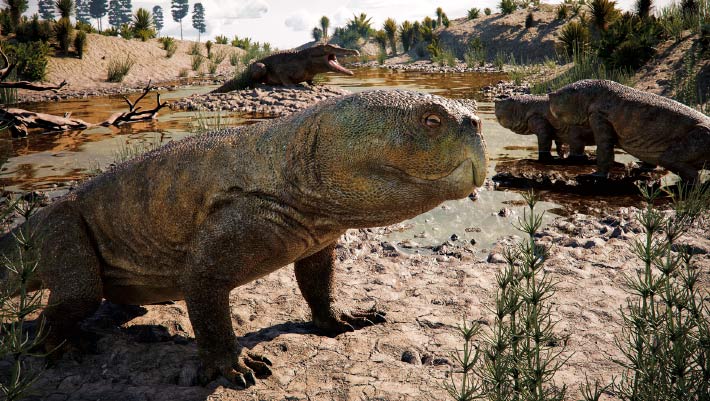
New Fossil from Brazil Reveals Unexpected Diversity among Pre-Dinosaur Herbivores
jaw Brazil Triassic fossil Dinosauria new species partial skull
Paleontologists in Brazil have identified a new genus and species of hyperodapedontine rhynchosaur -- an extinct lineage of beaked, herbivorous reptiles -- based on a partial skull and lower jaws recovered from Triassic rocks. The post New Fossil from Brazil Reveals Unexpected Diversity among Pre-Dinosaur Herbivores appeared first on Sci.News: Breaking Science News.
23/04/2026 sci-news
New Triassic Dinosaur Species Identified in New Mexico
Mexico United States Triassic Dinosauria new species skull
A new genus and species of carnivorous herrerasaurian dinosaur has been described from an incomplete but well-preserved skull found in northern New Mexico, the United States. The post New Triassic Dinosaur Species Identified in New Mexico appeared first on Sci.News: Breaking Science News.
17/04/2026 sci-news
A crushed fossil revealed a dinosaur that shouldn’t have existed
Triassic fossil Dinosauria discovery extinction new species skull
A badly mangled dinosaur skull, once forgotten in a drawer, turned out to be a rare and important discovery. Reconstructed by a Virginia Tech student, it revealed a new species of early carnivorous dinosaur with unusual features never seen before. The fossil suggests some dinosaur groups were wiped out during the end-Triassic extinction, not just their rivals. It may represent one of the last survivors of an ancient dinosaur lineage.
15/04/2026 sciencedaily
Daemonosaurus: Beast of the Week
Mexico United States Late Triassic Triassic Daemonosaurus Dinosauria skull
 This week we will be checking out a unique looking early dinosaur with a very cool name.  Meet Daemonosaurus chaoliodus!Daemonosaurus was a small meat-eating dinosaur that lived in what is now New Mexico, United States, during the late Triassic period, roughly between 205 and 200 million years ago.  From nose to tail it is estimated to have measured roughly 5 to 7 feet (1.5-2.2m).  These are estimates based on the fact that only the skull and neck were found.  The genus name translates to "Demo
05/04/2026 prehistoricbeastoftheweek
Scientists found a baby dinosaur hidden in rock and it is surprisingly cute
bone drawing South Korea Dinosauria Doolysaurus CT-scan discovery skull
Scientists uncovered a rare baby dinosaur in South Korea and named it Doolysaurus after a famous cartoon character. Using cutting-edge CT scans, they discovered hidden bones—including a skull—inside rock much faster than traditional methods. The young dinosaur, possibly fluffy and lamb-like, even had stomach stones that reveal it ate a mix of plants and small animals. The discovery suggests many more dinosaurs may still be hidden in Korea’s rocks.
01/04/2026 sciencedaily
1 2 3 4 5 6