crâne

Type de vue

386 image(s) · 29 Actualités

Galerie d'images

Zhejiangopterus linhaiensis, skull (cast), Zhejiang Geological Museum

Zhejiangopterus linhaiensis, skull (cast), Zhejiang Geological Museum

musée moulage Zhejiangopterus crâne
Skull of Caiuajara dobruskii gen. et sp. nov. (holotype, CP.V 1449) with the shape of an adult individual.

Scale bar equals 50: d, dentary; dcr, dentary crest; dep, depression; exp, ventral expansion of the premaxilla; f, frontal; fcr, frontal crest; fo, foraminae; m, maxilla; oc, occipital condyle; op, opisthotic; p, parietal; pm, premaxilla; pmcr, premaxillary crest; q, quadrate; soc, supraoccipital. The quadrate is inverted.

Skull of Caiuajara dobruskii gen. et sp. nov. (holotype, CP.V 1449) with the shape of an adult individual. Scale bar equals 50: d, dentary; dcr, dentary crest; dep, depression; exp, ventral expansion of the premaxilla; f, frontal; fcr, frontal crest; fo, foraminae; m, maxilla; oc, occipital condyle; op, opisthotic; p, parietal; pm, premaxilla; pmcr, premaxillary crest; q, quadrate; soc, supraoccipital. The quadrate is inverted.

crête écaille holotype Caiuajara +1
Reconstructed skull of Caupedactylus.

Reconstructed skull of Caupedactylus.

Brésil Caupedactylus crâne
Azhdarchoid pterosaur Kariridraco dianae gen. et sp. nov. holotype (MPSC R 1056) from Lower Cretaceous of Northeastern Brazil. Skull in right lateral view. Photograph (A1), interpretative drawing (A2). Dark grey areas indicate remains of the carbonate matrix still attachaed to the skull.

Azhdarchoid pterosaur Kariridraco dianae gen. et sp. nov. holotype (MPSC R 1056) from Lower Cretaceous of Northeastern Brazil. Skull in right lateral view. Photograph (A1), interpretative drawing (A2). Dark grey areas indicate remains of the carbonate matrix still attachaed to the skull.

dessin Brésil Crétacé holotype +3
Nemicolopterus crypticus holotype (IVPP V-14377).

(A) Skeleton overview, and (B) schematic drawing. (C) Skull (right lateral view), and (D) schematic drawing. Abbreviations: cdv, caudal vertebrae; co, coracoid; cv, cervical vertebra; d1–d4, digits 1–4; f, frontal; fe, femur; h, humerus; hy, hyoid; il, illium; is, ischium; j, jugal; l, left; la, lacrimal; mand, mandible; mc, metacarpal; mt, metatarsal; naof, nasoantorbital fenestra; or, orbit; pa, parietal; pm, premaxilla; ph, phalanx; ti, tibia; r, right; sca, scapula. Scale bars: A–B, 100 mm; C–D, 5 mm.

Nemicolopterus crypticus holotype (IVPP V-14377). (A) Skeleton overview, and (B) schematic drawing. (C) Skull (right lateral view), and (D) schematic drawing. Abbreviations: cdv, caudal vertebrae; co, coracoid; cv, cervical vertebra; d1–d4, digits 1–4; f, frontal; fe, femur; h, humerus; hy, hyoid; il, illium; is, ischium; j, jugal; l, left; la, lacrimal; mand, mandible; mc, metacarpal; mt, metatarsal; naof, nasoantorbital fenestra; or, orbit; pa, parietal; pm, premaxilla; ph, phalanx; ti, tibia; r, right; sca, scapula. Scale bars: A–B, 100 mm; C–D, 5 mm.

humérus écaille vertèbre dessin +4
Australian Mesozoic pterosaurs. A, Aussiedraco molnari (QM F10613; holotype) mandible in dorsal view. Scale = 1 cm. B, Mythunga camara (QM F18896; holotype) partial skull and mandible in left lateral view. Scale = 5 cm. C, Thapunngaka shawi (KK F494; holotype) mandible in left lateral view. Scale = 5 cm. D, Ferrodraco lentoni (AODF 0876; holotype [part]) partial skull and mandible in left lateral view. Scale = 5 cm.

Australian Mesozoic pterosaurs. A, Aussiedraco molnari (QM F10613; holotype) mandible in dorsal view. Scale = 1 cm. B, Mythunga camara (QM F18896; holotype) partial skull and mandible in left lateral view. Scale = 5 cm. C, Thapunngaka shawi (KK F494; holotype) mandible in left lateral view. Scale = 5 cm. D, Ferrodraco lentoni (AODF 0876; holotype [part]) partial skull and mandible in left lateral view. Scale = 5 cm.

écaille Mésozoïque holotype Aussiedraco +6
Reconstruction of the Abelisaurus skull with original bones of the holotype. Museo Provincial Carlos Ameghino, Cipolletti, Argentina. Scale = 10 cm

Reconstruction of the Abelisaurus skull with original bones of the holotype. Museo Provincial Carlos Ameghino, Cipolletti, Argentina. Scale = 10 cm

os écaille Argentine holotype +3
The theropod skull displays the distinctive features of this apex predator, including a long, robust snout, conical teeth, and strong jaw muscles adapted for gripping and tearing prey.

The theropod skull displays the distinctive features of this apex predator, including a long, robust snout, conical teeth, and strong jaw muscles adapted for gripping and tearing prey.

prédateur proie Rajasaurus crâne
Reconstructed skull of Duriavenator hesperis showing known material (white) of the holotype and only known specimen. Unknown bones based on related Eustreptospondylus oxoniensis. Scale bar is 10cm, image is 10px/cm. Cranial anatomy based on Benson (2008) "A redescription of "Megalosaurus" hesperis (Dinosauria, Theropoda) from the Inferior Oolite (Bajocian, Middle Jurassic) of Dorset, United Kingdom"

Reconstructed skull of Duriavenator hesperis showing known material (white) of the holotype and only known specimen. Unknown bones based on related Eustreptospondylus oxoniensis. Scale bar is 10cm, image is 10px/cm. Cranial anatomy based on Benson (2008) "A redescription of "Megalosaurus" hesperis (Dinosauria, Theropoda) from the Inferior Oolite (Bajocian, Middle Jurassic) of Dorset, United Kingdom"

os écaille Royaume-Uni Bajocien +11
Reconstructed skull of Wiehenvenator albati based on holotype specimen (white). Scale bar is 10cm, image if 10px/cm. Unknown material based on related Torvosaurus tanneri. Cranial anatomy based on Rauhut et al (2016) "A new megalosaurid theropod dinosaur from the late Middle Jurassic (Callovian) of north-western Germany: implications for theropod evolution and faunal turnover in the Jurassic"

Reconstructed skull of Wiehenvenator albati based on holotype specimen (white). Scale bar is 10cm, image if 10px/cm. Unknown material based on related Torvosaurus tanneri. Cranial anatomy based on Rauhut et al (2016) "A new megalosaurid theropod dinosaur from the late Middle Jurassic (Callovian) of north-western Germany: implications for theropod evolution and faunal turnover in the Jurassic"

écaille Allemagne Callovien Jurassique +10
Reconstruceted skull of Dubreuillosaurus illustrating known (white) and unknown (grey) material. Scale bar is 10cm. Based of figures and description of Allain (2002) "Discovery of megalosaur (Dinosauria, Theropoda) in the middle Bathonian of Normandy (France) and its implications for the phylogeny of basal Tetanurae"

Reconstruceted skull of Dubreuillosaurus illustrating known (white) and unknown (grey) material. Scale bar is 10cm. Based of figures and description of Allain (2002) "Discovery of megalosaur (Dinosauria, Theropoda) in the middle Bathonian of Normandy (France) and its implications for the phylogeny of basal Tetanurae"

écaille description France Bathonien +8
Reconstructed skull of the holotype and only specimen of Leshansaurus qianweiensis based on the possibly related megalosaurid Dubreuillosaurus valesdunensis. Scale bar is 10cm, image is 10px/cm. Cranial anatomy from figures in Fei et al. (2009) "A new carnosaur from the Late Jurassic of Qianwei, Sichuan, China". White bones are figured, light grey bones are unfigured and minimally described.

Reconstructed skull of the holotype and only specimen of Leshansaurus qianweiensis based on the possibly related megalosaurid Dubreuillosaurus valesdunensis. Scale bar is 10cm, image is 10px/cm. Cranial anatomy from figures in Fei et al. (2009) "A new carnosaur from the Late Jurassic of Qianwei, Sichuan, China". White bones are figured, light grey bones are unfigured and minimally described.

os écaille Chine Jurassique +9
Riparovenator milnerae holotype skull

Riparovenator milnerae holotype skull

holotype Riparovenator crâne
Ceratosuchops inferodios Holotype skull fragments

Ceratosuchops inferodios Holotype skull fragments

holotype Ceratosuchops crâne
Caihong juji holotype specimen (PMoL-B00175). Photographs of the slab (a) and counter slab (b) and line drawing (c) of the specimen based on both slabs. Photograph (d) and line drawing (e) of a composite of the rostrum of the skull and mandible exposed on the counter slab and the post-rostrum cranium exposed on the slab. Arrows indicate lacrimal crests. Question mark indicates uncertain identification. Scale bars: 10 cm a–c, 1 cm d and e. aof antorbital fenestra, cav caudal vertebra, cev cervical vertebra, dr dorsal rib, dv dorsal vertebra, ect ectopterygoid, emf external mandibular fenestra, en external naris, f feather, fu furcula, ga gastralia, hy hyoid, il ilium, is ischium, la left angular, lar left articular, lc left coracoid, lcr lacrimal crest, ld left dentary, lf left, frontal, lfe left femur, lh left humerus, lj left jugal, ll left lacrimal, lma left maxilla, lm left manus, ln left nasal, lp left pes, lpa left palatine, lpo left postorbital, lq left quadrate, lqj left quadratojugal, lr left radius, ls left scapula, lsp left splenial, lsa left surangular, lsq left squamosal, lt left tibiotarsus, lu left ulna, ma mandible, mf maxillary fenestra, o orbit, p parietal, pm premaxilla, pt pterygoid, pu pubis, rar right articular, rc right coracoid, rd right dentary, rfe right femur, rh right humerus, rm right manus, rp right pes, rpra right prearticular, rq right quadrate, rr right radius, rs right scapula, rt right tibiotarsus, ru right ulna, scl sclerotic bones, sk skull, sy synsacrum

Caihong juji holotype specimen (PMoL-B00175). Photographs of the slab (a) and counter slab (b) and line drawing (c) of the specimen based on both slabs. Photograph (d) and line drawing (e) of a composite of the rostrum of the skull and mandible exposed on the counter slab and the post-rostrum cranium exposed on the slab. Arrows indicate lacrimal crests. Question mark indicates uncertain identification. Scale bars: 10 cm a–c, 1 cm d and e. aof antorbital fenestra, cav caudal vertebra, cev cervical vertebra, dr dorsal rib, dv dorsal vertebra, ect ectopterygoid, emf external mandibular fenestra, en external naris, f feather, fu furcula, ga gastralia, hy hyoid, il ilium, is ischium, la left angular, lar left articular, lc left coracoid, lcr lacrimal crest, ld left dentary, lf left, frontal, lfe left femur, lh left humerus, lj left jugal, ll left lacrimal, lma left maxilla, lm left manus, ln left nasal, lp left pes, lpa left palatine, lpo left postorbital, lq left quadrate, lqj left quadratojugal, lr left radius, ls left scapula, lsp left splenial, lsa left surangular, lsq left squamosal, lt left tibiotarsus, lu left ulna, ma mandible, mf maxillary fenestra, o orbit, p parietal, pm premaxilla, pt pterygoid, pu pubis, rar right articular, rc right coracoid, rd right dentary, rfe right femur, rh right humerus, rm right manus, rp right pes, rpra right prearticular, rq right quadrate, rr right radius, rs right scapula, rt right tibiotarsus, ru right ulna, scl sclerotic bones, sk skull, sy synsacrum

crête plume humérus écaille +7
Skull reconstruction of Shanag ashile based on holotype IGM 100/1119, missing elements based on Sinornithosaurus.

Skull reconstruction of Shanag ashile based on holotype IGM 100/1119, missing elements based on Sinornithosaurus.

holotype Shanag Sinornithosaurus crâne
1 2 3 4 5 6 7 8 9 10 11 12 13 14 15 16 17 18 19 20 21 22 23 24 25

Actualités

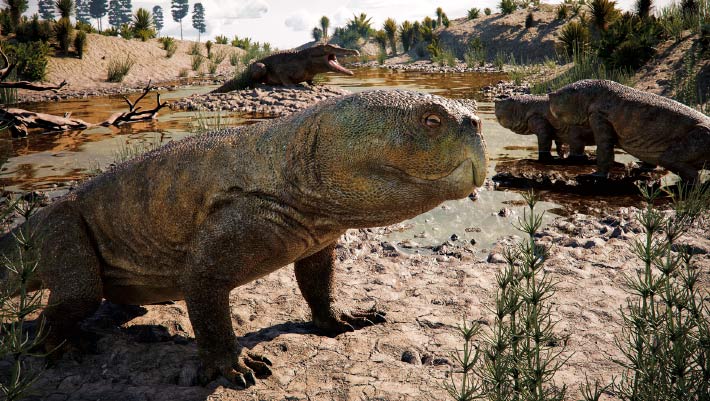
New Fossil from Brazil Reveals Unexpected Diversity among Pre-Dinosaur Herbivores
Un nouveau fossile du Brésil révèle une diversité inattendue parmi les herbivores pré-dinosaures
mâchoire Brésil Trias fossile Dinosauria nouvelle espèce partiel crâne
Des paléontologues du Brésil ont identifié un nouveau genre et une nouvelle espèce de rhynchosaure hyperodapédontique – une lignée éteinte de reptiles herbivores à bec – sur la base d'un crâne partiel et de mâchoires inférieures récupérés dans des roches du Trias. L'article Un nouveau fossile du Brésil révèle une diversité inattendue parmi les herbivores pré-dinosaures est apparu en premier sur Sci.News : Breaking Science News.
23/04/2026 sci-news ⚙ Traduction automatique
New Triassic Dinosaur Species Identified in New Mexico
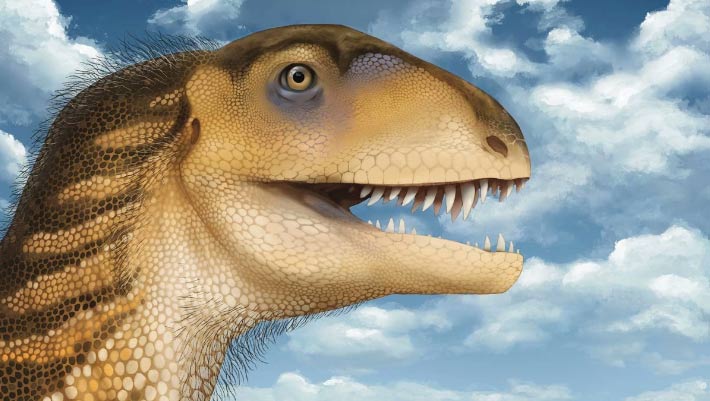
De nouvelles espèces de dinosaures du Trias identifiées au Nouveau-Mexique
Mexique États-Unis Trias Dinosauria nouvelle espèce crâne
Un nouveau genre et une nouvelle espèce de dinosaure herrerasaurien carnivore ont été décrits à partir d'un crâne incomplet mais bien conservé trouvé dans le nord du Nouveau-Mexique, aux États-Unis. L'article Nouvelles espèces de dinosaures du Trias identifiées au Nouveau-Mexique est apparu en premier sur Sci.News : Breaking Science News.
17/04/2026 sci-news ⚙ Traduction automatique
Un fossile écrasé révèle un dinosaure qui n’aurait pas dû exister
Trias fossile Dinosauria découverte extinction nouvelle espèce crâne
Un crâne de dinosaure gravement mutilé, oublié dans un tiroir, s'est avéré être une découverte rare et importante. Reconstruit par un étudiant de Virginia Tech, il a révélé une nouvelle espèce de dinosaure carnivore primitif présentant des caractéristiques inhabituelles jamais vues auparavant. Le fossile suggère que certains groupes de dinosaures ont été anéantis lors de l’extinction de la fin du Trias, et pas seulement leurs rivaux. Il s’agit peut-être de l’un des derniers survivants d’une ancienne lignée de dinosaures.
15/04/2026 sciencedaily ⚙ Traduction automatique
Daemonosaurus: Beast of the Week
Démonosaure : la bête de la semaine
Mexique États-Unis Trias supérieur Trias Daemonosaurus Dinosauria crâne
 Cette semaine, nous allons découvrir un premier dinosaure au look unique avec un nom très cool.  Rencontrez Daemonosaurus chaoliodus ! Daemonosaurus était un petit dinosaure carnivore qui vivait dans ce qui est aujourd'hui le Nouveau-Mexique, aux États-Unis, à la fin du Trias, il y a environ 205 à 200 millions d'années.  Du nez à la queue, on estime qu'il mesurait environ 5 à 7 pieds (1,5 à 2,2 m).  Il s’agit d’estimations basées sur le fait que seuls le crâne et le cou ont été retrouvés.  Le nom du genre se traduit par "Demo
05/04/2026 prehistoricbeastoftheweek ⚙ Traduction automatique
Les scientifiques ont trouvé un bébé dinosaure caché dans la roche et il est étonnamment mignon
os dessin Corée du Sud Dinosauria Doolysaurus tomographie découverte crâne
Des scientifiques ont découvert un bébé dinosaure rare en Corée du Sud et l'ont baptisé Doolysaurus, en hommage à un célèbre personnage de dessin animé. Grâce à des tomodensitogrammes de pointe, ils ont découvert des os cachés, notamment un crâne, dans la roche beaucoup plus rapidement que les méthodes traditionnelles. Le jeune dinosaure, peut-être duveteux et ressemblant à un agneau, avait même des calculs gastriques révélant qu'il mangeait un mélange de plantes et de petits animaux. Cette découverte suggère que de nombreux autres dinosaures pourraient encore être cachés dans les roches coréennes.
01/04/2026 sciencedaily ⚙ Traduction automatique
1 2 3 4 5 6