fossile

Nature du spécimen

371 image(s) · 183 Actualités

Galerie d'images

A hypothetical life restoration of Ampelosaurus atacis

• Ampelosaurus is known from hundreds of fossil specimens which show most of the dinosaur's osteological details, however, there are few articulated remains or reconstructions of the material so its overall proportions and life appearance are uncertain.
• Ampelosaurus is known to have supported osteoderms, only four are currently known. The number of these osteoderms that an individual Ampelosaurus would have supported in life and their and position on the body is not currently known. It's thought that due to the rarity of titanosaur osteoderms that they would be quite sparse on the body. The position and layout of the osteoderms has been loosely based on this interpretation, which is based on the work of Vidal et al 2015. [1]
Taxons Dashanpusaurus

A hypothetical life restoration of Ampelosaurus atacis • Ampelosaurus is known from hundreds of fossil specimens which show most of the dinosaur's osteological details, however, there are few articulated remains or reconstructions of the material so its overall proportions and life appearance are uncertain. • Ampelosaurus is known to have supported osteoderms, only four are currently known. The number of these osteoderms that an individual Ampelosaurus would have supported in life and their and position on the body is not currently known. It's thought that due to the rarity of titanosaur osteoderms that they would be quite sparse on the body. The position and layout of the osteoderms has been loosely based on this interpretation, which is based on the work of Vidal et al 2015. [1]

fossile spécimen Ampelosaurus Bagualosauria +6
Lower Triassic fossil footprint (ichnite) of the ichnogenus Chirotherium, probably caused by an early archosaur, and first discovered 1833 in Hildburghausen (Thuringia, Germany). This specimen, however, ist from the Helsby Sandstone of the Storeton Quarry near Liverpool. Its species name is Chirotherium storetonense.[1]
Taxons Abelichnus

Lower Triassic fossil footprint (ichnite) of the ichnogenus Chirotherium, probably caused by an early archosaur, and first discovered 1833 in Hildburghausen (Thuringia, Germany). This specimen, however, ist from the Helsby Sandstone of the Storeton Quarry near Liverpool. Its species name is Chirotherium storetonense.[1]

Allemagne Trias fossile spécimen +9
Lower Triassic fossil footprint (ichnite) of the ichnogenus Chirotherium, probably caused by an early archosaur, and first discovered 1833 in Hildburghausen (Thuringia, Germany). This specimen, however, ist from the Helsby Sandstone of the Storeton Quarry near Liverpool. Its species name is Chirotherium storetonense.[1]
Taxons Anticheiropus

Lower Triassic fossil footprint (ichnite) of the ichnogenus Chirotherium, probably caused by an early archosaur, and first discovered 1833 in Hildburghausen (Thuringia, Germany). This specimen, however, ist from the Helsby Sandstone of the Storeton Quarry near Liverpool. Its species name is Chirotherium storetonense.[1]

Allemagne Trias fossile spécimen +9
Lower Triassic fossil footprint (ichnite) of the ichnogenus Chirotherium, probably caused by an early archosaur, and first discovered 1833 in Hildburghausen (Thuringia, Germany). This specimen, however, ist from the Helsby Sandstone of the Storeton Quarry near Liverpool. Its species name is Chirotherium storetonense.[1]
Taxons Argoides

Lower Triassic fossil footprint (ichnite) of the ichnogenus Chirotherium, probably caused by an early archosaur, and first discovered 1833 in Hildburghausen (Thuringia, Germany). This specimen, however, ist from the Helsby Sandstone of the Storeton Quarry near Liverpool. Its species name is Chirotherium storetonense.[1]

Allemagne Trias fossile spécimen +9
Lower Triassic fossil footprint (ichnite) of the ichnogenus Chirotherium, probably caused by an early archosaur, and first discovered 1833 in Hildburghausen (Thuringia, Germany). This specimen, however, ist from the Helsby Sandstone of the Storeton Quarry near Liverpool. Its species name is Chirotherium storetonense.[1]
Taxons Delatorrichnus

Lower Triassic fossil footprint (ichnite) of the ichnogenus Chirotherium, probably caused by an early archosaur, and first discovered 1833 in Hildburghausen (Thuringia, Germany). This specimen, however, ist from the Helsby Sandstone of the Storeton Quarry near Liverpool. Its species name is Chirotherium storetonense.[1]

Allemagne Trias fossile spécimen +9
Lower Triassic fossil footprint (ichnite) of the ichnogenus Chirotherium, probably caused by an early archosaur, and first discovered 1833 in Hildburghausen (Thuringia, Germany). This specimen, however, ist from the Helsby Sandstone of the Storeton Quarry near Liverpool. Its species name is Chirotherium storetonense.[1]
Taxons Dinehichnus

Lower Triassic fossil footprint (ichnite) of the ichnogenus Chirotherium, probably caused by an early archosaur, and first discovered 1833 in Hildburghausen (Thuringia, Germany). This specimen, however, ist from the Helsby Sandstone of the Storeton Quarry near Liverpool. Its species name is Chirotherium storetonense.[1]

Allemagne Trias fossile spécimen +9
Lower Triassic fossil footprint (ichnite) of the ichnogenus Chirotherium, probably caused by an early archosaur, and first discovered 1833 in Hildburghausen (Thuringia, Germany). This specimen, however, ist from the Helsby Sandstone of the Storeton Quarry near Liverpool. Its species name is Chirotherium storetonense.[1]
Taxons Dromaeosauripus

Lower Triassic fossil footprint (ichnite) of the ichnogenus Chirotherium, probably caused by an early archosaur, and first discovered 1833 in Hildburghausen (Thuringia, Germany). This specimen, however, ist from the Helsby Sandstone of the Storeton Quarry near Liverpool. Its species name is Chirotherium storetonense.[1]

Allemagne Trias fossile spécimen +9
Lower Triassic fossil footprint (ichnite) of the ichnogenus Chirotherium, probably caused by an early archosaur, and first discovered 1833 in Hildburghausen (Thuringia, Germany). This specimen, however, ist from the Helsby Sandstone of the Storeton Quarry near Liverpool. Its species name is Chirotherium storetonense.[1]
Taxons Eutynichnium

Lower Triassic fossil footprint (ichnite) of the ichnogenus Chirotherium, probably caused by an early archosaur, and first discovered 1833 in Hildburghausen (Thuringia, Germany). This specimen, however, ist from the Helsby Sandstone of the Storeton Quarry near Liverpool. Its species name is Chirotherium storetonense.[1]

Allemagne Trias fossile spécimen +9
fossil Europasaurus, Aathal Dinosaur Museum.

fossil Europasaurus, Aathal Dinosaur Museum.

musée fossile Dinosauria Europasaurus
Left humerus of Haestasaurus becklesii (NHMUK R1870). A, anterior view; B, posterior view; Abbreviations: af, anconeal fossa; dp, deltopectoral crest; hh, humeral head; ltf, lateral triceps fossa; mtf, medial triceps fossa.

This fossil was found in strata of the Hastings Beds (late Berriasian—Valanginian in age) on the coast near Hastings, East Sussex, England.

Left humerus of Haestasaurus becklesii (NHMUK R1870). A, anterior view; B, posterior view; Abbreviations: af, anconeal fossa; dp, deltopectoral crest; hh, humeral head; ltf, lateral triceps fossa; mtf, medial triceps fossa. This fossil was found in strata of the Hastings Beds (late Berriasian—Valanginian in age) on the coast near Hastings, East Sussex, England.

crête humérus Berriasien Valanginien +2
Holotype fossils of Glacialisaurus (PR 1823); metatarsals, tibia, fibula, ankle bones

Holotype fossils of Glacialisaurus (PR 1823); metatarsals, tibia, fibula, ankle bones

os fossile holotype Glacialisaurus
Fossil Panphagia

Fossil Panphagia

fossile Panphagia
Fossil of Sthenarosaurus, an extinct reptile - Took the picture at Museum of Paleontology, Tuebingen

Fossil of Sthenarosaurus, an extinct reptile - Took the picture at Museum of Paleontology, Tuebingen

musée fossile Sthenarosaurus
fossil of seeleyosaurus

fossil of seeleyosaurus

fossile Seeleyosaurus
Fossil of Peteinosaurus zambellii (paratype MCSNB 3359), an extinct reptile

Fossil of Peteinosaurus zambellii (paratype MCSNB 3359), an extinct reptile

fossile Peteinosaurus
Fossil at the Museo Argentino de Ciencias Naturales in Caballito, Buenos Aires, Argentina.

Fossil at the Museo Argentino de Ciencias Naturales in Caballito, Buenos Aires, Argentina.

Argentine fossile Pterodaustro
1 2 3 4 5 6 7 8 9 10 11 12 13 14 15 16 17 18 19 20 21 22 23 24

Actualités

Une créature vieille de 518 millions d'années révèle les origines des crocs d'araignée
membre tissus fossile
Une minuscule créature marine vieille de 518 millions d’années a révélé les premières preuves connues des structures qui sont finalement devenues des crocs d’araignées. Cachés à l’intérieur du fossile se trouvaient des membres en forme de pinces et des tissus mous préservés qui aident à expliquer comment les ancêtres des araignées et des scorpions sont devenus de redoutables chasseurs.
04/08/2026 sciencedaily-paleo ⚙ Traduction automatique
Les fossiles remarquables d'Eoceras shaanxiense réécrivent l'évolution des céphalopodes
Chine Cambrien Étage 3 du Cambrien fossile évolution formation
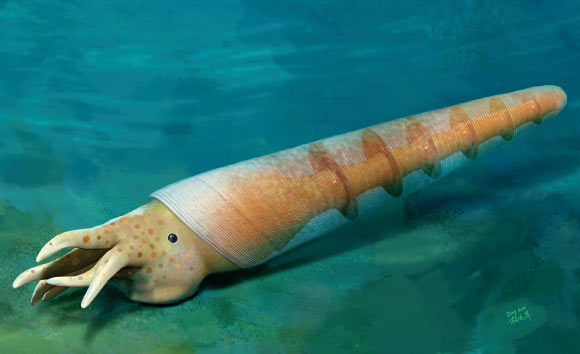
Les chercheurs ont identifié de minuscules fossiles de la formation Shuijingtuo (stade cambrien 3) du sud de la Chine qui pourraient transformer notre compréhension de l'évolution des céphalopodes. L'espèce nouvellement décrite, Eoceras shaanxiense, fournit la plus ancienne preuve connue d'un siphoncle primordial, une caractéristique anatomique cruciale qui a permis aux céphalopodes de réguler la flottabilité et de devenir finalement certains des océans.
03/08/2026 everythingdinosaur ⚙ Traduction automatique
Célébration de Peter Trusler Palaeoart – Redonner vie aux océans anciens
os fossile Ichthyosauria découverte
L’un des points forts du reportage sur les nouvelles découvertes scientifiques est de voir les œuvres d’art remarquables qui accompagnent de nombreux articles de recherche. Bien que les fossiles en fournissent la preuve, il faut souvent l'habileté d'un paléoartiste talentueux pour transformer les os et les impressions en scènes vivantes des temps profonds. Par exemple, nous avons récemment parlé d’un remarquable fossile d’ichtyosaure.
02/08/2026 everythingdinosaur ⚙ Traduction automatique
520-Million-Year-Old Fossil from China Fills Gap in Evolutionary History of Cephalopods
Un fossile chinois vieux de 520 millions d’années comble une lacune dans l’histoire évolutive des céphalopodes
Chine Cambrien fossile évolution
Les paléontologues ont identifié le plus ancien céphalopode connu équipé d'un siphoncle - une extension tubulaire du manteau trouvée chez les céphalopodes à coquille - remontant les archives fossiles de cette caractéristique clé de l'évolution au Cambrien inférieur, il y a environ 520 millions d'années. L'article Un fossile chinois vieux de 520 millions d'années comble une lacune dans l'histoire évolutive des céphalopodes est apparu en premier sur Sci.News : Breaking Science News.
30/07/2026 sci-news ⚙ Traduction automatique
Un fossile oublié vient de révéler un nouveau prédateur du Trias datant d'il y a 210 millions d'années
mâchoire prédateur proie Mexique Trias fossile crâne
Un fossile négligé depuis près de 80 ans a révélé un parent de crocodile jusqu'alors inconnu qui vivait il y a 210 millions d'années dans ce qui est aujourd'hui le Nouveau-Mexique. Nommé Eosphorosuchus lacrimosa, ce prédateur de la taille d'un chacal avait un crâne renforcé, des muscles de mâchoire puissants et un museau court conçu pour s'attaquer à des proies plus grosses.
30/07/2026 sciencedaily ⚙ Traduction automatique
1 2 3 4 5 6 7 8 9 10 11 12 13 14 15 16 17 18 19 20 21 22 23 24 25 26 27 28 29 30 31 32 33 34 35 36 37