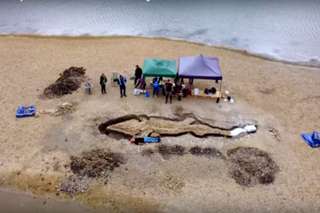
fossile

Nature du spécimen

371 image(s) · 185 Actualités

Galerie d'images

Montanoceratops cerorhynchus (Brown & Schlaikjer, 1942) - fossil ceratopsian dinosaur skeleton from the Cretaceous of Montana, USA. (MOR 542, Museum of the Rockies, Bozeman, Montana, USA)
The species name is sometimes incorrectly spelled "cerorhynchos".  The original publication spells it "cerorhynchus".  The genus name is sometimes incorrectly spelled "Montanaceratops".
Ceratopsians are the "horned dinosaurs".  They were large, quadrupedal, herbivorous dinosaurs having a beaked skull and a frill - an extension of bone behind the skull that partially covered the neck.  Ceratopsian dinosaurs are known from the Jurassic and Cretaceous.  The last members of the group died out at the Cretaceous-Tertiary boundary, 65 million years ago.
This is a partial skeleton of a juvenile Montanoceratops, a ceratopsian from the near-latest Cretaceous of western North America.  This type of ceratopsian lacked facial horns.


From exhibit signage:
Sixty-eight million years ago, when the horned dinosaurs Triceratops and Torosaurus inhabited the coastal plain near the inland ocean, primitive "horned" dinosaurs named Montanoceratops lived in uplands near the young Rocky Mountains.  These little protoceratopsians fed on plants with slicing teeth and narrow beaks similar to their giant three-horned relatives.


Classification: Animalia, Chordata, Vertebrata, Reptilia, Archosauria, Dinosauria, Ornithischia, Marginocephalia, Ceratopsia, Leptoceratopsidae
Stratigraphy: St. Mary River Formation, Maastrichtian Stage, Upper Cretaceous
Locality: Little Rocky Coulee, north of the town of Cut Bank, eastern Glacier County, northwestern Montana, USA


Info. at:

en.wikipedia.org/wiki/Montanoceratops
Taxons Montanoceratops

Montanoceratops cerorhynchus (Brown & Schlaikjer, 1942) - fossil ceratopsian dinosaur skeleton from the Cretaceous of Montana, USA. (MOR 542, Museum of the Rockies, Bozeman, Montana, USA) The species name is sometimes incorrectly spelled "cerorhynchos". The original publication spells it "cerorhynchus". The genus name is sometimes incorrectly spelled "Montanaceratops". Ceratopsians are the "horned dinosaurs". They were large, quadrupedal, herbivorous dinosaurs having a beaked skull and a frill - an extension of bone behind the skull that partially covered the neck. Ceratopsian dinosaurs are known from the Jurassic and Cretaceous. The last members of the group died out at the Cretaceous-Tertiary boundary, 65 million years ago. This is a partial skeleton of a juvenile Montanoceratops, a ceratopsian from the near-latest Cretaceous of western North America. This type of ceratopsian lacked facial horns. From exhibit signage: Sixty-eight million years ago, when the horned dinosaurs Triceratops and Torosaurus inhabited the coastal plain near the inland ocean, primitive "horned" dinosaurs named Montanoceratops lived in uplands near the young Rocky Mountains. These little protoceratopsians fed on plants with slicing teeth and narrow beaks similar to their giant three-horned relatives. Classification: Animalia, Chordata, Vertebrata, Reptilia, Archosauria, Dinosauria, Ornithischia, Marginocephalia, Ceratopsia, Leptoceratopsidae Stratigraphy: St. Mary River Formation, Maastrichtian Stage, Upper Cretaceous Locality: Little Rocky Coulee, north of the town of Cut Bank, eastern Glacier County, northwestern Montana, USA Info. at: en.wikipedia.org/wiki/Montanoceratops

os musée États-Unis Crétacé +17
Title: The dinosaur book : the ruling reptiles and their relatives
Identifier: bookruli00colb (find matches)
Year: 1951 (1950s)
Authors: Colbert, Edwin H. (Edwin Harris), 1905-2001; Knight, Charles Robert, 1874-1953; American Museum of Natural History
Subjects: Dinosaurs; Reptiles, Fossil
Publisher: New York : Published for the American Museum of Natural History by McGraw-Hill
Contributing Library: American Museum of Natural History Library
Digitizing Sponsor: IMLS / LSTA / METRO

View Book Page: Book Viewer
About This Book: Catalog Entry
View All Images: All Images From Book
Click here to view book online to see this illustration in context in a browseable online version of this book.

Text Appearing Before Image: 
'
Text Appearing After Image: 
bone A typical example of the parts usually found fossilized: portions of the skeleton of a small dinosaur from Mongolia A.M.N.H. photographs One of the rarest fossils: a dino- saur egg over 60 million years old, compared with a hen's egg (left) and an alligator egg (right)

Note About Images

Please note that these images are extracted from scanned page images that may have been digitally enhanced for readability - coloration and appearance of these illustrations may not perfectly resemble the original work.
Taxons Oviraptor

Title: The dinosaur book : the ruling reptiles and their relatives Identifier: bookruli00colb (find matches) Year: 1951 (1950s) Authors: Colbert, Edwin H. (Edwin Harris), 1905-2001; Knight, Charles Robert, 1874-1953; American Museum of Natural History Subjects: Dinosaurs; Reptiles, Fossil Publisher: New York : Published for the American Museum of Natural History by McGraw-Hill Contributing Library: American Museum of Natural History Library Digitizing Sponsor: IMLS / LSTA / METRO View Book Page: Book Viewer About This Book: Catalog Entry View All Images: All Images From Book Click here to view book online to see this illustration in context in a browseable online version of this book. Text Appearing Before Image: ' Text Appearing After Image: bone A typical example of the parts usually found fossilized: portions of the skeleton of a small dinosaur from Mongolia A.M.N.H. photographs One of the rarest fossils: a dino- saur egg over 60 million years old, compared with a hen's egg (left) and an alligator egg (right) Note About Images Please note that these images are extracted from scanned page images that may have been digitally enhanced for readability - coloration and appearance of these illustrations may not perfectly resemble the original work.

os livre musée Mongolie +4
Various fossils pertaining to the holotype of the Triassic ichthyosaur Toretocnemus californicus. This image is derived from plate 24 in Merriam (1903), done by an uncredited artist. The arrangement of the individual figures has been modified from the original.
Original description:
Toretocnemus californicus n. gen. and sp.
Figures reproduced natural size from the type specimen.

Fig. 1. — Inferior side of right posterior limb. t, tibia.
Fig. 2. — Right anterior limb. r, radius.
Fig. 3.— Pelvic arch.
Fig. 4. — Middle dorsal vertebrae and a rib from the same region.
Taxons Toretocnemus

Various fossils pertaining to the holotype of the Triassic ichthyosaur Toretocnemus californicus. This image is derived from plate 24 in Merriam (1903), done by an uncredited artist. The arrangement of the individual figures has been modified from the original. Original description: Toretocnemus californicus n. gen. and sp. Figures reproduced natural size from the type specimen. Fig. 1. — Inferior side of right posterior limb. t, tibia. Fig. 2. — Right anterior limb. r, radius. Fig. 3.— Pelvic arch. Fig. 4. — Middle dorsal vertebrae and a rib from the same region.

membre description Trias fossile +5
Fossil specimen RTMP 82.19.23 - A lacrimal, postorbitals, squamosals, frontals, parietals, and braincase referred to Latenivenatrix mcmasterae, but formerly assigned to Stenonychosaurus inequalis (=Troodon inequalis). Described by 

Currie, 1985. "Cranial anatomy of Stenonychosaurus inequalis (Saurischia, Theropoda) and its bearing on the origin of birds." Canadian Journal of Earth Sciences, 22(1), 643-658.
5d-dinosaur-camp-day2-20120802-15.jpg
Taxons Latenivenatrix

Fossil specimen RTMP 82.19.23 - A lacrimal, postorbitals, squamosals, frontals, parietals, and braincase referred to Latenivenatrix mcmasterae, but formerly assigned to Stenonychosaurus inequalis (=Troodon inequalis). Described by Currie, 1985. "Cranial anatomy of Stenonychosaurus inequalis (Saurischia, Theropoda) and its bearing on the origin of birds." Canadian Journal of Earth Sciences, 22(1), 643-658. 5d-dinosaur-camp-day2-20120802-15.jpg

Canada fossile spécimen Dinosauria +7
fossil of hauffiosaurus
Taxons Hauffiosaurus

fossil of hauffiosaurus

fossile Hauffiosaurus
The probable azhdarchid trace fossil Haenamichnus uhangriensis. A, the 7.3 m trackway CNUPH.P9; B, H. uhangriensis holotype (CNUPH.P2), manus (top) and pes (bottom) prints. Scale bars represent 1 m (A) and 100 mm (B).
Taxons Haenamichnus

The probable azhdarchid trace fossil Haenamichnus uhangriensis. A, the 7.3 m trackway CNUPH.P9; B, H. uhangriensis holotype (CNUPH.P2), manus (top) and pes (bottom) prints. Scale bars represent 1 m (A) and 100 mm (B).

écaille fossile holotype Azhdarchidae +1
Pelvis (fused ilia and pubes) of UALVP 48778, holotype of Hesperonychus elizabethae, from the late Campanian Dinosaur Park Formation of Alberta, Canada. Fossil collected by Dr. Elizabeth Nicholls. Prepared by Clive Coy. Digital photography by Nick Longrich. Additional digital editing by Nick Longrich.
Taxons Hesperonychus

Pelvis (fused ilia and pubes) of UALVP 48778, holotype of Hesperonychus elizabethae, from the late Campanian Dinosaur Park Formation of Alberta, Canada. Fossil collected by Dr. Elizabeth Nicholls. Prepared by Clive Coy. Digital photography by Nick Longrich. Additional digital editing by Nick Longrich.

bassin Canada Dinosaur Park Campanien +6
Sinosauropteryx fossil, from our trip to Hohhot, Inner Mongolia, China for National Day Holiday 2007.

This is the Inner Mongolia Museum, the biggest museum in the region.
Taxons Sinosauropteryx

Sinosauropteryx fossil, from our trip to Hohhot, Inner Mongolia, China for National Day Holiday 2007. This is the Inner Mongolia Museum, the biggest museum in the region.

musée Chine Mongolie fossile +1
fossil of liliensternus
Taxons Liliensternus

fossil of liliensternus

fossile Liliensternus
Fossil of Utatsusaurus- Took the picture at Museo di Storia Naturale, Milano
Taxons Utatsusaurus

Fossil of Utatsusaurus- Took the picture at Museo di Storia Naturale, Milano

fossile Utatsusaurus
Tanius sinensis restoration based on fossil images and related animals.
Taxons Tanius

Tanius sinensis restoration based on fossil images and related animals.

fossile Tanius
fossil of Prenocephale prenes, an extinct ornithischian
Taxons Prenocephale

fossil of Prenocephale prenes, an extinct ornithischian

fossile Ornithischia Prenocephale
Fossil specimen BSP 1935.I.24 (Ctenochasma elegans), an extinct pterosaur
Taxons Ctenochasma

Fossil specimen BSP 1935.I.24 (Ctenochasma elegans), an extinct pterosaur

fossile spécimen Ctenochasma Pterodactylus +1
Fossil skeleton of Qianichthyosaurus zhoui on display at the Geological Museum of China.
Taxons Qianichthyosaurus

Fossil skeleton of Qianichthyosaurus zhoui on display at the Geological Museum of China.

musée Chine fossile Qianichthyosaurus +1
Photograph of a fossil cast of a Keichousaurus hui skeleton taken at the North American Museum of Ancient Life.
Taxons Keichousaurus

Photograph of a fossil cast of a Keichousaurus hui skeleton taken at the North American Museum of Ancient Life.

musée moulage fossile Keichousaurus +1
Fossil of Leptoceratops at the Canadian Museum of Nature, Ottawa
Taxons Leptoceratops

Fossil of Leptoceratops at the Canadian Museum of Nature, Ottawa

musée fossile Leptoceratops
1 2 3 4 5 6 7 8 9 10 11 12 13 14 15 16 17 18 19 20 21 22 23 24

Actualités

Ce serpent vieux de 100 millions d'années avait des pattes postérieures et un os perdu qui change l'évolution
os membre prédateur Argentine fossile évolution
Il y a près de 100 millions d’années, les serpents n’étaient pas les créatures élégantes et sans membres que nous connaissons aujourd’hui : ils avaient encore des pattes postérieures et même une pommette qui ont presque disparu chez les espèces modernes. Un fossile remarquablement préservé de Najash rionegrina d'Argentine a remodelé la façon dont les scientifiques pensent aux origines des serpents, suggérant que les premiers serpents étaient de grands prédateurs à la bouche large plutôt que de minuscules fouisseurs.
24/04/2026 sciencedaily ⚙ Traduction automatique
New Fossil from Brazil Reveals Unexpected Diversity among Pre-Dinosaur Herbivores
Un nouveau fossile du Brésil révèle une diversité inattendue parmi les herbivores pré-dinosaures
mâchoire Brésil Trias fossile Dinosauria nouvelle espèce partiel crâne
Des paléontologues du Brésil ont identifié un nouveau genre et une nouvelle espèce de rhynchosaure hyperodapédontique – une lignée éteinte de reptiles herbivores à bec – sur la base d'un crâne partiel et de mâchoires inférieures récupérés dans des roches du Trias. L'article Un nouveau fossile du Brésil révèle une diversité inattendue parmi les herbivores pré-dinosaures est apparu en premier sur Sci.News : Breaking Science News.
23/04/2026 sci-news ⚙ Traduction automatique
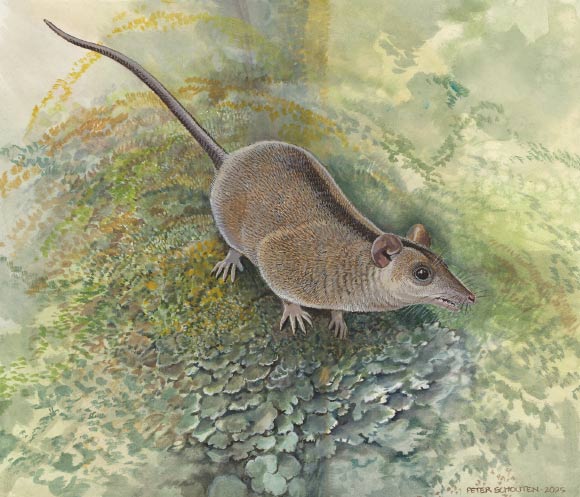
De superbes traces de dinosaures vieilles de 132 millions d’années réécrivent l’histoire
fossile empreintes Dinosauria découverte
Un mystère de longue date dans les archives fossiles de l’Afrique australe commence à être résolu. Après que des coulées de lave massives, il y a 182 millions d'années, aient semblé effacer les traces de dinosaures dans la région, les scientifiques ont maintenant découvert de nouveaux indices surprenants le long de la côte du Cap occidental. Des dizaines de traces de dinosaures, vieilles d'environ 132 millions d'années, ont été découvertes dans une petite étendue rocheuse près de Knysna, ce qui en fait les plus jeunes jamais découvertes en Afrique australe.
23/04/2026 sciencedaily ⚙ Traduction automatique
Des scientifiques découvrent des fossiles parfaits dans la rouille sous les terres agricoles australiennes
fossile
Sous les terres agricoles arides de la Nouvelle-Galles du Sud se trouve une fenêtre cachée sur une forêt tropicale perdue regorgeant de vie datant d'il y a 11 à 16 millions d'années. À McGraths Flat, les scientifiques ont découvert des fossiles préservés avec des détails étonnants, non pas dans des roches typiques comme le schiste ou le grès, mais dans des sédiments riches en fer que l'on croyait autrefois incapables d'une telle préservation. De minuscules particules de fer remplissaient et capturaient des cellules entières, préservant tout, des organes d'insectes aux pigments des yeux de poisson et aux délicats poils d'araignées.
23/04/2026 sciencedaily ⚙ Traduction automatique
Cet ancien parent du crocodile a grandi sur quatre pattes puis a marché sur deux
fossile Dinosauria
Un étrange parent d'un crocodile de l'époque des dinosaures réécrit ce que les scientifiques pensaient savoir sur les anciens reptiles. Cette créature de la taille d'un caniche, appelée Sonselasuchus cedrus, semble avoir commencé sa vie en marchant à quatre pattes avant de passer à une position sur deux pattes à mesure qu'elle grandissait - une transformation inhabituelle rarement observée dans les archives fossiles.
23/04/2026 sciencedaily ⚙ Traduction automatique
1 2 3 4 5 6 7 8 9 10 11 12 13 14 15 16 17 18 19 20 21 22 23 24 25 26 27 28 29 30 31 32 33 34 35 36 37